Report Automation with AI: Fewer Spreadsheets, More Decisions
Analysts spend too much time consolidating data in spreadsheets instead of interpreting it. AI agents for report automation deliver analyses ready for decision, in natural language.

Marlos Carmo
Founder of Tolky
Updated on November 15, 2026
Share
Every BI Head has lived a version of this scene: it's Friday afternoon, the weekly operational report is late because the ERP data has not yet been exported, the sales spreadsheet uses a different column to represent the same field that the financial system uses with another name, and the report that should be ready at 5:00 PM will come out at 8:00 PM by email, to executives who will read it on Sunday.
It is not a problem of unqualified people. It is an architectural problem: qualified analysts spending hours on mechanical consolidation work, instead of interpretation and analysis work. The report that reaches the CFO at 8:00 PM on Friday is technically correct but it arrived too late to influence decisions that were made during the week.
Report automation with AI solves the problem from a different angle: it not only speeds up consolidation, but transforms data from multiple sources into natural language analyses, ready for decision, without human intervention in the assembly process.
Reporting Comparison: Traditional vs. AI-Automated
| Criteria | Traditional Reporting | AI-Automated Reporting |
|---|---|---|
| Preparation Time | Hours/days of manual data gathering | Minutes, depending on the source and refresh frequency |
| Analytical Depth | Static charts and basic descriptions | Predictive insights and complex correlations |
| Risk of Error | High (manual data copying) | Fewer manual-copy errors via integrations; interpretation still needs validation |
| Team Focus | Formatting and filling spreadsheets | Strategic analysis and data-driven action |
The Real Problem Is Not the Spreadsheet
Before talking about the solution, it is worth understanding the problem with more precision because the temptation is to say "the problem is that we have too many spreadsheets" when the real problem is something else.
Spreadsheets are not a problem in themselves. They are an adequate tool for many analyses. The problem is the manual consolidation process that feeds them: someone extracts data from the CRM, someone extracts data from the ERP, someone extracts data from the support system, and then someone spends hours transforming three different formats into a coherent table.
This process has three costs that rarely appear in the same place:
Time cost: hours of expensive professionals doing work that does not require expertise, only patience and attention to detail.
Delay cost: reports that arrive after the decision window do not influence the decision. A performance report from last week that arrives on Friday night does not help Tuesday's decisions.
Inconsistency cost: when different areas of the company build their own reports with their own sources and their own definitions of metrics, numbers diverge in meetings creating discussions about which data is correct instead of discussions about what to do with the information.
What an AI Agent Does Differently
An AI agent for report automation does not just speed up manual consolidation: it sharply reduces the manual consolidation process (with human validation of the interpretation).
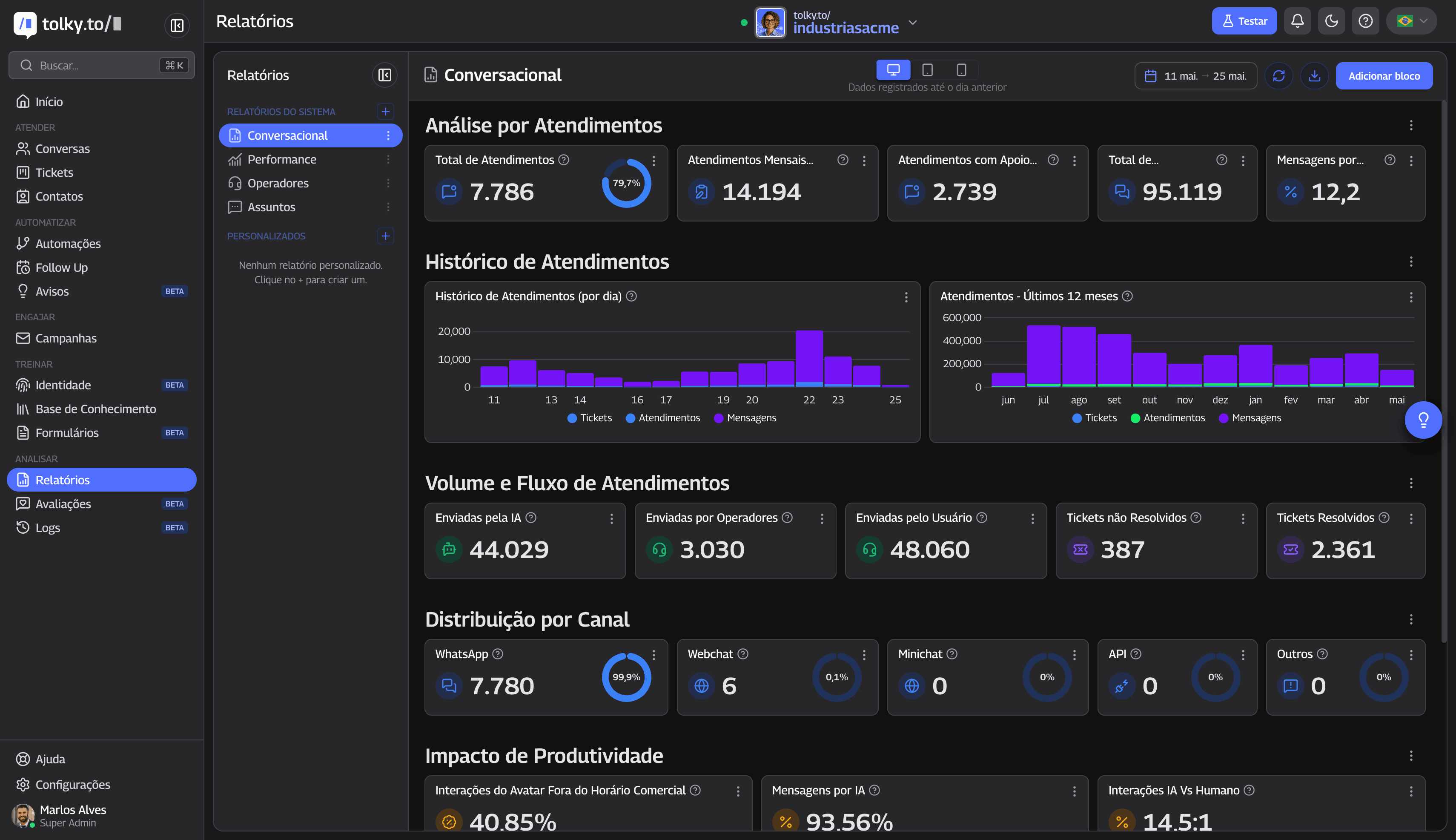
The agent connects to the relevant data sources (CRM, ERP, ticket system, marketing platform, analytics tools), collects and consolidates data on a schedule, interprets the numbers based on metrics defined by the company, and delivers the report in natural language with the main highlights, identified anomalies, and significant variations compared to the previous period.
What the manager receives is not a spreadsheet to interpret. It is an analysis that has already been interpreted, with points of attention identified, ready for the decision-maker to ask in-depth questions or make decisions.
Use Cases with the Greatest Immediate Impact
Customer Service Operational Report
For Support Heads and Operations Directors, the weekly support report consolidates data from multiple sources: ticket volume by category, AHT by request type, CSAT by channel, deflection rate, SLAs met and violated, and comparison with the previous week.
As a hypothetical example, with AI automation this report could be generated every Monday at 8:00 AM, consolidating data from the ticketing system, the satisfaction survey platform, and the conversational AI dashboard. The manager would receive a natural language summary (channel and scheduling depend on what the product offers today: ask the team) with the three points of attention for the week and the evolution of key metrics.
In the example, the analyst who used to spend 3 hours putting the report together would review the agent-generated report in 15 minutes (illustrative numbers, not measured), focusing on interpretation and recommendation, not consolidation.
Commercial Pipeline Report
For Sales VPs and Commercial Directors, pipeline visibility is critical but the quality of that visibility depends on CRM data that is only as good as the sales reps' discipline in registering it.
An AI agent for pipeline reporting automatically consolidates: open opportunities by stage, movement for the week, deals at risk (no updates for more than X days), closing forecast for the month, and variation compared to the previous forecast.
With an agent that also collects data from conversational interactions (qualifications made, meetings scheduled, follow-ups sent), the report includes real commercial activity not just what was manually recorded in the CRM.
Consolidated Financial Report
For CFOs and Controllers, the financial consolidation of multiple units, cost centers, or subsidiaries is one of the most time-intensive and precision-critical processes.
An AI agent for financial reports connects to the ERP, extracts the data for each period, applies the consolidation rules defined by the financial department, and delivers a report with the main variations, exceptions that deserve attention, and comparison with the budget in language that the CEO or board can read directly, without needing an analyst to "translate" the numbers.
Customer Health Dashboard (CS)
For Customer Success heads, the customer health report consolidates data from multiple sources: product usage (logins, activated features, engagement), support data (open tickets, CSAT, resolution time), NPS data, and CRM data (contract stage, renewal value, contact history).
An agent monitors this data continuously and generates proactive alerts (for example, "this customer reduced usage by 40% in the last 15 days and opened two support tickets this week"; hypothetical example) without waiting for the CS manager to manually run a report to identify the pattern.
What Differentiates AI Automation from Traditional BI
BI tools like Tableau, Power BI, and Looker do an excellent job of data visualization, but they are exploration tools, not delivery tools. Someone still needs to open the dashboard, interpret the charts, and decide what is relevant to communicate.
AI automation goes one step further: the agent not only visualizes: it interprets, prioritizes, and actively communicates. Instead of a dashboard waiting for someone to open it, the idea is a report that reaches the manager with the points of attention already identified.
The ideal combination is BI for deep exploration (when the analyst wants to investigate something specific) and an AI agent for proactive delivery (when the manager needs the information without having to go find it).
How to Evaluate the Quality of an AI-Generated Report
The adoption of automated reports raises a legitimate concern: how to guarantee that the numbers are correct and that the interpretation is appropriate?
The practical answer has two components:
Initial validation: in the first cycles of use, the analyst compares the report generated by the agent with the report they would produce manually. This validation process identifies inconsistencies in consolidation logic or analysis criteria and feeds the necessary adjustments in the agent's configuration.
Traceability: quality AI-generated reports include the data sources for each number presented. Any number can be verified back to the original source which gives the analyst the confidence to present the report to the board without having reviewed each individual cell.
How Tolky Applies AI to Operational Intelligence
Tolky acts as an operational intelligence agent for clients who need to consolidate support, CRM, and other operational source data into regular reports and proactive alerts.
The differentiator is that the report is built from the conversations themselves: AI resolution, SLA and support queues, not just generic BI. On the Enterprise plan, the pricing page lists unlimited custom reports and weekly Advisor notices. Scheduled reports and delivery through channels such as Slack or email are not a promise of this article: ask the team what is available today and what is coming soon.
An analyst's time should not be spent on consolidation. It should be spent on interpretation, recommendation, and the questions that automatic consolidation reveals. Report automation with AI does not eliminate the analyst: it frees the analyst for the work that justifies their hiring.
Want to see how report automation would work for your operation's metrics? See the dashboard view in our solutions or talk to our team: we identify the data sources, delivery format, and frequency that make sense for your context.
Share
Tags
- AI for business report generation
- automated data analysis with AI
- AI agent for business intelligence
- automatic reports with LLM
- report automation with AI
About the author
Marlos Carmo
Founder of Tolky
Marlos Carmo is an AI entrepreneur and founder of Tolky, the conversational-era infrastructure and AI CRM that unifies intelligent service, multi-channel support (such as WhatsApp and voice), live CRM, and operational intelligence in a single ecosystem. He is a finalist for the SXSW Innovation Awards and a member of Francesco's Economy, a global network of young entrepreneurs focused on innovation and social impact. He works connecting Artificial Intelligence and digital transformation in projects for large organizations.
Next step
Want to bring this to your operation?
Tati, Tolky's AI assistant, understands your scenario in a few questions, suggests the best path and connects you with someone from the team, with full context.