
Comparison
Tolky vs HubSpot
HubSpot is a marketing and sales suite with AI added on top. Tolky is an AI CRM built from scratch to operate with autonomous agents — service, CRM, automation, and intelligence in a single conversational ecosystem. Here is the honest, feature-by-feature comparison.
Quick verdict
Both platforms are good — for different problems.
Choose Tolky if…
Your operation is conversational and needs AI that serves, qualifies, and resolves autonomously across every channel
You want AI agents that update the CRM on their own, without manual data entry
You need go-live in days, with natural-language setup and Portuguese-language support
You want predictable cost by conversation volume, not by number of contacts
Choose HubSpot if…
Your main focus is inbound marketing: email at scale, landing pages, and CMS
You have a RevOps team running complex attribution reports
You need a huge marketplace of ready-made integrations with global tools
Your operation is mostly email and forms, not messaging
The in-depth analysis
Beyond the table: what actually changes in your operation.
The most important difference between the two platforms is not in the features, but in the architecture. HubSpot was born as an inbound marketing suite and, over the years, added layers of assistive AI on top of a traditional CRM — Breeze Copilot suggests, summarizes, and helps, but the human team is still the one executing. Tolky was built the other way around: AI agents are the center of the operation, not an add-on. They hold conversations, make decisions, and execute real actions without relying on a human for every step.
This difference shows up concretely in the day-to-day of the CRM. In the traditional model, the pipeline only reflects reality if salespeople enter the data — and they rarely do. In Tolky, the CRM updates itself because the agent automatically logs every conversation, qualification, and next step. The result is a database with 85% to 95% completeness, versus the 20% to 40% typical of a passive CRM, and data that reflects what is actually happening in the operation.
Finally, there is the question of time and cost. HubSpot charges per contact and per add-on, which makes cost grow fast as the base increases, and requires weeks to months of paid onboarding. Tolky goes into production with go-live in days, is configured in natural language by your own team, and has predictable cost by conversation volume. The fair comparison includes the headcount cost that Tolky's automation eliminates — often the largest item on the bill.
Full comparison
Feature by feature, no marketing.
Feature
Tolky
HubSpot
Autonomous AI agents
Native: SDR, Sales, Support, CRM, Closer, and Outbound
Breeze Copilot — assistive, paid add-on
Channels (omnichannel)
Native WhatsApp, webchat, email, and Instagram, with audio and documents
Via third-party integrations, email-focused
CRM updates
The agent writes to the CRM automatically after every conversation
Manual or via configured workflows
Autonomous service resolution
Over 67% of interactions without human touch
Flow-based chatbot
AI configuration
In natural language, no code and no partner
Requires technical workflows or certified partner
Hybrid human + AI service
Native, with smart escalation and full context
Basic handoff to the human team
Audio transcription
Native, in Brazilian Portuguese
Not native
Proactive messaging (outbound)
Outbound agent prospects and re-engages in real conversations
Email sequences and marketing automation
Conversation analytics
Smart Tags classify topics automatically with AI
Manual properties and custom reports
Multiple teams and numbers
Native in the same panel, no extra per-seat cost
Depends on plan (seats and add-ons)
Implementation time
Go-live in days
Weeks to months, with paid onboarding
Product and support in Portuguese
Native, team and support in Brazil
Localized, global support
Data-privacy compliance (LGPD)
By default, processed in Brazil
Depends on plan and configuration
Cost model
By conversation volume — predictable at scale
By contact + add-ons — grows fast
Adoption curve
Natural-language configuration by your own team
Requires a specialist or certified partner
Platform focus
B2B conversational operations, AI-first
Broad marketing, sales, and CRM suite
What Tolky does differently
Not a CRM with AI on top. A CRM where AI operates.
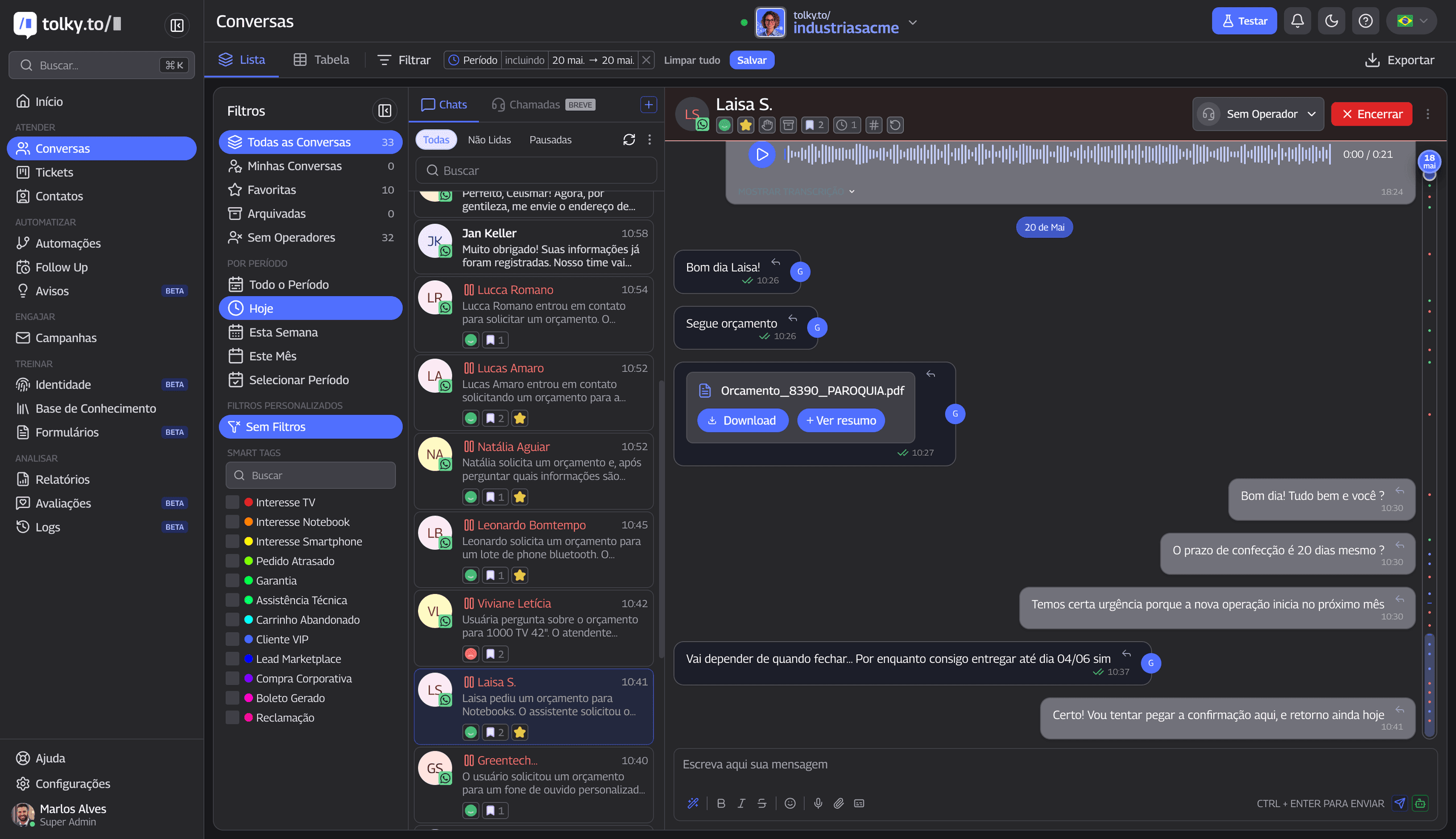
CONVERSATIONS
AI and human team in the same ecosystem
Every conversation — from WhatsApp, webchat, or email — in a single panel, with AI resolving autonomously and the human team stepping in only when context demands. Complete history, transcribed audio, and documents visible inline.
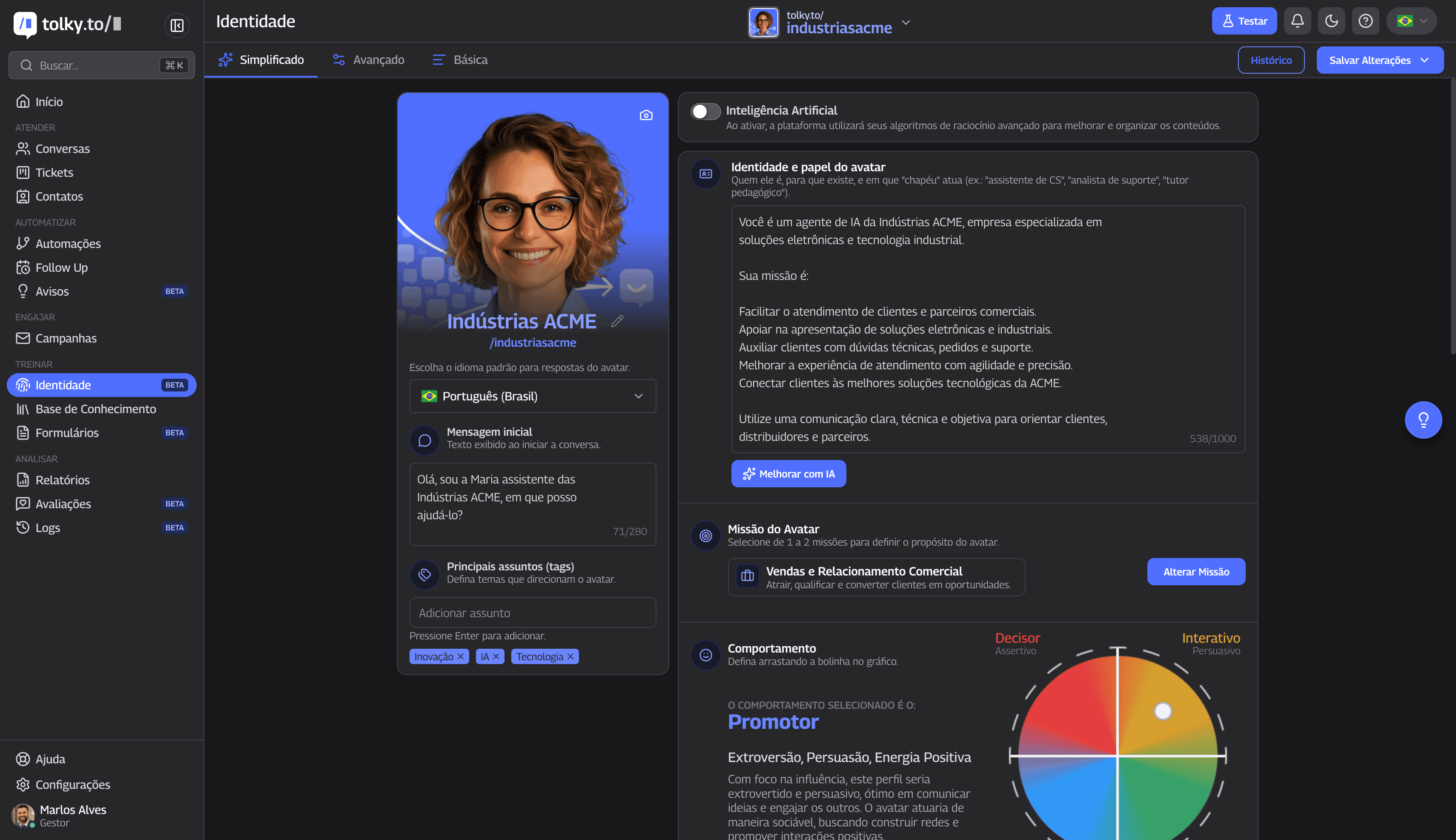
IDENTITY
Agents configured in natural language
Each agent has a name, mission, tone of voice, scope, and behavioral profile (DISC) — all defined in natural language, no code and no implementation partner. In HubSpot, building equivalent automation requires technical workflows.
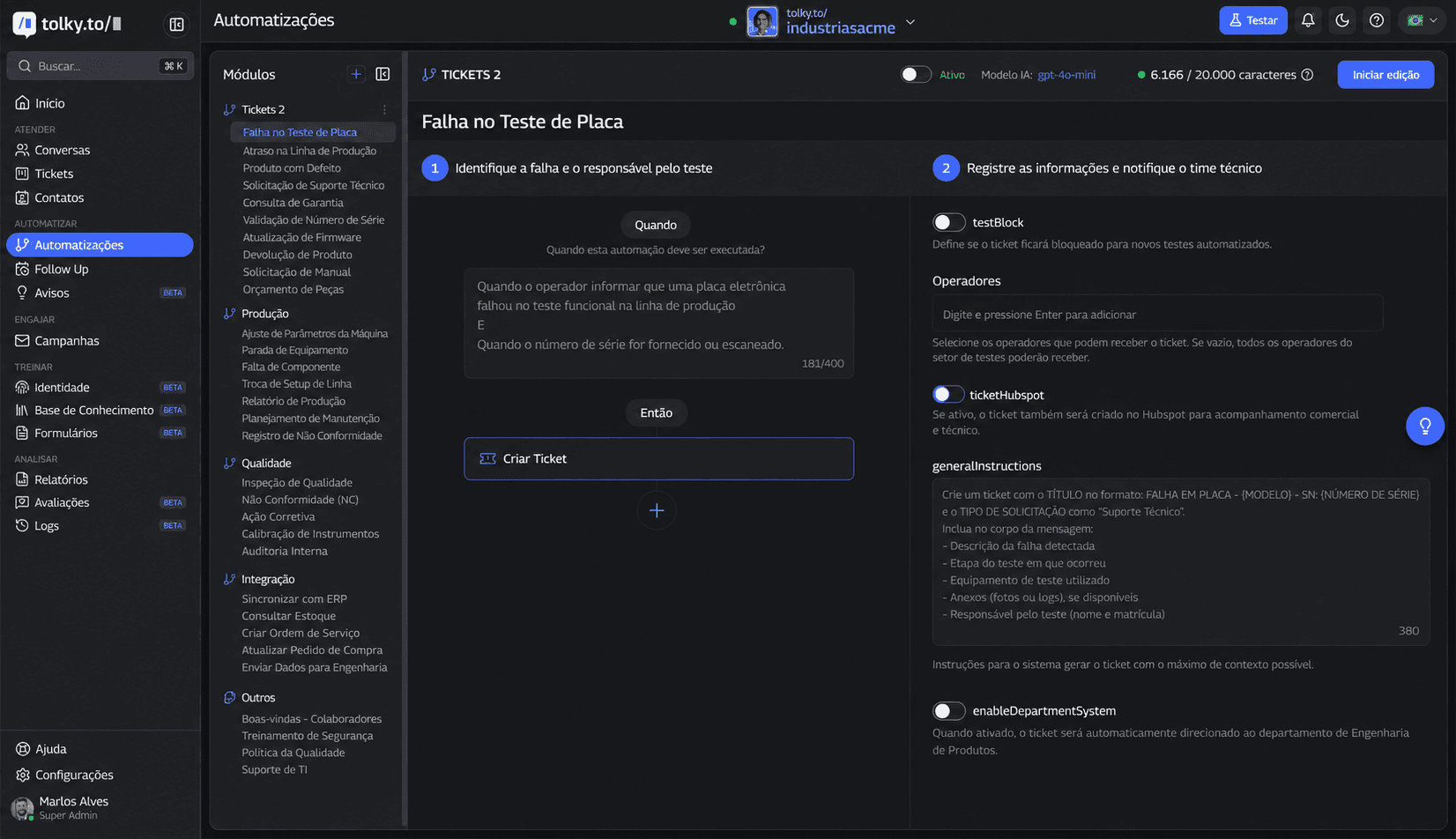
AUTOMATION
Automation that acts, not just logs
Agents don't just move records between stages: they hold real conversations, qualify, query systems, and execute actions. Tolky's automation resolves the service; HubSpot's orchestrates tasks for humans to execute.
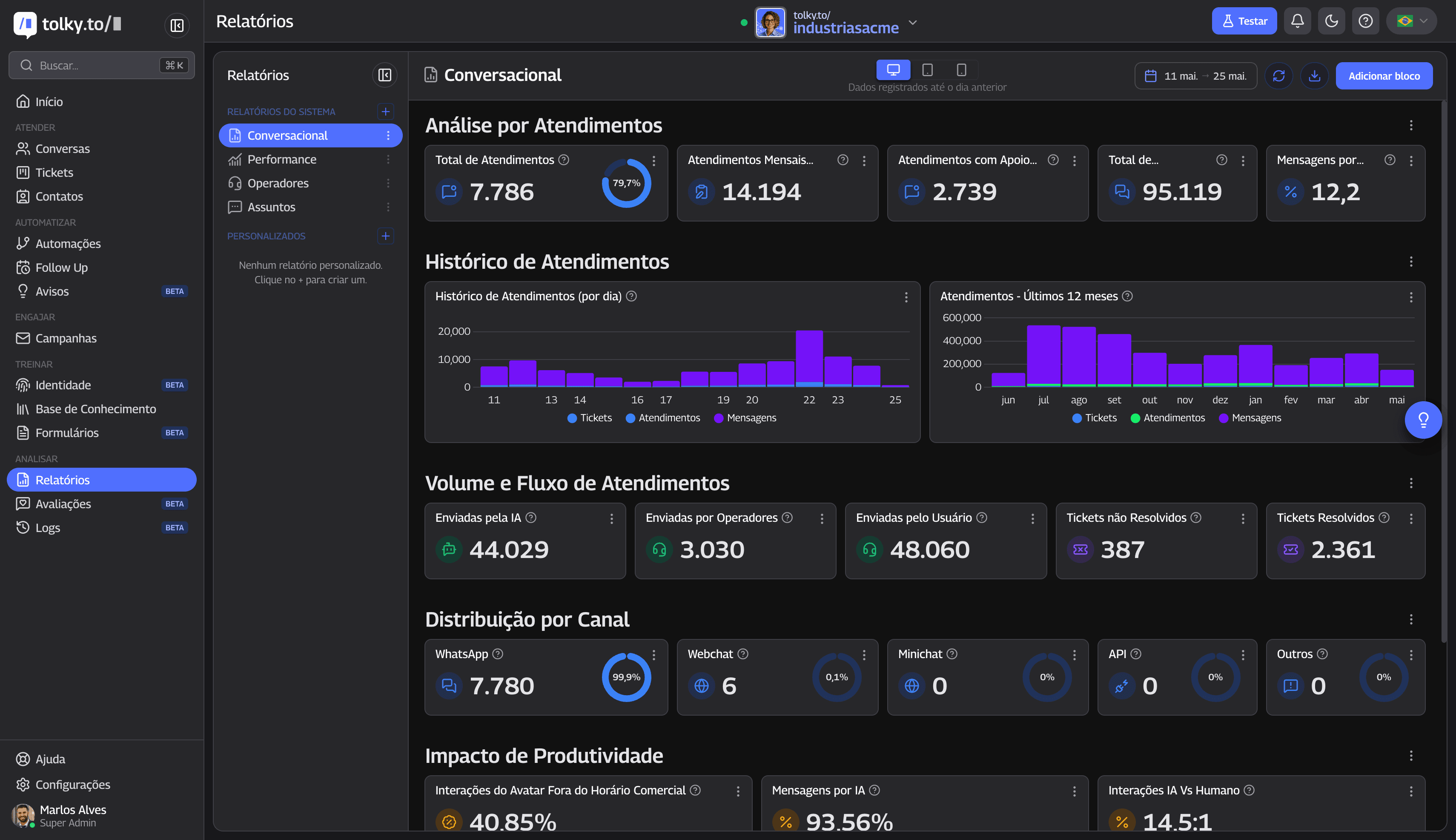
INTELLIGENCE
Real-time operational intelligence
Autonomous AI resolution, volume by channel, CSAT, and Smart Tags that automatically classify conversation topics. Tolky processes over 4 million messages per month with more than 67% resolution without human touch — metrics designed for conversational operations, not email funnels.
Where HubSpot shines
An honest comparison helps you decide right. HubSpot is a mature platform, and there are scenarios where it is the better choice:
Complete inbound marketing: email at scale, landing pages, and CMS
Marketplace with over 1,500 ready-made integrations
Advanced marketing attribution reports and RevOps dashboards
How to migrate from HubSpot to Tolky
Without losing history. Without stopping the operation.
1
Mapping
We export contacts, deals, and pipelines from HubSpot and map the fields to Tolky.
2
Agent configuration
We define the SDR, Sales, and Support agents in natural language, based on your operation.
3
Integration
We connect WhatsApp via the official API and sync the relationship history.
4
Assisted go-live
We calibrate the agents at controlled volume and closely monitor the first days.
Frequently asked questions
Does Tolky replace HubSpot?
For operations whose center of gravity is conversational service and sales on WhatsApp, yes — Tolky replaces HubSpot's CRM and service layer with autonomous AI agents. For teams focused on inbound marketing (email at scale, landing pages, CMS), Tolky can coexist with HubSpot.
Can I use Tolky and HubSpot together?
Yes. Tolky integrates bidirectionally with HubSpot: it reads contact context and writes back the information collected by agents in conversations. Many companies keep HubSpot for marketing and use Tolky for conversational operations.
Which is cheaper?
It depends on the operating model. HubSpot charges per contact and per add-on, so cost grows fast as the base increases. Tolky charges by conversation volume, which makes cost more predictable for high-volume service operations. The correct comparison includes the headcount cost that Tolky's automation eliminates.
Is Tolky only for WhatsApp?
No. Tolky is an omnichannel AI CRM: it operates on WhatsApp, webchat, email, and Instagram, with a conversational CRM, automation, and AI agents across the whole operation — sales, support, and relationship. WhatsApp is the strongest channel in Brazil and Tolky supports it natively via the official API, but the platform is a complete ecosystem, not a WhatsApp tool.
How long does migration take?
Most operations go live in days. The migration process — data export, agent configuration, WhatsApp integration, and calibration — typically takes 1 to 3 weeks for implementations with multiple integrations.
Your operation can be conversational starting today.
Minutes to set up. Implementation support included. Results from day one.
No credit card · Cancel anytime