AI in Customer Service: Automating Support, Sales and Relationships
AI is now an operational layer across customer service, sales and post-sale. See how companies use conversational AI to resolve tickets, qualify leads at scale and keep relationships active.

Marlos Carmo
Founder of Tolky
Updated on November 15, 2026

Share
Talking about "AI in customer service" has become almost a pleonasm. Nearly every reasonably mature operation already has some layer of artificial intelligence between the customer and the human team, whether in a website assistant, a WhatsApp bot, a ticket router or a copilot that drafts replies in the helpdesk. What has changed in recent years is not the presence of AI, it is its scope.
Until recently, the discussion was narrow: use AI to deflect repetitive tickets and cut service-desk costs. Today, companies that extract real value use conversational AI as a shared operational layer across three areas that used to be silos: support, sales and relationships. The same agent that resolves a duplicate-bill request does the initial qualification of the lead that came from an ad and follows the customer at risk of churn while coordinating with the CS team.
This article is a map of that shift, not a defense of "automate everything", an approach that produces a worse experience and worse margins. It is an honest read on where AI delivers value, where it still fails, and how to design the operation without dehumanizing it. The ranges cited below are illustrative, not published benchmarks, and vary widely with the quality of the knowledge base and the connected systems.
What changed: from reactive chatbot to operational agent
The first wave was led by rule-based chatbots: you mapped a set of intents, built a decision tree, and the system answered as long as the customer used the expected wording. It worked for stable FAQs and failed at anything off-script.
Generative AI broke that equation. Instead of matching input against a catalog of intents, the system understands the intent behind the question, consults the relevant sources, executes actions in internal systems and only escalates to a human when complexity calls for judgment. The practical difference is large, but it depends on three things:
- Access to context: the agent needs to know who the customer is (history, contracts, open tickets) at the time of the conversation.
- Capacity to act: query the ERP, update the CRM, open a ticket, not just talk about it.
- Clear escalation policy: when a case needs a human, the handoff happens with a full briefing, not as the start of a new conversation.
Where these three pillars exist, AI works. Where one is missing, it becomes theater. On context, see also conversational memory.
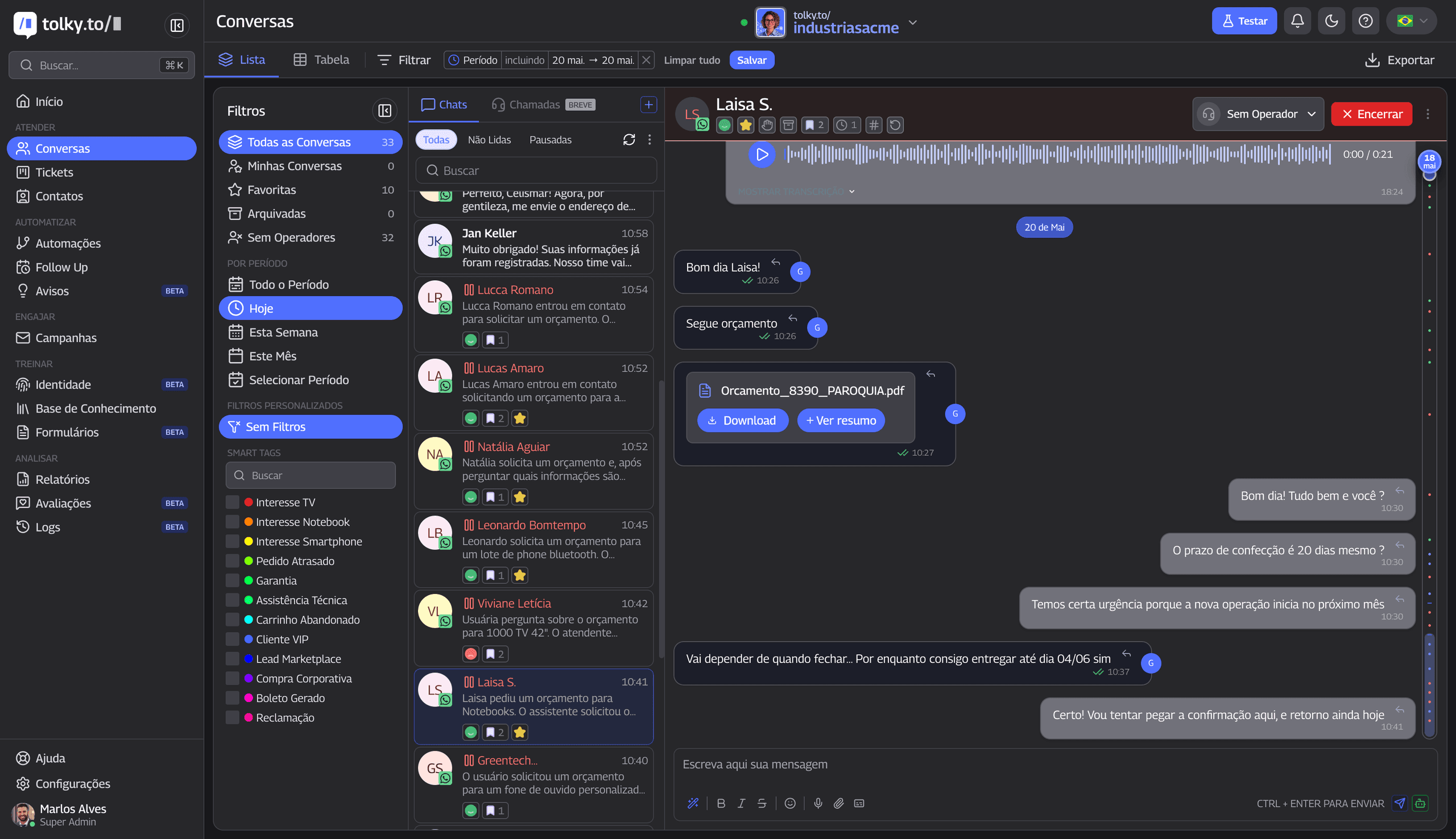
Support: from "cut costs" to "expand capacity"
For nearly a decade, the business case for AI in support was a single one: reduce headcount. The current generation flipped the argument. The most robust gain is absorbing growing volume without hiring proportionally, freeing human agents for strategic customers, complex exceptions and delicate conversations.
The highest-impact flows are:
Autonomous resolution of transactional requests. Duplicate bills, registration updates, balance queries, order status, simple cancellations. Here the agent competes with the frustrating 8-level IVR: answers in seconds, no queue. See how to measure this in ticket deflection with AI.
Smart triage. When a case needs a human, the agent runs the initial interview, collects the data and routes to the right queue with a briefing ready. This tends to reduce handling time, because it removes the "please confirm your tax ID and describe the problem again."
Human-agent copilot. AI suggests replies, looks up the applicable policy in the knowledge base and proposes next steps. The agent becomes a reviewer, not a typist.
Post-interaction work. Conversation summary into the CRM, reason classification, satisfaction survey and an improvement ticket when feedback is negative.
Illustrative ranges that mature operations tend to pursue (no public source; they vary by knowledge base, channel and industry):
| Metric | Before | After (mature operation, illustrative range) |
|---|---|---|
| % of tickets resolved in self-service | low, with rule-based chatbots | growing target, set per ticket type |
| Handling time for cases that go to a human | baseline | expected reduction |
| CSAT | baseline | equal or higher, monitored alongside |
| Cost per resolved interaction | baseline | expected reduction |
| Same-customer recontact within 24h | baseline | expected reduction |
These gains only show up when the knowledge base is current and the agent has real access to systems. Implementations that stop at "answers FAQs" deliver far less and create the feeling that "AI doesn't work for us." The cost of slow replies matters too: see the invisible cost of slow service.
Sales: AI as an on-call SDR, not a closer
In sales, conversational AI helps do what was historically never done right: respond fast, qualify well and route the right lead to the right salesperson. Closing the deal remains human.
Speed matters. In a classic study published in the Harvard Business Review in 2011 (Oldroyd, McElheran and Elkington), companies that contacted web leads within an hour were about 7 times more likely to qualify them than those that contacted them later. It is a study of US web leads, more than a decade old, but the direction still holds. For a deeper look, read B2B lead qualification with AI.
The agent is available 24/7, makes the initial approach in seconds, qualifies by the operation's criteria (BANT, MEDDIC, whatever fits) and routes the qualified lead to the salesperson. It can also suggest meeting times and hand the lead to the salesperson, depending on the configured integration, but calendar scheduling should not be treated as guaranteed. Where AI helps most:
Initial qualification. Structured questions and classification as "ready for salesperson," "nurture" or "out of profile," saving the time of expensive salespeople.
Product and pricing questions. Many pre-sale questions repeat and can be answered from documentation, commercial policy and the price list.
Scheduled follow-up. A lead who asked to talk in two weeks, who watched the demo and vanished, who opened the quote three times without replying: the agent picks it up at the right time with a contextual message.
Pipeline reactivation. Old leads that went cold get a probing conversation at a low opportunity cost.
The essential caution: do not make the AI pretend to be human. B2B customers notice and become suspicious. The right stance is transparency: "I'm [company]'s virtual assistant, I can help now or connect you with a human specialist." That builds trust.
Relationships: where AI is starting to enter
Relationships (onboarding, activation, customer success, retention, upsell, NPS) have always suffered from a capacity gap: touching every customer individually is too expensive. What remains is rough segmentation, with a dedicated CSM for some, a quarterly email for others and silence for the rest. Conversational AI makes touching every customer economically viable. Observable maturity signals: onboarding with conversational follow-up, surveys at the right moment and account alerts for CS. In practice:
Active onboarding. Conversational follow-up in the first 30/60/90 days, with contextual tips and escalation to the human team at signs of difficulty. The flow is detailed in customer onboarding automation with AI.
Account health. With usage, ticket and NPS data available on the platform, the team can open a proactive conversation when signals worsen: "I noticed usage of module X dropped in recent weeks, can I help?"
Contextual surveys. NPS and CSAT at the right moment, on the preferred channel, with real follow-up when the score is poor. Ignored detractors raise churn risk.
Contextual upsell and cross-sell. The agent spots the hook (usage limit, complementary module) and the human CSM closes, with no mass campaign.
Proactive renewal. Before renewal, map the account's temperature and blockers instead of discovering in the renewal month that the customer already decided to leave.
The gain does not come from "roboticizing" CS but from closely following accounts that used to be invisible between the strategic customer and the long tail. Any retention gain should be measured on your own base, with a defined baseline and period.
The layer that ties it together: orchestration, not chatbots
What separates companies that benefit from AI from those accumulating scattered tools is orchestration. The architecture is covered in the article on AI agent orchestration.
The first generation treated AI as isolated modules: a chatbot on the site, a bot on WhatsApp, a copilot in the helpdesk, each with its own base and integration. A customer who came in via the site and then messaged on WhatsApp became two conversations and two histories. The current generation aims for a single conversational agent that spans channels and areas and keeps persistent customer context. Today Tolky operates on WhatsApp, webchat, Microsoft Teams and voice; Instagram, SMS and email are coming soon.
Orchestration also enables frictionless handoff between AI and humans, and between areas. A customer who starts in support and reveals they are thinking of canceling goes to retention with all the context, in a single history. A lead who becomes a customer moves to onboarding without introducing themselves again. Without this layer, AI becomes a collection of point solutions. With it, it becomes an operational platform.
An end-to-end example (illustrative scenario)
Imagine a B2B software company using a single agent across the same customer's three phases. The items below are not results, they only indicate what to measure at each stage:
| Stage | What happens | Metric to track |
|---|---|---|
| Pre-sale | A lead asks about pricing on WhatsApp, is qualified and routed to the salesperson | Time to first response |
| Support | After purchase, the customer asks usage questions with the sales context available | Resolution rate without a human |
| Renewal | CS sees the history and account signals before talking | Portfolio renewal rate |
Common implementation mistakes
Launching without a complete knowledge base. A generic answer or "I don't know" is worse than no agent. Cover most use cases before go-live.
Optimizing for deflection only. High deflection with low CSAT is worse than no automation. Measure deflection, resolution, CSAT and recontact together.
Hiding that it is AI. It works for one conversation, then breaks trust.
Launching on every channel at once. Each channel has its own dynamics. Stabilize one before expanding.
Ignoring human agents in the design. They know the exceptions and the undocumented processes.
Treating handoff as failure. In mature architectures, escalating is the AI doing the right thing. If the culture treats escalation as failure, the agent resists escalating and the experience gets worse.
How to start (without buying the next fad)
Stage 1: honest mapping. Understand where the operation is bleeding: volume growing faster than capacity, response times out of range, leaking leads, accounts that cancel without warning. AI amplifies what exists, so fix a broken process first.
Stage 2: one anchor use case. Pick where ROI is clearest and risk is contained, usually deflecting transactional tickets or initial lead qualification. Stabilize, measure, and only then expand. Tolky's Individual plan is free and works as a pilot (see the plans).
Stage 3: a platform with orchestration. Look for a platform where the same agent spans channels and areas, with unified context, CRM integration (native or via API/MCP) and auditable governance.
How Tolky fits in
Tolky is a conversational AI platform. The positioning is clear: we are not a chatbot, we are an operational AI layer. There are public cases from large operations, such as CNJ (see the cases page).
In practice: an agent on WhatsApp, webchat, Microsoft Teams and voice (with Instagram, SMS and email coming soon), a native CRM, tickets, immutable history and audit logs on every plan, and configurable rules on what the agent can and cannot do, with limits where the human always decides. SSO is on the Enterprise plan. API/MCP integrations, with quantity depending on the plan.
You can verify this without a demo: the public changelog, the pricing page and the documentation at docs.tolky.to.
Well-built AI does not replace the human, it frees the human for the work that justifies the hire: the agent handles the twelfth duplicate bill of the day so the human agent is available for the customer who needs empathy, judgment or negotiation.
The question is no longer "whether" to implement AI in customer service. Today that is operational hygiene. The real question is how to implement it so the operation comes out stronger, more human and more efficient.
The answer rests on three pillars: orchestration across channels and areas, granular control over what the agent does, and a culture that treats AI as a layer that amplifies the team, not as an attempt to replace it.
Want to see how this applies to your operation? Talk to our team and we will map together the support, sales and relationship flows with the fastest ROI, with no generic demo, or start with the free plan.
Share
Tags
- #conversational ai
- #customer service
- #automation
- support
- sales
- relationships
- #cx
- #b2b
Cited in
- The Hidden Cost of Slow Response: How Delays Hurt Sales and Operations
- Conversational AI Is Not a Chatbot: Why Go Beyond Automated Replies
- What is omnichannel customer service and why your company needs it now
- AI for B2B Sales: How Agents Qualify Leads and Prioritize the Funnel
- Conversational AI in Customer Service: From Hype to Reality
About the author
Marlos Carmo
Founder of Tolky
Marlos Carmo is an AI entrepreneur and founder of Tolky, the conversational-era infrastructure and AI CRM that unifies intelligent service, multi-channel support (such as WhatsApp and voice), live CRM, and operational intelligence in a single ecosystem. He is a finalist for the SXSW Innovation Awards and a member of Francesco's Economy, a global network of young entrepreneurs focused on innovation and social impact. He works connecting Artificial Intelligence and digital transformation in projects for large organizations.
Next step
Want to bring this to your operation?
Tati, Tolky's AI assistant, understands your scenario in a few questions, suggests the best path and connects you with someone from the team, with full context.