What is omnichannel customer service and why your company needs it now
Omnichannel service is not being on many channels: it is treating every channel as one conversation, with unified history, context and identity. In 2026 it is the foundation for scaling with quality.

Marlos Carmo
Founder of Tolky
Updated on November 15, 2026

Share
An example before the definition. A customer asks for a duplicate bill in the website chat, continues on WhatsApp and calls the next day to negotiate. In a multichannel operation, every step starts from zero: the phone agent doesn't know what was said, and the customer repeats everything. In an omnichannel operation, they are recognized as the same person, the history follows them and whoever answers starts with the context.
Almost every company serves customers on more than one channel: WhatsApp, email, website, phone, social media, app. That model is called multichannel, and for years it was sold as a synonym for good service. Being on many channels without them converging into one operation produces exactly the problem the customer wants to avoid: repeating everything in each conversation. Omnichannel is the model that solves it.
This article explains what real omnichannel service is, why it matters in 2026 and how to structure the transition without replacing your whole stack.
Multichannel vs. omnichannel: the difference that changes everything
Multichannel: the company is present on several channels, each with its own team, system, knowledge base and history.
Omnichannel: the company operates as a single experience that shows up on several channels. The customer starts on WhatsApp, continues on the website and, from their point of view, it is one conversation. History, identity and context are single.
The technical difference is architectural, the practical one is experiential, and the business one is measurable: track CSAT, average handling time and retention in your own operation before and after unifying channels, instead of adopting third-party figures.
| Aspect | Multichannel | Omnichannel |
|---|---|---|
| Channels | Independent | Integrated |
| Customer history | Per channel | Unified |
| Customer identity | Repeated on each channel | Recognized on any channel |
| Team | Specialized by channel | Works any channel |
| Conversation continuity | Restarts | Picks up where it left off |
| Focus | Channel | Customer |
In multichannel, the channel is at the center. In omnichannel, the customer is.
Why now: what changed in 2026
The omnichannel discussion isn't new, but most older implementations integrated sales channels and left service fragmented. Three factors make it more urgent today:
1. WhatsApp is central in Brazil. Estimates from named sources point to roughly 147 to 148 million users in the country (Statista and eMarketer, cited by Forbes Brasil and Carta Capital). It is the most-used messaging app in the country, and those who treat WhatsApp as an add-on miss the real conversation. See also WhatsApp as a service hub.
2. Conversational AI changed the economics. Running omnichannel with humans only on every channel has always been expensive. AI agents that span channels and keep context reduce the cost of adding a channel. The article on AI in customer service shows how that layer cuts across channels and teams.
3. The customer journey is cross-channel. Someone who sees an ad, lands on WhatsApp, receives a proposal and closes in a meeting is the norm, not the exception. Operations structured by isolated channel can't follow that journey.
The channels in the equation
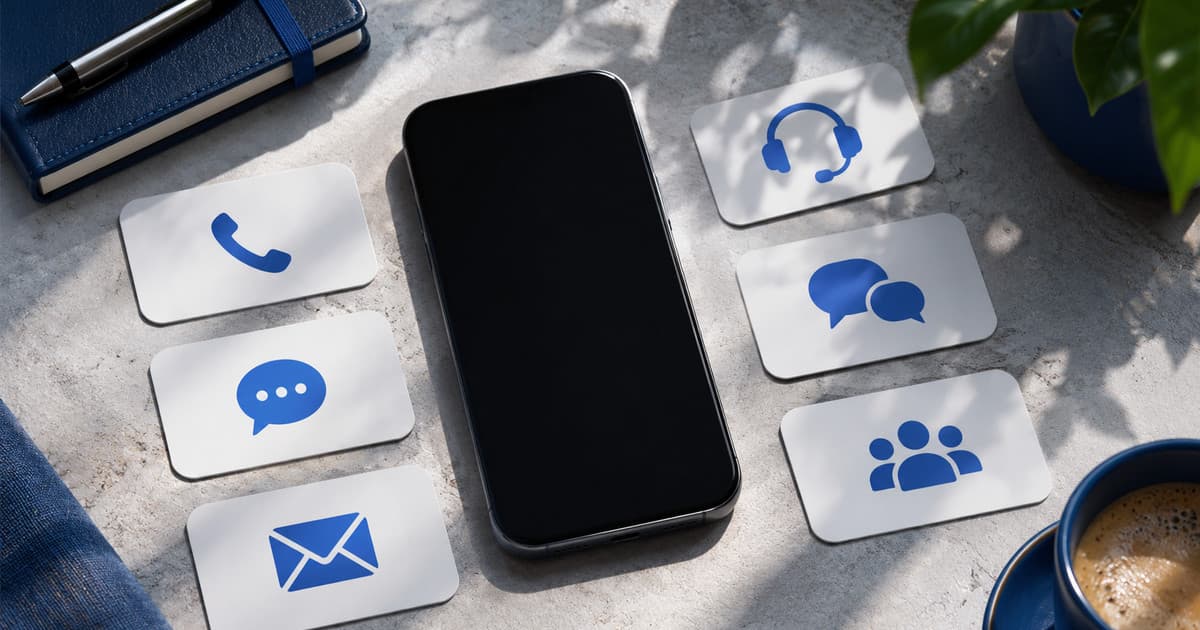
A mature omnichannel model integrates several types of channel. In short:
- Conversational: WhatsApp, website chat and, depending on the platform, social media and messengers.
- Asynchronous and voice: email, forms, phone and AI voice.
- Self-service and in-person: app, logged-in area and stores, which must also feed the same history.
The list isn't the hard part. The hard part is making a conversation started on one channel arrive updated on another, with the same customer identifier, without anyone typing anything twice. At Tolky, the active channels today are WhatsApp, webchat, Microsoft Teams and voice; the others appear as "coming soon" (see the plans).
The architecture behind real omnichannel
Three layers must work together. Without any one of them, it's theater.
Layer 1: unified customer identity
The system must recognize it's the same person when they arrive through different channels. It isn't trivial: each channel has its own identifier. On WhatsApp, the BSUID has appeared in webhooks since April 2026 and businesses have been able to reserve usernames since June 29, 2026, so a contact may arrive without a phone number. That's why the customer profile should store phone and BSUID and cross them with other identifiers (email, CRM ID).
Layer 2: centralized knowledge base
In poorly done multichannel, the WhatsApp team says one thing and the phone team another. Omnichannel solves it with a single source of truth: policies, procedures and FAQs live in one place, and every channel answers from it. When a policy changes, it changes everywhere at once.
Layer 3: orchestration across channels and areas
The most sophisticated layer: the system knows how to move the customer between channels without losing context. For example, the customer is in the website chat and needs to send a document; the agent proposes continuing on WhatsApp, with history preserved. Without orchestration, the customer is stuck on the channel they entered through.
Talk to Tolky to see how to design these three layers in your operation.
How Tolky recognizes the same customer on two channels
In any omnichannel architecture the golden rule is the same: merge profiles automatically only when there is a strong shared identifier (phone, BSUID or verified email), and ask the customer to confirm when the match is ambiguous, so histories of different people aren't mixed. To learn exactly how Tolky applies this today on WhatsApp, webchat, Microsoft Teams and voice, talk to the team.
The role of conversational AI in omnichannel operations
AI makes omnichannel viable at scale because it sustains orchestration and context continuity, not because it replaces humans on every channel.
Maintains a single context. A customer who talks to the AI and then to a human hands that human a summary of the earlier conversation. The AI passes the context, not the customer.
Recommends the right channel. If the case will need a document or voice, the AI suggests the most suitable channel and prepares the transition.
Resolves transactional cases. Duplicate bills and order status are resolved on the channel the customer is on, without handing off to a human.
Proactive contact, with rules. On WhatsApp, starting a conversation outside the 24-hour window requires an approved template and opt-in, with a per-message cost. Contact triggers must respect those rules.
On cost, since October 1, 2026 Meta also charges Service messages per message (with 1,000 free per number per month); see New WhatsApp Business pricing. With AI and omnichannel you can raise the volume handled by the same team and improve CSAT, but the gain depends on your operation: measure before and after.
Common mistakes in the omnichannel transition
Thinking omnichannel is UI. Putting every channel on the same screen isn't enough: it's data architecture, identity and orchestration. A single screen over fragmented systems is still multichannel.
Keeping teams specialized by channel. Each with its own goals, systems and playbooks. Omnichannel needs teams that cut across channels with unified context.
Not unifying history before channels. If the CRM, helpdesk and WhatsApp hold different versions of the customer, joining them on a screen only amplifies the confusion.
Underestimating WhatsApp's complexity. The channel has its own rules: the 24h window, approved templates, per-message cost, BSUID and limits on proactive messages. See also lead loss on WhatsApp and why WhatsApp is not a CRM.
Implementing everything at once. The path that works is to start with 2 well-integrated channels, stabilize and expand.
Not measuring the integrated experience. Measure the whole journey, not just each channel's CSAT.
How to start (without rebuilding the whole stack)
You can implement omnichannel without replacing your CRM, helpdesk or ERP. What comes in is an orchestration layer that connects those systems and establishes unified identity. To understand the concepts better, see what conversational CRM is and how the platform is organized in WhatsApp service platform.
Step 1: map the real journey. List where customers arrive, where they get lost and where they repeat information. Usually most volume concentrates on a few channels; confirm with your data.
Step 2: unify identity. Implement the layer that recognizes the customer on every channel. It's database and lookup work, not interface work.
Step 3: integrate the 2 or 3 main channels. Start with the ones that concentrate volume, connecting them to orchestration and the single knowledge base.
Step 4: expand. With the main ones stable, add the others as they become available. Timing varies with size and the systems involved.

How Tolky delivers the foundation of an omnichannel operation
Tolky was built as a conversational-AI service platform, with customer identity, a centralized knowledge base and human handoff with a conversation summary. Today the same agent serves WhatsApp, webchat, Microsoft Teams and voice, with per-customer history; Instagram, SMS and email are marked "coming soon". Tolky connects to the systems the company already uses to look up and update information, according to the configured integration. Talk to our team to assess the fit with your stack, and see the market alternatives to compare.
Brazilian customers expect to enter one channel and pick up exactly where they left off on another. The transition doesn't require rebuilding the stack: it requires unified identity, a centralized knowledge base and orchestration, with conversational AI making the model viable at scale.
Want to see how an omnichannel architecture works in practice for your operation? Talk to our team: together we map your customers' real journey and show how to integrate the channels that matter without replacing what already works.
Share
Cited in
- Customer Service Automation Without Losing Humanity: Use AI Well
- AI Without Integration Becomes FAQ: It Talks but Does Not Resolve
- Lead Loss on WhatsApp: Why Companies Let Sales Slip in Conversations
- The Hidden Cost of Slow Response: How Delays Hurt Sales and Operations
- Conversational AI Is Not a Chatbot: Why Go Beyond Automated Replies
- WhatsApp Is Not CRM: Why Companies Lose Sales, Data and Relationships
- Customer Experience (CX) Guide 2026: Strategies, Tools and AI
- What Is Conversational CRM? Omnichannel CRM, Chatbot and AI Compared
- Customer Service Software and Platforms: How to Choose the Best
- We launched our new Conversational AI platform for enterprises
About the author
Marlos Carmo
Founder of Tolky
Marlos Carmo is an AI entrepreneur and founder of Tolky, the conversational-era infrastructure and AI CRM that unifies intelligent service, multi-channel support (such as WhatsApp and voice), live CRM, and operational intelligence in a single ecosystem. He is a finalist for the SXSW Innovation Awards and a member of Francesco's Economy, a global network of young entrepreneurs focused on innovation and social impact. He works connecting Artificial Intelligence and digital transformation in projects for large organizations.
Next step
Want to bring this to your operation?
Tati, Tolky's AI assistant, understands your scenario in a few questions, suggests the best path and connects you with someone from the team, with full context.