AI Models Are Becoming Commodities: Operation Is the Real Advantage
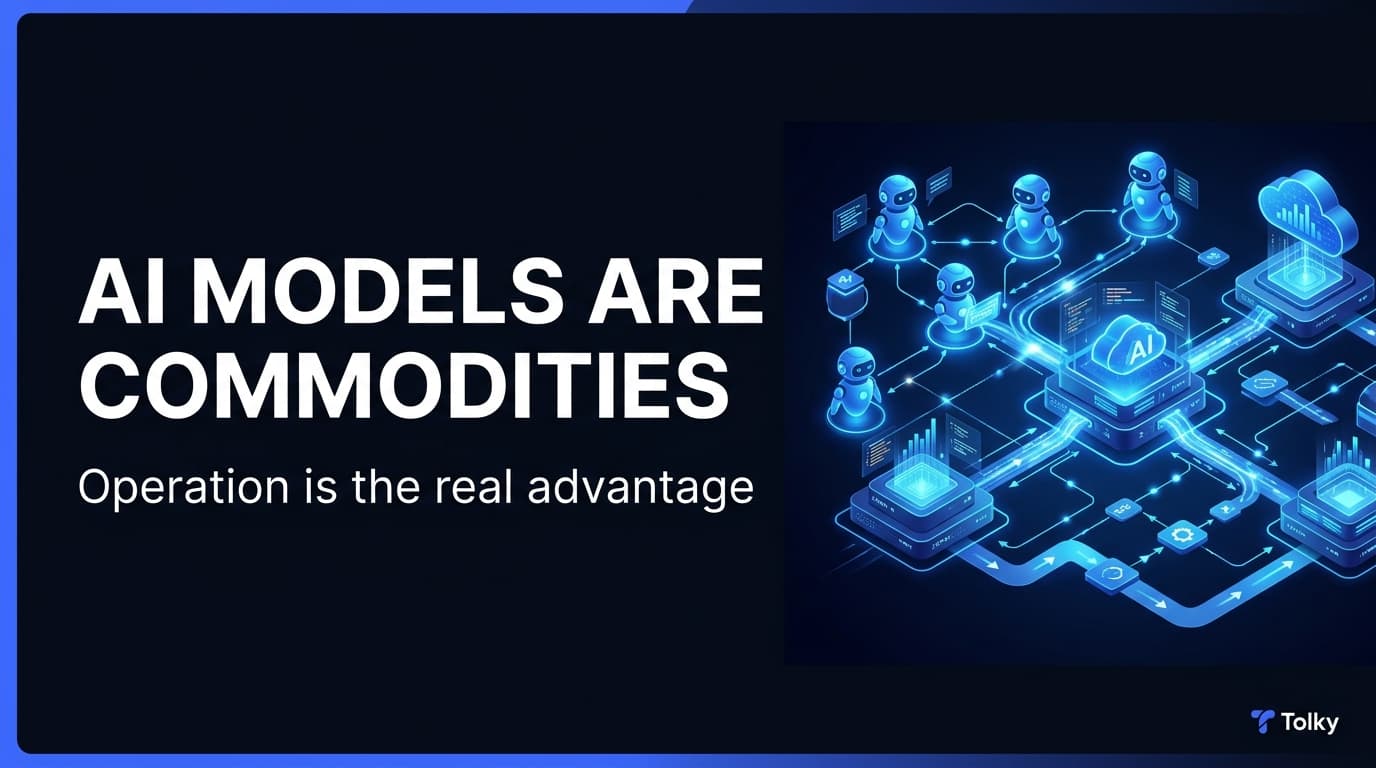
AI models like GPT, Claude, Gemini, and DeepSeek are becoming commodities. The true competitive edge for mature enterprises is not the chosen LLM, but the operational architecture built on top of it.

Marlos Carmo
Founder of Tolky
Updated on November 15, 2026
Share
Not long ago, technology directors and innovation executives spent whole meetings debating which vendor had the best AI model. The question was: "Which model should we use, and when should we switch?"
Today, that is usually the least relevant question for a mature company. While beginners jump from API to API with every new benchmark, the operations that are generating returns with artificial intelligence have reached a conclusion:
AI models are becoming commodities. The competitive advantage is in the operation built on top of them.
Switching models is unlikely to fix the fact that your company has no unified customer history, does not integrate customer service with the CRM and ERP, has no governance over data permissions and still asks agents to copy and paste data between five open tabs. The language model is the engine. Without a chassis, transmission, fuel and a driver, the best engine does not go anywhere.
In this article, we look at why the contest between AI models has changed layers, what makes up a high-impact enterprise AI architecture and how to build a conversational operation that is scalable, secure and results-oriented.

The Race Between Models Has Changed Layers
In the early years of the generative AI wave, the gap between the leading model and its competitors was large. That has been changing, and today the trend is convergence:
- Top proprietary models (current versions of GPT, Claude and Gemini) compete closely. On comparable customer service tasks, the difference between them is usually small and varies by case and benchmark, so it is worth measuring in your own operation.
- Open source and open weight models (such as Llama, Qwen, DeepSeek and Mistral) have been getting closer to proprietary ones, generally at lower cost and with the option of private deployment. This is a trend, not a rule for every use case.
- Smaller, specialized models (SLMs), tuned for specific tasks or running on dedicated instances, process data quickly at lower infrastructure cost.
The result: the ability to process natural language has become a widely available resource through APIs, with falling cost per token (but not zero: cost per call remains an operations metric).
The model answers. The operation delivers results.
When Everyone Has Access to the Same AI
If your company and your biggest competitor have access to the same API, where is the differentiation? Technology history has shown this movie before: having cloud servers, using a database or having broadband does not make anyone innovative. The value comes from how the application is architected and from the services built on top of the infrastructure.
+-----------------------------------------------------------------------+
|                           THE MODEL LAYER                             |
|     Current versions of GPT · Claude · Gemini · DeepSeek · Llama      |
+-----------------------------------------------------------------------+
                                    │
                                    ▼
+-----------------------------------------------------------------------+
|                    THE COMPETITIVE VALUE LAYER                        |
|  Conversational memory · Integrations · Agent orchestration           |
|  Governance and logs · Observability · Human + AI interface           |
+-----------------------------------------------------------------------+
When everyone has access to the same AI, whoever integrates people, data and processes best wins.
The Myth of the Best Model
Innovation committees spend weeks on spreadsheets to decide between LLM A and LLM B, and ignore operational bottlenecks:
- The AI does not know the customer has an overdue invoice because it cannot access the ERP.
- The AI answers generically because it does not read the history in the CRM.
- The agent takes minutes to find the previous ticket because channels do not talk to each other.
- Nobody knows how many times the AI got it wrong last week because there is no observability.
Swapping the LLM without touching the architecture is swapping the engine of a car with no wheels.
Switching models is easy. Building an intelligent operation is hard.
The Model Is Only One Part of the Architecture
In a corporate AI architecture, the LLM is one piece of a larger stack. The components that usually appear in mature platforms:
- Model gateway: a layer that chooses the model by cost, latency and complexity (a common market practice that not every platform offers).
- Context and dynamic prompts, with brand instructions and tone of voice.
- Conversational memory, short and long term.
- Tool layer (tool calling, MCP, an open standard for connecting AI applications to external systems).
- Business integrations with CRM, ERP, helpdesk and databases.
- RAG (semantic search over internal knowledge bases).
- Orchestration of specialized agents, as detailed in AI agent orchestration.
- Ticket management and handoff to humans.
- Observability and business metrics (resolution, deflection, CSAT, cost per call).
- Governance and security: role-based access control, masking of sensitive data and guardrails.
   ┌─────────────────────────────────────────────────────────────┐
   │                     CUSTOMER ENTRY                          │
   │         WhatsApp · Webchat (other channels: coming soon)    │
   └──────────────────────────────┬──────────────────────────────┘
                                  ▼
   ┌─────────────────────────────────────────────────────────────┐
   │              OPERATION & GOVERNANCE LAYER                   │
   │  Conversational memory · Agent orchestrator                 │
   │  Integrations (CRM · ERP · tickets) · Human handoff         │
   └──────────────────────────────┬──────────────────────────────┘
                                  ▼
   ┌─────────────────────────────────────────────────────────────┐
   │                      MODEL LAYER                            │
   └─────────────────────────────────────────────────────────────┘
The company's real asset is not the model. It is the architecture built on top of it.
The Real Differentiator Is in the Operation
Operational excellence in AI shows up in five dimensions:
1. End-to-End Execution Speed
The time to the first token matters less than the time to solve the customer's problem. A response generated in 1 second that forces the customer to wait hours for a human reply has little operational value.
2. Context Quality and Unification
A 360° view of the customer at the moment they write: with history, open tickets and profile, the AI does not ask redundant questions.
3. Deep Process Integration
The AI should not just answer questions (which turns it into an expensive FAQ): it should execute tasks within defined permissions. Illustrative market examples: issuing an invoice copy, resetting a password, registering an opportunity in the CRM.
4. Transparent Human-AI Handoff
Good automation recognizes its limits. When the case requires empathy, negotiation or an exception to the rule, the system transfers the full context to the human agent, with a summary of the conversation.
5. Fast Continuous Improvement Cycles
Mature operations review the tickets where the AI failed, adjust the knowledge base, refine policies and update integrations.
Prompts age. Operations evolve.
The Role of Conversational Memory
Many platforms treat each conversation as an isolated event. If the customer opens a ticket on Monday via WhatsApp and returns on Thursday through the website chat, the AI behaves like a stranger. Conversational memory turns scattered history into active context: it remembers stated preferences, recognizes ongoing negotiations and keeps the history available to the team.
The AI answers. Memory connects. The operation retains the customer.
Integrations Matter More Than Prompts
There is a maxim in conversational AI: AI without integration becomes a FAQ. Without reading and writing to corporate systems, prompt engineering quickly hits a ceiling: the AI can answer "how does the warranty work", but not "what is the shipping status of my warranty replacement". As we detail in AI without integration becomes a FAQ, AI only generates tangible value when it acts as an execution layer integrated with ERPs, CRMs, helpdesks and proprietary APIs. See also AI integration with CRM.
Governance Is a Competitive Advantage
Scaling corporate AI without governance is a recipe for operational errors, data leaks and reputational damage. A mature operation requires four pillars: auditing (records of calls, prompts and responses), security (masking of sensitive data), permissions (access control by profile and team) and control (guardrails and spending limits). Go deeper in AI governance in customer service.
Without governance, using AI in the company is not innovation: it is uncalculated risk.
The Future Tends Toward Multi-Agent Architectures
Instead of one giant chatbot trying to solve everything, the trend is specialized agents working in coordination. An illustrative example:
- Triage agent (supervisor): analyzes intent, identifies urgency and delegates to the right agent.
- B2B qualification agent: collects lead data, queries the CRM and proposes time slots to the salesperson.
- Tier 1 support agent: solves recurring tickets and forwards the rest with context.
- Collections agent: identifies overdue invoices and guides regularization, within the rules approved by the company.
All under shared memory and with clear rules for handing off to humans. See the design in AI agent orchestration and the definition in what an AI agent is. For autonomy limits, read agentic AI in business.
How to Test the Thesis: A Simple Experiment
The thesis "the model matters less than the operation" is verifiable. A protocol (not a result):
- Set aside the same set of, for example, 200 real customer service conversations.
- Run them on two different models, with the same knowledge base and the same rules.
- Measure accuracy, latency, cost and the impact of integrations (with and without CRM access).
- Compare: if the difference between models is smaller than the difference between having integration or not, the operation weighs more.
If Tolky publishes real results of this kind, they will come with a period and sample size.
Comparison: Choosing the Best Model vs. Building the Best Operation
| Criterion | Model focus | Operation focus |
|---|---|---|
| Main focus | Benchmarks and parameters | First contact resolution, cost and satisfaction |
| Priority investment | API subscriptions and vendor switching | Integrations, memory and governance |
| Business impact | Well-written answers, but disconnected from action | Resolved tickets and qualified leads |
| Maintenance | Long prompts adjusted at every model version | Rules and integrations decoupled from the model |
| Dependency | Greater dependence on a single provider | Lower dependence, if the architecture is decoupled |
| Integration | Usually limited to a knowledge base | Deep (CRM, ERP, helpdesk, APIs) |
| Governance | Limited to the provider's filters | Access control, logs and guardrails |
| Return (ROI) | Harder to measure | Measurable in efficiency indicators |
Those who compete only on the model tend to fall behind. Those who build the best operation gain scale.
Indicators That Really Matter
Forget benchmark scores and focus on operations:
- First contact resolution (FCR): requests resolved end to end, with no repeat contact.
- Average resolution time: from the first message to actual completion, not just to the first reply.
- Qualified deflection rate: repetitive tickets successfully resolved. See ticket deflection with AI.
- Context delivered to the agent: share of handoffs with a structured summary.
- Cost per resolved interaction: infrastructure (models, messages) plus allocated human time.
- AI ROI: financial gain compared to total cost. See ROI in AI automation.
How Tolky Sees This Transformation
Tolky does not sell access to a specific model: it treats the LLM as infrastructure. The platform is the customer service operation layer, with agents that serve on WhatsApp, webchat, Microsoft Teams and voice, integrate with systems such as ERPs, CRMs and APIs, keep conversation context, hand off to agents with the history and give managers visibility. Other channels (Instagram, SMS and email) appear as "coming soon" on the website; check the pricing page and the changelog.
Points such as routing between models from different providers and integration via MCP are part of the direction the market is pointing to and of what we discuss in this article, but what is available today depends on your plan and your case: talk to our team.
Frequently Asked Questions (FAQ)
What is the best AI model today?
There is no absolute best model. Advanced reasoning and coding tasks may benefit from top models; high-volume, low-cost tasks often work well with smaller models. What matters is measuring in your operation.
Is it worth switching model providers?
It can bring latency or cost gains, but it rarely solves operational problems. First, check whether the AI has memory, whether it is integrated with your systems and whether the human service flow is well designed.
How do I choose an enterprise AI platform?
Prioritize: integration with your systems, conversational memory, governance and logs, smooth handoff to humans and clarity about what is active today and what is roadmap.
What sets apart companies that really scale AI?
They treat AI as systems architecture and process management, not as a prompt experiment: they invest in governance, data quality, integrations and training for operations teams.
How long does it take to build an AI operation?
It depends on scope, integrations and the quality of the knowledge base. A pilot on a well-chosen queue is usually the fastest path; the timeline for your case should be defined with the team, after mapping the processes.
The Competitive Advantage Is Within Reach
If your board still spends weekly meetings choosing which model to hire, your company is looking at the wrong layer of the problem. The model answers. The operation delivers results.
Want to see this in practice? Bring 50 real conversations and watch a Tolky agent resolve them with your own knowledge base and hand off to a human when necessary. Talk to the team or explore the WhatsApp customer service solution.
Share
Tags
- ai models
- enterprise ai
- #conversational ai
- #ai agents
- ai architecture
- ai operations
- #AI CRM
- #ai governance
- conversational memory
- enterprise automation
About the author
Marlos Carmo
Founder of Tolky
Marlos Carmo is an AI entrepreneur and founder of Tolky, the conversational-era infrastructure and AI CRM that unifies intelligent service, multi-channel support (such as WhatsApp and voice), live CRM, and operational intelligence in a single ecosystem. He is a finalist for the SXSW Innovation Awards and a member of Francesco's Economy, a global network of young entrepreneurs focused on innovation and social impact. He works connecting Artificial Intelligence and digital transformation in projects for large organizations.
Next step
Want to bring this to your operation?
Tati, Tolky's AI assistant, understands your scenario in a few questions, suggests the best path and connects you with someone from the team, with full context.