Ethics in artificial intelligence: principles, laws and service
Ethics in artificial intelligence in practice: five principles (transparency, privacy, bias, human oversight, accountability), LGPD, PL 2338/2023, the EU AI Act and customer service.
TL;DR
Ethics in artificial intelligence is the set of principles that guides how AI is built and used so that it does no harm: transparency, privacy, fighting bias, human oversight and accountability. In Brazil, the LGPD (the country's data protection law) already applies to AI that uses personal data and PL 2338/2023 is awaiting a rapporteur's opinion in the Chamber of Deputies (status on November 23, 2026); in the European Union, the AI Act is in force with obligations phased in over time.
Share
An AI that serves customers speaks on behalf of the company. If it makes up a rule, treats one customer worse than another or hides that it is a machine, the company answers for it, not the model provider.
Ethics in artificial intelligence is no longer just a research topic: it is now a criterion for buying, operations and the law. This guide explains the principles, shows where the laws stand in Brazil and the European Union (checked on November 23, 2026) and applies it all to the daily use of AI in customer service.
Updated November 2026.
What is ethics in artificial intelligence?
Ethics in artificial intelligence is the set of principles and practices that guides how AI systems are designed, trained, deployed and supervised, so that they respect rights, avoid harm and have someone accountable for the decisions they make.
It is not an abstract topic. In November 2021, the 193 member states of UNESCO adopted the Recommendation on the Ethics of Artificial Intelligence, the first global agreement on the subject. Not legally binding, it guides public policy (UN News, checked on November 23, 2026). Since then, countries and blocs have started turning those principles into rules.
For a company, AI ethics comes down to one question: if this AI answer had been given by an employee, would the company stand behind it?
What are the principles of AI ethics?
The five principles that show up in almost every set of AI ethics guidelines are transparency, privacy, fighting bias, human oversight and accountability. Each becomes a concrete practice when the AI talks to customers.


| Principle | What it means | How to apply it in customer service |
|---|---|---|
| Transparency | People know they are talking to an AI and understand what it does | The agent introduces itself as an AI assistant and says when the conversation is recorded or transcribed |
| Privacy | Personal data used only for the stated purpose, at the minimum necessary | Don't ask for data the conversation doesn't need; follow the LGPD |
| Bias and non-discrimination | The AI does not treat people differently because of personal characteristics | Test answers with varied profiles and review priority criteria |
| Human oversight | People can monitor, correct and take over at any time | Handoff rules and an operator who can pause the AI |
| Accountability | Someone answers for what the AI does and there is a record to explain it | History of every answer, configuration versions and an owner for the agent |
Transparency
Anyone talking to an AI has the right to know it. Hiding that breaks trust the moment the customer notices, and the European AI Act already requires this notice, as we'll see below. Transparency also means explaining why the AI decided something, such as handing off the case or turning down a request.
Privacy
A customer service AI handles names, phone numbers, orders and, sometimes, health and financial information. The LGPD calls for purpose, necessity and security. Health data, for example, is sensitive personal data and calls for extra care. See the LGPD entry in the glossary.
Bias
Models learn from data about the world, and the world is full of prejudice. In customer service, bias shows up in the details: a harsher tone with people who write informally, lower priority for certain regions, refusing legitimate requests. Testing with varied profiles is the only way to spot it.
Human oversight
Human oversight is the human-in-the-loop principle: people monitor, correct and take over. In practice, it means clear rules for the handoff between AI and human and an operator who can pause the AI.
Accountability
The company answers for what the AI says in its name. To do that, it needs to know what changed in the configuration, who changed it and why the AI gave each answer. Without a record, there is no way to correct or explain anything.
What does the LGPD say about artificial intelligence?
The LGPD does not mention AI by name, but it applies to every system that processes personal data, AI agents included, and it gives data subjects the right to request a review of decisions made solely through automated processing.
Three points of Law No. 13,709/2018, Brazil's data protection law, weigh most in AI customer service (checked on November 23, 2026):
- Principles (art. 6). Purpose, necessity, transparency, security, non-discrimination and accountability. It is almost the list of ethical principles written as law.
- Automated decisions (art. 20). Data subjects can request a review of decisions made solely on the basis of automated processing of personal data that affect their interests, such as consumer and credit profiles.
- Legal bases (art. 7). All processing needs a legal basis, such as performance of a contract, consent or legitimate interest.
Compliance is the data controller's responsibility, not a feature you buy off the shelf. Check this with your legal team.
What is the status of PL 2338/2023, Brazil's AI legal framework?
PL 2338/2023, the bill that sets rules for developing and using AI in Brazil, was approved by the Senate on December 10, 2024 and, as of November 23, 2026, is awaiting the rapporteur's opinion in the Chamber of Deputies' Special Committee on Artificial Intelligence, with no floor vote.
The facts, checked on the official pages on November 23, 2026:
- Senate. The text was approved on the floor on December 10, 2024 and sent to the Chamber on March 17, 2025 (Senate record).
- Chamber of Deputies. The official status is "Aguardando Parecer do(a) Relator(a) na Comissão Especial sobre Inteligência Artificial (PL 2338/23)" (Awaiting the Rapporteur's Opinion in the Special Committee on Artificial Intelligence). The rapporteur is Deputy Aguinaldo Ribeiro (PP-PB), appointed on May 20, 2025. The latest actions are attachments of other bills, not votes (Chamber tracking record).
- What happens next. If the Chamber changes the text, it goes back to the Senate. Only then does it go for presidential signature. Until then, there is no general AI law in force in Brazil.
The text approved by the Senate classifies systems by risk and creates stricter duties for high-risk uses. Since it can still change, treat any summary of obligations as provisional and follow the Chamber record.
What about the European Union's AI Act?
The AI Act (Regulation (EU) 2024/1689) is the European law on artificial intelligence: it has been in force since August 1, 2024, with obligations phased in over time, and some deadlines were postponed in 2026 by the so-called Digital Omnibus. It applies to anyone who offers or uses AI in the European market, including companies outside the EU.
| Framework | What it provides | Status on 11/23/2026 |
|---|---|---|
| LGPD (Law 13,709/2018) | Principles, legal bases and review of automated decisions | In force |
| PL 2338/2023 | Brazil's AI legal framework, with risk classification | Approved by the Senate; awaiting opinion in the Chamber's Special Committee |
| AI Act: prohibited practices | Bans uses such as manipulation and social scoring | Applies since February 2, 2025 |
| AI Act: transparency (art. 50) | Telling people they are interacting with an AI, among other duties | Applies since August 2, 2026 |
| AI Act: high risk (Annex III) | Duties for uses such as employment, credit and education | Postponed to December 2, 2027 |
| AI Act: high risk (Annex I) | AI embedded in regulated products | Postponed to August 2, 2028 |
| UNESCO Recommendation (2021) | Global ethical principles, not legally binding | Adopted by the 193 member states |
The postponements came from Regulation (EU) 2026/1744, published in the Official Journal of the EU on July 24, 2026 (text on EUR-Lex; original AI Act on EUR-Lex, checked on November 23, 2026). For a typical customer service agent, the most direct point is art. 50: whoever talks to the AI needs to know it is an AI.
How do you apply AI ethics in customer service?
Applying AI ethics in customer service means turning each principle into a configured, verifiable rule: the AI introduces itself, answers only from what the company has taught it, hands off to a person when it should and leaves a record of every decision.


A practical roadmap, in eight steps:
- Introduction. The agent says it is an AI assistant in the very first message and offers to connect the customer with a person.
- Scope. Define what the agent handles and what it declines. Outside its scope, it redirects politely.
- Knowledge base. Answers come from company documents, not from the model's memory, to reduce hallucination.
- Written limits. Guardrails state what the AI never does: promise a discount outside the rules, give medical or legal advice, ask for a password.
- Tests before publishing. Simulate conversations with varied profiles, including prompt injection attempts and sensitive cases.
- Handoff with context. Complaints, disputes, bereavement, illness and a direct request from the customer go to a person, with the history.
- Record. Keep the conversation, the instructions used and the configuration versions, so you can explain and correct.
- Regular review. Read a sample of conversations every week and adjust whatever sounded harsh, wrong or unfair.
The guide to AI governance in customer service goes deeper into metrics and a checklist. For a reflection on human dignity and automation, see the piece on the encyclical Magnifica Humanitas.
Common ethical mistakes in customer service AI
The most common ethical mistakes are hiding that it is an AI, leaving the customer with no way to reach a human and using more personal data than necessary. Almost all of them come from rushed configuration, not bad intent.
- Pretending to be human. A human name without saying it is an AI deceives the customer.
- Endless loop. The customer asks for a person and the AI keeps answering.
- Collecting too much. Asking for a tax ID, address and income to answer a simple question.
- Promising what it can't. The AI makes up a deadline, price or policy, and the company answers for it.
- Never reviewing. The day-one configuration is still live months later, with nobody reading the conversations.
How Tolky applies these principles
Tolky is a conversational AI CRM in which the AI agent follows the rules written by the company, goes through tests before going live, can be paused by any operator and leaves a trail for every answer. Details on the trustworthy AI page.


- Identity and limits. Mission, context, tone, scope, refusal policies and the uncertainty rule: when in doubt, the agent doesn't make things up and calls someone.
- Simulations. Personas and scenarios with success criteria, run in batches before publishing.
- Draft and restore. Changes go to a draft, are compared with the live version and can be undone.
- Investigate. For each answer, the platform shows the instructions used, the knowledge base excerpts and the calls to external systems.
- People in control. Handoff rules with history, pausing the AI at any time and, for the decisions you choose, a second AI that checks the action before carrying it out.
- Management. Access profiles and an activity log with export. In Voice Campaigns, every call starts with the transcription notice.
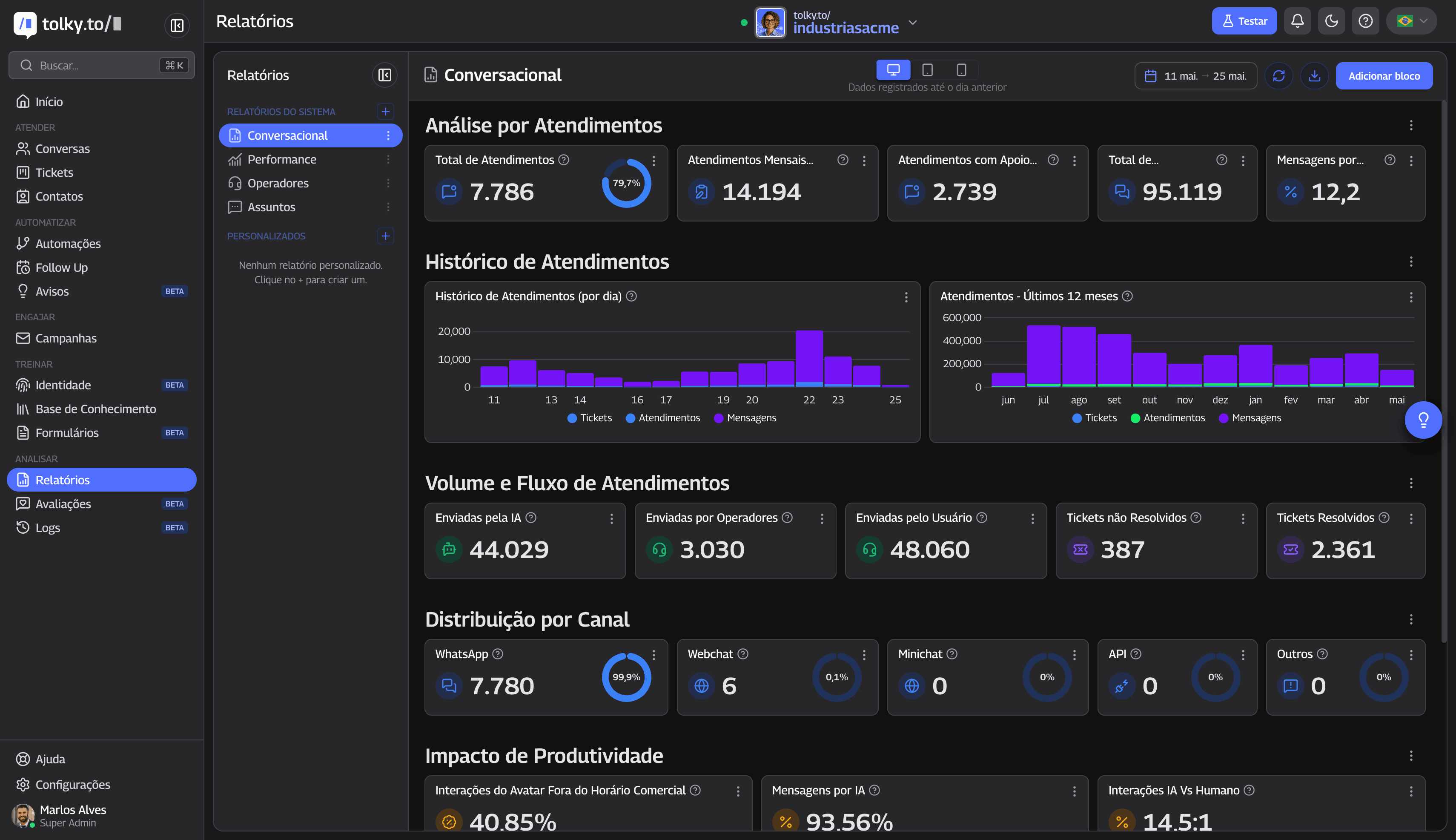
What Tolky does not do: it does not guarantee legal compliance on its own and does not offer anonymization or configurable data retention. Responsibility for the use, the legal basis and the data policy stays with your company. The verified controls are listed on the security page.
Frequently asked questions
What is ethics in artificial intelligence in a few words?
It is the set of principles that guides how AI is built and used so that it does no harm: transparency, privacy, fighting bias, human oversight and accountability for every decision.
Does Brazil already have an artificial intelligence law?
There is no general AI law in force yet. PL 2338/2023 was approved by the Senate on December 10, 2024 and, as of November 23, 2026, is awaiting the rapporteur's opinion in the Chamber's Special Committee. Meanwhile, the LGPD and Brazil's Consumer Protection Code already apply to customer service AI.
Does the AI Act apply to Brazilian companies?
It applies to companies from any country that offer or use AI systems in the European Union market. A company that serves only customers in Brazil is not subject to it, but the text works as a reference for good practice.
Does an AI have to say it is an AI?
In the European Union, art. 50 of the AI Act has required this notice since August 2, 2026. In Brazil, there is no specific rule in force, but the LGPD's transparency principle and the duty to inform consumers point in the same direction, and hiding the fact breaks trust.
How do you avoid bias in a customer service AI agent?
Test the agent with varied customer profiles, review the priority and handoff criteria and read samples of real conversations often. Bias shows up in the details, such as a harsher tone with certain profiles.
Who is responsible when the AI makes a mistake in customer service?
The company using the AI answers to the customer for what the agent says in its name. That is why conversation records, configuration versions and handoff rules are part of ethics, not just engineering.
Conclusion
Ethics in artificial intelligence is what separates an AI that helps the customer from one that exposes the company. The principles are well known, the LGPD already applies, the AI Act is in force in phases and PL 2338/2023 is still in the Chamber. What remains is to turn each principle into a rule that is configured, tested and reviewed.
See how Tolky handles trustworthy AI, read the governance guide, see the plans or talk to the team →. Let's talk?
Share
Tags
- ethics in artificial intelligence
- ai ethics
- responsible ai
- pl 2338/2023
- ai act
- lgpd and ai
- #ai governance
- #conversational CRM
About the author

Co-founder of Tolky
Marlos Carmo is an AI entrepreneur and founder of Tolky, the conversational-era infrastructure and AI CRM that unifies intelligent service, multi-channel support (such as WhatsApp and voice), live CRM, and operational intelligence in a single ecosystem. He is a finalist for the SXSW Innovation Awards and a member of Francesco's Economy, a global network of young entrepreneurs focused on innovation and social impact. He works connecting Artificial Intelligence and digital transformation in projects for large organizations.
Next step
Want to bring this to your operation?
Tati, Tolky's AI assistant, understands your scenario in a few questions, suggests the best path and connects you with someone from the team, with full context.
Share