What Is Conversational CRM? Omnichannel CRM, Chatbot and AI Compared
Understand what a Conversational CRM is, how it overcomes the limitations of traditional CRM (Omnichannel), and why the transition from rigid chatbots to Conversational AI is redefining sales.

Marlos Carmo
Founder of Tolky
Updated on November 15, 2026
Share
The customer relationship no longer happens in long forms: it happens on WhatsApp and in instant conversations. When that conversation has to be copied by hand into a pipeline, the data arrives late, incomplete, or never.
This post is about vocabulary: it explains the difference between omnichannel CRM, chatbot, conversational AI, and conversational CRM. If you are already comparing vendors, start with the AI CRM guide, which covers selection and cost.
Starting point: data that depends on typing
Traditional CRMs are excellent databases, but they depend on someone (or an integration) to feed them. When the rep is closing a deal, updating stage, value, and summary becomes a background task, and managers end up deciding with stale data. Today the big suites (Salesforce, HubSpot, RD Station) already ship their own AI: Agentforce, HubSpot's Breeze Customer Agent (comparison), and the RD Station Conversas agents (comparison) handle conversations and update records inside their suites. The useful question is therefore not "which category died" but which capabilities you need and where the conversation fits in.
The four capabilities that separate the categories
| Capability | Omnichannel CRM | Rule-based chatbot | Conversational CRM with AI |
|---|---|---|---|
| 1. Unify history | Yes: gathers channels into one inbox for the agent. | Partial: stores button answers. | Yes: the conversation becomes the customer history, linked to the record. |
| 2. Trigger flows | Routes to queues. | Follows a predefined decision tree. | Understands free language and triggers the right flow or tool, as configured. |
| 3. Update fields | Manual: the agent notes it in the ticket. | Limited to predefined answers. | Reduces typing: extracts data from the conversation and suggests or writes fields, with rules and approval for sensitive actions. |
| 4. Control identity and permission | Depends on channel and record. | Identifies by phone number, no context. | Cross-checks identity, history, and permissions before acting. |
Identity on WhatsApp: BSUID and usernames
Meta started sending the BSUID (business-scoped user ID) in webhooks in April 2026, and supporting it is mandatory for partners and directly integrated businesses (see Meta's documentation and our post on BSUID). With usernames, the phone number is no longer always the customer key, so a CRM must tie history to more than one identifier. That is capability 4 in practice.
What omnichannel CRM is
Omnichannel CRM centralizes inboxes: WhatsApp, email, and other channels land on one screen for the agent. It greatly improves service organization, but action and data stay apart: the agent still opens another tab to update the pipeline. Available channels vary by platform and plan.
What a rule-based chatbot is
The traditional chatbot follows fixed decision trees ("press 1 for Billing"). It is predictable and useful for structured collection and regulated flows, but fails when the customer writes off-script. For a practical comparison, see conversational AI vs traditional chatbot and conversational AI is not a chatbot.
What conversational AI is
It is the use of language models (LLMs) to understand free language, including audio and typos, query knowledge bases and, when integrated and authorized, run actions through APIs. It works with AI agents operating within rules set by the company. A sensitive action, such as a refund, should go through value limits and approval.
What conversational CRM (AI CRM) is
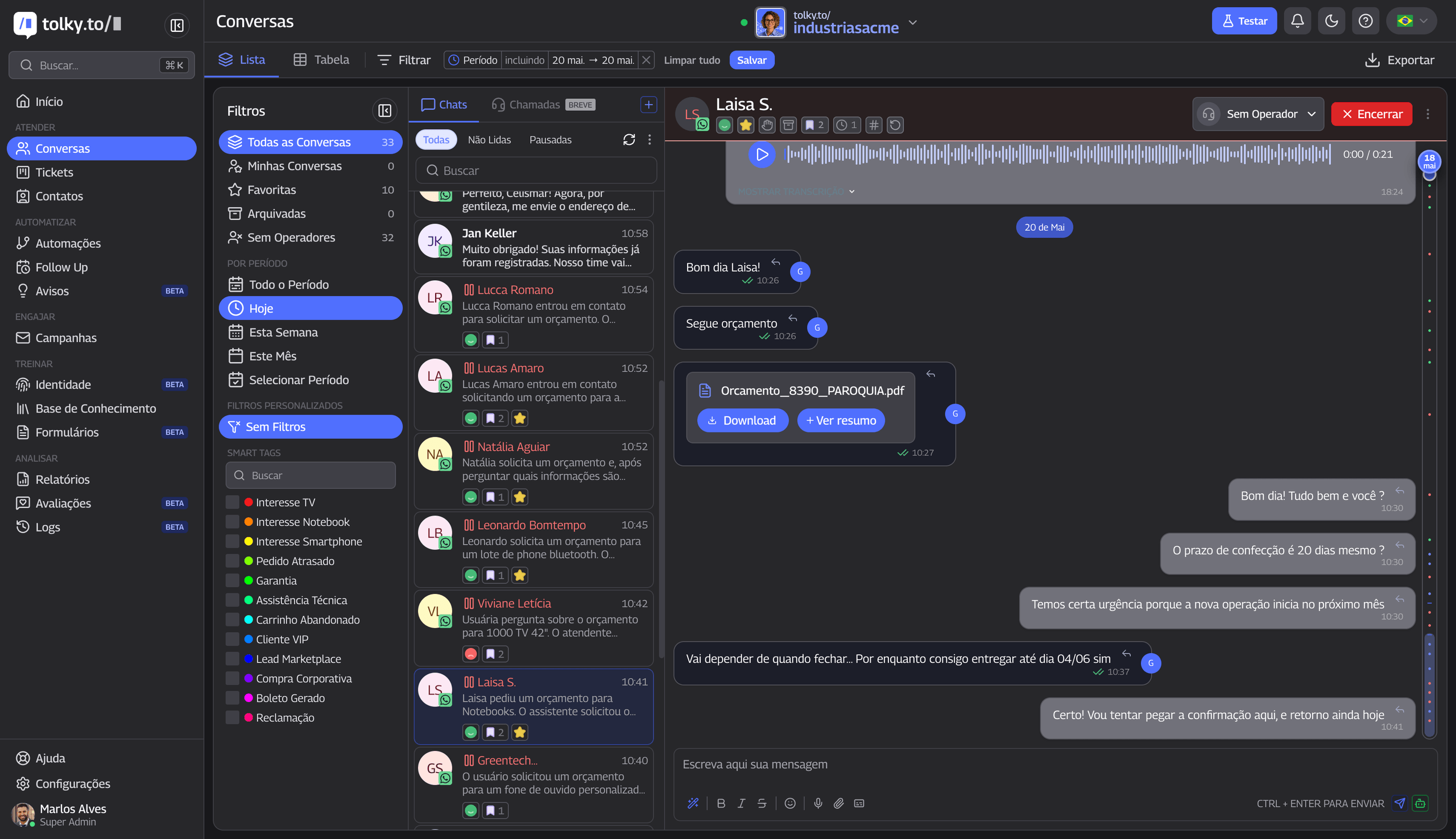
Conversational CRM is the CRM where the conversation is the source of customer history and fields. At Tolky, the WhatsApp or webchat conversation feeds the record, tags, and funnel stage, and the human team works in the same environment. Examples of what can happen, depending on configuration:
- Data extraction: the customer writes "I'm Carlos from XPTO, my email is carlos@xpto" and the AI suggests or fills in the record fields.
- Stage management: if the customer says "I'll review with my partner and get back on the 15th", the AI can move the card to "Under review" and log a follow-up, when that automation is configured.
- Continuous qualification: qualification questions flow into the conversation instead of a long form.
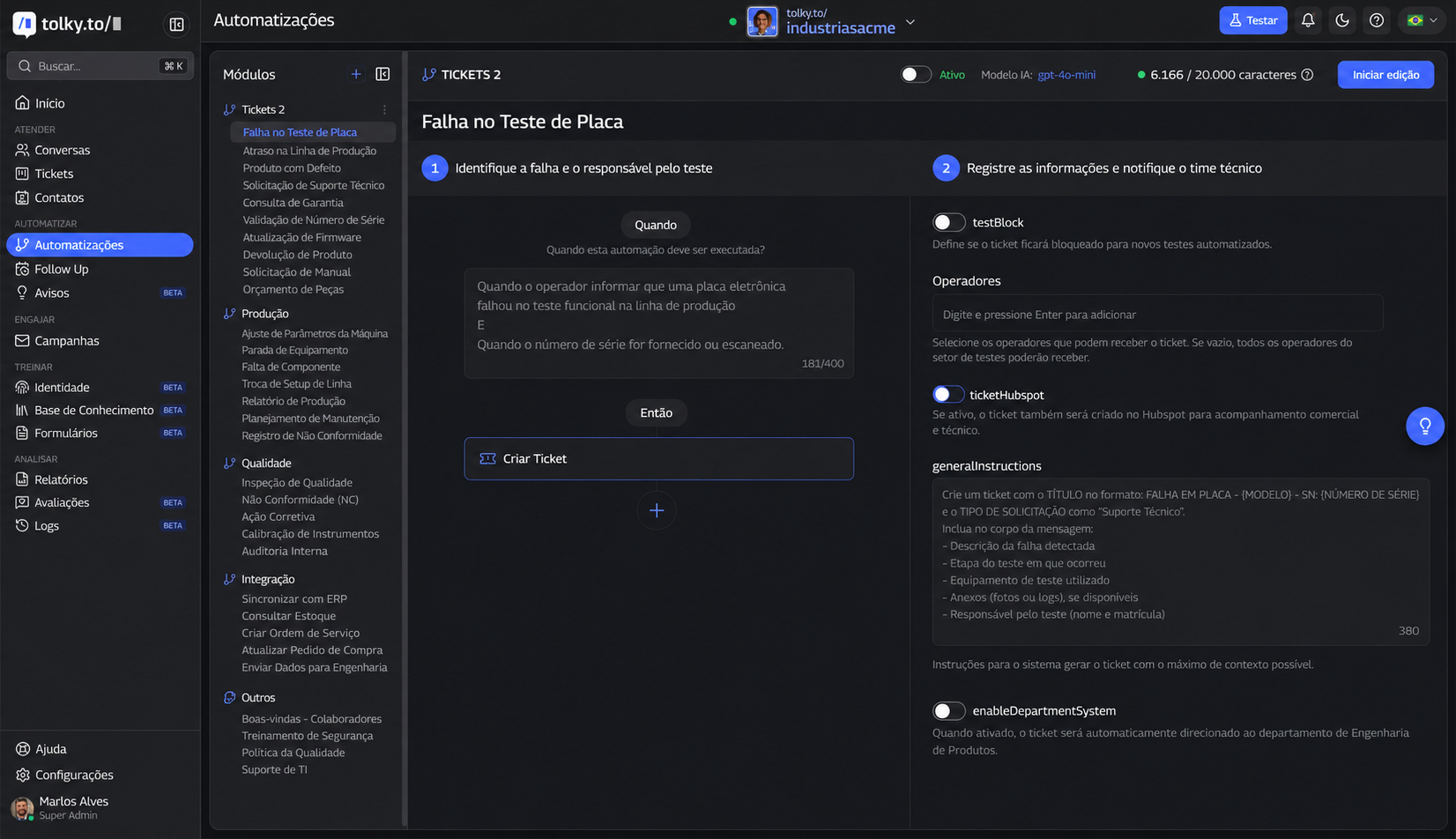
To see how this looks on screen, check the conversation with history and the flow automation in the product. The AI reduces typing, but sensitive actions go through rules and human approval. Buying, cost, and rollout details are in the AI CRM guide.
Summary of differences
| Feature | Omnichannel | Rule-based chatbot | Conversational CRM with AI |
|---|---|---|---|
| Focus | Centralize channels for the agent. | Automate fixed answers. | Use free language as the source of history and fields. |
| Data entry | Manual, in the ticket. | Predefined button answers. | Reduces typing; sensitive actions go through rules and approval. |
| Customer experience | Depends on team availability. | Menus that miss nuance. | Free language, with handoff to the human team when needed. |
| Relationship view | Loose interactions per channel. | Customer treated as a temporary ticket. | History tied to the record and used in later replies. |
Conversational CRM: frequently asked questions
What is the difference between conversational CRM and omnichannel CRM?
Omnichannel CRM brings channels into one inbox, but the record is still typed in by the agent. In a conversational CRM, the conversation itself feeds the history, the fields and the funnel stage, and AI reduces manual data entry.
Is conversational CRM the same as a chatbot?
No. A rule-based chatbot answers with fixed menus and buttons and treats the customer as a temporary ticket. A conversational CRM uses AI to understand free-form language, keeps the history on the customer record and hands the conversation to the human team with context when needed.
Does conversational CRM work with WhatsApp?
Yes, and WhatsApp is the main channel for this kind of CRM in Brazil. At Tolky, WhatsApp conversations (official Meta API) and web chat conversations feed the record, tags and funnel stage in the same workspace where the team works.
Does the AI change the CRM on its own?
It depends on configuration. The AI can suggest or fill in fields and move stages based on the conversation, but sensitive actions go through rules and human approval.
Who is conversational CRM best for?
Companies where WhatsApp is the main sales and service channel and that want CRM, customer service and AI in one workspace. If your operation already lives in a suite such as HubSpot, Salesforce or RD Station, compare them side by side before deciding.
How to choose
There is no single "right" category: HubSpot, Salesforce, and RD Station are good choices when your operation already lives in their suites. Tolky makes more sense when WhatsApp is your main channel and you want CRM, service, and AI in the same environment, with plans based on service allowances and without requiring a full suite. Compare side by side at /alternativas, see the plans, and explore the solutions.
Book a Tolky demo and see your WhatsApp flow become history and CRM fields.
Share
Tags
- conversational crm
- #omnichannel
- #ai crm
- chatbots
- #artificial intelligence
- sales
Cited in
- How to Choose an AI Agent for WhatsApp: A 12-Question Checklist
- Conversational AI for clinics and healthcare: appointments and LGPD
- Conversational AI for education: student enrollment on WhatsApp
- Conversational AI for vehicle protection: quotes, claims and billing
- How much a conversational CRM costs in Brazil in 2026
- Intercom and Zendesk alternative for WhatsApp support
- Tolky vs Respond.io: which one to choose for support in Brazil
- Tolky vs SleekFlow and Wati: which one to choose on WhatsApp
- Conversational Memory: Your Company Needs to Remember Better
- AI CRM: Why the Next CRM Will Be Conversational and Integrated
- Customer Service Automation Without Losing Humanity: Use AI Well
- AI Without Integration Becomes FAQ: It Talks but Does Not Resolve
- Lead Loss on WhatsApp: Why Companies Let Sales Slip in Conversations
- WhatsApp Is Not CRM: Why Companies Lose Sales, Data and Relationships
- What is AI CRM? The Complete Guide for Businesses in 2026
- What is omnichannel customer service and why your company needs it now
About the author
Marlos Carmo
Founder of Tolky
Marlos Carmo is an AI entrepreneur and founder of Tolky, the conversational-era infrastructure and AI CRM that unifies intelligent service, multi-channel support (such as WhatsApp and voice), live CRM, and operational intelligence in a single ecosystem. He is a finalist for the SXSW Innovation Awards and a member of Francesco's Economy, a global network of young entrepreneurs focused on innovation and social impact. He works connecting Artificial Intelligence and digital transformation in projects for large organizations.
Next step
Want to bring this to your operation?
Tati, Tolky's AI assistant, understands your scenario in a few questions, suggests the best path and connects you with someone from the team, with full context.