What is AI CRM? The Complete Guide for Businesses in 2026
Understand what AI CRM is, how it differs from traditional CRM and chatbots, use cases, how to choose a platform (with comparisons), and how to measure performance.

Marlos Carmo
Founder of Tolky
Updated on November 15, 2026
Share
Every company that has adopted a CRM knows the same frustration: the tool only works when people enter data, and people never enter enough of it.
The outcome is predictable: stale pipelines, incomplete customer histories, managers deciding on information they do not trust. AI CRM attacks the problem through architecture: instead of waiting for a human to log things, AI agents run the conversation and update the record.
Updated in November 2026.
What Is AI CRM: Definition
An AI CRM is a customer relationship platform in which artificial intelligence agents run conversations, qualify leads, update records, and execute actions on the channels customers already use, such as WhatsApp, reducing manual data entry. Sensitive actions follow rules, limits, and, when needed, human approval.
The core difference from traditional CRM is not having AI built in to generate insights, but having agents that act: the CRM updates because the agent made it happen, not because the rep remembered to log it. For vocabulary (omnichannel, chatbot, conversational AI), see What is conversational CRM. For the chatbot vs conversational AI distinction, see Conversational AI is not a chatbot.
AI CRM vs Traditional CRM vs Chatbot
| Feature | Traditional CRM | Chatbot | AI CRM |
|---|---|---|---|
| Data updates | Manual, depends on the rep | Usually does not update the CRM | Via agents, as configured |
| 24/7 service | No (a human is needed) | Yes, limited to scripts | Yes, resolving structured cases |
| Lead qualification | Manual, by human SDRs | Partial (FAQ, basic triage) | By the agent, using ICP criteria set by the company |
| Decision making | Human | Fixed rules | Contextual reasoning, within rules |
| System integration | Via API, without executing | Usually none | Reads and writes to connected systems |
| Main channel in Brazil | Email / phone | Webchat |
The distinction that matters most is decision making: a chatbot follows a pre-programmed flow and breaks off-script; an AI CRM agent interprets intent, handles variation, and decides how to act from context, within company rules.
Why Traditional CRM Failed (and How AI Helps)
The CRM problem is behavioral, not technological. According to Salesforce's State of Sales 2026 report (n = 4,050 sales professionals, surveyed Aug-Sep 2025), sellers spend about 40% of their time selling; the rest goes to other activities, including manual data entry (Salesforce). Updating the system competes with selling time, and decades of training and pressure have not fixed that.
The structural way out is to reduce dependence on typing. When an agent runs a qualification on WhatsApp, the conversation ends with title, company size, main pain, timeline, and next step logged on the lead, without the SDR opening the system. The rep who opens the record finds context, not an empty field.
How an AI CRM Works in Practice
Three layers work at the same time.
Layer 1: Conversation
The agent runs natural-language conversations on the configured channels. In Brazil the central channel is WhatsApp, installed on 99% of smartphones according to the Mobile Time/Opinion Box 2025 panorama (n = 2,019 smartphone owners, fieldwork March 2025; Mobile Time). The agent understands text, audio (with transcription), images, and documents.
Layer 2: Reasoning
The agent accesses the contact's CRM history, the configured policies and business rules, data from integrated systems, and the catalog. With that context it decides: qualify or not, answer or escalate, log as an opportunity or a ticket.
Layer 3: Execution
The agent acts: updates CRM fields, opens tickets, queries integrated systems via API, notifies the team, and records CSAT at the end. Each action depends on the configured integration and permission.
The Full Cycle
- A lead arrives on WhatsApp after seeing an ad.
- The SDR agent qualifies: title, company, context, urgency.
- Qualified lead: the agent creates the opportunity in the CRM with the data filled in.
- The agent can send the scheduling link configured by the company or hand the lead to the responsible rep.
- Post-demo: follow-up according to the defined rules.
- Deal closed: the pipeline is updated and the success team is notified.
- During the relationship: the agent answers questions and flags cases to the team.
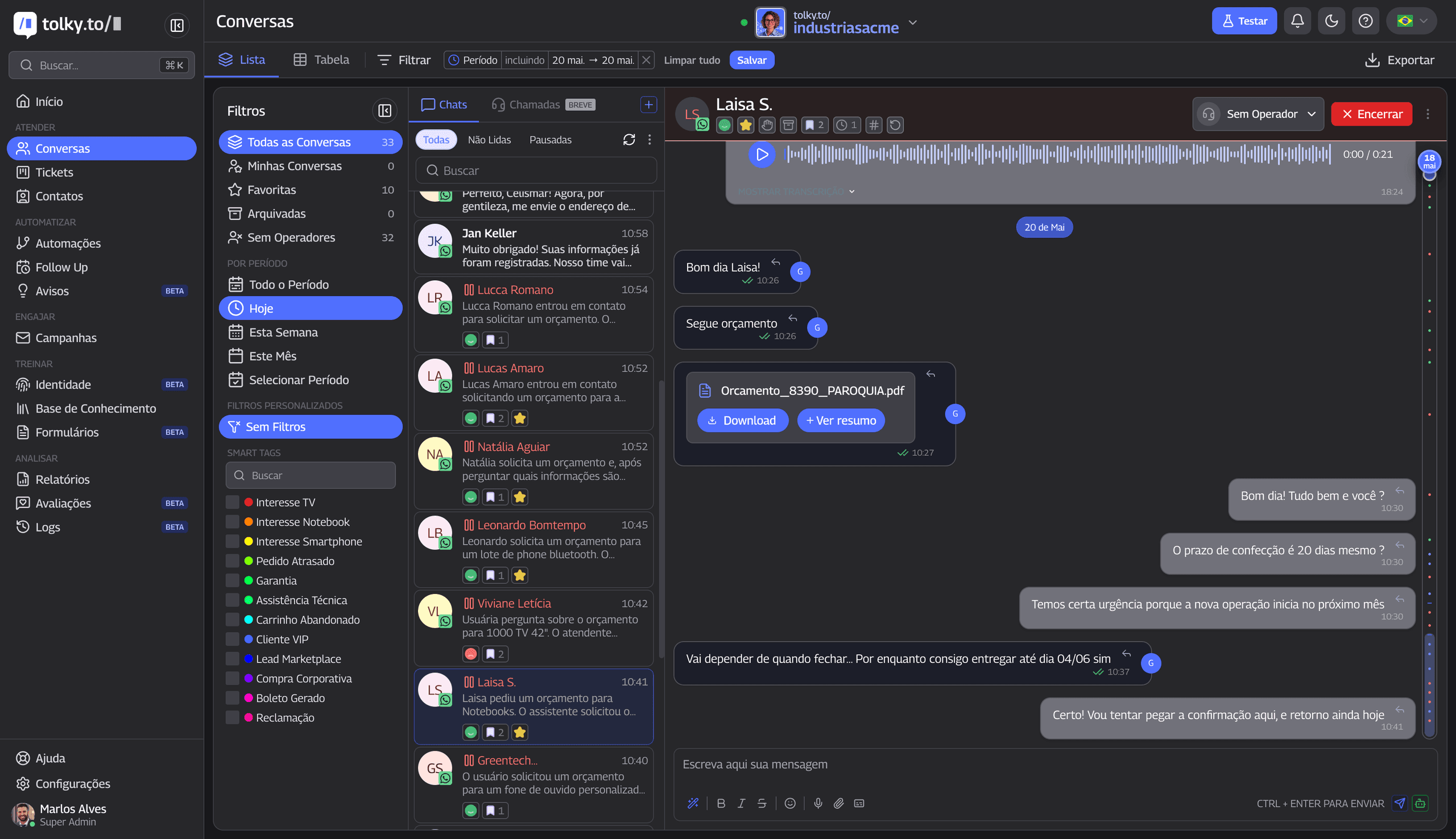
At each stage the CRM updates because the agent executed, not because someone remembered. Tolky's conversation panel shows AI and the human team in the same environment, with filters by operator, status, channel, and period, and each conversation with history, transcribed audio, and documents.
Want to see this cycle on your WhatsApp? Talk to the Tolky team.
The 6 Types of AI Agents in an AI CRM
A modern AI CRM has specialized agents for each stage of the relationship. Tolky works with six: SDR, CRM, Sales, Closer, Outbound, and Support.
- SDR agent (qualification): runs the first conversation, applies the ICP criteria defined by the company, and hands the sales team leads with full context.
- CRM agent (updates): follows interactions and updates records so each opportunity's history is complete without manual typing.
- Sales agent (arguments and catalog): answers product/service questions from the current catalog and hands off to the rep at the right moment.
- Closer agent (proposals): supports the late funnel stages, with proposals and follow-up according to the rules and approvals set by the company.
- Outbound agent (active prospecting): runs active campaigns on WhatsApp, subject to contact opt-in and Meta's template rules, and warms the lead up until handoff to sales.
- Support agent (resolution): resolves active-customer tickets from the knowledge base and available integrations, and escalates complex cases to the right human with the conversation context.
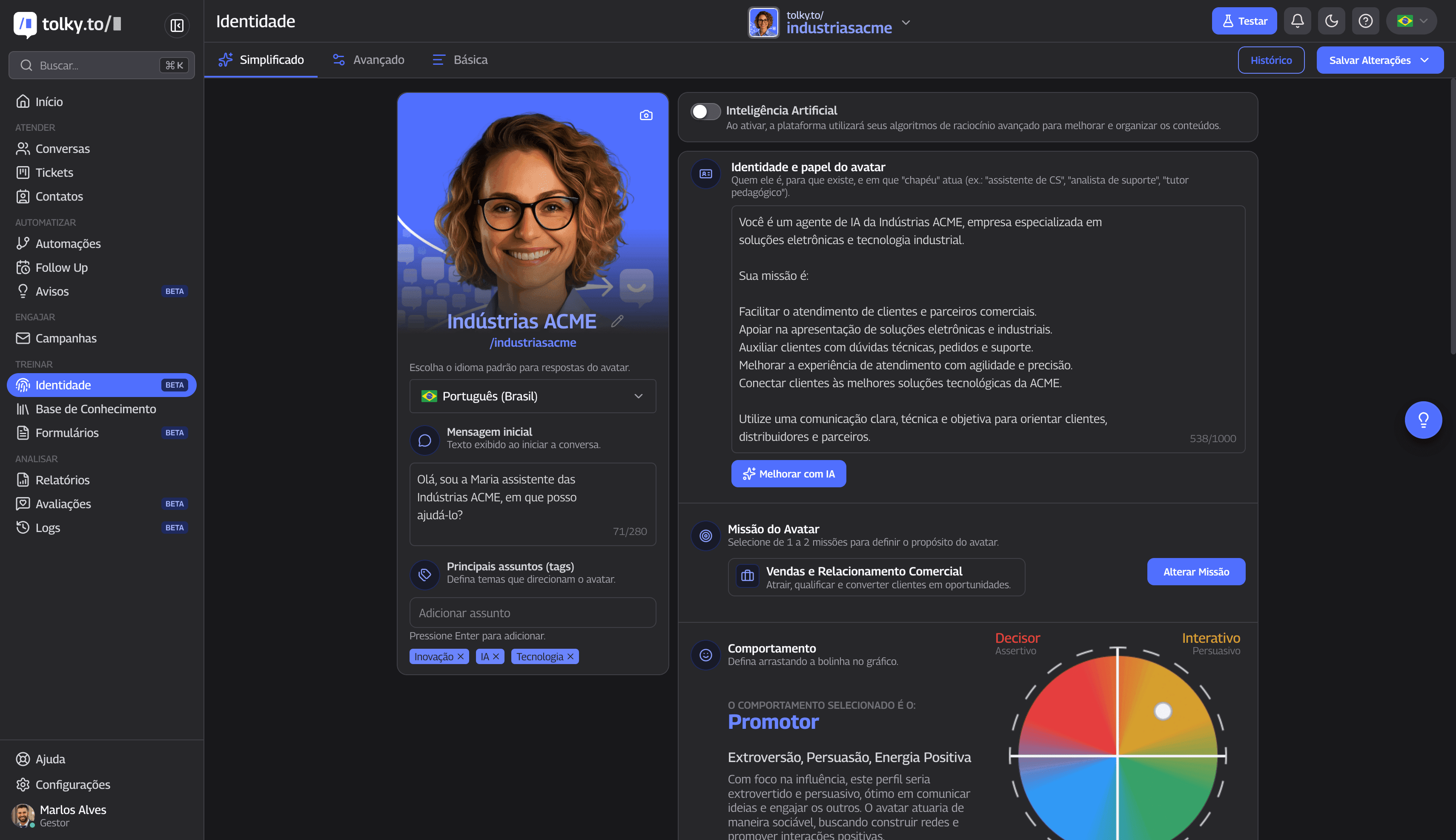
Each agent has its own identity: name, agent, mission, tone of voice, scope, and behavioral profile (such as the DISC model). At Tolky this is configured in natural language in the Identity panel, no code.
Why WhatsApp Is the Central Channel of AI CRM in Brazil
The guide on WhatsApp as a service hub details advantages, risks, and rollout. In short: WhatsApp is on 99% of Brazilian smartphones (Mobile Time/Opinion Box, 2025), so a company that runs its CRM inside it serves, qualifies, and retains customers on the channel where they already are.
That requires an AI CRM designed with WhatsApp as the primary channel, not just "with an integration". An AI CRM for Brazil must support:
- WhatsApp Business API with control of the number
- Text, audio (with transcription), image, and document
- Meta message templates for outbound messages (prospecting, follow-up, notifications)
- Management of multiple numbers and teams in the same panel
- Compliance with Meta policies and LGPD
- Support for WhatsApp identifiers (BSUID and usernames), mandatory for direct integrations since 2026
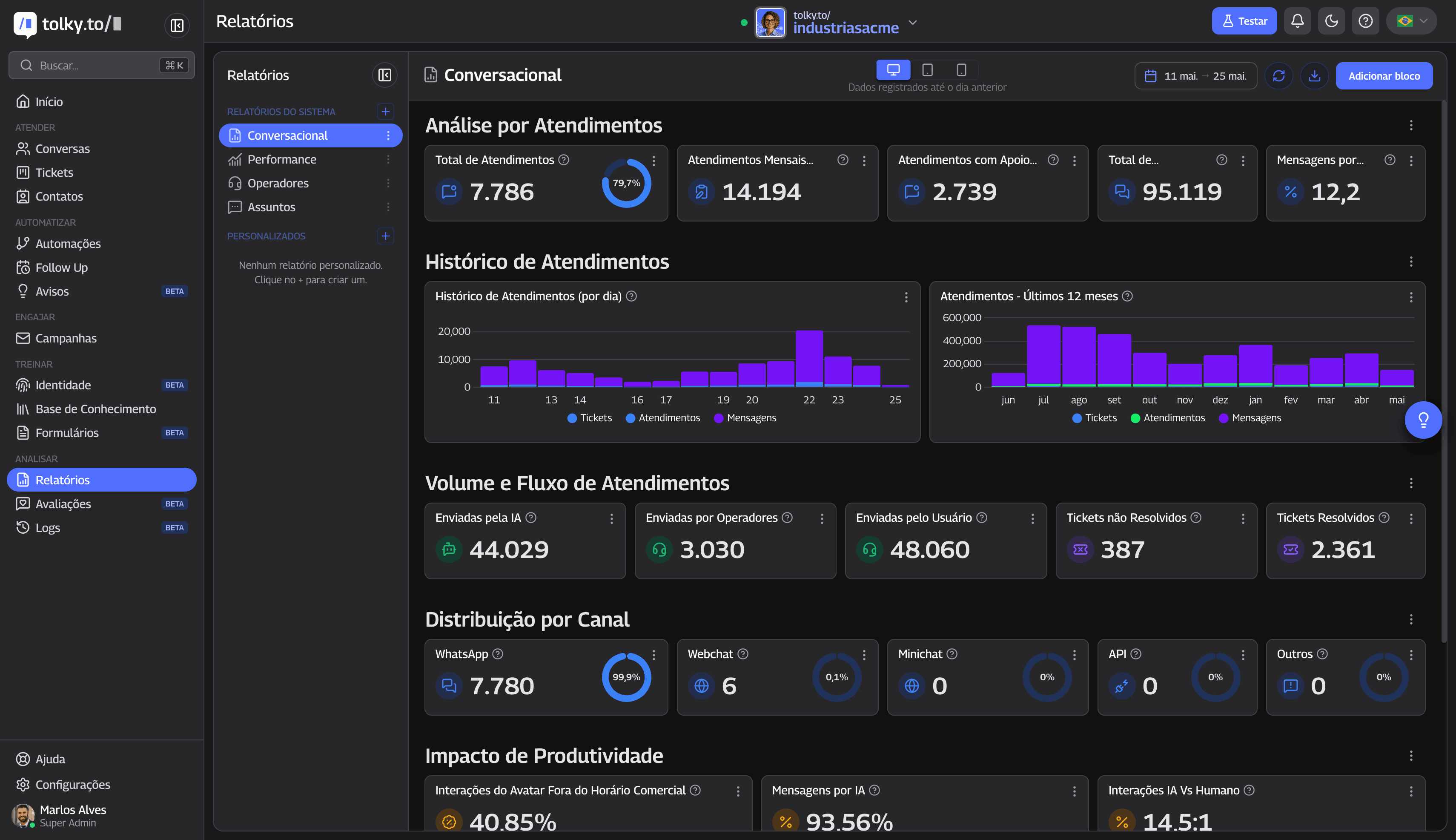
Tolky internal data: in Tolky's customer reports, on average 96.9% of conversations arrive via WhatsApp and 93.56% of messages are sent by AI, at a ratio of 14.5 AI interactions per human interaction. These are figures from Tolky's customer base, not the market at large; the period and sample are not disclosed here.
AI CRM vs Chatbot
The most common confusion is treating AI CRM and chatbot as synonyms. A chatbot answers within a predefined scope; an AI CRM agent queries data, decides, and executes actions in connected systems. The full comparison table and the concept are in Conversational AI is not a chatbot and the 15-minute practical test. Companies that install a chatbot expecting AI CRM results tend to be frustrated: the capabilities are not comparable.
AI CRM Use Cases in B2B Companies
Public sector: scale without marginal cost
CNJ (Brazil's National Council of Justice) implemented a conversational service ecosystem on WhatsApp for queries about court cases, handling demand peaks without increasing service headcount.
Industry: service in a complex operation
Volvo implemented conversational service in its truck aftersales operation, where each ticket has technical complexity and financial impact for the customer: the agent triages cases and brings context to the right technician.
Application hypotheses (illustrative)
The scenarios below are application hypotheses, not results from specific customers:
- Distributor with high inbound lead volume: an SDR agent on WhatsApp tends to raise the consistency of the data collected, which helps measure MQL-to-SQL conversion before and after.
- SME credit fintech: an onboarding agent can collect documents, answer questions, and keep the lead warm, with a goal of reducing process abandonment. The goal and timeline should be set in the pilot.
How to Choose an AI CRM: When Each Path Makes Sense
Compare each path using Tolky's updated profiles, without forcing your operation to adapt to the tool.
| Path | Makes sense when | What to consider |
|---|---|---|
| HubSpot | You already use Smart CRM, Marketing Hub, or Service Hub. | The Breeze Customer Agent uses knowledge sources, can run configured actions and, if authorized, query and update CRM properties. Requires an eligible plan and consumes credits. |
| Salesforce | Sales Cloud and Service Cloud hold your data and processes. | Agentforce runs configured actions, including on records. WhatsApp depends on the edition and messaging features. |
| RD Station | Marketing, CRM, and service already run on the RD ecosystem. | RD Station Conversas offers AI agents for service and qualification, with native CRM integration. |
| Manychat | The focus is flow automation on social and messaging. | Visual flows with AI steps; assess CRM depth. |
| Blip | You need a large-scale service and chatbot platform. | Assess the billing model and integration with your CRM. |
| Tolky | WhatsApp is your main channel and you want CRM, service, and AI in one panel, without buying a whole suite. | Plans based on monthly service allowances. See the plans. |
Evaluation criteria
- Official WhatsApp Business API: ensures deliverability, compliance, and features such as audio, documents, and templates.
- Agents configurable by role: sales and technical support speak differently.
- Integration with the existing CRM: the agent must read (context) and write (update) in your systems. Ask which integrations fit in the plan.
- Management panel for the human team: show what AI handles, what escalated, and what needs attention.
- Traceability (LGPD): every agent action must be auditable (what was said, when, by which agent). Data security is detailed in security and privacy on enterprise AI platforms.
- Availability: WhatsApp service has no business hours. Ask for the availability commitment in writing.
- Implementation time: it depends on the integrations. Ask the vendor for a timeline for your case, and be wary of projects that take many months.
- Transparent cost model: compare allowances, users, and message fees, not just price per user.
If your operation revolves around a specific suite's CRM, the comparisons above help you decide; see them all at /alternativas.
Metrics to Measure AI CRM Performance
Define acceptance criteria before the pilot. Suggested metrics (targets depend on your operation):
AI
- Autonomous resolution rate: interactions resolved by the agent without human intervention. Measure over 30 to 90 days.
- Appropriate escalation: of escalated cases, how many truly needed a human.
- Average resolution time: AI versus your human team, in your operation.
CRM
- Completeness: in the pilot, measure the fill rate of five key fields on AI-handled leads.
- Data freshness: time between the conversation and the record update.
- Fast response: percentage of leads answered within 5 minutes.
Business
- Cost per resolved interaction and CSAT tracked throughout the pilot.
- Automation ROI: (savings generated + additional revenue) / investment.
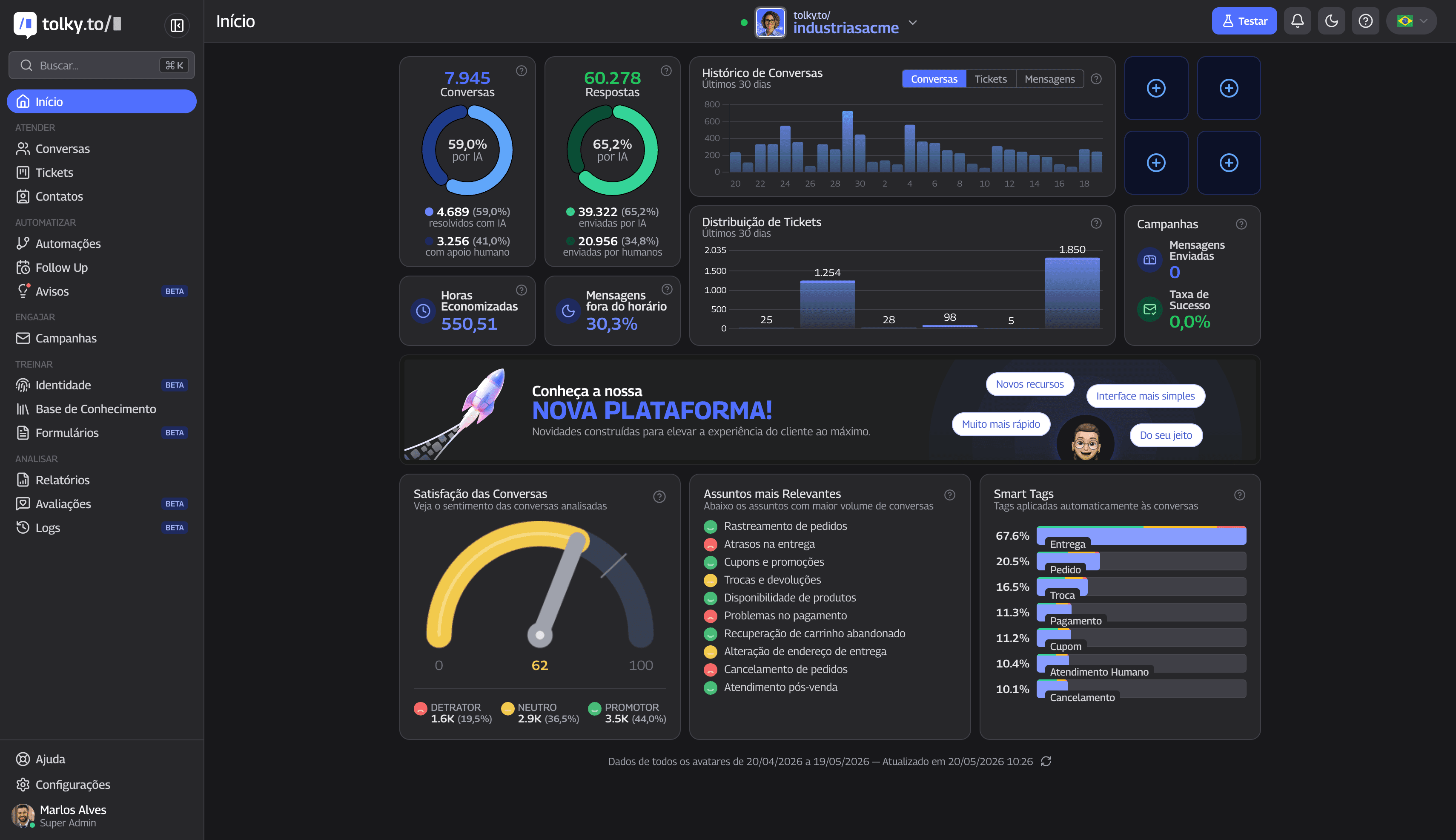
Tolky's dashboard consolidates AI resolution rate, conversation history, ticket distribution, average CSAT, and Smart Tags with the most recurring topics.
How Much Does an AI CRM Cost
Cost varies with volume, number of agents, channels, and integrations. The components are:
| Component | What it covers |
|---|---|
| Platform license | Software, infrastructure, and AI models |
| Onboarding and setup | Agent setup, integration with the existing CRM, initial training |
| WhatsApp Business API | Meta fees, charged separately |
| Support and evolution | Agent tuning, new integrations |
At Tolky, plans are based on monthly service allowances, with a free Individual plan to get started; see prices and allowances at /precos. Meta fees are charged separately.
To estimate return, use a formula with your own assumptions: cost per human service interaction × monthly volume × % resolved by the agent − the platform's monthly allowance fee. Compare against the full stack cost (CRM + service tool + chatbot + team hours), not just a CRM license. The post AI automation ROI details the calculation.
Implementation: What to Expect in the First 90 Days
The timeline depends on the integrations. A typical path:
Days 1-15 (Setup): agents, scope, tone of voice, qualification criteria, and escalation rules; integration with CRM and channels; first tests at controlled volume.
Days 15-45 (Calibration): agents operate under close supervision, with frequent conversation reviews to find knowledge gaps and tune instructions.
Days 45-90 (Scale): with calibrated agents, volume can grow and the human team focuses on cases that require judgment.
From day 90: accumulated data improves qualification and personalization, and cost per interaction tends to fall.
AI CRM and LGPD
Customer conversations are personal data: name, title, company, pains, and needs. The concrete security requirements are in data security and privacy on enterprise AI platforms.
Minimum compliance requirements for an AI CRM:
- Legal basis and consent for collecting and using data in the conversation
- Traceability of which data was collected, when, and by which agent
- Ability to delete a contact's data on request
- Access controls over who sees the conversations
- Access profiles and audit logs (at Tolky, audit logs are in all plans and SSO is on the Enterprise plan)
Special requirements (certifications such as SOC 2, data residency) should be handled in enterprise implementations on request: ask the vendor for the documentation and current policy.
FAQ: Frequently Asked Questions about AI CRM
What does AI CRM mean?
AI CRM is a CRM with artificial intelligence: a platform where AI agents run conversations, qualify leads, update records, and resolve service requests, reducing manual data entry.
What is the difference between AI CRM and traditional CRM?
Traditional CRM stores data that humans enter. AI CRM has agents that act on the company's behalf, run conversations, and update the CRM. The main suites (HubSpot, Salesforce, RD Station) already offer their own AI; see the comparison to decide.
What is the difference between AI CRM and a chatbot?
A chatbot answers within a script. An AI CRM agent has memory of the history, queries integrated systems, decides from context, and executes actions. See Conversational AI is not a chatbot.
Does AI CRM work with WhatsApp?
Yes. For Brazilian companies, WhatsApp is the central channel. Serious platforms operate through the official WhatsApp Business API, with support for audio, documents, and images.
How long does it take to implement an AI CRM?
It depends on integrations and scope. The process includes configuring agents, connecting CRM and channels, and calibrating at controlled volume. Ask the vendor for a timeline for your case.
Does AI CRM replace the sales team?
No. It frees the team from repetitive tasks (basic qualification, routine follow-up, data logging) for complex negotiation and strategic relationships.
Is AI CRM safe for corporate data?
It depends on the vendor. Evaluate action traceability, role-based access controls, and security documentation. Certifications and data residency must be confirmed in writing.
What is the typical ROI of an AI CRM?
There is no universal number. In a Google Cloud and National Research Group study ("ROI of AI 2025", 3,466 executives in 24 countries, Apr-Jun 2025), 74% of executives at companies with generative AI in production reported positive return within a year (The Journal). PagerDuty (April 2025, 1,000 executives at companies with revenue above US$ 500 million) reported an expected average return of 171% from AI agents (BusinessWire). These are separate surveys, and the second measures expectation, not realized results. Use the formula in the cost section with your own assumptions.
Conclusion
The relevant question for B2B companies in 2026 is not "AI CRM, yes or no?" but "which path fits my operation?". For those with WhatsApp as the main channel who want CRM, service, and AI in one panel, Tolky is a starting point: plans based on service allowances, a free plan to begin, and agents configured in natural language.
Internal data: Tolky processes over 5 million messages per month, with more than 67% autonomous resolution.
See the plans, compare with other platforms, or book a demo with your own operation →
Share
Tags
- what is AI CRM
- AI CRM for business
- CRM with artificial intelligence
- AI agent in CRM
- AI CRM vs traditional CRM
- best AI CRM
- AI CRM WhatsApp
- intelligent CRM B2B
Cited in
- How much a conversational CRM costs in Brazil in 2026
- Intercom and Zendesk alternative for WhatsApp support
- Zenvia and Blip alternative: an AI agent for WhatsApp
- Tolky vs Respond.io: which one to choose for support in Brazil
- Tolky vs SleekFlow and Wati: which one to choose on WhatsApp
- Conversational Memory: Your Company Needs to Remember Better
- Conversational AI at Scale: What Powers High-Volume B2B Conversations
- AI CRM: Why the Next CRM Will Be Conversational and Integrated
- Using AI to Scale Chaos: Conversational AI Needs Governance
- Conversational AI Is Not a Chatbot: Why Go Beyond Automated Replies
- WhatsApp Is Not CRM: Why Companies Lose Sales, Data and Relationships
- Customer Experience (CX) Guide 2026: Strategies, Tools and AI
- Conversational AI Integration with Legacy Systems: CRM, ERP, APIs
- What Is Conversational CRM? Omnichannel CRM, Chatbot and AI Compared
- NPS vs CSAT: Differences, Comparison and Which to Choose (2026)
- We launched our new Conversational AI platform for enterprises
- AI Integration with CRM: How AI Agents Power Salesforce and HubSpot
About the author
Marlos Carmo
Founder of Tolky
Marlos Carmo is an AI entrepreneur and founder of Tolky, the conversational-era infrastructure and AI CRM that unifies intelligent service, multi-channel support (such as WhatsApp and voice), live CRM, and operational intelligence in a single ecosystem. He is a finalist for the SXSW Innovation Awards and a member of Francesco's Economy, a global network of young entrepreneurs focused on innovation and social impact. He works connecting Artificial Intelligence and digital transformation in projects for large organizations.
Next step
Want to bring this to your operation?
Tati, Tolky's AI assistant, understands your scenario in a few questions, suggests the best path and connects you with someone from the team, with full context.