Lead Loss on WhatsApp: Why Companies Let Sales Slip in Conversations
Many companies do not have a lead generation problem: they have a WhatsApp service, speed and follow-up problem. See how silent lead loss works and how to structure WhatsApp sales with AI and CRM.

Marlos Carmo
Founder of Tolky
Updated on November 15, 2026
Share
Illustrative scenario: it is 11:23 AM on a Thursday. The company spent $3,500 on paid traffic this week. The website form logged 47 leads. Three of them sent a WhatsApp message asking for a proposal. A fourth came from a referral with real urgency.
By 3:40 PM, only one of those four had received a reply. The other three sat in silence, not because they lost interest, but because the message landed on a shared number used by sales, support, and finance, with no queue, no prioritization, and no owner. On Friday, the hottest lead signed with a competitor who replied in 9 minutes. The marketing report said "47 leads generated, campaign performing well." Nobody counted the sales that slipped away in the conversation.
The numbers are hypothetical, but the pattern is common: companies that invest to generate demand and run WhatsApp as an informal shortcut, with no process, no history, and no structured follow-up.
Your problem may not be generating more leads. It may be serving better the leads that already arrive.
Lead loss on WhatsApp is silent because a lost lead rarely announces it. They don't open a ticket or send a complaint email: they buy elsewhere or give up. This article covers where the funnel leaks, what changes with conversational AI, tickets, and CRM, and how to measure and fix it.

Why WhatsApp became one of the main sales channels
In Brazil, WhatsApp is the most used messaging app, with estimates of roughly 147 to 148 million active users according to Statista, cited by Forbes Brasil and eMarketer, cited by Carta Capital. The customer is already there, and starting a conversation takes almost no effort: a link on the landing page, a QR code, a button in an ad.
Three factors explain the growth of WhatsApp for sales: proximity and continuity (the conversation stays visible and the lead can resume anytime), channel convergence (traffic, inbound, referrals, and events end up in the same chat), and perceived speed (sending a message feels faster than filling out a form). The trouble starts when the company treats the channel as a substitute for process rather than a channel that needs an operation behind it.
WhatsApp can be a sales machine or a hole in the funnel. The difference is the architecture of the operation.
Generating leads is expensive; losing them seems invisible
Marketing knows what each lead costs and leadership demands campaign ROI. But when the opportunity reaches WhatsApp and is lost to delay, missing follow-up, or an ownerless conversation, the cost shows up on no dashboard.
| What the company measures | What the company ignores |
|---|---|
| Clicks and sign-ups | Leads without a reply on WhatsApp |
| Cost per lead (CPL) | Cost per lead lost in the conversation |
| Traffic volume | Conversion rate by channel |
| Campaign performance | Time to first commercial contact |
Investing more in traffic without fixing the leak is raising the pressure in a leaking pipe. Our article on the invisible cost of slow response details how slow replies erode sales before the first proposal.
How leads are lost inside WhatsApp
It is not a lack of market interest; it is operational failure at predictable points:
- Unanswered messages. Nobody sees it in time, or the reply comes the next day, when urgency has cooled.
- Ownerless conversations. On a shared number, each agent assumes someone else will answer.
- Poor handoffs. SDR, closer, and support take turns and context is lost; the customer repeats everything.
- Follow-up that never happens. "I'll get back tomorrow" without a ticket, task, or alert evaporates.
- Commercial leads treated as support. The proposal request waits behind the duplicate-invoice request.
- No funnel record. The conversation never becomes an opportunity and the manager decides blind.
A lost lead rarely announces it.
Each point is avoidable with process, technology, and metrics. None is solved by simply "hiring another salesperson."

Why slow replies reduce buying intent
In WhatsApp sales, speed is conversion. The classic study The Short Life of Online Sales Leads (Harvard Business Review, 2011, Oldroyd, McElheran, and Elkington) shows that many companies are slow to respond to online leads, and that the speed of first contact weighs on the chance of qualifying them. It covers online leads in general, not WhatsApp specifically; treat it as direction, not a number to promise.
In practice, three mechanisms: urgency decays (the problem at 10 AM may be delegated by 4 PM), trust erodes (delay signals disorganization), and competitors act (another vendor has already sent a proposal). Replying in minutes, with AI or a human, does not replace sales quality, but it protects the buying-intent window.
There is also a cost reason to answer well the first time: outside the 24-hour window you can only send an approved template, and since 10/01/2026 Meta also charges per message for service messages. See the WhatsApp cost guide.
Mixing sales, support, and billing on one number
Without triage, three problems appear: opportunities lose priority (a proposal request in the same queue as "where is my invoice?"), the experience becomes inconsistent (sales and billing tones differ), and metrics get distorted ("200 conversations answered," with no idea how many were revenue).
The fix is not opening ten numbers. It is to route, classify, and prioritize in a unified operation, with AI triage, queues by demand type, and escalation to the right team. Our article on omnichannel service shows how to separate demands without fragmenting the experience, and the one on WhatsApp service centers details the structure.
History, follow-up, and improvised controls
Without unified history, every conversation starts from zero. The salesperson asks what the lead already answered, the SDR doesn't know a proposal was sent, and knowledge lives on the agent's phone. History is sales ammunition: a closer who knows the source campaign, the qualification, and the earlier objection starts ahead.
Manual follow-up fails because it depends on memory, has no trigger, doesn't scale, and can't be measured. Structured follow-up combines rules (deadline, channel, owner), automation (reminders), and supervision. One caution: outside the 24-hour window, re-engagement requires an approved template, contact opt-in (a legal basis under privacy law), and each send is charged. Record consent in the re-engagement flow.
| Improvised control | What it seems to solve | What actually happens |
|---|---|---|
| Shared spreadsheet | Visibility | Stale data, no conversation history |
| WhatsApp Business labels | Organization | No funnel, no SLA, no integration |
| Screenshots in internal groups | Communication | Lost context, no audit trail |
| CRM filled in "later" | Record keeping | Pipeline always outdated |
The article WhatsApp is not a CRM explains why treating the app as a management system causes this leak.
A new risk: leads without a phone number
With usernames and BSUID, a lead coming from an ad or a link may reach WhatsApp without a visible phone number. A CRM that matches contacts only by phone duplicates or loses that lead, which is pure lead loss. See BSUID on WhatsApp: what changes.
Conversational AI, automation, and the human moment
Conversational AI does not replace salespeople; it covers the gap between "lead arrived" and "the right human took over with context." At the top of the funnel it can reply in seconds, ask qualification questions (volume, timeline, budget, decision maker), classify the request, record the collected data, and escalate hot leads with a briefing. See Conversational AI is not a chatbot and AI for B2B lead qualification.
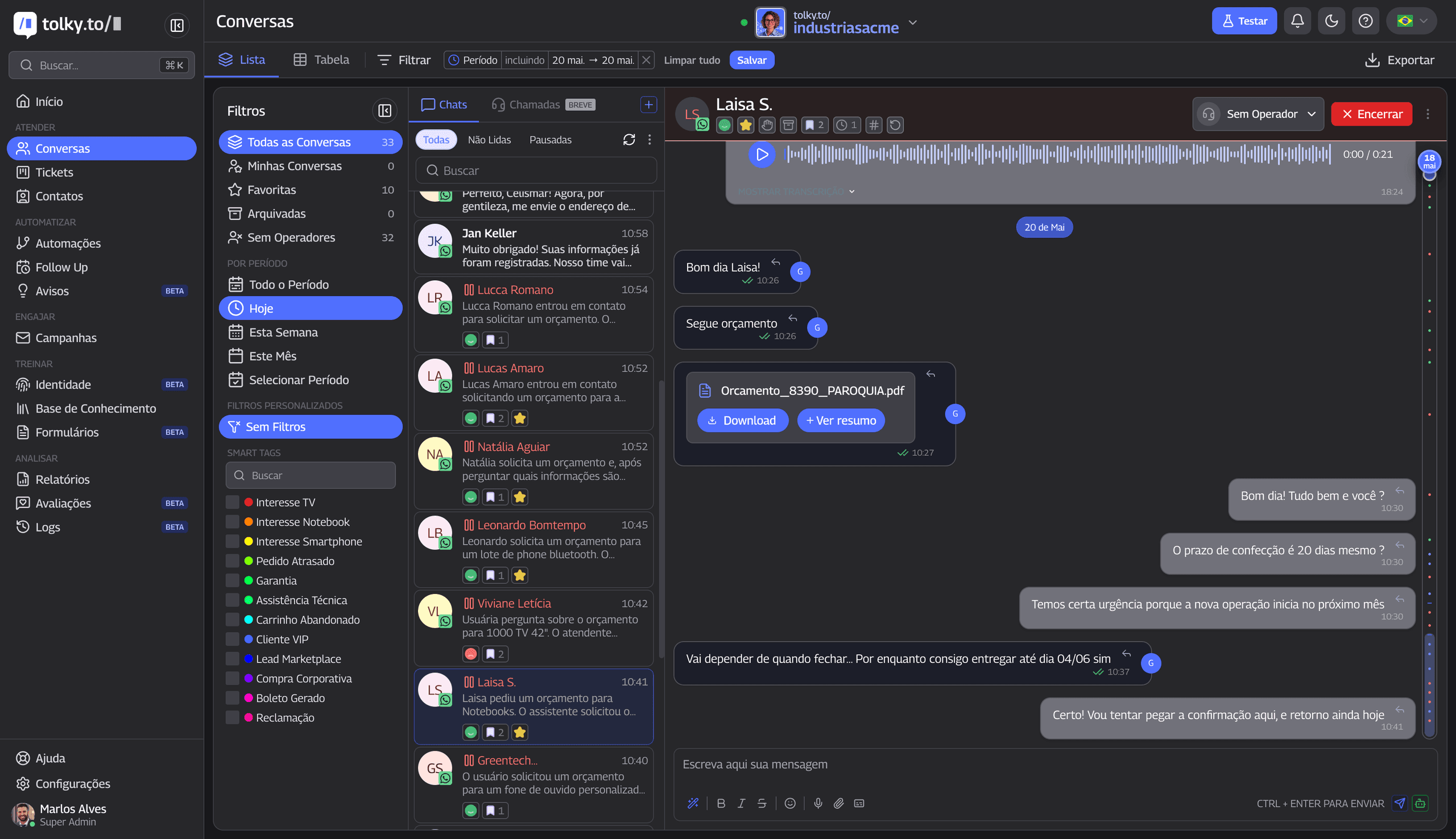
The mature model: automate the repetitive (triage, FAQ, order status, basic data and preferred-time collection) and keep humans for the valuable (negotiation, objections, contracts, relationships). Humanization is not replying slowly: "I see you need a proposal for 80 licenses in two weeks, can I connect you with Ana, who handles accounts this size?" is more human than three hours of silence.
The lead should go to a human when potential value is high, negotiation is complex, urgency is explicit, the objection needs judgment, or the customer asks for a person. Without clear criteria, either everything stays with AI (and hot leads cool) or everything goes to humans (and the team drowns in repetitive work).
Tickets, queues, and integration
Ticket management turns loose conversations into trackable demands with owner, deadline, status, and priority: it separates sales from support without multiplying numbers, applies differentiated SLAs to hot leads, spreads the load, and ensures follow-up with tasks and alerts. The manager sees a queue, not chaos.
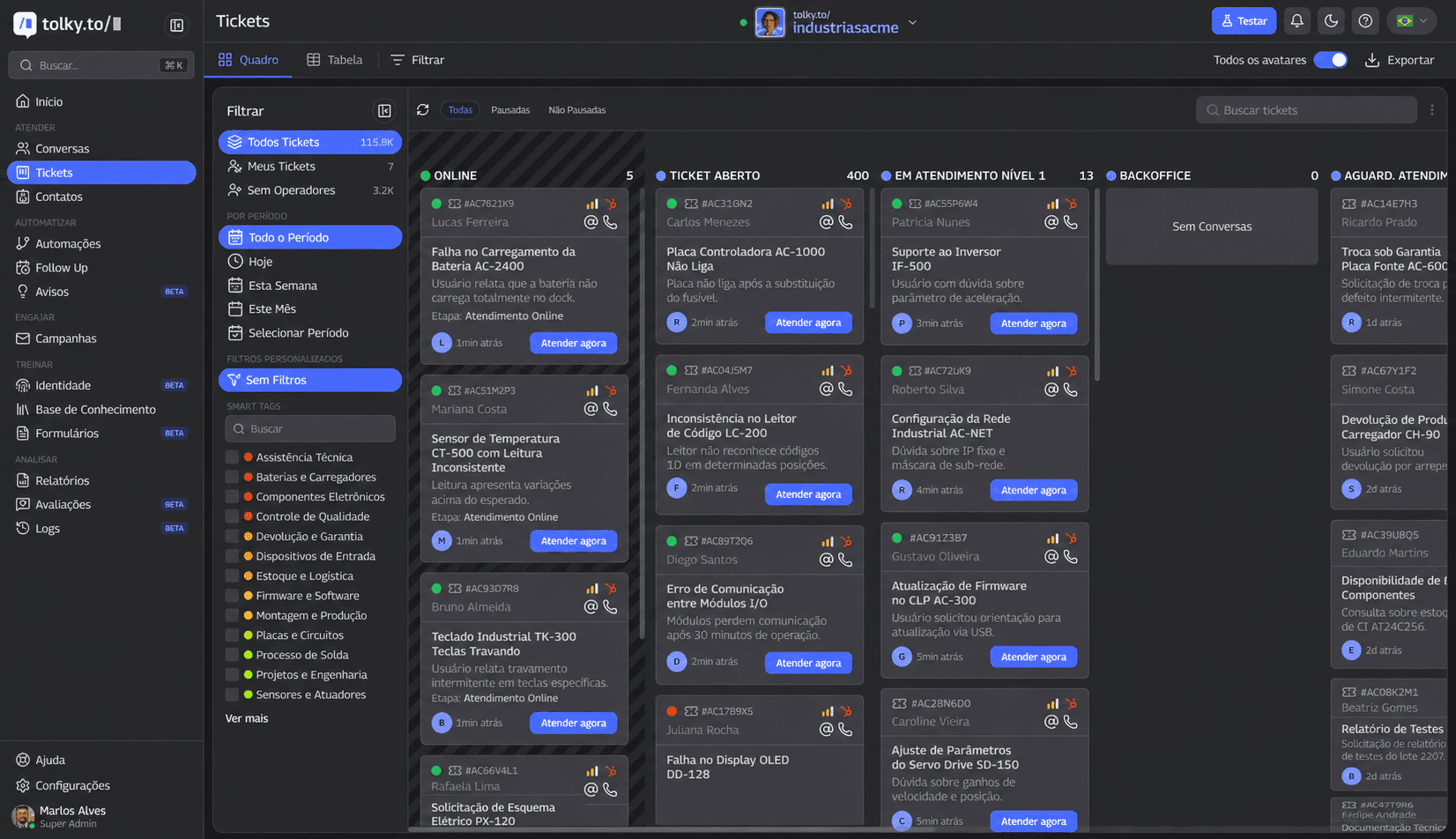
Isolated WhatsApp sales are islands. A mature architecture connects channels (today, WhatsApp, website chat, Microsoft Teams and voice; Instagram and SMS are coming soon), conversational AI, tickets and queues, CRM, campaigns, and internal systems. If a lead fills out the form and then messages, the operation should recognize the same person. How deep the integration with your CRM goes depends on configuration; confirm with the team what applies to your case. See AI and CRM integration.
Diagnosis: is your company losing leads?
First, five questions. If you can't answer most of them, you are probably losing leads and can't tell how many:
- How many leads came in on WhatsApp yesterday?
- How many got a first reply within a few minutes?
- How many became opportunities in the CRM?
- How many went unanswered?
- How many got follow-up on the promised date?
Then run a sample audit: take 30 conversations from the last 7 days and mark the final state, time to first useful reply, and reason for loss. Then track the metrics below.
| Metric | What it measures | Warning sign |
|---|---|---|
| First response time | Minutes to first contact | Conversion window at risk once it reaches hours |
| Unanswered lead rate | % of ignored conversations | Any recurring leak |
| Qualified and handoff rates | Triage efficiency and handoff health | Handoff without context |
| Conversion by channel and source | Lead, opportunity, closed deal | Manager doesn't know lead sources |
| Follow-ups per lead and drop-off rate | Discipline and friction | Follow-up only in memory |
| Loss reasons | Why deals didn't close | No diagnosis, the error repeats |
| Revenue attributed to conversations | Real commercial impact | CRM out of sync with WhatsApp |
Common mistakes: treating WhatsApp as a CRM, using one number for everything, measuring answered messages instead of conversions, handing off leads without context, leaving follow-up to memory, misconfiguring AI (a menu bot that frustrates), ignoring integration, scaling by hiring without process, and not measuring loss reasons. Our article on scaling B2B service with AI adds efficiency metrics.
From disorganized WhatsApp to conversational sales
The roadmap: map the lead journey, define SLAs per demand type, implement AI triage, centralize history, integrate with the CRM, structure follow-up, and measure weekly.
| Dimension | Disorganized WhatsApp | Structured conversational sales |
|---|---|---|
| Speed | Hours or days; depends on who is online | Seconds (AI) or minutes (human with SLA) |
| Organization | Labels, spreadsheets, memory | Funnel with source and status |
| History | Stuck on devices and screenshots | Centralized and auditable |
| Prioritization | Whoever sees it first answers | Queues and SLAs by demand type |
| Qualification | Manual and inconsistent | Conversational AI with defined criteria |
| Follow-up | Salesperson's memory | Rules, tasks, and alerts |
| Handoff | "Pass it to John" with no context | Briefing and full history |
| Reporting | "How many messages we answered" | Conversion, response time, loss reasons |
How Tolky views conversational sales with AI
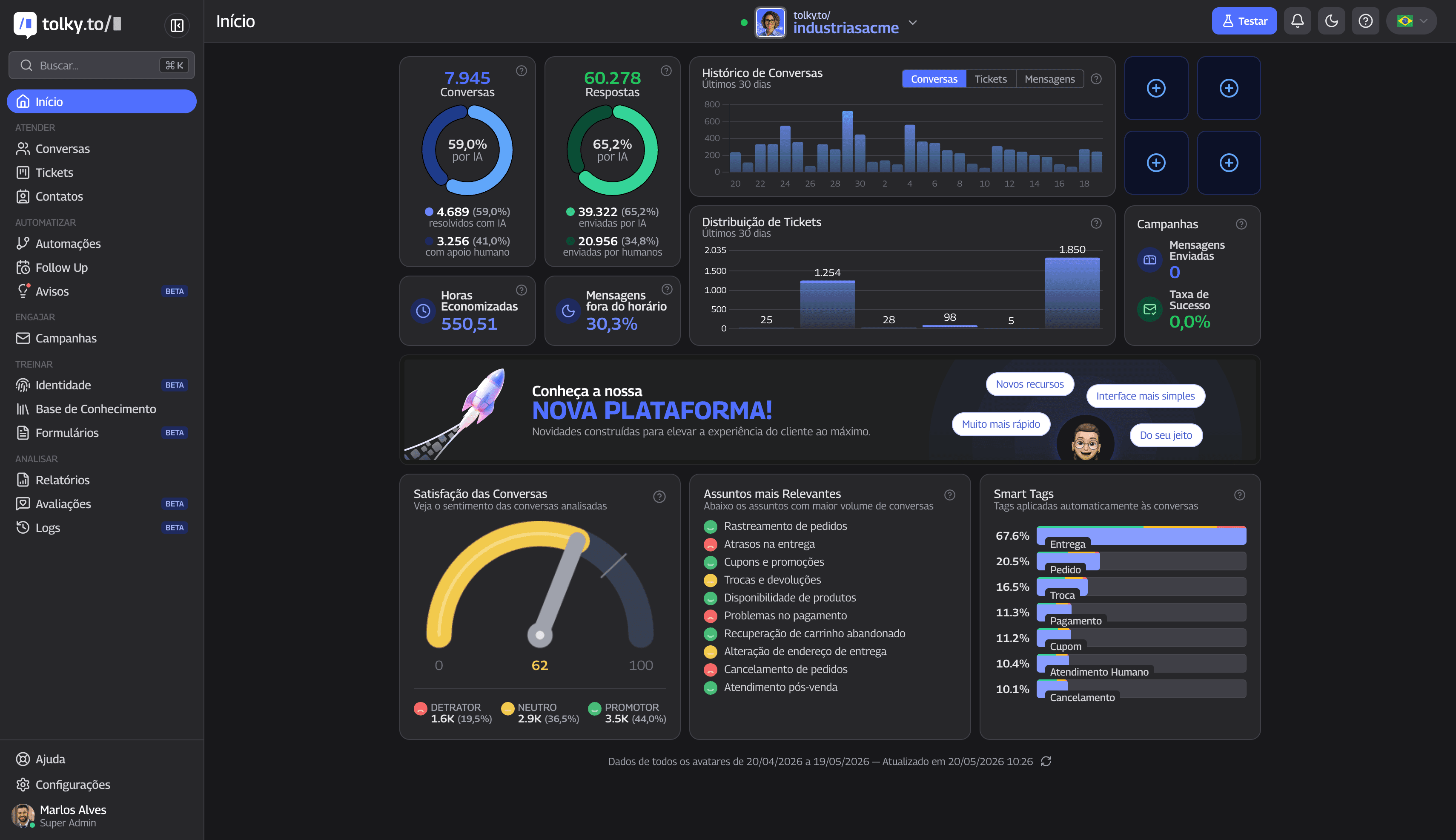
Tolky starts from a simple premise: the customer is already talking. The question is whether the company is ready to turn those conversations into predictable revenue. The platform combines conversational AI for triage and first response, human support with context at handoff, ticket and queue management, automations, reports, and integrations, today on WhatsApp, webchat, Microsoft Teams and voice (Instagram, email, SMS, and voice appear as "coming soon"; see the pricing page and the changelog for current status).
Tolky is not an isolated chatbot and does not aim to replace your CRM: it organizes the conversation, records the data collected, and, depending on the configured integration, feeds your system. The conversational CRM is born from the conversation, not from forms filled in later. To estimate message costs, use the WhatsApp pricing simulator.
Conclusion: fix the leak before paying for more traffic
If your company invests in traffic, inbound, and referrals but still relies on loose conversations, screenshots, and memory to sell on WhatsApp, the problem probably isn't demand generation. It is the operation: speed, qualification, history, follow-up, integration, and metrics.
A lost lead rarely announces it. But the metric does, if you measure.
Talk to the Tolky team about your operation and see where WhatsApp can stop being a bottleneck and become a competitive advantage.
Frequently asked questions
How to sell more on WhatsApp?
Structure the operation before scaling traffic: fast response (AI or human), qualification at entry, commercial prioritization, centralized history, rule-based follow-up, and CRM integration. Selling more means converting the messages that already arrive better.
Why do companies lose leads on WhatsApp?
Slow replies, ownerless conversations, mixing commercial and operational demands, no history, manual follow-up, and no funnel record. The loss is silent: the lead simply buys from someone else.
How to organize leads arriving on WhatsApp?
With triage (AI or rules), queues by demand type, tickets with owner and SLA, qualification at entry, CRM records, and conversion metrics. Organization is not a label; it is process with data.
How can AI help with WhatsApp sales?
By replying in seconds, qualifying with ICP questions, classifying requests, recording collected data, and escalating hot leads with context. AI handles the repetitive; humans close the valuable.
Does WhatsApp automation hurt humanized sales?
Only when poorly implemented. Mature automation speeds up triage and collection; humans step in for negotiation and closing.
How to follow up with leads on WhatsApp?
With deadline rules, tasks, reminders and, outside the 24-hour window, approved templates sent to opted-in contacts (each send is charged by Meta). Structured follow-up depends on a system, not memory.
Can WhatsApp be integrated with a CRM?
Yes, through integration. What is synchronized depends on the configured integration; Tolky records the conversation and the data collected and connects to your CRM as applicable.
Which metrics to track in WhatsApp sales?
Lead volume, first response time, unanswered rate, qualification rate, conversion by channel, follow-ups per lead, loss reasons, and lead sources.
Share
Tags
- whatsapp sales
- lead loss
- whatsapp leads
- whatsapp for sales
- #whatsapp customer service
- #whatsapp crm
- whatsapp automation
- #conversational ai
- lead management
- lead conversion
- sales follow-up
- #omnichannel support
Cited in
- Conversational AI for education: student enrollment on WhatsApp
- Conversational AI for vehicle protection: quotes, claims and billing
- WhatsApp 24-hour window, templates and campaigns without blocks
- AHT, SLA and First Response Time: How to Calculate and Set Targets
- What changed on October 1: a WhatsApp Business cost guide for Brazil
- WhatsApp Is Not CRM: Why Companies Lose Sales, Data and Relationships
- What is omnichannel customer service and why your company needs it now
- AI for B2B Sales: How Agents Qualify Leads and Prioritize the Funnel
About the author
Marlos Carmo
Founder of Tolky
Marlos Carmo is an AI entrepreneur and founder of Tolky, the conversational-era infrastructure and AI CRM that unifies intelligent service, multi-channel support (such as WhatsApp and voice), live CRM, and operational intelligence in a single ecosystem. He is a finalist for the SXSW Innovation Awards and a member of Francesco's Economy, a global network of young entrepreneurs focused on innovation and social impact. He works connecting Artificial Intelligence and digital transformation in projects for large organizations.
Next step
Want to bring this to your operation?
Tati, Tolky's AI assistant, understands your scenario in a few questions, suggests the best path and connects you with someone from the team, with full context.