WhatsApp Is Not CRM: Why Companies Lose Sales, Data and Relationships
WhatsApp is the preferred channel, but treating it as CRM causes lost leads, fragmented history and blind operations. See why a real WhatsApp CRM integrates AI, human support, tickets and systems.

Marlos Carmo
Founder of Tolky
Updated on November 15, 2026
Share
Illustrative scenario: it is 6:47 PM on a Tuesday. A qualified lead messages the company's WhatsApp asking urgently for a proposal. The agent replies warmly, exchanges three voice notes, promises to send the material the next day, and keeps the commitment in her head.
On Wednesday she is off, and the lead follows up. Nobody answers. On Thursday another salesperson takes over the number, asks the customer to repeat the context, and closes with "I'll check internally." The lead disappears. The sales manager never knew the lead existed, and the CRM still shows an empty funnel.
This is the pattern of companies that treat WhatsApp as a CRM, a service desk, an automation tool, and a database all at once. WhatsApp is not the problem: the channel works and the customer is there. The problem is the operating architecture: ownerless conversations, history locked in devices, and decisions made without visibility.

WhatsApp is a channel; CRM is management
In Brazil, WhatsApp became the front door of customer relationships: sales, support, billing, and retention converge in the same conversation. But it was designed for conversation between people, not for sales funnels, SLAs, queues, ERP integration, auditing, or management visibility.
WhatsApp is a channel. CRM is management.
The confusion is understandable: the Business app has labels, quick replies, and a catalog, which looks like management in small operations; replying fast feels like control; and many traditional CRMs were never really adopted, so the channel becomes the real system and the CRM becomes a report nobody trusts.
In 2026 there is one more reason. With WhatsApp usernames and BSUID, the phone number no longer guarantees identity: a contact may arrive with a user identifier and no visible number. That reinforces the thesis: the CRM needs its own customer identity instead of depending on the device number. See BSUID on WhatsApp: what changes.
What a real CRM for WhatsApp needs
"CRM for WhatsApp" became a market label; not everything with that name solves the problem. A serious platform must deliver:
- Connection through the official WhatsApp Business API, not just an app on a phone (there is now also coexistence, where the same number uses the app and the API, with limitations; confirm eligibility)
- Multiple agents, conversation management, and queues
- Unified history per customer, not per device, with BSUID support
- Conversational AI with handoff to humans
- Tickets with status, owner, priority, and SLA
- Funnel and lead management
- Integrations with your systems (CRM, ERP, billing, helpdesk)
- Event-based automations (new lead, inactivity, post-sale)
- Operational and commercial reports, including cost per message category (marketing, utility, authentication, service)
- Governance: permissions, logs, audit, and privacy compliance
- Audio, documents, templates, and campaigns within Meta's rules
Without the official API there is practically no scale, and without integration there is no context, although coexistence now allows a gradual transition. The difference between a shared inbox and a conversational CRM is turning language into data and data into action; the conversational CRM guide goes deeper.
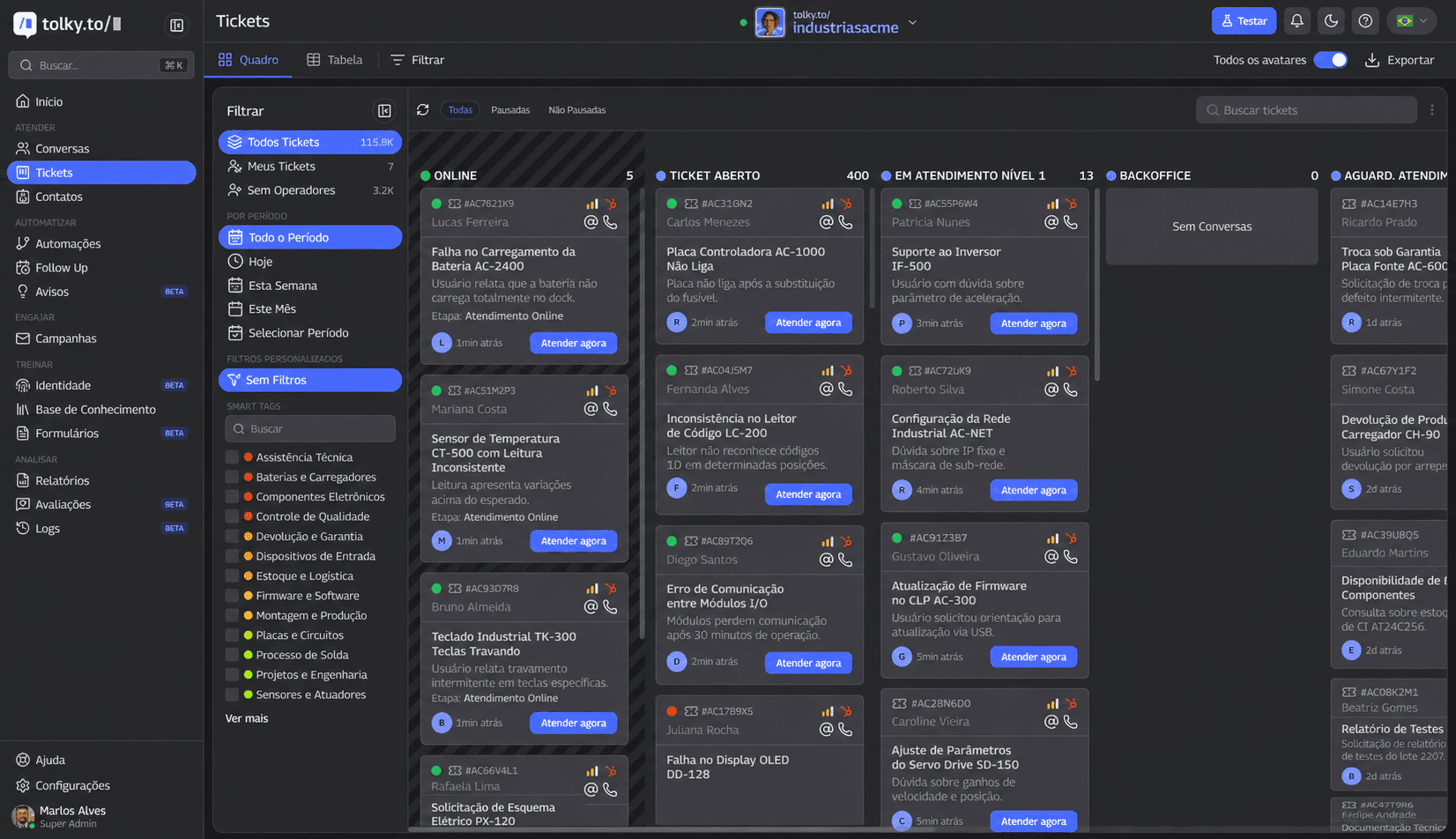
Want to see this structure working without building infrastructure? Talk to the Tolky team.
The problems with using WhatsApp as a CRM
These are structural limits, not app bugs:
- Fragmented history. Conversations on corporate phones, personal backups, and screenshots. When someone leaves, part of the relationship leaves too.
- No ownership. The customer is in limbo between sales, support, and finance.
- Zero management visibility. How many leads came in yesterday? How many got a reply within 5 minutes? How many died without follow-up?
- Rework. The customer repeats tax ID, order, and earlier promise; this erodes trust and lengthens resolution time.
- Legal risk. Without service logs, disputes become "he said, she said"; sensitive data circulates in informal chats.
- Linear scale. Growing means hiring more people to do the same thing by hand.
| Symptom | What it looks like | What it really is |
|---|---|---|
| "We reply fast" | A good operation | No resolution metric |
| "The team knows the customers" | Strong relationships | Dependence on key people |
| "We have labels in Business" | Organization | No funnel or structured data |
| "The CRM exists" | Control | A system parallel to the real operation |
A lost lead rarely announces it. They just stop replying. The critical points: slow first response, handoff without context, follow-up without a task, conversations with no record, and several numbers without shared history. See also lead loss on WhatsApp.

Example: the lead that changes salesperson
| Item | WhatsApp as CRM | Structured conversational operation |
|---|---|---|
| Contact | Number on the phone of whoever answered | Customer record, independent of the device number |
| Owner | "Whoever saw it first" | Defined owner; changes are logged |
| Stage | In the salesperson's memory | Recorded in the ticket or funnel |
| History | Stuck on a colleague's device | Conversation, attachments, and notes visible to the new owner |
| Next action | "I'll check" | Task with deadline and alert |
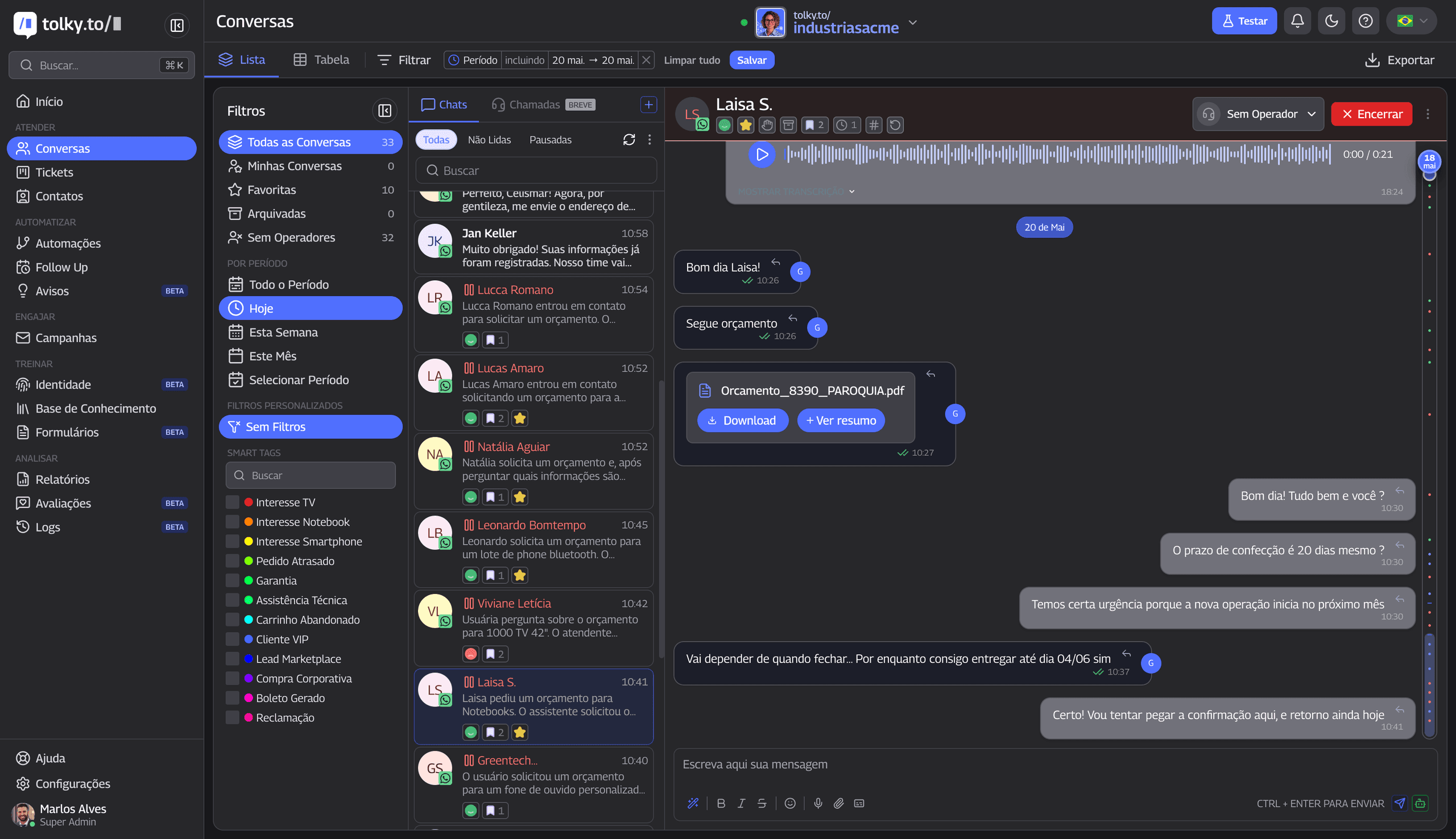
Without context, humanized service becomes a canned phrase. Humanizing is not using the customer's name; it is remembering the context: who the customer is, what they bought, what was promised, whether there is an open ticket or an ongoing opportunity.
Spreadsheets, screenshots, and manual controls
A lead spreadsheet updated "when possible," an internal group with screenshots, a CRM fed on Fridays, sticky notes: they work like a bandage and don't heal the fracture. Spreadsheets don't talk to the channel, screenshots can't be audited, process in people's heads doesn't scale, and stale data leads to wrong decisions.
If the conversation lives on one person's phone, the relationship doesn't belong to the company.
Mature operations replace manual control with centralized conversation management: messages become records, records become metrics, and metrics become continuous improvement.
Conversational AI and automation without losing the human
Conversational AI is not a menu chatbot: it understands natural language, queries systems, and takes actions within business rules. In practice it replies instantly (including at night, qualifying, collecting data and preferred time so the human team can follow up), does triage by intent, resolves repetitive cases (order status, duplicate invoice, FAQ), and records the conversation and the data collected; updating fields and stages in external CRMs depends on the configured integration. To understand the difference from a rigid chatbot, see conversational AI vs. traditional chatbot.
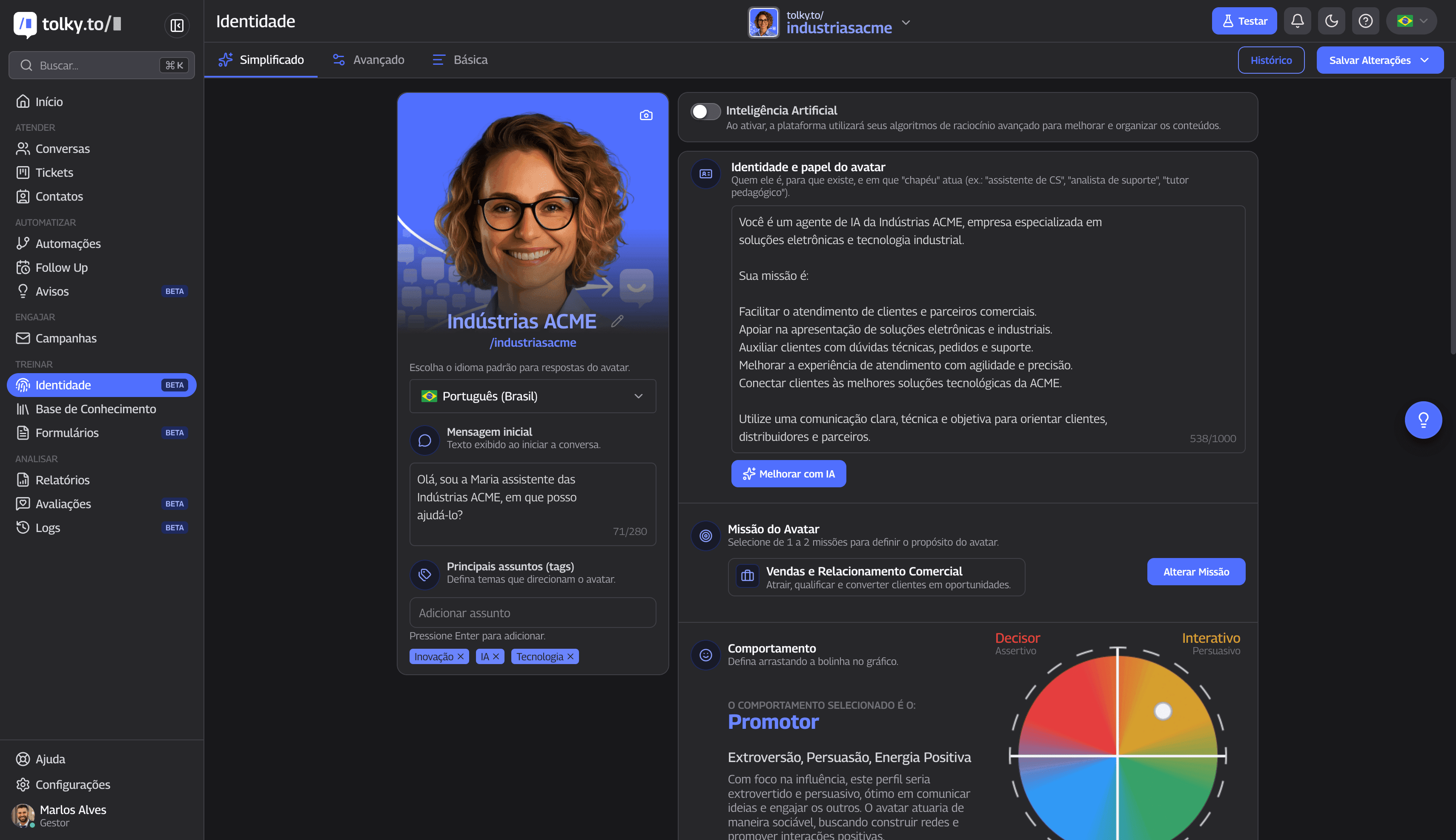
Good automation doesn't replace care. It replaces disorganization.
Automate: welcome messages, data collection, criteria-based qualification, repetitive answers, follow-up reminders, and SLA escalation. Don't automate blindly: sensitive negotiation, retention of at-risk customers, commercial exceptions, emotional situations, and regulatory topics without supervision. When the AI detects low confidence, frustration, or complexity, the conversation goes to a person with the full history. No AI eliminates the risk of error, which is why the knowledge base and supervision matter.
Integration: WhatsApp, website, tickets, CRM, and systems
WhatsApp alone is an island. Customers don't think in channels, they think about getting things solved, and a modern operation connects:
| Layer | Function |
|---|---|
| Channels | WhatsApp, webchat, Microsoft Teams and voice today; Instagram, email and SMS appear as "coming soon" |
| Conversational engine | AI, humans, queues, and SLA |
| Ticket management | Protocol, priority, status, escalation |
| CRM | Lead, opportunity, history, pipeline (your CRM, integrated) |
| Internal systems | ERP, billing, helpdesk, logistics, depending on the integration |
| Analytics | Volume, conversion, CSAT, deflection |
Before: the customer asks for an invoice, the agent asks for the tax ID, checks another system, and returns 20 minutes later. After: the AI identifies the customer, queries the integrated billing system, sends the duplicate in seconds, and logs the ticket; a human steps in only for exceptions.
Also read the omnichannel service guide and AI and CRM integration.
Metrics and common mistakes
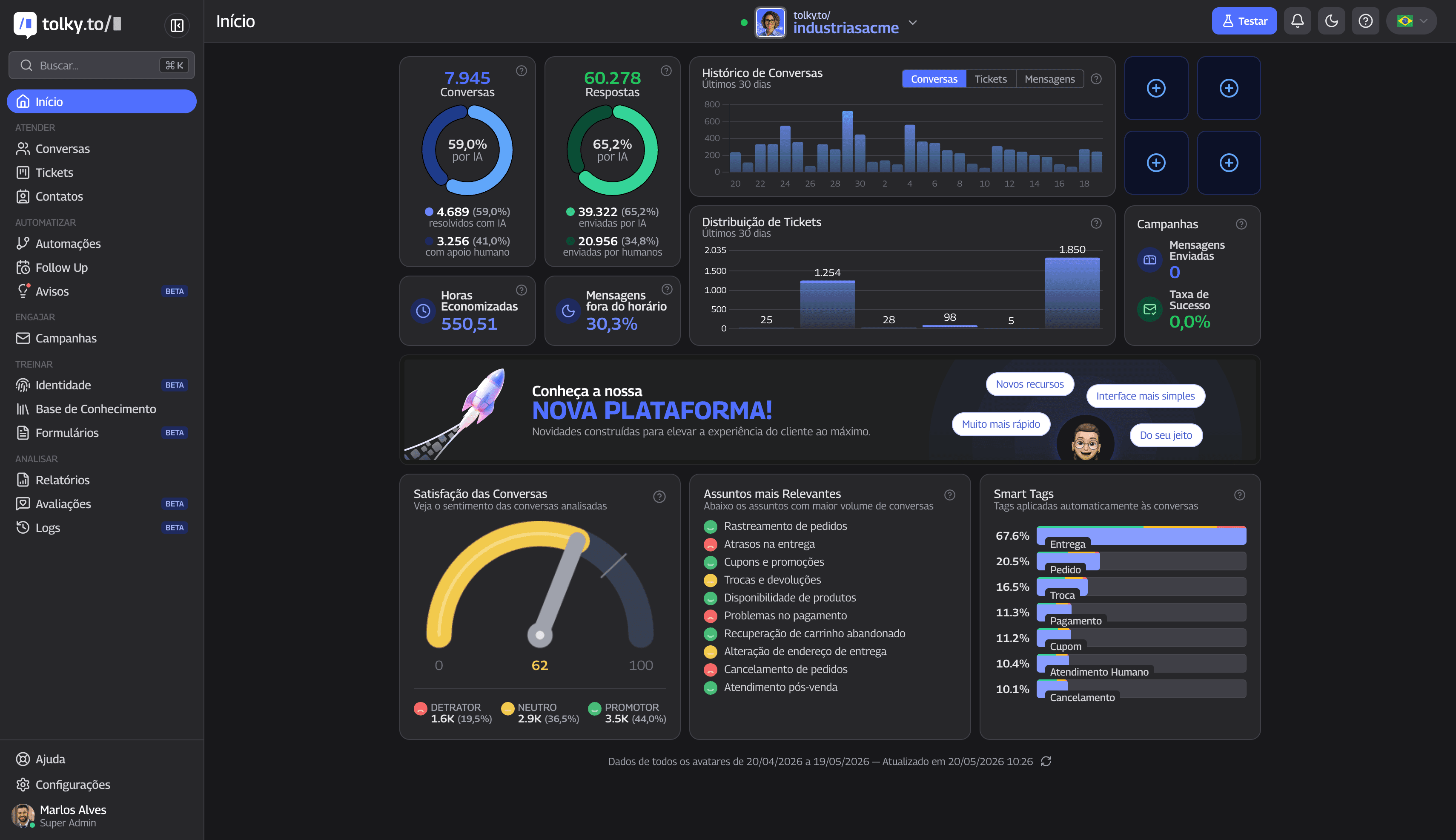
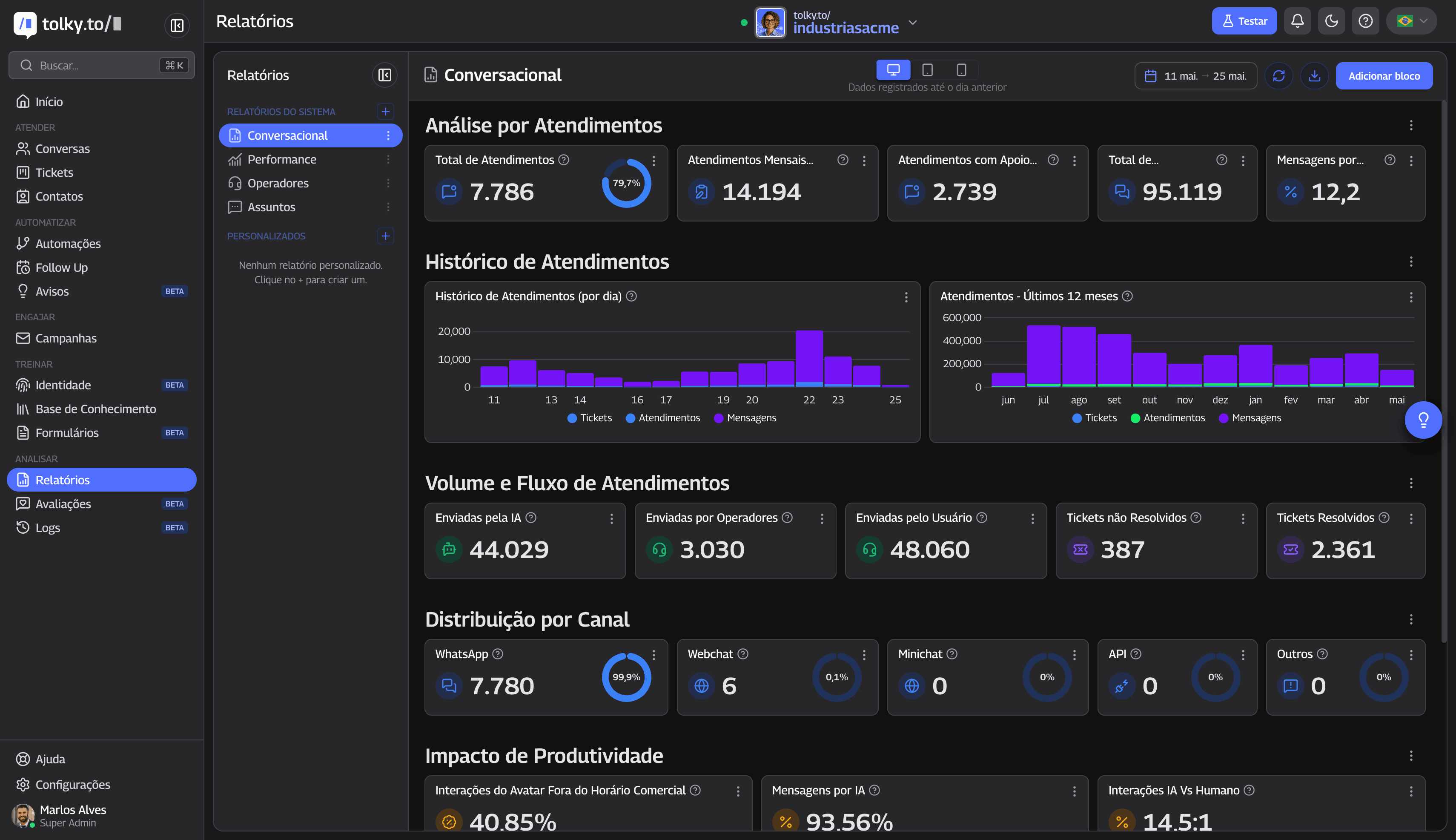
A mature conversational operation is measured: speed (first response, resolution time), quality (first-contact resolution, CSAT/NPS, recontact), commercial (lead-to-opportunity conversion, follow-ups completed, revenue influenced by WhatsApp), and efficiency (AI deflection, cost per resolved conversation, team occupancy).
Frequent mistakes when choosing a solution: buying a "shared inbox" thinking it is a CRM; starting on the app and postponing migration (see WhatsApp as a service center); automating with a rigid chatbot; ignoring integration; using AI without governance; tracking vanity metrics ("messages answered"); and leaving the channel on "the sales number" with no owner or SLA.
How Tolky sees customer relationships
Tolky starts from a simple premise: conversation is the infrastructure of the relationship. The future belongs to operations where customers talk on their preferred channel, AI resolves, qualifies, and records, humans step in with context and authority, and managers see everything in real time.
Tolky does not replace your CRM: it organizes the conversation, the AI, and the tickets, records the data collected, and, depending on the configured integration, sends it to the system you already use. That is the idea behind AI CRM and the conversational CRM: the conversation becomes data, not the other way around. Today the active channels are WhatsApp, webchat, Microsoft Teams and voice; the others appear as "coming soon" on the pricing page.
The future is not abandoning WhatsApp. It is to stop improvising on top of it.
Conclusion: turn conversations into operation
If your company already sells, serves, or bills through WhatsApp, you don't have a channel problem, you have an architecture problem. WhatsApp is excellent for opening the door; a CRM for WhatsApp keeps that door from becoming a dead end.
Final question: if your best salesperson leaves tomorrow, how much of the customer relationship stays in the company?
Talk to the Tolky team about the maturity of your operation and where WhatsApp can stop being a bottleneck and become a competitive advantage.
Frequently asked questions
Can WhatsApp be used as a CRM?
Not completely. It is a messaging channel, with no structured funnel, governance, management metrics, or history independent of people. Labels help organize conversations but don't replace a CRM for WhatsApp integrated into the operation.
What is the difference between WhatsApp Business and a CRM for WhatsApp?
The WhatsApp Business app is a communication tool for small operations. A CRM for WhatsApp connects the official API to queues, AI, tickets, automations, reports, and internal systems. The first delivers messages; the second delivers management.
How to avoid losing leads on WhatsApp?
With fast response (human or AI), qualification at entry, every conversation recorded in the funnel, and follow-up with a task and a defined owner. Leads are lost more for lack of process than lack of interest.
Can AI serve customers on WhatsApp?
Yes, in triage, FAQ, order status, and lead qualification, escalating complex cases to humans with context. The ideal model combines AI with human supervision where judgment is critical.
How to keep service humanized while using automation?
Automate collection, triage, and repetitive cases; keep humans for negotiation, exceptions, and sensitive moments. Humanization is context plus empathy, and context comes from integrated history.
What does a conversational AI platform need to integrate?
At least CRM, tickets, knowledge base, and channels. In mature operations, also ERP, billing, and BI. Without integration, AI is a sophisticated chat with no real action.
When should a company stop relying on manual WhatsApp?
When there is more than one agent per number, leads lost to delay, customers repeating information, managers without visibility, or dependence on key people. As a reference (not a rule), this tends to appear between 30 and 100 conversations a day, depending on the segment.
How to measure whether WhatsApp service is working?
Track first response time, resolution rate, CSAT, lead-to-opportunity conversion, follow-ups completed, AI deflection, and cost per resolved conversation. If you only measure "messages answered," you measure activity, not results.
Share
Tags
- #whatsapp crm
- whatsapp for business
- whatsapp sales
- #whatsapp customer service
- #conversational ai
- conversation management
- #ai crm
- #omnichannel support
Cited in
- Gupshup, BSUID, and usernames: what BSPs like Gupshup are doing
- Conversational AI at Scale: What Powers High-Volume B2B Conversations
- AI Governance in Customer Service: Scale Conversations with Control
- Using AI to Scale Chaos: Conversational AI Needs Governance
- Lead Loss on WhatsApp: Why Companies Let Sales Slip in Conversations
- The Hidden Cost of Slow Response: How Delays Hurt Sales and Operations
- What is omnichannel customer service and why your company needs it now
- BSUID and WhatsApp Usernames: What Has Changed and What to Do Now
About the author
Marlos Carmo
Founder of Tolky
Marlos Carmo is an AI entrepreneur and founder of Tolky, the conversational-era infrastructure and AI CRM that unifies intelligent service, multi-channel support (such as WhatsApp and voice), live CRM, and operational intelligence in a single ecosystem. He is a finalist for the SXSW Innovation Awards and a member of Francesco's Economy, a global network of young entrepreneurs focused on innovation and social impact. He works connecting Artificial Intelligence and digital transformation in projects for large organizations.
Next step
Want to bring this to your operation?
Tati, Tolky's AI assistant, understands your scenario in a few questions, suggests the best path and connects you with someone from the team, with full context.