Lead response SLA: the agreement that protects your agency
Lead response SLA: what lead response time to agree on with the client, how to measure it without screenshots, how to cover after hours and how to put it in the contract.
TL;DR
A lead response SLA is the written agreement between agency and client on how fast leads get a first reply, a follow-up and a handoff to sales, with a target and an agreed way to measure it. It separates media results from customer service results and protects the agency when the client's sales team is slow. Measure on the platform, not with screenshots, and cover after hours with an AI agent.
Share
The agency delivers a lead at 9:00 p.m. on a Friday. The client replies Monday morning, the lead has already bought from a competitor, and at the end of the month the report says the campaign "brought no sales". Without a written agreement, the blame for the lost sale lands back on the media.
This post explains what a lead response SLA is, which targets to set, how to measure without relying on the client's screenshots, how to cover after hours and how to bring the agreement into the agency's contract and report.
Updated in November 2026.
What is a lead response SLA?
A lead response SLA is the agreement between the agency and the client that defines how quickly each lead gets a first reply, a follow-up and a salesperson, with a compliance target and an agreed way to measure it. It is a specific case of the customer service SLA, applied to the stretch between the click and the sale.


It answers the question every performance agency has heard: "why didn't the campaign sell?". With an SLA, the answer stops being opinion. If the lead got a reply on time and did not buy, the problem may be the offer or the audience; if they waited a day, the problem is customer service. What that wait costs the business is detailed in the hidden cost of slow customer service.
Which targets should the SLA include?
A useful lead SLA has few metrics: time to first reply, follow-up with leads who went quiet, handoff to sales and CRM records, each with a target, the hours it applies to and a measurement source. Anything more becomes a spreadsheet nobody reads.
The model below is illustrative: the targets are a starting point for the conversation with the client, not a market standard.
| Metric | Target (illustrative example) | How to measure |
|---|---|---|
| Time to first reply, business hours | 90% of leads within 5 min | Time of the lead's message and of the first useful reply, on the platform |
| Time to first reply, after hours | 90% of leads within 5 min, with an AI agent | Same measurement, filtered by hour |
| Follow-up with leads who went quiet | First follow-up within 24 h | Date of the lead's last message and of the follow-up |
| Handoff to sales | Qualified lead with a salesperson within 30 min | Time of the transfer recorded in the conversation |
| CRM records | 100% of leads with source and stage | Contacts with no source or stage in the period |
Two measurement rules. An automatic "we got your message" reply does not count as a first reply, because it resets the clock without helping anyone. And use the compliance rate and the median, not just the average, as the guide to AHT, SLA and first response time explains.
How do you measure without relying on the client's screenshots?
Measure on the platform where the conversations happen, with read access for the agency, not with screenshots sent at the end of the month. A screenshot shows the conversation the client chose to show; the platform shows all of them.
Three conditions make the measurement reliable:
- One source. WhatsApp, webchat and other channels recorded in the same place, with the time of each message.
- Agency access. A read-only profile for whoever builds the report, without depending on someone on the client side to export data.
- Written definitions. What counts as a first reply, what business hours are and when a lead counts as qualified.
The core metric is first response time. When it gets worse, the effect shows up in sales before it shows up in the media, as the guide lead not responding on WhatsApp shows.
How do you cover after hours with an AI agent?
The simplest way to meet the SLA at night and on weekends is an AI agent that replies right away, asks the qualification questions and leaves the lead ready for a salesperson on the next shift. Ads keep running after hours; customer service needs to keep up.


In Tolky, the conversational AI CRM, the agent answers through the official WhatsApp API and webchat, records the conversation on the contact and does the human handoff with the full history when the lead asks or when the sale needs negotiation. The time of each message, transfer and closing stays in the conversation itself, and the reports show, among other data, how the AI performs outside business hours. See the WhatsApp customer service solution.
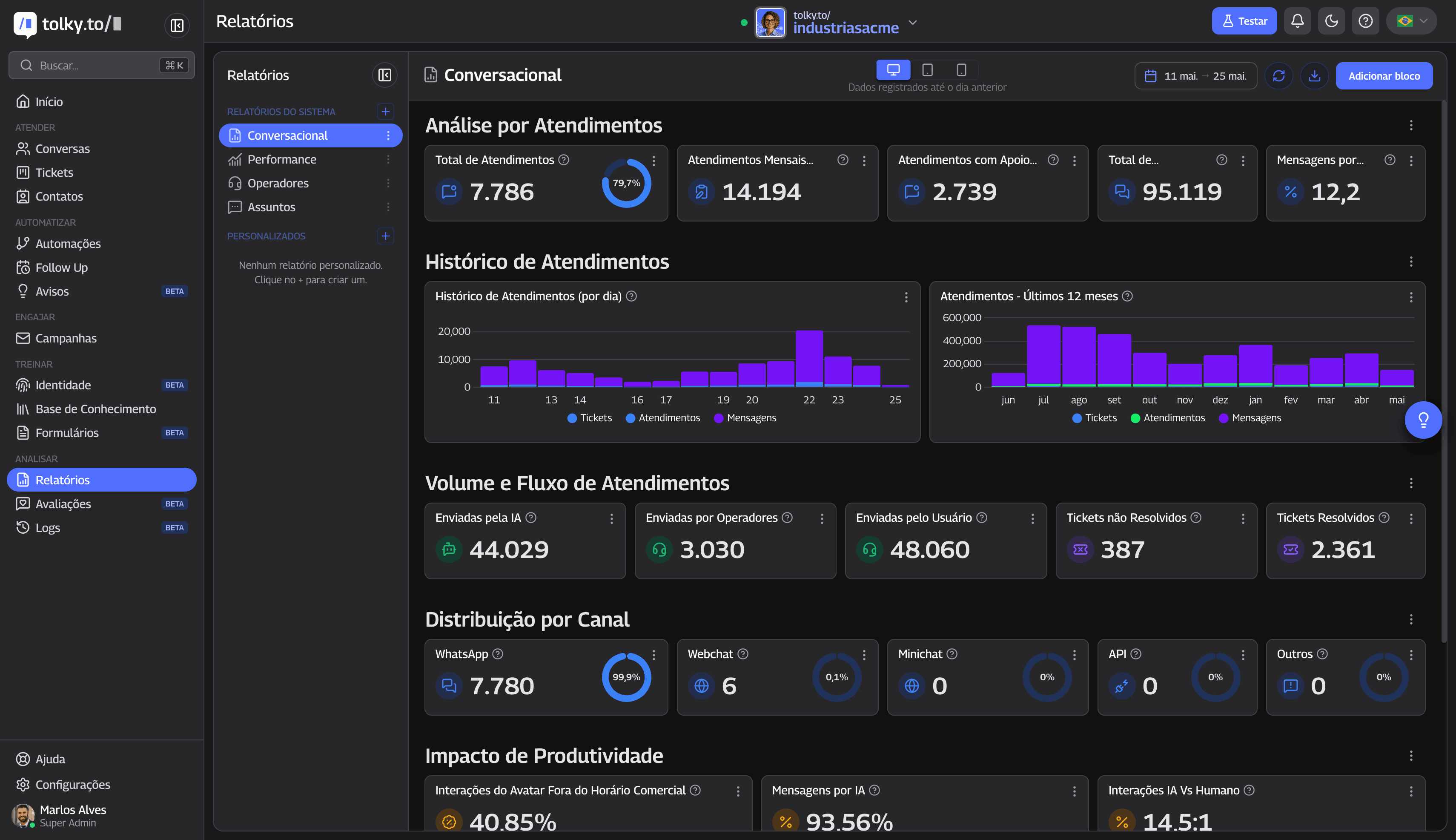
The platform does not set the target for you: targets and measurement rules are a decision for the agency and the client. Confirm in a demo which reports cover the agreed SLA before promising a dashboard.
How do you put the SLA in the contract and the report?
The SLA goes into the contract as a responsibilities appendix, with metrics, targets, data source and an agreed consequence, and comes back every month in the report as a line next to the media results. The consequence does not have to be a penalty; often it is just making clear how missing the SLA affects how results are read.
| Clause | What to write |
|---|---|
| Scope | Which channels and campaigns the SLA covers |
| Metrics and targets | The items in the previous table, with the hours they apply to |
| Data source | Customer service platform and CRM, with read access for the agency |
| Responsibilities | What belongs to the agency (media, pre-filled message, report) and to the client (reply, follow-up, records) |
| Review | Monthly meeting with the numbers and quarterly target adjustments |
| Consequence | How missing the SLA factors into the campaign's evaluation |
In the report, place SLA compliance next to cost per lead and sales. When the sale is tied to the campaign, the post on Meta offline conversions shows how to close the funnel.
What does this change for your agency?
With a written SLA, the agency no longer answers for the sale alone and is judged on the part it controls, which lowers the risk of losing the account over a customer service problem. In practice:
- Renewals backed by data. The discussion moves from "the campaign didn't sell" to "at which stage did the lead stop".
- A new service. A response audit and SLA monitoring can go into the package, as the guide to an agency retainer with AI shows.
- A solution conversation. When the client misses the SLA, the agency can refer a platform with an AI agent instead of just complaining about the delay.
Frequently asked questions
What is a good lead response time?
There is no universal number, but the direction is clear: the sooner the first reply, the better the odds of qualifying. On WhatsApp, replying within minutes catches the interest and keeps the 24-hour window open for free-form messages.
What should a lead response SLA include?
Metrics (first reply, follow-up, handoff to sales, CRM records), a compliance target, the hours it applies to, a data source and each side's responsibilities. Without an agreed data source, the SLA turns into a screenshot argument.
Can the agency penalize the client for missing the SLA?
It can, if the contract says so, but the more common use is different: making clear how missing the SLA affects the campaign's evaluation. The goal is to protect how results are read, not to fine the client.
How do you meet the SLA outside business hours?
With an AI agent that replies right away, qualifies and leaves the lead ready for the next shift's salesperson. Clients who do not have that yet can pause or reduce ad delivery during unstaffed hours.
Conclusion
A lead response SLA is the agreement that separates media results from customer service results. Set a few metrics, measure them on the platform, cover after hours with an AI agent and bring compliance into the contract and the report; an agency that does this discusses renewal with data, not screenshots.
Your agency can deliver this with Tolky
The Tolky Partner Program is for agencies that want to bring AI agents, CRM and WhatsApp campaigns to their own client base, with recurring revenue. If the client misses the SLA and your agency does not want to run customer service, the Referral track is the way in: you introduce Tolky and register the opportunity, the Tolky team sells, signs and serves the client, and the agency earns a recurring commission for 12 months. Training and certification are free for program companies, and the Solution and White-label tracks stay open for when the agency wants to implement.
Explore the Partner Program → Let's talk?
Share
Tags
- lead response time
- lead response sla
- customer service sla
- marketing agency sla
- first response time
- #speed to lead
- agency contract
- #conversational CRM
About the author

Co-founder of Tolky
Marlos Carmo is an AI entrepreneur and founder of Tolky, the conversational-era infrastructure and AI CRM that unifies intelligent service, multi-channel support (such as WhatsApp and voice), live CRM, and operational intelligence in a single ecosystem. He is a finalist for the SXSW Innovation Awards and a member of Francesco's Economy, a global network of young entrepreneurs focused on innovation and social impact. He works connecting Artificial Intelligence and digital transformation in projects for large organizations.
Next step
Want to bring this to your operation?
Tati, Tolky's AI assistant, understands your scenario in a few questions, suggests the best path and connects you with someone from the team, with full context.
Share