Meta offline conversions: how to prove a WhatsApp lead bought
Meta offline conversions and the Conversions API for Business Messaging: what ctwa_clid is, how to link a click-to-WhatsApp ad to the sale and what the agency reports.
TL;DR
Offline conversions are sales that happen outside the website and are sent to Meta to tie the ad to the result. For click-to-WhatsApp ads, Meta offers the Conversions API for Business Messaging: the platform stores the ctwa_clid that arrives with the first message and sends it back when the sale happens. Without it, the agency can still link ad and sale through a CRM stage and a pre-filled message per campaign.
Share
The agency's report ends at "conversation started". The client, across the table, wants to know how much was sold. Between those two numbers sits a stretch the media cannot see: the WhatsApp conversation, the proposal, the payment. That is where the renewal gets decided.
This guide is for agency leaders who need to answer that question with data, not estimates. It explains what offline conversions are at Meta, how the Conversions API for Business Messaging works, what ctwa_clid is, the three ways to link ad and sale and what to put in the report. Every Meta rule was checked against the official documentation on November 20, 2026.
Updated in November 2026.
What are offline conversions at Meta?
Offline conversions are sales events that happen outside the website or app, such as in a store, over the phone or in a conversation, and that the business sends to Meta to tie the result to the ad. With that data, Ads Manager stops showing only clicks and conversations and starts showing sales.
According to Meta's offline events documentation, the Conversions API is now the recommended method for sending offline and physical store events. The old Offline Conversions API appears on the same page as Meta's legacy API for offline events, and the guidance is to upload transactions within 62 days of the conversion.


For a click-to-WhatsApp ad, though, there is a more precise path than uploading store sales: the Conversions API for Business Messaging, which ties the sale to the specific click that opened the conversation.
What is the Conversions API for Business Messaging?
The Conversions API for Business Messaging is the official way to send Meta the events that happen inside a conversation started by an ad, such as a qualified lead or a purchase. According to Meta's documentation, it helps understand and improve the performance of ads that click to WhatsApp, Messenger or Instagram Direct.
What the documentation sets out, in short:
- Who integrates: Business Messaging Partners, on behalf of their clients, with specific permissions such as
whatsapp_business_manage_events. On WhatsApp, the dataset is created from the WhatsApp Business Account (WABA). - How the event arrives: with
action_sourceset tobusiness_messagingandmessaging_channelset towhatsapp. - Which events: the list includes Purchase, LeadSubmitted, QualifiedLead, InitiateCheckout, AddToCart, ViewContent, OrderCreated, OrderShipped, OrderDelivered, OrderCanceled, OrderReturned, CartAbandoned, RatingProvided and ReviewProvided.
- Optimization: purchase optimization is available for ads that click to WhatsApp and Messenger; not yet for Instagram.
- What stays out: website or app conversions should go through the web or app Conversions API, and Meta does not deduplicate these events, so that falls on the sender.
What does Meta send with the first message (ctwa_clid)?
When the conversation comes from a click-to-WhatsApp ad, the first message reaches the platform with a referral object that includes ctwa_clid, an identifier unique to each click. The Conversions API for Business Messaging documentation defines ctwa_clid as a personal identifier, unique per click, exposed to the business when the conversation originates from an ad, and says to store it with the conversation and send it when the conversion happens.
In Meta's own sample payload, the referral object carries these fields:
| Field | What it is, in Meta's sample | What it does for attribution |
|---|---|---|
ctwa_clid | Unique identifier of the ad click | It is what ties the sale event to the click |
source_id | Identifier of the source | Tells which ad opened the conversation |
source_type | Type of source (ad in the sample) | Separates ad conversations from the rest |
source_url | Link to the source | Lets you check the ad manually |
headline and body | The ad's headline and text | Gives context to whoever answers |
Without ctwa_clid, the documentation offers a WhatsApp-only fallback using hashed customer data (email or phone). It has stated limits: matching is not guaranteed, it attributes events to ad interactions from the past seven days and it is only available in a subset of countries. ctwa_clid is not subject to those limits, according to the same page.
The practical point for the agency: ctwa_clid is only useful if the platform receiving the client's conversations stores it. The ad can be perfect; if the identifier is lost on the way in, linking it to the sale depends on another path.
How do you link the ad to the sale?
There are three ways to link a click-to-WhatsApp ad to the sale: a CRM stage with the source recorded, a campaign code in the pre-filled message and an integration that stores ctwa_clid and sends events to Meta. They are not mutually exclusive; many agencies start with the first and grow into the third.


| Path | How it works | Precision | Effort | Goes back to Meta? |
|---|---|---|---|---|
| CRM stage | Source recorded on the contact and sale marked in the pipeline | Medium: depends on who records it | Low | No, it stays in the report |
| Code in the pre-filled message | Each campaign has its own pre-filled message, and the source is read in the conversation | Medium: per campaign, not per ad | Low | No, it stays in the report |
| Conversions API integration | Platform stores ctwa_clid and sends Purchase or QualifiedLead | High: per click | High: messaging partner, permissions and development | Yes, and it enables campaign optimization |
CRM stage. The AI agent or the salesperson tags the contact's source when the conversation starts, and the sale becomes a stage in the sales funnel. It is simple and already changes the report, but it depends on the client team's discipline.
Code in the pre-filled message. A different pre-filled message per campaign ("I saw the ad for the annual plan") leaves the source written in the conversation itself. The guide to click-to-WhatsApp ads shows how to customize that text.
Integration. It is the only path that sends the sale back to Meta at the click level and feeds campaign optimization. It requires a platform that stores ctwa_clid, messaging partner access and someone to build and maintain the sending, via webhook or API.
What should the client report show?
The report that protects the account shows the whole funnel, from spend to revenue, and does not stop at cost per conversation. Each line comes from a different source, and it is worth stating in the report where each number came from.
- Spend and conversations started, from Ads Manager.
- Conversations answered and time to first reply, from the customer service platform. This is where leads lost to delay show up, the subject of the guide lead not responding on WhatsApp.
- Qualified leads, from the CRM, with the qualification criteria written down.
- Opportunities and sales, from the CRM, by campaign when the source is recorded.
- Cost per qualified lead and cost per sale, calculated: spend divided by qualified leads and by sales in the period.
To turn that into return, the guide to measuring the ROI of AI automation shows how to separate the effect of the media from the effect of customer service.
Where does Tolky fit, and what does it not do?
Tolky, the conversational AI CRM, answers the ad lead through the official WhatsApp API, qualifies with the AI agent and records contact, opportunity and pipeline stage in the WhatsApp CRM, which is where the sale gets counted. That puts the CRM stage and the per-campaign pre-filled message paths in the same place where the conversation happens.
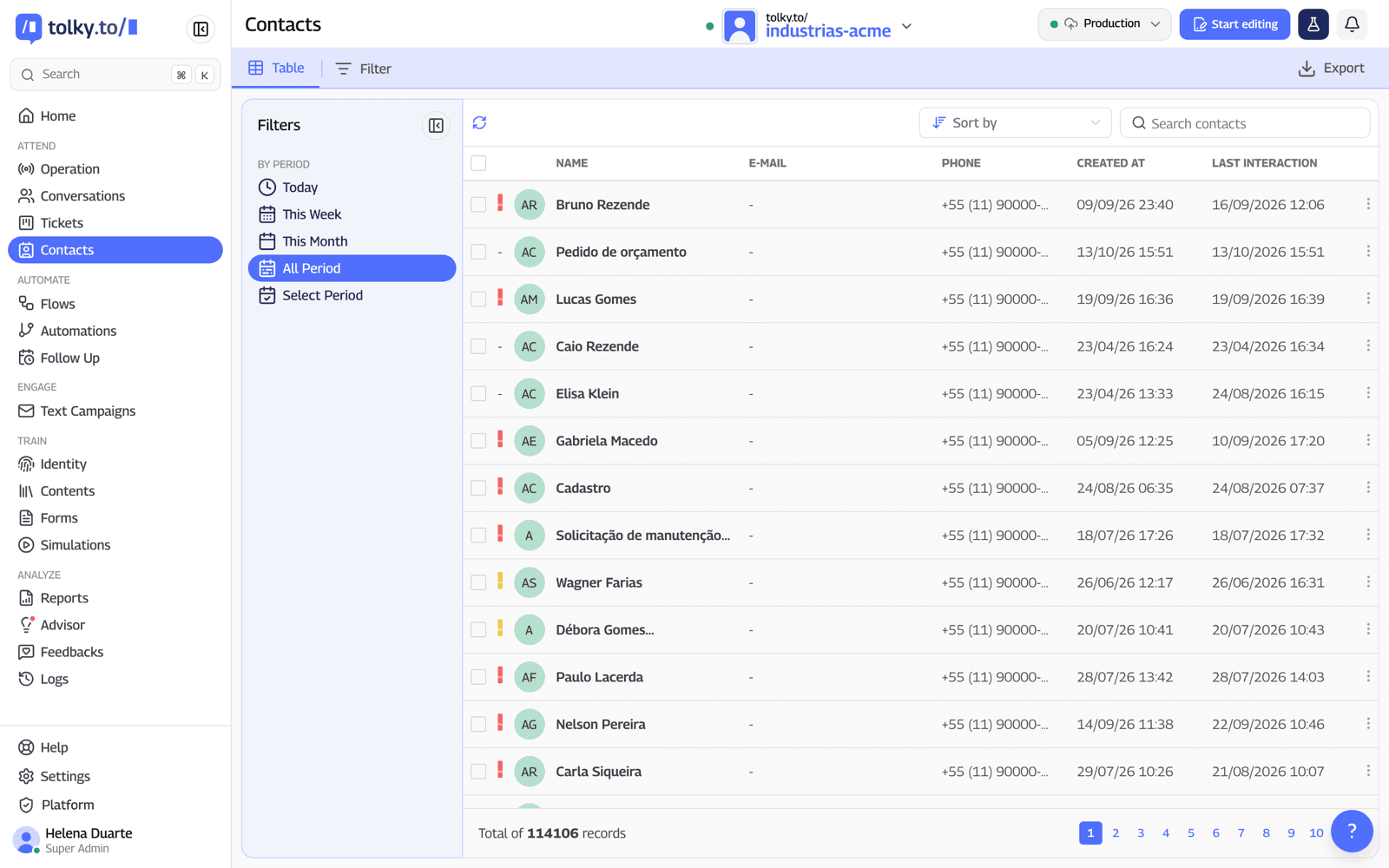
To send data to other systems, Tolky offers a REST API, webhooks, HTTP requests and MCP tools in Flows, a native HubSpot integration and more than 1,000 apps through the Integration node; the list is on integrations.
What Tolky does not do: it does not store the ad of origin or the ctwa_clid of a click-to-WhatsApp lead, so it does not send click-level conversion events to Meta on its own. A custom integration through the API and webhooks can take the CRM's sale stage to another system; if per-ad attribution is a buying criterion for your client, confirm in a demo what is feasible in their case.
What does this change for your agency?
An agency that links ad and sale stops being judged on cost per conversation and starts being judged on the revenue it generated, which changes the renewal and the size of the retainer. In practice:
- Sell a measurement project. Mapping the source, defining the sale stage in the CRM and building the report is a deliverable with a clear beginning, middle and end.
- Put record-keeping in the contract. If the sale depends on the client's team marking the stage, it goes into the agreement, along with the lead response SLA.
- Separate what the media controls from what customer service controls. A funnel report shows where the result was lost, without blaming the campaign.
- Charge for the recurrence. Measurement that repeats every month fits a recurring package, as the guide to an agency retainer with AI shows.
Frequently asked questions
What are offline conversions in Meta Ads?
They are sales or events that happen outside the website and app, such as in a store, over the phone or in a conversation, and that the business sends to Meta to tie to the ad. According to Meta's documentation, the Conversions API is the recommended method for sending these events.
Is there a conversions API for WhatsApp?
Yes. The Conversions API for Business Messaging receives events that happen inside conversations started by ads that click to WhatsApp, Messenger and Instagram Direct. The integration is done by a Business Messaging Partner with specific Meta permissions.
What is ctwa_clid?
It is an identifier unique to each click that Meta sends with the first message when the conversation comes from a click-to-WhatsApp ad. The platform stores that code and sends it back to Meta with the sale event.
How do you track sales that happen on WhatsApp?
Record each contact's source and the sale as a CRM stage, use a different pre-filled message per campaign and, when possible, integrate the platform with the Conversions API for Business Messaging. The first two paths already change the report; the third sends the sale back to Meta.
Does Tolky send conversions to Meta?
Not natively: Tolky does not store the ad of origin or the ctwa_clid. It records contact, opportunity and sale stage in the CRM, and a custom integration through the API and webhooks can be assessed in a demo.
Conclusion
Proving that a WhatsApp lead bought depends less on the media and more on what happens to the data after the click. With a sale stage in the CRM and a pre-filled message per campaign, the agency already brings revenue into the report; with an integration that stores ctwa_clid and uses the Conversions API for Business Messaging, it sends the sale back to Meta and helps the campaign optimize.
Your agency can deliver this with Tolky
The Tolky Partner Program is for agencies that want to bring AI agents, CRM and WhatsApp campaigns to their own client base, with recurring revenue. If your agency wants to focus on media and measurement without running customer service, the Referral track is the way in: you introduce Tolky and register the opportunity, the Tolky team sells, signs and serves the client, and the agency earns a recurring commission for 12 months. Training and certification are free for program companies, and the Solution and White-label tracks stay open for when the agency wants to implement.
Explore the Partner Program → Let's talk?
Share
Tags
- meta ads offline conversions
- whatsapp conversions api
- track whatsapp sales
- conversions api business messaging
- ctwa_clid
- #click to whatsapp ads
- sales attribution
- #conversational CRM
About the author

Co-founder of Tolky
Marlos Carmo is an AI entrepreneur and founder of Tolky, the conversational-era infrastructure and AI CRM that unifies intelligent service, multi-channel support (such as WhatsApp and voice), live CRM, and operational intelligence in a single ecosystem. He is a finalist for the SXSW Innovation Awards and a member of Francesco's Economy, a global network of young entrepreneurs focused on innovation and social impact. He works connecting Artificial Intelligence and digital transformation in projects for large organizations.
Next step
Want to bring this to your operation?
Tati, Tolky's AI assistant, understands your scenario in a few questions, suggests the best path and connects you with someone from the team, with full context.
Share