White-label software reselling: refer, resell or run your own brand
White-label software reselling for agencies: the three partnership models (referral, reselling and white label), who bills and supports in each one and what to ask before you sign.
TL;DR
In white-label software reselling, the agency sells another vendor's software under its own brand, sets the final price and bills the client. It's one of three partnership models: with referral, the agency only introduces the vendor; with reselling under the vendor's brand, it sells and implements; with white label, it also owns the brand, the billing and first-line support. The choice depends on how much of the relationship the agency wants to carry.
Share
Your agency recommends tools to clients every day. The CRM they use, the WhatsApp platform, the scheduling system: a lot of it entered their operation because someone at the agency said it was the best option. The agency made the sale, helped set it up and, when something breaks, still picks up the phone.
And it earns nothing from it. All the recurring revenue from that recommendation goes to the vendor, who doesn't always remember who brought the client in. Software reselling, with or without white label, turns that influence into revenue and a long-term relationship.
Updated November 2026.
What is white-label software reselling?
White-label software reselling is the model in which an agency sells another vendor's software under its own brand, domain and price, and bills the client directly. The vendor builds, hosts and maintains the technology; the agency handles the brand, the sale, the implementation and first-line support.
"White label" refers to a product with no visible brand that the reseller labels as its own. In software as a service (SaaS), this means the end client signs in through the agency's login screen and never sees the vendor's name.
Not all reselling is white label. Many partner programs let the agency sell and implement under the vendor's brand, and some only pay for referrals. All three models coexist in the market, and each one suits a different kind of agency.
Referral, reselling and white label: the three partnership models
Software partnerships with agencies fall into three models: referral, where the agency only introduces the vendor; reselling under the vendor's brand, where it sells and implements; and white label, where it runs the software as its own product. What changes from one to the next is how much of the relationship stays with the agency.


- Referral. The agency introduces the vendor, registers the deal and steps aside. The vendor sells, contracts and serves. The agency earns a commission, usually recurring for a period. It's the model with the least effort and the least control.
- Reselling under the vendor's brand. The agency sells and implements the software, which keeps the vendor's brand, and charges for its own implementation and operation services. There's usually a partner discount or terms. The agency gets a role in the project, but the brand the client sees is the vendor's.
- White label. The agency runs the software under its own brand and domain, sets the final price, bills and handles tier-1 support. The vendor disappears from the client's view. It's the model with the most control and the most responsibility.
To see how white label works in two specific products, read the guides to the white-label AI agent and the white-label CRM with WhatsApp.
Who bills, who supports and whose brand is it?
In referral, the vendor does almost everything; in reselling under the vendor's brand, the agency sells and implements, but the vendor bills for the software; in white label, the agency does everything the client sees. The matrix below follows the same split of roles as the Tolky Partner Program.
| Role | Referral | Reselling under the vendor's brand | White label |
|---|---|---|---|
| Who refers | Agency | Agency | Agency |
| Who sells | Vendor | Agency | Agency |
| Who implements | Vendor | Agency | Agency |
| Who bills for the software | Vendor | Vendor; the agency bills for its own services | Agency |
| Brand the client sees | Vendor's | Vendor's, with a partner badge | Agency's |
| First-line support | Vendor | Agency or vendor, per the contract | Agency |
| How the agency earns | Recurring commission for a period | Partner terms on the software plus service revenue | Partner pricing; the agency sets the final price |
One point weighs more than it seems: who bills for the software. When the agency sends the invoice, it controls the price, the adjustments and the timing of renewal. When the vendor bills, the agency depends on the conversation between the two.
Which model fits which agency?
Referral fits an agency that doesn't want to implement, reselling under the vendor's brand fits an agency that already has an implementation team, and white label fits an agency that wants software as a product line. The client base and the team decide more than the agency's size.
- Paid media and performance agency. The team is focused on media and doesn't want to handle implementation. Referral keeps the agency in charge of media and earning recurring revenue from the client it brought in.
- Digital marketing agency with an operations team. It already sets up CRMs, automations and reports for clients. Reselling under the vendor's brand puts that team to work and adds service revenue.
- AI or automation agency. It wants its own product, often after building agents by hand. White label takes the technology weight off and leaves the brand and the price with the agency. The full path is in AI agency: what it is and how to start one.
- Sales or customer service consultancy. It designs the client's process and wants the tool to follow that design. Reselling or white label, depending on whether it wants to bill for the software.
Nothing stops you from starting with one model and switching later. A common path is to refer first, learn from the first clients and move to reselling when the volume justifies a team.
What does this change for your agency?
Software reselling turns recommendations that are free today into recurring revenue and puts the agency at the center of the client's operation. The practical effects show up in four places.
- Revenue that doesn't depend on a new contract. The software runs every month, and earnings come with it while the client uses it.
- A new service for the current client base. Implementation, operation and reporting become proposal items, charged separately from the media or content retainer. Pricing is covered in how much to charge for a WhatsApp AI agent.
- Retention through operation. When the agency implements and runs the tool the client uses every day, switching agencies comes at a cost for the client.
- A stronger sales pitch. Arriving with a ready, certified solution carries more weight than arriving with a recommendation. How to build the sale is in how to sell AI agents to businesses.
What should you ask before signing a partnership contract?
Before signing, ask who bills, who supports, how the deal is protected, what happens to the data and how earnings change over time. The answers show whether the vendor treats the agency as a channel or as a competitor.


| Question | Why it matters |
|---|---|
| How do I register a deal, and for how long is it mine? | Avoids competing for the same client with the vendor's sales team |
| Can the vendor offer a different price to a client I registered? | Shows whether there is channel conflict |
| Who handles tier 1 and tier 2 support, and with which history? | Defines the size of the team the agency needs |
| Who owns the client's data, and what is my role under privacy law? | The agency usually acts as a processor, with a data processing agreement |
| Does white label include domain, login, system emails and webchat? | Branding only in the dashboard leaks the vendor's name |
| How do my earnings change with volume and time? | Shows whether the program rewards growth |
| Is there training and certification for my team? | Shortens the time to the first live client |
| Can I switch partnership models later? | Lets you start small without getting locked in |
Reselling software has tax and business registration effects (business activity, invoicing, taxation) that vary case by case. Before billing software under the agency's brand, talk to your accountant.
To compare the public terms of other programs on the market, see the best partner programs for agencies.
How to start reselling software without stalling operations
The safest path is to start with a pilot client, certify the people who will sell and implement, and only then take the offer to the entire client base.
- Pick the pilot client that feels the problem the software solves the most, such as the one losing leads on WhatsApp.
- Certify the team that will sell and implement before the first proposal.
- Write the proposal separating software, implementation and operation.
- Measure the pilot's results and turn them into a case for the client base.
- Review the model every quarter: move from referral to reselling, or from reselling to white label, when the volume calls for it.
Where Tolky fits in software reselling
Tolky, a conversational AI CRM with AI agents, CRM and campaigns on the official WhatsApp API, runs a Partner Program with all three tracks: Referral, Solution and White-label. Partners choose a track when they join and can switch at the quarterly review; referral and reselling don't stack on the same client.
- Referral: the agency registers the deal, and the Tolky team sells, contracts and serves. Recurring commission for 12 months.
- Solution: the agency sells, implements and supports under the Tolky brand and charges for its own services. A discount that grows with your level.
- White-label: the agency runs the platform under its own brand and domain, sets the final price and bills its clients. It builds on the "Your brand and domain" feature of the Enterprise plan.
The Certified, Advanced and Strategic levels are reviewed every quarter. The first partner to register a company gets 90 days of preference in that deal, and Tolky's sales team doesn't offer a different price to a client registered by a partner. Earnings are shared on the fit call. The plans end clients buy are on pricing, and integrations on integrations.
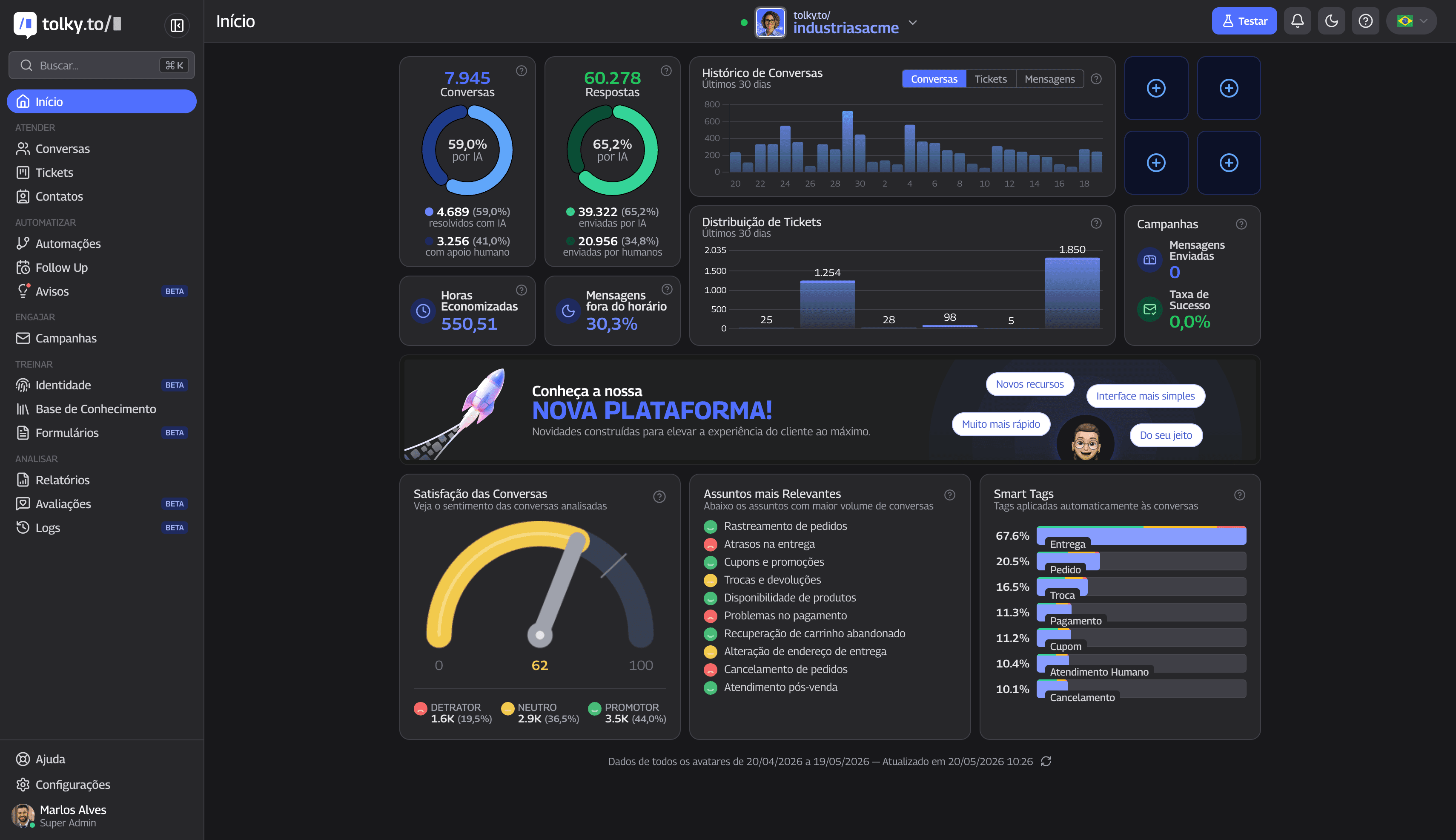
The screen above is the dashboard each client sees; on the White-label track, the agency enters every account with one login. Who is behind Tolky is on the about page.
Frequently asked questions
What is white-label software reselling?
It's the model in which an agency sells another vendor's software under its own brand and domain, sets the final price and bills the client. The vendor handles the technology, and the agency handles the brand, the sale and first-line support.
What's the difference between referral, reselling and white label?
With referral, the agency only introduces the vendor and earns a commission. With reselling under the vendor's brand, the agency sells and implements and charges for its own services. With white label, the agency runs the software under its own brand and bills the client.
What software can a marketing agency resell?
The software the client uses every day and that the agency already helps set up: CRM, WhatsApp customer service platforms, AI agents and campaign tools. The more the software depends on the agency's operation, the more reselling makes sense.
Do I need a specific business registration to resell software?
Business registration and the taxation of reselling vary case by case and by country. Before billing software under the agency's brand, talk to your accountant.
Does Tolky allow white-label reselling?
Yes, through the White-label track of the Partner Program, which builds on the "Your brand and domain" feature of the Enterprise plan. The agency runs the platform under its own brand and domain, sets the final price and bills its clients.
How much does an agency earn reselling software?
It depends on the model and the program: recurring commission in referral, partner terms plus services in reselling, partner pricing and your own final price in white label. At Tolky, the numbers are shared on the fit call with the partnerships team.
Conclusion
White-label software reselling is one of three ways to turn recommendations into revenue: refer, resell under the vendor's brand or run it under your own brand. Choose based on the team the agency has today and the control it wants over price, brand and support, and read the contract looking for deal protection, data roles and the rule for switching models.
Your agency can deliver this with Tolky
The Tolky Partner Program is for agencies that want to bring AI agents, CRM and WhatsApp campaigns to their own clients, with recurring earnings. There are three tracks: refer Tolky, sell and implement under the Tolky brand, or run the platform under your own brand and domain. Training and certification are free for program members, and the Tolky team supports every initial project in 1:1 sessions.
Explore the Partner Program → Let's talk?
Share
Tags
- white label software reselling
- saas reseller programs
- white label saas to resell
- software to resell
- resell whatsapp crm
- saas partner program
- white label for agencies
- #conversational CRM
About the author

Co-founder of Tolky
Marlos Carmo is an AI entrepreneur and founder of Tolky, the conversational-era infrastructure and AI CRM that unifies intelligent service, multi-channel support (such as WhatsApp and voice), live CRM, and operational intelligence in a single ecosystem. He is a finalist for the SXSW Innovation Awards and a member of Francesco's Economy, a global network of young entrepreneurs focused on innovation and social impact. He works connecting Artificial Intelligence and digital transformation in projects for large organizations.
Next step
Want to bring this to your operation?
Tati, Tolky's AI assistant, understands your scenario in a few questions, suggests the best path and connects you with someone from the team, with full context.
Share