How much to charge for a WhatsApp AI agent: a guide for agencies
How much to charge for a WhatsApp AI agent: what goes into the price, three billing models, how to estimate Meta's fees and a sample proposal with the math shown.
TL;DR
To work out how much to charge for a WhatsApp AI agent, an agency adds five parts: platform, Meta's per-message fee, implementation, monthly operation and out-of-scope changes. Platform and Meta are the client's costs, ideally billed separately; the agency's price lives in implementation, billed as a project, and operation, billed as a monthly retainer that tracks volume.
Share
The client asks how much it costs to "put AI on WhatsApp," and the agency answers with a round number. Three months later, the campaign works, conversations triple, Meta's bill grows and someone has to cover the difference. It's almost always the agency.
For you, running the agency, a badly built price turns into a silent loss or a canceled account. This guide covers how much to charge for a WhatsApp AI agent from the seller's side: what goes into the price, the billing models, how to estimate Meta's fees, a sample proposal with the math shown and how to adjust. The buyer's side is in WhatsApp AI agent pricing; here the topic is the price the agency charges.
Updated in November 2026.
What goes into the price of a WhatsApp AI agent?
The price of a WhatsApp AI agent has five parts: the platform, Meta's per-message fee, implementation, monthly operation and out-of-scope changes; the first two are the client's costs, and the last three are the agency's service. Separating the parts is what lets the agency charge for its own work without carrying the volume risk.


| Price component | What it pays for | How to bill it | Who carries the volume risk |
|---|---|---|---|
| Platform | Agent, inbox, CRM, reports | Vendor's monthly fee, billed separately | The client, through the plan's allowance |
| Meta's fee | Every message delivered through the official API | Actual usage, paid to Meta directly or passed through | The client |
| Implementation | Discovery, knowledge base, rules, integrations, testing, go-live | Project, with stages and a timeline | The agency, through a closed scope |
| Operation | Conversation review, adjustments, reporting, campaigns | Monthly retainer | Shared, through volume tiers |
| Out-of-scope changes | New integration, new channel, new flow | Hourly or change order | Nobody, if the scope is written down |
The rule of thumb: the agency charges for what it controls (hours, know-how, the outcome of its work) and stays transparent about what it doesn't (Meta's messages, the platform's allowance). The guide on what it costs to implement an AI agent details implementation costs for larger projects.
What are the billing models for an AI agent?
There are three billing models: an implementation project, a monthly operation retainer and pay-for-results; most agencies combine the first two and use the third only when measurement is reliable. Each one solves a different problem.
Implementation project
The project pays for the work of getting the agent live: discovery, knowledge base, handoff rules, integrations and testing. Price it by estimated hours per stage, with a closed scope. Integrating with the client's systems (calendar, orders, ERP) tends to vary most; treat it as a separate line item.
Monthly operation retainer
The retainer pays for what keeps the agent good after go-live: reading conversations, fixing the knowledge base, adjusting rules, building the report and, if agreed, running reactivation campaigns. It's the agency's recurring revenue. The guide to an agency retainer with AI shows how to build the package.
Pay-for-results
Charging per qualified lead, booking or sale aligns the agency with the client, but both sides have to agree on how to count. If the result depends on linking the ad to the sale, that link needs the client's process or an integration; without it, the end-of-month review turns into an argument. Use it as a bonus on top of the retainer, not as the only revenue.
How do you estimate Meta's fees?
Meta charges each message delivered through the official API by category and the recipient's country; for US and Canada numbers, marketing costs US$ 0.025 and utility, authentication and service cost US$ 0.0034, with 1,000 free service messages per business number each month. These figures come from the rate card in effect since October 1, 2026, billed in dollars, checked on November 17, 2026 in Meta's pricing documentation.


Three details change the math in a proposal:
- What the contact sends is free. Meta only charges for the business's messages.
- Split replies cost more. One answer sent as four messages counts as four; set the agent to reply in one.
- Click-to-WhatsApp ads open a free entry point window when the business replies in time, which makes answering media leads cheaper.
To estimate at the client's volume, use the WhatsApp API cost calculator, which has the rate cards by country. The full model is in the glossary entry on per-message pricing and the guide to WhatsApp Business's new pricing.
A sample proposal, with the math shown
In the illustrative example below, the client pays about US$ 1,122 a month across platform, Meta and the agency's operation, plus implementation once. The volumes and the agency's figures are made up to show the math and are not a market range; the platform uses a published Tolky plan and the Meta rates above.
| Item (illustrative) | Math | Amount | Who gets paid |
|---|---|---|---|
| Implementation (one-time) | Discovery, knowledge base, rules, one integration, testing | US$ 1,500.00 | Agency |
| Platform per month | Example: Tolky Professional, 1,000 attendances | US$ 450.00 | Platform vendor |
| Meta: service | 9,000 minus 1,000 free = 8,000 × US$ 0.0034 | US$ 27.20 | Meta |
| Meta: utility | 2,000 reminders × US$ 0.0034 | US$ 6.80 | Meta |
| Meta: marketing | 1,500 reactivation messages × US$ 0.025 | US$ 37.50 | Meta |
| Operation per month | Conversation review, adjustments, report, one campaign | US$ 600.00 | Agency |
| Monthly total | Platform, Meta and operation | US$ 1,121.50 |
Notice two things. The marketing line is Meta's largest, even with fewer messages than service; that's why a reactivation campaign needs clear criteria. And the agency's revenue (implementation and operation) doesn't depend on Meta's bill: if conversations double, the agency doesn't pay the difference.
In the proposal, write the estimated volume and the rule for when it changes. A client who sees the math accepts the adjustment.
How do you adjust as volume grows?
Adjust with rules written into the proposal from day one: Meta's fee follows actual usage, the platform moves up a tier when the allowance runs out and the operation retainer follows agreed volume tiers. Without those rules, every adjustment becomes a negotiation from scratch.
- Meta at actual usage. Show messages by category every month. If Meta changes its rate card, the proposal already says the current rate card applies.
- Platform by allowance. When the client exceeds the plan's attendances, they move up a plan or tier; say what the next step is.
- Retainer by tier. Set two or three conversation volume tiers and the retainer for each.
- Quarterly review. Agree on a meeting every three months with the period's report and the proposed adjustment.
Common mistakes when pricing an AI agent
The most expensive mistake is folding Meta's fee into a flat price; the others are billing only implementation, promising results without a baseline and leaving the scope open.
- A flat price with Meta inside. The campaign works, volume rises and the agency pays the bill.
- Implementation only. The agent goes stale without review, quality drops and the client cancels.
- Results without a baseline. Without measuring first, nobody proves improvement; the guide to AI automation ROI shows what to measure.
- An open scope. "Integrates with the client's system" without naming the system becomes endless work.
What does this change for your agency?
Separating platform, Meta and service turns the AI agent from a one-off project into predictable recurring revenue, without the agency carrying the client's volume risk. The price starts to reflect the work the agency does every month.
- Revenue that repeats. Monthly operation sustains the agency's revenue more than implementation does.
- A defensible proposal. With the math shown, the client compares service with service, not one round number with another.
- Adjustments without friction. Agreed volume tiers avoid renegotiating at every spike.
- A package next to media. If you already bill a media retainer, the agent becomes a new line in the same contract.
- An easier sale. The discovery and demo from how to sell AI agents to businesses reach the proposal with the numbers ready.
Where does Tolky fit?
Tolky charges per attendance, with a monthly allowance per plan and AI in every conversation, and Meta's fees stay outside the plan; that keeps the platform line predictable in the agency's proposal. Prices are on the pricing page: Starter at US$ 90 a month with 500 attendances and Professional at US$ 450 with 1,000 attendances, as of this review.
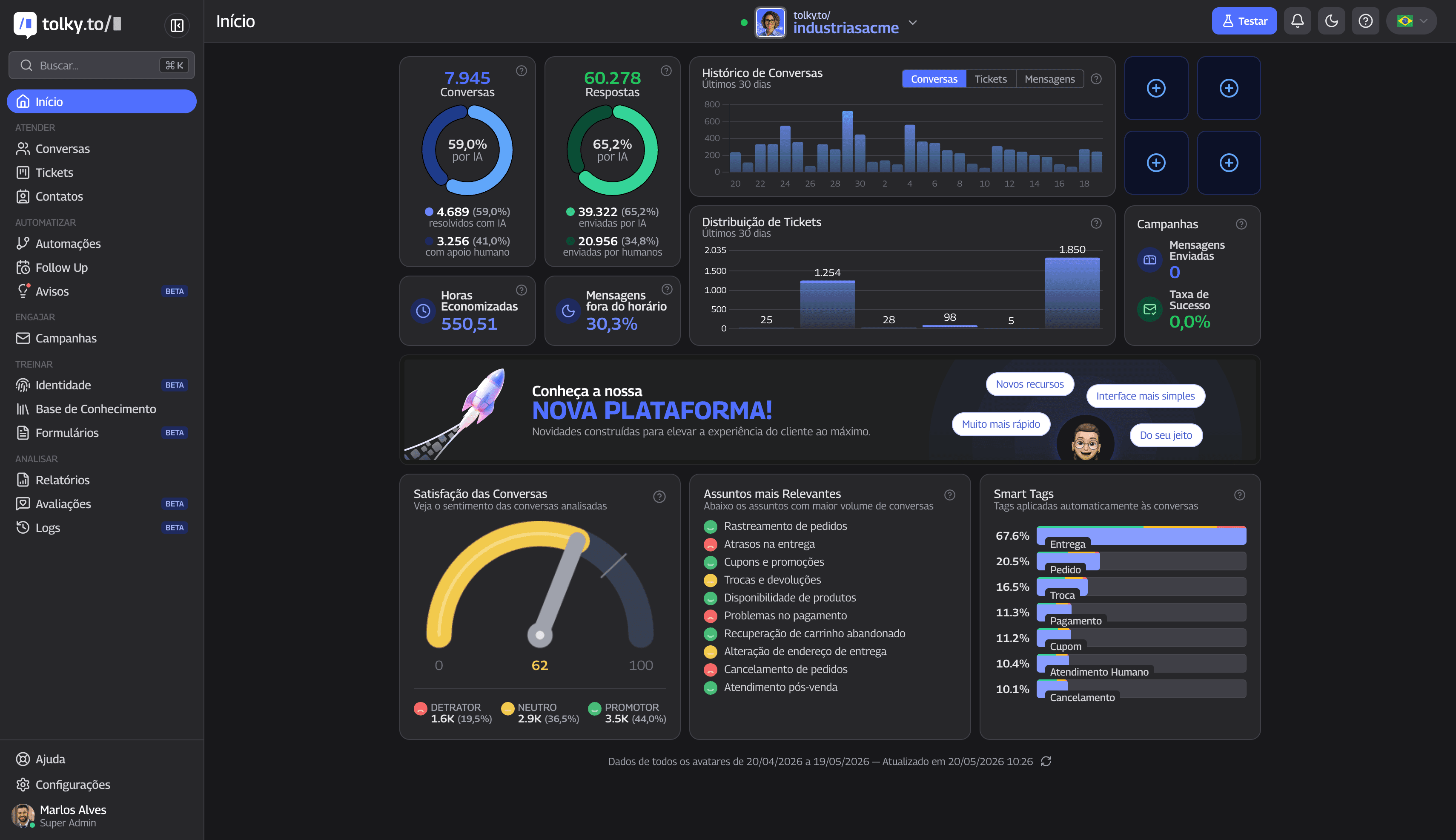
- A report for the retainer. The home screen shows conversations resolved with AI, AI replies, hours saved and after-hours messages, the numbers that justify monthly operation.
- A simple billing unit. An attendance is a conversation in which the contact sent at least one message that month; the AI isn't charged per reply.
- Plans to start. Individual is free, with webchat and AI; WhatsApp starts on Starter. For volumes above the allowances, Enterprise is quoted on request.
What Tolky doesn't do: it doesn't pay or bundle Meta's fees, and it doesn't link the originating ad to the sale on its own, which matters if you want to charge for results; that link needs the client's process or a custom integration, to be confirmed in a demo.
Frequently asked questions
How much should you charge for an AI agent?
There's no single price list: add implementation, billed as a project by the hours in each stage, and monthly operation, billed as a retainer by volume tier. Platform and Meta's fee stay separate, as the client's cost. We didn't find a public, dated source with a market price range we could verify, so this guide doesn't give one.
How much should you charge for a WhatsApp chatbot?
The logic is the same as for an AI agent: implementation plus operation, with platform and Meta billed separately. A rule-based chatbot usually needs fewer knowledge base hours, and an AI agent needs more conversation review. See how to sell WhatsApp chatbots to build the offer.
Should the agency include Meta's fee in its price?
Better not. Meta's fee grows with volume, which the agency doesn't control. Leave Meta at actual usage, paid by the client or passed through with a report, and charge for your service.
How much should you charge for WhatsApp automation?
A simple automation, such as a reminder or confirmation, fits as an item in implementation or the operation retainer. Automation that integrates the client's systems needs its own scope, with estimated hours and testing.
Is pay-for-results worth it?
It works as a bonus when measurement is reliable and agreed before go-live. As the only revenue, it leaves the agency dependent on factors it doesn't control, such as the client's prices, stock and sales team.
Conclusion
How much to charge for a WhatsApp AI agent depends on scope, but the structure is always the same: platform and Meta billed separately, implementation as a project and operation as a monthly retainer by volume tier. An agency that shows the math in its proposal gets paid for its own work and adjusts without friction as the client grows.
Calculate your WhatsApp API cost, see the plans, read how to start an AI automation agency or talk to the team →.
Your agency can deliver this with Tolky
The Tolky Partner Program is for agencies that want to bring AI agents, CRM and WhatsApp campaigns to their own client book, with recurring earnings. On the Solution track, your agency sells, implements and supports clients under the Tolky brand and sets the price of its own implementation and operation services; the other tracks are referring Tolky or running the platform under your own brand and setting the final price. Training and certification are free for companies in the program, and the Tolky team supports every initial project in 1:1 sessions.
Explore the Partner Program → Let's talk?
Share
Tags
- how much to charge for ai chatbot
- how much to charge for a whatsapp ai agent
- how much to charge for whatsapp automation
- ai agent pricing for agencies
- agency retainer
- whatsapp business api pricing
- #ai automation agency
- #conversational CRM
Cited in
- AI automation agency: what it is and how to start one in 2027
- Marketing agency with AI: how to change the model and keep clients
- White-label AI agent: how agencies sell AI under their own brand
- How to sell AI agents to businesses: a playbook for agencies
- How to sell WhatsApp chatbots in 2027 without breaking Meta's rules
- White-label CRM with WhatsApp: what it is and how agencies choose
- Agency retainer with AI: how to build a recurring monthly package
- n8n or a platform? How agencies should deliver AI agents
- White-label software reselling: refer, resell or run your own brand
- Marketing agency services: what to offer in 2027 with AI
About the author

Co-founder of Tolky
Marlos Carmo is an AI entrepreneur and founder of Tolky, the conversational-era infrastructure and AI CRM that unifies intelligent service, multi-channel support (such as WhatsApp and voice), live CRM, and operational intelligence in a single ecosystem. He is a finalist for the SXSW Innovation Awards and a member of Francesco's Economy, a global network of young entrepreneurs focused on innovation and social impact. He works connecting Artificial Intelligence and digital transformation in projects for large organizations.
Next step
Want to bring this to your operation?
Tati, Tolky's AI assistant, understands your scenario in a few questions, suggests the best path and connects you with someone from the team, with full context.
Share