White-label CRM with WhatsApp: what it is and how agencies choose
What a white-label CRM is, how it differs from a conversational CRM, what it needs for clients who sell on WhatsApp, how to price it and what an open source CRM really costs to run.
TL;DR
A white-label CRM is a CRM that an agency delivers to clients under its own brand and domain, on top of another vendor's software. For clients who sell on WhatsApp, it has to be born from the conversation: contact, history and deal created from the message, through the official API. Agencies usually charge in three parts: license, implementation and operation.
Share
The agency builds the pipeline, creates the tags, writes the automations and trains the client's team on the CRM. Six months later, the sales rep says "the system" organized the sales, and the system's name is the vendor's. The work was the agency's; the credit went to the CRM's brand.
Anyone who runs an agency feels this at renewal time. When the client decides to cut costs, the CRM stays, because it holds the history, and the agency's service goes, because it looks like setup that's already done. A white-label CRM changes that reading: the client now uses the agency's CRM, with the agency's brand and domain.
Updated November 2026.
What is a white-label CRM?
A white-label CRM is customer relationship management software that the agency delivers under its own brand, domain and product name, while another vendor builds and hosts the technology. The end client signs in through the agency's login screen and never sees the name of the company that built the software.
The model is common in SaaS: the vendor scales by selling through partners, and the partner gets a product without needing an engineering team. For the agency, the CRM stops being "the tool we recommended" and becomes "our platform."
This guide covers the CRM and the pipeline. If you're interested in AI-powered customer service, the companion piece is the guide to the white-label AI agent.
White-label CRM vs. conversational CRM: what's the difference?
White label describes whose brand it is; conversational describes how the CRM works. A CRM can be white label and traditional, fed by forms and typing, or white label and conversational, fed by conversations on WhatsApp, the website and email.
A conversational CRM creates the contact and the deal from the message, keeps the conversation history on the record and lets AI answer, qualify and log what the customer said. The full comparison is in what a conversational CRM is.


| Aspect | Traditional white-label CRM | Conversational white-label CRM |
|---|---|---|
| Where the contact starts | Form, import or manual entry | The customer's first message |
| History | Notes the rep writes | The entire conversation on the contact record |
| Separate integration, sometimes a browser extension | Native channel, through the official API | |
| AI | Optional, usually for summaries | Answers, qualifies and fills in contact data |
| Who feeds the CRM | The rep, when they remember | The conversation, with the rep reviewing |
| What the agency delivers | Pipeline and reports | Pipeline, customer service and sales reports |
For clients who sell on WhatsApp, the second column matters more. A rep who has to copy conversations into the CRM stops doing it by week two, and the pipeline the agency built sits empty.
What does a white-label CRM need for WhatsApp clients?
For clients who sell on WhatsApp, a white-label CRM needs the official API, contacts created from the conversation, a pipeline with deals, follow-up, access profiles and open integrations. Without them, the agency delivers a nice dashboard the team doesn't use.
- Official WhatsApp API. Connecting through a WhatsApp Web QR code puts the client's number at risk. The CRM must connect through Meta's official API and show every conversation in a shared inbox.
- Contacts and deals born from the conversation. Name, interest and details the customer shared go to the record with no typing. The sales funnel stage changes as the conversation moves forward.
- Follow-up and campaigns. A lead who stopped replying gets a nudge at the right time, and a dormant base can get segmented campaigns. See how it works in WhatsApp lead follow-up.
- Access profiles. Reps see their own leads, managers see the team, the agency sees everything. More in CRM with access control.
- Integrations and export. APIs, webhooks and data export let the CRM connect to the client's ERP and let the client leave if needed. A client who knows they can leave trusts you more when coming in.
To compare market options against these criteria, see the best CRMs for WhatsApp.
How does an agency charge for a white-label CRM?
Agencies usually charge for a white-label CRM in three parts: a monthly license under their brand, implementation as a project and operation as a recurring retainer. Separating the three makes clear what the client pays for software and what they pay for work.


| Part | What it includes | How it's usually charged | What changes the price |
|---|---|---|---|
| License | Access to the CRM under the agency's brand, users, channels | Monthly fee by plan, user or conversation volume | Number of users and conversations |
| Implementation | Pipeline, stages, tags, contact import, WhatsApp connection, integrations | One-time project fee | Number of pipelines, integrations and imported lists |
| Operation | Pipeline reviews, new automations, reports, training new reps | Monthly retainer | Team hours and report frequency |
| Meta fees | Messages sent through the official API | Passed through or paid directly by the client | Message volume and category |
On the license, the agency sets its own price on top of the vendor's partner price. On operation, the retainer depends on what the report shows: a CRM that proves sales supports a bigger retainer than one that only organizes contacts. The recurring package logic is in agency retainer with AI.
Meta's fees deserve their own line in the proposal. They vary by message category and country, and agreeing on who pays avoids an argument in the first month.
What does this change for your agency?
With a white-label CRM, the agency stops configuring another company's tool and starts running its own product, with recurring revenue and sales data to show in the report. The effects show up on four fronts.
- The pipeline becomes an agency asset. The pipeline model that worked for one clinic becomes the template for the next clinic. Each implementation gets faster and cheaper to deliver.
- Sales reports, not click reports. With the lead recorded from the conversation to the closed deal, the agency shows how much of the media spend turned into negotiations. That's the conversation that protects the retainer at renewal.
- Retention through daily operation. The client opens the CRM every day. Switching agencies now means switching systems, migrating history and retraining the team.
- A view of the entire client base. With every client in one login, the agency sees who is using it, who stopped answering leads and where to offer more services.
Open source or SaaS: what does it cost to run your own white-label CRM?
An open source CRM looks free, but the agency starts paying for servers, updates, security, the official WhatsApp API connection and support, in its own team's hours. Searches like "white label crm github" show up in Google's autocomplete, a sign that agencies consider this path; it's worth doing the math first.
What goes into the cost of running your own CRM:
- Hosting and database for each client, with backups.
- Updates and security patches, which don't stop after launch.
- Official WhatsApp API connection, which needs Meta approval, message templates and maintenance whenever Meta changes the rules.
- AI, with model costs, testing and answer control.
- Privacy compliance, with access profiles, activity logs and a data processing agreement with each client.
- Support, including at night, when the client's WhatsApp stops working.
Open source pays off when the agency has an engineering team and wants software as its main business. For an agency that wants to sell relationships and results, a white-label SaaS takes that weight off in exchange for the license. The same logic applies to agents built in automation tools, compared in n8n or a platform for agencies.
How to choose a white-label CRM with WhatsApp in five steps
Choose a white-label CRM by testing it with a real client, not a generic demo: a pilot shows in weeks what a contract would only show in months.
- Map the pipeline of two or three clients in your base and check whether the CRM handles the stages without workarounds.
- Run a pilot with the client who sells the most on WhatsApp, connected through the official API.
- Check the branding end to end: domain, login, system emails and webchat. The full list is in the guide to the white-label AI agent.
- Test the exit: import a list, export it back and confirm nothing gets lost.
- Read the partnership contract: partner pricing, who bills, who supports and what happens if the vendor approaches your client. The possible models are in white-label software reselling.
Where Tolky fits in a white-label CRM
Tolky is a conversational AI CRM: the contact, history and deal are born from the WhatsApp conversation through the official API, and white label builds on the "Your brand and domain" feature of the Enterprise plan. With it, the agency runs the platform on its own domain, with its logo, colors, favicon, product name, login screen and system emails, and enters each client's account with the same login.
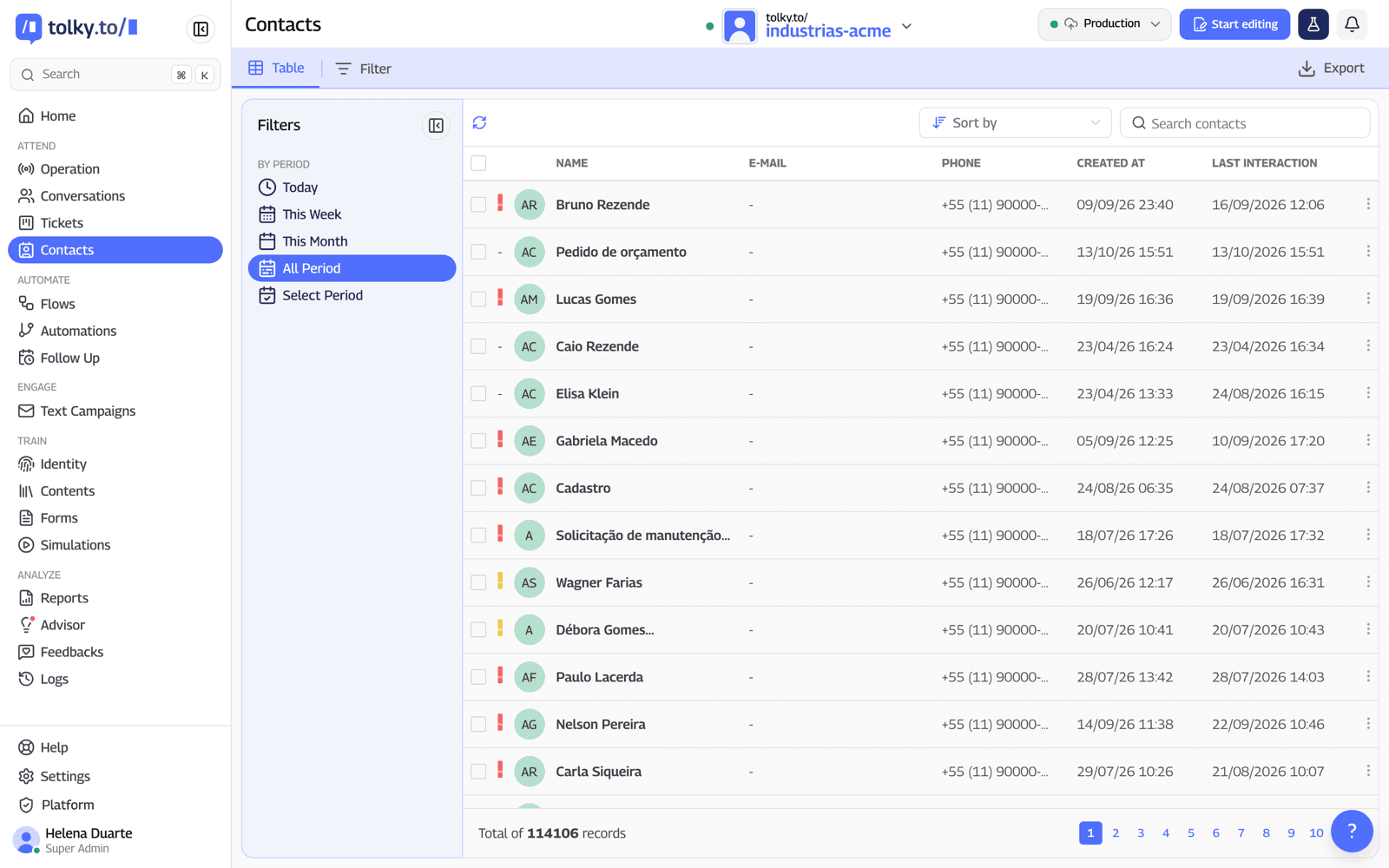
The CRM is Tolky's own, with pipeline, deals, Follow Up, campaigns and contact data capture from the conversation. It has a native HubSpot integration, connects 1,000+ apps through the Integration node in Flows and offers a REST API, webhooks and MCP tools; the catalog is on the integrations page. Details in Tolky's conversational CRM and CRM for WhatsApp.
What Tolky doesn't do: it has no native Salesforce or Pipefy integration (you can connect them through the API and webhooks), doesn't support Instagram or SMS, which are coming soon, and doesn't pay Meta's fees.
Frequently asked questions
What is a white-label CRM with WhatsApp?
It's a CRM the agency delivers under its own brand and domain, connected to the client's WhatsApp through the official API. Contacts and conversations enter the CRM with no typing. The end client sees only the agency's brand.
What's the difference between a white-label CRM and CRM reselling?
When reselling, the agency sells the CRM under the vendor's brand and charges for its own services. With white label, the client sees only the agency's brand, and the agency sets the final price and bills the client.
Is there a white-label CRM with AI?
Yes. In a conversational CRM with AI, the agent answers the lead, qualifies them and fills in the contact record, and the agency delivers it all under its own brand. At Tolky, this builds on the "Your brand and domain" feature of the Enterprise plan.
Is an open source white-label CRM worth it for an agency?
It's worth it when the agency has an engineering team and wants software as its main business. Otherwise, servers, updates, security, the WhatsApp API and support usually cost more in hours than a white-label SaaS license.
How much should you charge for a white-label CRM?
Separate license, implementation and operation, and put Meta's fees on their own line. The license follows the price the agency sets; implementation and operation follow hours and scope. The guide on how much to charge for a WhatsApp AI agent shows the math.
Conclusion
A white-label CRM with WhatsApp puts the agency's brand on the tool the client opens every day. To work, it has to be conversational, connect through the official API and let the agency see its whole client base in one login; to deliver results, the agency has to price license, implementation and operation separately and show sales in the report.
Your agency can deliver this with Tolky
The Tolky Partner Program is for agencies that want to bring AI agents, CRM and WhatsApp campaigns to their own clients, with recurring earnings. On the White-label track, the agency runs the conversational CRM under its own brand and domain, sets the final price and bills its clients; agencies that prefer to start smaller can refer Tolky or sell and implement under the Tolky brand. Training and certification are free for program members, and the Tolky team supports every initial project in 1:1 sessions.
Explore the Partner Program → Let's talk?
Share
Tags
- white label crm
- white label crm for agencies
- white label crm whatsapp
- white label crm with ai
- white label saas crm
- open source white label crm
- resell whatsapp crm
- #conversational CRM
About the author

Co-founder of Tolky
Marlos Carmo is an AI entrepreneur and founder of Tolky, the conversational-era infrastructure and AI CRM that unifies intelligent service, multi-channel support (such as WhatsApp and voice), live CRM, and operational intelligence in a single ecosystem. He is a finalist for the SXSW Innovation Awards and a member of Francesco's Economy, a global network of young entrepreneurs focused on innovation and social impact. He works connecting Artificial Intelligence and digital transformation in projects for large organizations.
Next step
Want to bring this to your operation?
Tati, Tolky's AI assistant, understands your scenario in a few questions, suggests the best path and connects you with someone from the team, with full context.
Share