Agentic AI trends for 2027: the 10 that will change companies
The 10 agentic AI trends for 2027, from AI CRM and AI voice to security and regulation, with data from primary sources and the full ebook as a free PDF.
TL;DR
The agentic AI trends for 2027 come down to agents that do more (long tasks, voice, learning), reach the customer (AI CRM, AI customer service, commerce) and demand control (agent teams, security and regulation). With more than 40% of agentic projects at risk of cancellation by the end of 2027, according to Gartner, the edge lies in process, data and governance.
Share
Agentic AI left the lab in 2025 and 2026, but it has not yet reached the operations of most companies. Six in ten organizations already test AI agents, and only a small share see results at scale. In 2027, the gap between companies that put agents into production and those still stuck in pilots should show up in cost, customer service and sales.
This article summarizes the ten trends in our ebook Agentic AI trends for 2027, with the key numbers and what to do about each one. The full ebook has 55 pages, charts, quotes checked against the original source and real product screens, and it is a free PDF download.
Updated November 2026.
In short:
- Agentic AI is AI that receives a goal and carries out the steps to reach it, using tools, memory and verification.
- 62% of organizations at least experiment with agents, but only 23% scale them in some area, according to McKinsey.
- Gartner predicts that more than 40% of agentic AI projects will be canceled by the end of 2027 due to cost, unclear value and risk.
- The trends closest to the customer are AI CRM, AI customer service, AI voice calls and agents that learn from the team.
- Teams that measure resolution, repeat contacts and cost per task will be the first to know where to expand agent autonomy.
What is agentic AI
Agentic AI is AI that receives a goal and decides the sequence of steps to reach it, using tools, keeping context and checking the result before moving on. A generative assistant answers when someone asks; an AI agent receives an objective, such as resolving a customer's duplicate invoice, and completes the task: it looks up the record, issues the bill, sends it through the right channel and logs what it did.
That difference changes how operations are designed. Instead of fixed scripts, the company defines goals, limits and quality criteria. The full definition is in the agentic AI glossary entry, and the comparison with chatbots is in conversational AI is not a chatbot.


Where does the market stand at the end of 2026?
The market sits between enthusiasm and proof: many companies test agents, few have scaled them, and analysts expect a cleanup of projects that show no return. The table brings together the baseline numbers used in the ebook.
| Indicator | Number | Source |
|---|---|---|
| Organizations that at least experiment with AI agents | 62% | McKinsey, The state of AI in 2025 |
| Organizations already scaling an agentic system in some area | 23% | McKinsey, November 2025 |
| Enterprise apps with task-specific agents by the end of 2026 | 40% (less than 5% in 2025) | Gartner, Aug 26, 2025 |
| Agentic AI projects canceled by the end of 2027 | More than 40% | Gartner, Jun 25, 2025 |
| Customers who require access to a person when a company uses GenAI | 87% | Gartner, Aug 4, 2026 |
Gartner's warning carries more weight than the optimistic forecasts. The reasons given for the cancellations are rising costs, unclear business value and inadequate risk controls, which reinforces a simple rule: adopt agents where the return is clear and measure from day one.
What are the 10 agentic AI trends for 2027?
The ten trends fall into three groups: what agents start doing on their own, where they meet the customer and what it takes to trust them.
| # | Trend | Signal to watch in 2027 |
|---|---|---|
| 01 | Agents that work for hours and use screens | Hours of work completed without rework, per process |
| 02 | Real-time AI voice calls | Calls resolved without transfer |
| 03 | Agents that learn from operations | Unanswered questions that become approved knowledge within seven days |
| 04 | Smaller, specialized models | Cost per resolved conversation, per agent step |
| 05 | AI CRM fed by conversations | Hours returned to sellers and opportunities that move forward |
| 06 | AI customer service with people in the loop | Repeat contact within seven days |
| 07 | Agentic commerce | Orders started by agents |
| 08 | Agent teams and open protocols | Hand-offs between agents without rework |
| 09 | Agent identity and security | Agent inventory with an owner and reviewed permissions |
| 10 | Regulation and governance | Vote on bill PL 2.338/2023 in Brazil's Chamber of Deputies |
What agents start doing on their own
The agents of 2027 work longer, take phone calls, learn from the team and cost less per step, as long as the company organizes its processes and data.
Longer tasks and screen use
The length of tasks that agents complete with 50% success has been doubling roughly every seven months, according to METR. In the February and March 2026 measurement, the best public model reached 17.8 hours on well-defined tasks and 6.4 hours on tasks with incomplete instructions. The message: clear processes get far more out of agents than improvised ones. At the same time, agents began operating browsers and systems without APIs, which brings automation to legacy systems, with their own permissions and a log of every click.
AI voice calls
Models that listen and respond in audio, without routing everything through text, accept interruptions mid-sentence and query systems during the call. A Metrigy survey for AVOXI, a vendor survey of 365 IT and CX leaders, indicates that 81% of companies already use AI in the voice channel. Appointment confirmations, duplicate invoices and order status are the first use cases. See how AI voice for customer service works and what a semantic IVR is.
Agents that learn and specialized models
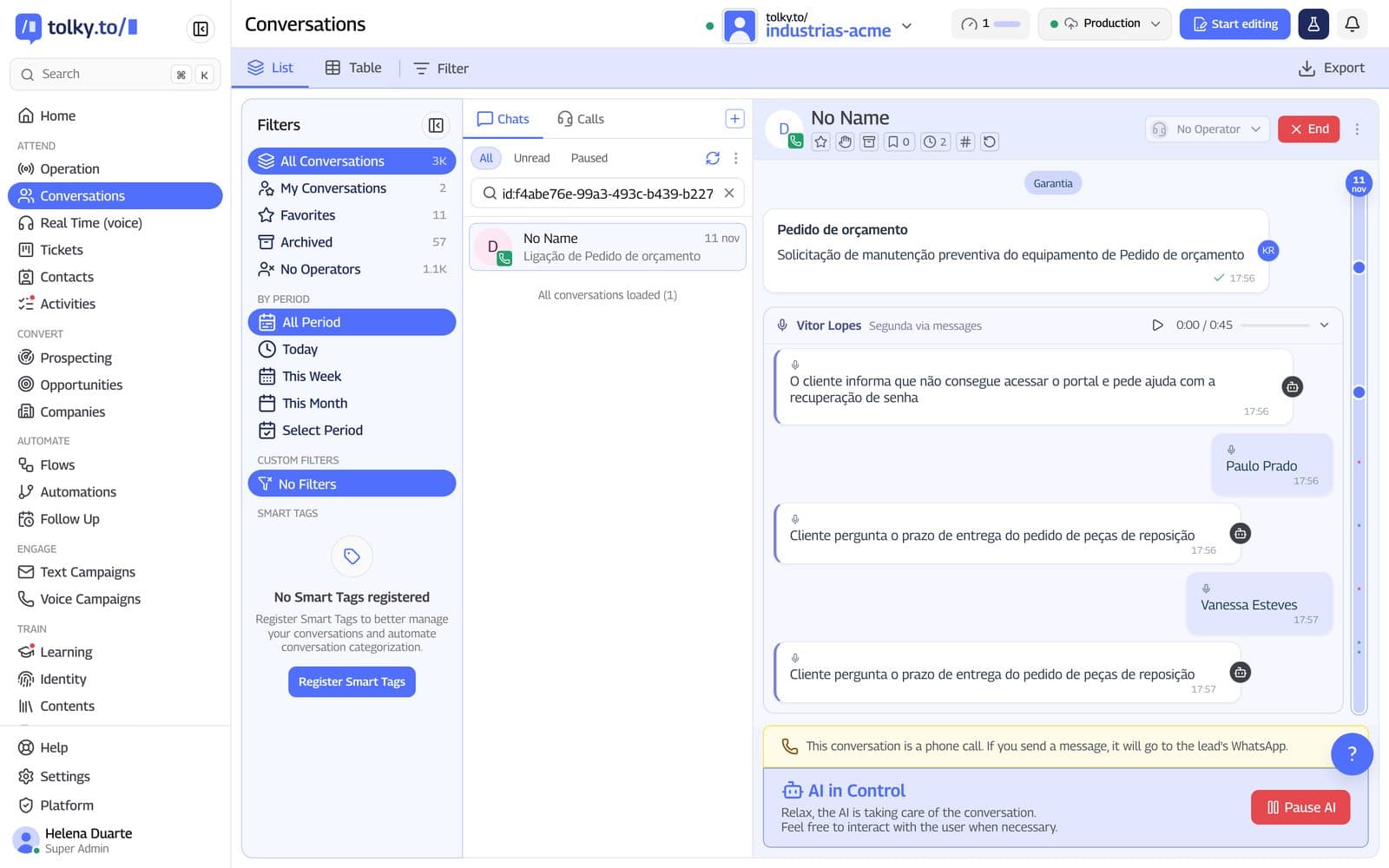
The new generation of agents keeps what worked and uses the team's corrections in later conversations. In September 2025, Anthropic measured a 39% performance gain by combining memory and context editing in an internal test. Learning needs an owner: someone approves what the agent comes to know, and the knowledge base becomes a weekly routine. On cost, Gartner predicts that by 2027 companies will use small, task-specific models three times more than general-purpose models, with a router choosing the model for each step.


AI CRM and AI customer service: where customers feel the change
AI CRM and AI customer service are the trends in which agentic AI touches revenue and experience at the same time, and where the hand-off to a person has to work.
In the CRM, records start to come from the conversation itself: the agent identifies interest, qualifies the lead, creates the opportunity and sets the next step. Salesforce's State of Sales, with 4,050 sales professionals, shows that the average seller spends only 40% of their time selling and that 54% have already used agents. The same study carries a warning that applies to any AI CRM: agents without unified customer data tend to fail.
In customer service, customers accept the agent when they know they can reach a person. The winning design for 2027 combines AI for volume, the team for what requires judgment and a hand-off with context between the two. Gartner also reports that 85% of service leaders are expanding the responsibilities of frontline staff, with roles in supervising and training agents.
Agentic commerce and agent teams
Agentic commerce and agent teams show agentic AI moving beyond a single company and talking to others.
In September 2025, Google launched AP2, a payments protocol with signed mandates, and OpenAI and Stripe launched the Agentic Commerce Protocol. For sellers, the next customer may arrive as an agent that compares price, delivery time and return policy in seconds. Inside companies, the agent that tries to do everything gives way to a team with an orchestrator, the subject of our guide to AI agent orchestration. MCP connects agents to tools and data, A2A connects agents from different vendors, and both have been under neutral governance at the Linux Foundation since 2025.
What changes in security and regulation?
Security and regulation start to decide which agents reach production. In December 2025, OWASP published the ten most critical risks of agentic applications, starting with agent goal hijacking through instructions hidden in emails, attachments or web pages. The answer is to treat the agent like a person with access to systems: its own identity, minimum permissions, approval for anything irreversible and a log of every action.
On regulation, the European AI Act already requires telling people when they are talking to an AI, and Brazil's AI framework bill, PL 2.338/2023, passed the Senate in December 2024 and is still in the Chamber of Deputies. Brazil's data protection law (LGPD) already applies to any personal data the agent touches. See also our guide to AI governance in customer service.
How to prepare in 90 days
The safest path starts with the process and only then gets to the model: choose where the agent makes a difference, measure the baseline and scale only with numbers.
- Days 1 to 30, choose: three processes with volume, clear rules and accessible data, with a baseline for cost, time and quality.
- Days 31 to 60, build: an agent with minimal tools, a reviewed knowledge base, tests with real conversations and a designed hand-off to people.
- Days 61 to 90, operate: production on part of the volume, a weekly review of what the agent learned and a decision to scale based on measured results.
The ebook also includes ten questions to take to the committee before putting an agent into production, from autonomy level to decision logs.
Where Tolky fits
Tolky is a conversational AI platform that brings together CRM, customer service and AI. Four of the trends in the ebook are already part of it: AI CRM fed by conversations, AI customer service on WhatsApp and other channels with hand-off to the team with context, AI voice calls with a semantic IVR, and learning from the team's answers. It is not a payments or agentic commerce platform, and what the agent learns still goes through the team's approval.
The full ebook
The ebook Agentic AI trends for 2027 was written by Marlos Carmo and Patrick Bonnereau, co-founders of Tolky. It has 55 pages, with an opening, an analysis and a practical page for each trend, charts, quotes in the original language and real screens. The PDF is in Brazilian Portuguese, and the ebook page summarizes it in English. It is part of Tolky's new area of free ebooks.
Frequently asked questions
What are the main agentic AI trends for 2027?
Agents that work for hours and use screens, AI voice calls, agents that learn from operations, specialized models, AI CRM, AI customer service with people in the loop, agentic commerce, agent teams with open protocols, agent security and regulation. The ebook explains each one with data and a practical page.
Why are so many agentic AI projects expected to be canceled?
Gartner points to rising costs, unclear business value and inadequate risk controls. Projects born from hype, with no business process behind them, are the most exposed.
What is the difference between a chatbot and an AI agent?
A chatbot follows a script designed in advance. An AI agent receives a goal, chooses the tools and completes the task within the limits the company sets, handing off to a person when needed.
What is an AI CRM?
It is a CRM in which AI agents log conversations, qualify leads, create opportunities and suggest the next step, instead of relying on manual data entry. It works when conversation, history and pipeline live in the same place.
Will AI agents replace human customer service?
That is not what the research shows. Customers ask for a way to reach a person, and service leaders are expanding their teams' responsibilities, with new roles in supervision, agent training and complex cases.
How do I download the agentic AI trends ebook?
On the agentic AI trends for 2027 ebook page. The PDF is free, with no sign-up, and it is written in Brazilian Portuguese.
Conclusion
The ten trends point in the same direction: agents can already do a lot, and what separates results from cancellation is how the company organizes process, data, people and rules around them. Start with a few processes, measure from day one and give your team the role of teaching and supervising.
Download the free ebook, see the plans or talk to the team →. Let's talk?
Share
Tags
- agentic AI trends
- agentic AI 2027
- AI agents
- #AI CRM
- AI customer service
- AI voice
- agentic AI ebook
About the author

Co-founder of Tolky
Marlos Carmo is an AI entrepreneur and founder of Tolky, the conversational-era infrastructure and AI CRM that unifies intelligent service, multi-channel support (such as WhatsApp and voice), live CRM, and operational intelligence in a single ecosystem. He is a finalist for the SXSW Innovation Awards and a member of Francesco's Economy, a global network of young entrepreneurs focused on innovation and social impact. He works connecting Artificial Intelligence and digital transformation in projects for large organizations.
Next step
Want to bring this to your operation?
Tati, Tolky's AI assistant, understands your scenario in a few questions, suggests the best path and connects you with someone from the team, with full context.
Share