Conversational AI at Scale: What Powers High-Volume B2B Conversations
Scaling conversational AI is not just about choosing a model. This post covers the engineering behind scale: queues, integration, observability and real failures.

Marlos Carmo
Founder of Tolky
Updated on November 15, 2026
Share
Picture this scenario: the board approves a new project, and by the following Monday, a B2B company launches a powerful language model on their corporate WhatsApp to serve thousands of customers. During testing, the responses were fast, accurate, and polite. However, in the first week of real-world operation, reality hits hard.
A VIP client requests a modification to an overdue invoice. The AI, using its flawless natural language, replies that it "understands the request and will take care of it." The client says thank you. The conversation ends. But absolutely nothing happens in the financial system. No invoice is generated, no ticket is opened for the billing team, the SLA silently expires, and three days later, the client's service is suspended due to non-payment.
This is the harsh reality for those who try to solve complex problems with text alone: scaling Conversational AI isn't about changing models. It's about sustaining an operation.
The most critical part of artificial intelligence often isn't the conversation visible on the customer's screen. It's behind the scenes. The ability to reply to a high volume of messages only generates business value if there's an invisible infrastructure ensuring traceability, system integration, ticket management, seamless human handoffs, and data governance.
In this article, we'll open the black box of a high-volume contact center and understand what separates an AI that makes pretty demos from a conversational platform truly ready to scale.

Why Scaling Conversational AI is Different from Building a Chatbot
The first generation of customer service automation accustomed the market to the idea that building a bot meant drawing a decision tree ("press 1 for sales"). When generative artificial intelligence arrived, many companies believed that simply plugging a Large Language Model (LLM) into a WhatsApp account was enough to achieve intelligent support.
The problem with this view is that it ignores the weight of scale. Serving ten customers with AI is a prompt engineering exercise; serving ten thousand customers a day is an engineering and management challenge.
A conventional chatbot breaks when the customer deviates from the script. A poorly orchestrated AI hallucinates, promises undue discounts, and loses track of the demand. Scaling AI means building an operation where the conversation is just the tip of the iceberg, while the rest of the platform absorbs the impact of the volume.
What Happens Behind the Scenes of a Conversational Operation at Scale
For a simple message ("I want to renew my contract") to be interpreted, processed, and resolved in seconds, a hidden gear mechanism runs non-stop.
The model responds. The infrastructure sustains.
Behind the scenes of a real Conversational AI platform, the following happens simultaneously:
- Identification and Enrichment: The system identifies the contact (through the BSUID, Meta's business-scoped user ID; if a user enables a username, the phone number may be omitted from webhooks, so identification should not depend on the number alone) and queries the CRM to know who the client is, their current plan, and their ticket history. See what BSUID changes.
- Intent Triage: The AI reads the message and classifies it not as text, but as a commercial intent ("Renewal").
- System Queries (RAG/APIs): The platform checks the ERP for the specific financial conditions for that client's renewal.
- Governance: Business rules validate whether the AI has permission to offer special terms autonomously.
- Response Generation: Only at this point is the text written and sent to the client naturally.
All of this happens in seconds (the ERP query and LLM generation have latency that must be monitored). Without this architecture, the AI would just be a digital parrot, friendly, but useless for driving business forward.
Why the AI Model is Important, but Not Enough
The tech race has led companies to idolize language models. However, in a high-volume and commercially critical scenario, for comparable tasks, the AI model tends to become a commodity. You can swap out the artificial intelligence engine whenever a faster and cheaper version is released.
The true differentiator lies not just in the AI's response, but in what the company can do with each conversation. Models can be replaced, but the infrastructure built around them is your competitive advantage. If your company places all its bets solely on "which LLM to use," it is ignoring the layer that actually delivers results: operational governance.
Channels, Queues and Tickets: What Lives in the Dedicated Guides
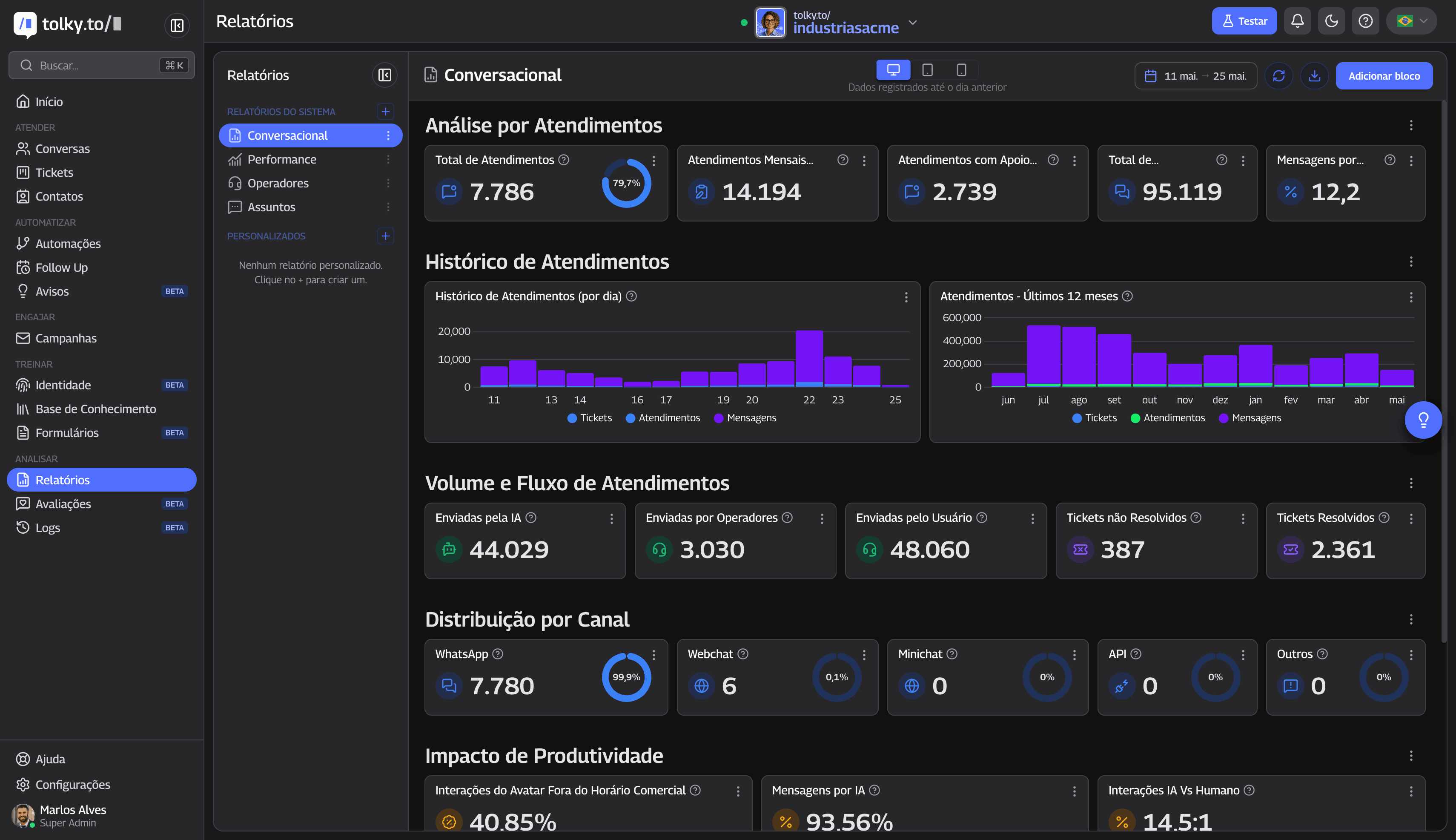
Unified channels, priority queues and tickets with a protocol number and SLA are the base of any high-volume operation. How they are organized in practice is in the guide to AI-powered contact centers; here the focus is the engineering that sustains them.
The Role of Observability: Knowing What's Happening in Real-Time
In a manual operation, a supervisor can hear an agent's tone of voice or peek at their screen to understand how work flows. But how do you supervise a thousand automated conversations happening in the same minute?
The answer is observability. At massive scale, you need reports that show not just message volume, but the health of the operation. Real-time dashboards must monitor bottlenecks, integration outages (if the ERP goes down, the AI cannot freeze), response latency, and spikes in negative customer sentiment.
Governance, Integration and Human Handoff: Where to Go Deeper
Three layers sustain scale and have their own guides. Governance: scope, sources of truth, permissions and accountability are in AI governance in customer service. Integration: without APIs the AI becomes an FAQ, as shown in AI without integration becomes an FAQ. Human handoff: the handoff playbook is in how to implement AI without losing the human touch. For a ticket with summary and SLA, the golden rule is simple: the AI transfers with context and the human never rereads the whole conversation.
An End-to-End Path (illustrative example)
A customer's renewal message enters the queue, the platform calls the ERP for the terms, the call times out, the AI does not invent a value: it logs the failure, tells the customer it will confirm, and escalates to a human with a summary in a ticket with an SLA. Tracing each step shows the failure was the ERP's, not the AI's, and the team fixes the integration. If the customer reopens the conversation days later, the unified history shows what happened. That is what "observability" means in practice.
How AI Learns from Operations Without Losing Control
At-scale service isn't just measured by messages sent. It's measured by resolution, control, and learning. Every conversation processed is a source of data on market pain points, product flaws, and sales objections.
However, AI shouldn't learn chaotically. B2B scale learning requires curation. Tickets successfully closed by humans feed back into the AI's Knowledge Base. Reports highlight the most frequent reasons for contact, allowing the company to adjust workflows or improve its own software interface, eliminating the root cause of the query.
Demo AI vs. Conversational AI at Scale: What's the Difference?
To understand the true leap in digital maturity, compare these two scenarios:
| Dimension | Demo AI (Pilot) | Conversational AI at Scale (Real Operation) |
|---|---|---|
| Objective | Show the AI can converse humanly | Solve problems by integrating business processes |
| Volume | Hundreds of messages in isolated tests | Real volume, with queues, latency monitoring and defined integration limits |
| Channels | Usually runs on a single WhatsApp number | Connected channels (today WhatsApp, webchat, Microsoft Teams and voice; Instagram, SMS and email coming soon) |
| History | Fragmented; AI forgets the client the next day | Unified in a centralized AI CRM |
| Human Handoff | Unstructured, requires reading the full thread | Fluid, via automated ticket with summary and SLA |
| System Integration | None; answers based only on the prompt | Deep via API and MCP, configured per system |
| Governance | Loose rules, higher risk of incorrect answers | Configurable guardrails, defined scope and permissions |
| KPIs | Only measures quantity of messages sent | Measures resolution (FCR), deflection, CSAT, and recurrence |
| Stability | Crashes during sudden traffic spikes | Infrastructure designed for peaks, with monitoring and contingency (ask the team about availability) |
A good demo AI isn't necessarily ready for Monday morning. The true test is operational survival.
Common Mistakes When Trying to Scale Conversational AI
Many companies fail to transition from a pilot project to full scale because they make basic operational mistakes:
- Looking only at the AI, not the system: Putting a smart bot in front of a disorganized operation only accelerates how quickly you provide bad service.
- Failing to define ownership: Conversations and tickets without a defined owner (a team or an executive) get lost in limbo.
- Treating WhatsApp as an island: WhatsApp is not a CRM. Using it in isolation from the rest of the company prevents a 360º view of the customer.
- Having no fallback plan: If the LLM service goes down, your company can't stop selling. The system needs safety mechanisms or immediate human overflow; ask your vendor what the contingency is if the LLM provider is unavailable.
Checklist: Is Your Company Ready to Scale Conversational AI?
Is your operation mature enough to handle high volume, or is it still in the experimental phase? Use this checklist to validate:
- Does the company offer support on multiple channels, and are they connected in a single view?
- Is the complete conversation history accessible to all agents?
- Do important demands and commercial issues turn into trackable tickets?
- Does every conversation have a defined owner and a scheduled next step?
- Is there an SLA per channel, team, or demand type?
- Does the AI know exactly when to transfer to a human?
- Does the human agent receive context (a generated summary) before taking over the chat?
- Is the AI connected to internal systems (APIs) to read and write data?
- Can managers monitor response quality and operational health in real-time?
- Does the operation measure resolution, productivity, and issue recurrence?
If you checked fewer than 7 boxes, your company's next step isn't changing language models, it's building conversational infrastructure.
Indicators: The Engineering Cut
Beyond resolution, SLA and CSAT (detailed in AI-powered contact centers), engineering watches latency per step and integration failure rate. These are the signals that show where scale breaks first; set limits with your technical team and measure before promising numbers.
How Tolky Views the Infrastructure Behind Conversational AI
At Tolky, we understand that the text sent to the customer is just the final result of a robust engineering process. We don't just provide a text generator; we provide a platform that organizes digital customer service for B2B companies.
Tolky brings channels like WhatsApp, webchat, Microsoft Teams and voice into a single operation: autonomous service, a multi-user inbox, ticket management, reports, access profiles (from Starter), audit logs (on all plans) and API and MCP integration with your company's systems. Instagram, SMS and email are listed as "coming soon".
Conclusion: The Invisible Foundation of Scale
Scaling Conversational AI isn't a prompt challenge or a choice of language model. It's a strategic decision on how your company chooses to organize data, people, and processes.
If your company wants to use artificial intelligence to serve more customers but still lacks unified history, accountable tickets, SLA monitoring, systemic integrations, and data governance, your current challenge isn't innovating the reply. It's building the operation that sustains scale. Automation without a solid foundation is like accelerating a car without a steering wheel.
Tolky helps companies turn channels like WhatsApp, webchat, Microsoft Teams and voice into an at-scale conversational operation, uniting technological efficiency, human support, management and trackable results. Talk to our experts, explore the solutions and AI governance in customer service, or see the plans.
Frequently Asked Questions (FAQ)
What is Conversational AI at scale?
It is the use of dialogue-based artificial intelligence supported by robust software infrastructure that manages high contact volumes (high message volume), integrating automated service, human handoffs, governance, ticketing, and back-office system connections (CRM, ERP) without losing quality or control.
What's the difference between a chatbot and Conversational AI at scale?
A chatbot operates on fixed tracks (decision flows) and often freezes when faced with complex questions. Conversational AI understands context naturally, manages customer intent, queries databases in real-time, and orchestrates service integrated with internal processes and smart human handoffs.
Why isn't an AI model enough to scale customer service?
Because the model only processes natural language and generates replies. In a real operation, the customer needs the system to change invoices, open tickets, check status, or perform system integrations. This is only achieved by the infrastructure and governance surrounding the model.
How do you integrate WhatsApp, web and chat in an AI operation?
By using an omnichannel platform (like Tolky) that acts as the central "brain" of the operation. The active channels (today WhatsApp, webchat, Microsoft Teams and voice) converge into the platform's unified inbox, consolidating customer history and allowing the AI to maintain context regardless of the chosen channel.
How do you ensure quality in many automated conversations?
Quality is ensured through data governance (guardrails that reduce incorrect answers), continuous curation of the AI's knowledge base, and observability dashboards that measure bottlenecks and satisfaction ratings (CSAT).
When should the AI transfer to human support?
Transfers should happen automatically when the AI identifies low confidence in its response, detects negative sentiment/frustration via NLP, or when the request requires critical financial/commercial negotiation that depends on human empathy or decision-making authority.
Which indicators should be tracked in a conversational operation?
Track metrics focused on results and control: Automated Resolution Rate (Deflection), SLA compliance, Mean Time to Resolution, Human Transfer Rate, Reasons for contact, and not just the sheer volume of messages.
How to prevent AI from scaling operational problems?
AI shouldn't be inserted into an already disorganized process. Before automating, you must organize queue distribution, define ownership for each request, and implement a ticketing system for traceability to prevent demands from falling into limbo.
What must a Conversational AI platform have?
It must offer natural language processing (NLP/LLMs) connected to a robust governance system, ticket management, managerial reports, a unified omnichannel inbox for human agents, and API integration capabilities (RAG) with the company's legacy systems.
How to prepare a company for at-scale AI service?
Start by organizing the product and service database. Define clear service flows and the required SLAs for each queue. Adopt a platform that can merge the artificial intelligence layer with the operational management layer before directing 100% of traffic to automation.
Share
Tags
- conversational ai at scale
- #conversational ai
- #ai customer service
- #ai contact center
- #customer service automation
- #omnichannel service
- #ticket management
- conversational operations
- #ai governance
- at-scale support
- #conversational ai platform
- #ai crm
About the author
Marlos Carmo
Founder of Tolky
Marlos Carmo is an AI entrepreneur and founder of Tolky, the conversational-era infrastructure and AI CRM that unifies intelligent service, multi-channel support (such as WhatsApp and voice), live CRM, and operational intelligence in a single ecosystem. He is a finalist for the SXSW Innovation Awards and a member of Francesco's Economy, a global network of young entrepreneurs focused on innovation and social impact. He works connecting Artificial Intelligence and digital transformation in projects for large organizations.
Next step
Want to bring this to your operation?
Tati, Tolky's AI assistant, understands your scenario in a few questions, suggests the best path and connects you with someone from the team, with full context.