AI auto dialer: types, pricing and how it differs from a voice agent
What an auto dialer is, the main types (preview, progressive, power and predictive), how vendors charge, Brazil's Anatel rules and how it differs from an AI voice campaign.
TL;DR
An auto dialer is software that calls a list of numbers on its own and hands answered calls to an agent; the main types are preview, progressive, power and predictive. With AI, the dialer gets better at choosing when and whom to call, but a human agent still does the talking. In an AI voice campaign, the AI itself holds the conversation, qualifies and transfers only the people who need a human.
Share
Anyone shopping for an auto dialer usually has a concrete problem: the team spends more time dialing, waiting for rings and hitting voicemail than talking to customers. A dialer fixes part of that. The question AI raises is a different one: does every call still need a person on it?
This guide explains the dialer types, when each one fits, how vendors charge, the Anatel rules in Brazil and where an AI voice campaign changes the math.
Updated in November 2026.
What is an auto dialer?
An auto dialer is software that calls a list of numbers without the agent typing them, detects who picked up and routes the call to an available agent. It is the backbone of outbound sales, collections and survey operations in contact centers.
The gain is in dead time. With manual dialing, the agent types the number, waits for it to ring, hears voicemail and logs the result before trying the next one. The dialer handles that part and leaves the agent only the answered calls.
Today almost every dialer runs in the cloud and calls over SIP telephony, which removes the need for an on-site PBX and lets you start with a few agents.
What are the types of auto dialer?
The four types of auto dialer are preview, progressive, power and predictive, and what changes between them is how many calls the system places per agent and who decides when to dial. Names vary between vendors, so check each definition in the proposal.
| Type | How it dials | Pace | Risk of a call with no agent | Best for |
|---|---|---|---|---|
| Preview (assisted manual) | The agent reviews the record and decides when to call | Low | None | B2B sales, high-value accounts |
| Progressive | Dials the next number when an agent becomes free | Medium | None | Small teams, collections, lead callbacks |
| Power | Dials more than one number per agent at a fixed ratio | High | Medium | Large lists with a known answer rate |
| Predictive | An algorithm decides how many numbers to dial from forecasts of free agents and answer rates | Very high | Highest | Call centers with many agents and long lists |
Preview and progressive
With preview, the agent reads the customer record before calling, which favors prepared conversations. With progressive, the system dials on its own, but only one call per free agent. Neither leaves a customer waiting with nobody on the line.
Power and predictive
Power and predictive dialers call more numbers than there are agents, betting that some won't answer. When the bet misses, someone answers and finds no agent: the call goes silent or drops within seconds. That is exactly the pattern Brazil's abusive-call rules target, as the Anatel section below shows.
When does each type of dialer make sense?
The right type depends on the value of each conversation and the size of the team: the more valuable the call, the slower and better prepared the dialer should be. High volume with standardized conversations calls for aggressive dialing; consultative conversations call for preview.
- Small businesses. With few agents, progressive is usually enough. Predictive needs a lot of people on the floor for the forecast to work.
- B2B sales. Preview lets the rep read the history and plan the approach. For first contact with leads, see the guide to the AI SDR that makes phone calls.
- Collections. Progressive balances volume and respect for the customer. See the collections page.
- Call centers with dozens of agents. Predictive makes better use of the team, as long as abandonment and call length are watched closely.
What does AI change in an auto dialer?
In an AI auto dialer, artificial intelligence improves the dialing: it picks the best time, prioritizes contacts more likely to answer, detects voicemail and adjusts the pace. The conversation still belongs to the human agent.


The most common AI features in these systems are:
- Answering machine detection. The system recognizes voicemail and doesn't tie up an agent with it.
- Best time per contact. Answer history shows when each person tends to pick up.
- List prioritization. Contacts more likely to convert move up the queue.
- Adaptive pacing. In predictive mode, the algorithm adjusts the dialing ratio to the available team.
- Post-call analysis. Transcripts and summaries for the supervisor to review.
Notice that in every item, the AI works before or after the conversation. The dialer's limit is the team: it can only call as fast as there are agents to answer.
AI dialer or AI voice campaign: what is the difference?
The difference is who does the talking: with an AI dialer, the AI dials and a person speaks; in an AI voice campaign, the AI itself talks to the customer, follows a script and transfers to a person only those who need one. That changes the limit of the operation, which is no longer the number of agents.
| Criterion | AI auto dialer | AI voice campaign |
|---|---|---|
| Who talks | Human agent | AI voice agent |
| Volume limit | Number of agents | Configured concurrent calls and budget |
| Answered call with no agent | Possible with power and predictive | Does not happen: the AI takes the conversation |
| Script | Read by the agent | Followed by the AI, with objections planned |
| Transfer | Every answered call goes to a person | Only those who meet the criteria or ask |
| Main metric | Calls per agent per hour | Goals reached and cost per goal |
| Best for | Long, complex conversations with a large team | First contact, qualification, confirmations, reactivation |
The two can coexist. An operation can use a voice campaign for first contact and hand the agent only those who showed interest. The same logic appears in the guide to AI telemarketing. If all you need is to play a recorded message with no conversation, the topic is outbound IVR.
How much does an auto dialer cost?
Auto dialer pricing usually combines a license per seat or per user, the telephony minutes used and sometimes setup and integration. Prices vary widely between vendors and are often quote-based, so compare proposals by cost per live contact, not by license fee.
The most common pricing models:
- Per seat. A monthly fee per logged-in agent, with or without included minutes.
- Per minute. You pay for telephony traffic, with different rates for landlines and mobile.
- Bundles. A license plus a minute allowance, with overage charges.
- Setup and integration. Initial configuration, SIP trunks and CRM integration, billed separately by some vendors.
To compare with an AI voice campaign, also add the cost of the team that takes the calls. In an AI campaign, the cost sits in the voice and telephony usage of each call, and the useful measure is cost per goal reached. To estimate the return on automation, use the customer service ROI calculator.
What rules apply to auto dialers in Brazil?
In Brazil, high-volume callers must follow Anatel's rules against abusive calls, the Não Me Perturbe (do not disturb) registry in the sectors it covers, and the LGPD data protection law. Rules vary by country, so check your local regulator; the Brazilian points below were checked against official sources on November 20, 2026.


- Short calls. According to Anatel's abusive calls page (last modified November 12, 2026), since June 1, 2024, calls of up to 6 seconds, hung up by either side, count as short calls. Since 2022, Anatel precautionary measures have ordered blocks on callers with an excessive daily volume of short calls. That is the typical side effect of a poorly tuned predictive dialer.
- Authentication for large callers. The same page mentions an authentication requirement for anyone making more than 500,000 calls a month, to make number spoofing harder.
- Não Me Perturbe. The free registry at naomeperturbe.com.br blocks telemarketing from telecom carriers and from banks offering payroll-deductible loans. According to Anatel, it does not apply to collections, data confirmation, fraud prevention and other credit offers.
- The 0303 prefix. The prefix for outbound telemarketing became mandatory in 2022. According to Brazil's Federal Public Prosecutor's Office (MPF), in August 2025 Anatel made its use optional, and on January 15, 2026, the MPF recommended making it mandatory again. We found no later Anatel decision; confirm the current status with your carrier before you start.
- LGPD. Your list needs a stated purpose and contacts can ask not to be called again. See LGPD in the glossary.
How do you choose between an auto dialer and a voice campaign?
Choose by the kind of conversation: if every call needs a person from start to finish, you need a dialer; if most calls are repetitive, an AI voice campaign covers the volume and the team takes the ones who are ready. Before signing, ask the vendor:
- Which dialing mode does the system use, and how does it control abandonment and short calls?
- How does the do-not-call list work, and does it apply across all campaigns?
- Do the call, transcript and outcome land in the customer's history in the CRM?
- Which calling windows, retries and intervals can I configure?
- How do I see cost per live contact or per goal reached?
Where Tolky fits
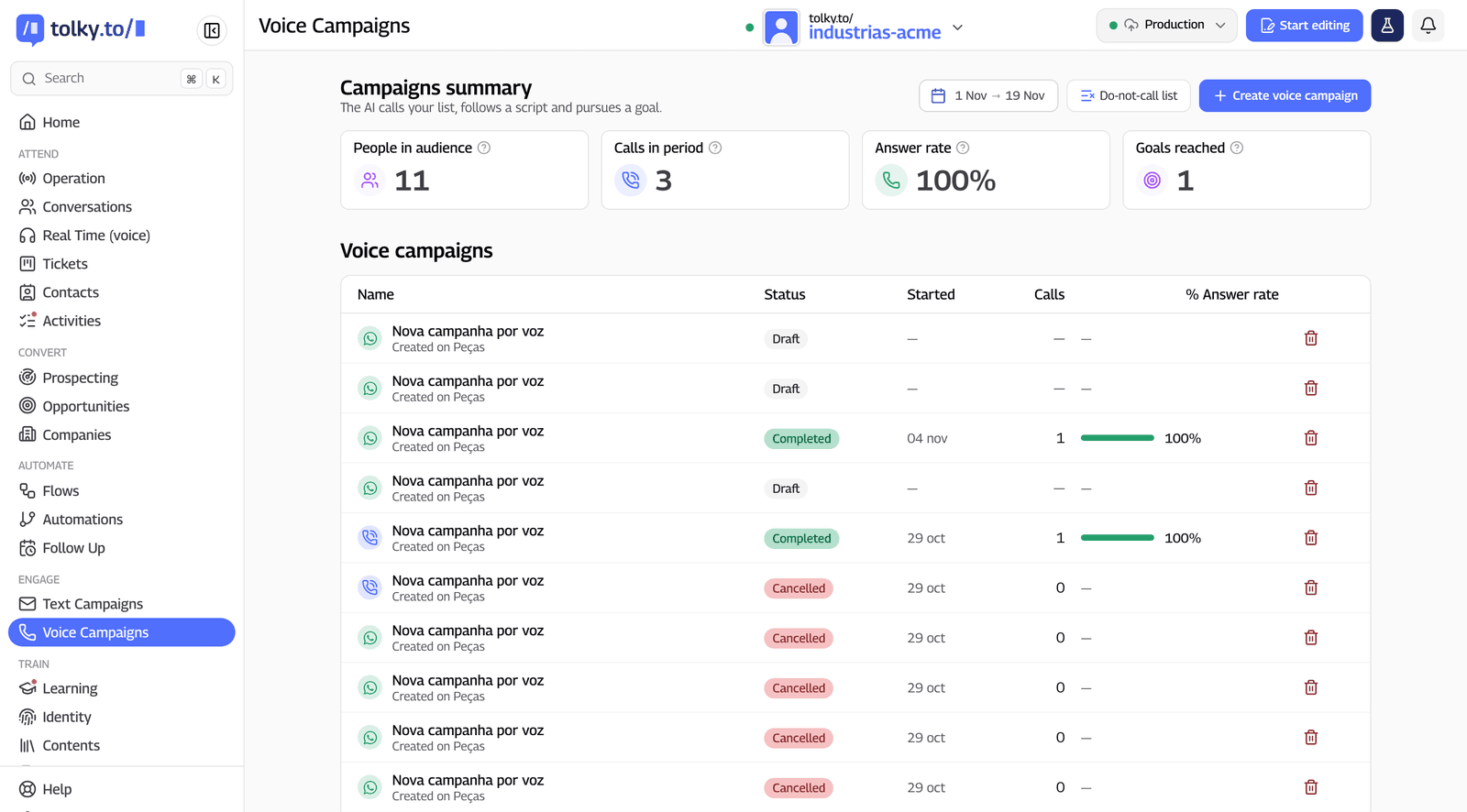
Tolky is not a dialer for agents: with Voice Campaigns, the AI calls your list over WhatsApp, telephony or both, holds the conversation following a script and pursues a goal, transferring to a person those who are ready. It is the alternative for teams looking for an AI dialer who want the AI to do the talking.
- Script and goal. The goal is free text or a flow node; the AI generates the script with opening, discovery, BANT or SPIN qualification, objections and close, and you rehearse it first playing the customer.
- Channel. In combined mode, Tolky tries to call over WhatsApp and, without the contact's permission, calls over telephony.
- Number protection. Gradual ramp-up, calling windows, retries with intervals, voicemail messages, skipping anyone called recently, a do-not-call list valid across all campaigns and an alert when the number may have been flagged as spam.
- People and cost. Transfer during the call, scheduled callbacks, a credit estimate before launch, a daily spending cap and cost per goal reached on the real-time dashboard.
Every call starts with the transcription notice, which cannot be turned off. For return calls, Voice Service answers on the phone, on WhatsApp and on the website. Both are enabled on activation.
What Tolky does not do: it does not offer preview, progressive or predictive dialing for a team of agents. If your operation depends on people talking on every call, a traditional dialer is the right choice.
Frequently asked questions
What is the difference between a predictive and a progressive dialer?
A progressive dialer calls one number at a time, only when an agent is free, so it never leaves a customer with nobody on the line. A predictive dialer calls several numbers per agent based on a forecast, which raises volume and also the risk of silent or very short calls.
Are auto dialers allowed in Brazil?
Yes. What Anatel targets is abusive use, such as an excessive daily volume of calls lasting up to 6 seconds. Dialer users must tune the pace, respect Não Me Perturbe in the sectors it covers and comply with the LGPD. Rules differ in other countries.
How much does an auto dialer cost?
Vendors usually charge per seat or per user, plus telephony minutes, and sometimes setup. Prices are often quote-based; compare by cost per live contact.
Is an auto dialer a good fit for small businesses?
It can be, usually in progressive or preview mode, which work well with few agents. If the team is small and the calls are repetitive, an AI voice campaign can cover the volume without growing the team.
Can an AI voice campaign replace a dialer?
It can for repetitive calls, such as first contact, confirmations and reactivation, because the AI talks instead of just dialing. For long, complex conversations, a dialer with human agents is still the right choice, and both approaches can coexist.
Conclusion
An auto dialer removes dead time from dialing, and AI improves when and whom to call, but the limit is still the team. When most calls follow a script, an AI voice campaign holds the conversation and hands the team only those who are ready. Whatever you choose, tune the pace to avoid short calls, respect the do-not-call list and measure the outcome of each contact. For the bigger picture of a whole operation, read the guide to AI for call centers.
See Voice Campaigns, explore Voice Service, see the plans or talk to the team →. Let's talk?
Share
Tags
- ai auto dialer
- auto dialer
- predictive dialer
- auto dialer for call centers
- auto dialer pricing
- auto dialer for small business
- #voice campaigns
- #conversational CRM
About the author

Co-founder of Tolky
Marlos Carmo is an AI entrepreneur and founder of Tolky, the conversational-era infrastructure and AI CRM that unifies intelligent service, multi-channel support (such as WhatsApp and voice), live CRM, and operational intelligence in a single ecosystem. He is a finalist for the SXSW Innovation Awards and a member of Francesco's Economy, a global network of young entrepreneurs focused on innovation and social impact. He works connecting Artificial Intelligence and digital transformation in projects for large organizations.
Next step
Want to bring this to your operation?
Tati, Tolky's AI assistant, understands your scenario in a few questions, suggests the best path and connects you with someone from the team, with full context.
Share