AI for call centers: what to automate, how to roll it out and measure
What AI takes over in a call center, what stays with your agents, how both work on the same call, what Brazil's customer service rules require and which metrics prove results.
TL;DR
AI for call centers means voice agents that take the first call, triage, resolve repetitive requests and cover peaks and overnight hours, handing anything that needs judgment to a human agent with the reason and transcript. In Brazil, Decree 13,135/2026 allows AI in customer service for regulated services as long as consumers can reach a person. Measure it by first contact resolution, abandonment and cost per resolved call.
Share
Every call center manager knows the math that never works: call volume comes in waves, the agent schedule is fixed, and every spike turns into a queue, abandoned calls and complaints. Staff for the peak and people sit idle in the troughs; staff for the average and customers wait.
Voice AI changes that math, but only when it goes in the right place. This guide covers what AI takes over, what stays with people, how both work together on the same call, what Brazil's customer service rules require, how to roll it out and which numbers to track.
Updated November 2026.
What is AI for call centers?
AI for call centers is the use of AI voice agents to answer and place calls in natural language, resolving requests that follow clear rules and transferring anything that needs judgment to human agents, with context. It replaces the keypad IVR and the first tier of support, not the whole team.
In practice, the agent listens to the caller, understands the reason, checks your systems and replies with a synthetic voice. When the case falls outside its scope, it passes the call along with a summary. For the mechanics (transcription, language model and speech synthesis), see the guide to AI voice agents for customer service. For the full operation, including text channels, see AI-powered contact centers.
What does AI take over in a call center?
AI takes over high-volume, low-variation calls: the first call, triage, repetitive requests, hours with no staff and part of outbound. These are the calls that keep your agents busy without using what they do best.


First call and triage
A conversational IVR swaps "press 1" for an open question: "how can I help?" Callers speak in their own words, the AI identifies the reason and decides whether to resolve it or which queue to route it to. The gain shows up in menu time and in fewer calls landing in the wrong queue. See also smart IVR.
Repetitive requests
Invoice copies, order or ticket status, opening hours, addresses, data confirmation, booking and rescheduling. If the answer lives in a system or a reviewed knowledge base, the AI can handle it end to end, with no queue.
After hours and during spikes
AI answers overnight, on weekends and when volume spikes, without extra shifts. It resolves what it can and, for the rest, logs the request with the reason so the team can pick it up during business hours.
Outbound calls
Appointment confirmations, payment reminders, short surveys, lead follow-up and reactivation. The AI follows a script, works toward a goal and transfers anyone ready to move forward to a human agent. The guide to AI telemarketing goes deeper into outbound.
| Call type | Who resolves it | Signal to transfer |
|---|---|---|
| Triage and routing | AI | Reason still unclear after two tries |
| Invoice copy, status, hours | AI | Conflicting data in the system |
| Booking and rescheduling | AI | Rule exception or emergency |
| Complaint | AI triages, a person resolves | Always, with the summary |
| Debt or contract negotiation | Person | Whenever the caller asks for terms |
| Cancellation | Person, with retention | Always, with no hurdles for the customer |
| Caller asks for an agent | Person | Immediately |
What stays with people?
People keep everything that requires judgment, empathy or authority to decide: serious complaints, negotiations, cancellations, exceptions and callers who ask for an agent. The AI prepares these calls; it does not close them.
An angry customer calling for the third time does not want a polite answer from a bot. They want someone to own the problem. The same goes for someone negotiating a debt, disputing a charge or describing a case your knowledge base does not cover.
The rule of thumb: if the outcome depends on a decision that is not written down, it belongs to a person. The AI's job is to make sure that person gets the call already knowing who the customer is, what they asked for and what has been tried.
How does AI work alongside your agents?
AI works alongside your team when agents can see, hear and join its calls, and when every transfer arrives with the reason and transcript. Without that, the AI becomes a black box the team learns to work around.


- Live monitoring. Supervisors see calls in progress, filter by AI or human, and read the real-time transcription.
- Joining the audio. When a conversation goes sideways, an agent joins the call and the AI goes silent, with no transfer needed.
- Transfer with context. The handoff carries the reason, the data collected and the transcript, so callers do not repeat themselves. The rules are in the guide to AI to human handoff.
- No one answers, the call does not die. If the assigned agent does not pick up, the call rings other agents.
- One history. The call transcript stays in the contact's history, next to the text conversations.
Bring the team in from day one. Your agents know which questions repeat and where callers get stuck, and that is the raw material for the AI's knowledge base.
What do Brazil's customer service rules say about AI?
In Brazil, Decree 13,135 of October 9, 2026 allows AI in customer service, as long as consumers have the option to speak with a person. It replaced Decree 11,034/2022, which was revoked. The points below were checked against the official text on November 20, 2026. Rules vary by country, so if you operate elsewhere, check your local regulation.
The decree covers products and services regulated by the federal government, according to each regulator's criteria, and digital financial, payment and credit services supervised by Brazil's Central Bank (art. 1). The points that matter most for a call center:
- AI allowed. Companies may use automated procedures, including artificial intelligence, to triage and resolve requests (art. 3, § 3).
- A person on request. Human service is guaranteed when the consumer asks (art. 4, VIII), and the option to reach a person must be available at every level of the phone channel (art. 16, § 2).
- Human hours. Human phone service runs from 8 a.m. to 8 p.m., seven days a week (art. 14, § 1).
- Wait time. After choosing to speak with a person, the consumer waits up to 20 seconds in at least 80% of cases and up to 300 seconds in the rest, unless the regulator sets a specific rule (art. 15).
- Menus. The phone channel cannot have more than five levels (art. 16).
- No repeating. Once a request is logged, the consumer cannot be asked to state it again, except for a justified technical reason (art. 6, II).
- Recordings. Call recordings must be kept for at least 90 days (art. 19).
If your industry is outside the decree's scope, Brazil's Consumer Protection Code still applies, and the same practices help avoid complaints. Confirm the exact rule for your case with your legal team.
Which metrics should you track with AI in the call center?
Track AI by what it resolves and by its effect on the whole queue: first contact resolution, average handle time, abandonment, AI resolution and cost per resolved call. Looking only at the volume the AI handled hides the people who hung up or called back.
| Metric | How to calculate | What to watch |
|---|---|---|
| FCR | Cases resolved with no repeat call for the same reason ÷ total cases | If it drops after AI, the AI is closing calls without resolving them |
| AHT | Total call time ÷ calls handled | Split AI and humans; agents tend to keep the longer cases |
| Abandonment rate | Calls ended by the caller before service ÷ calls received | Should drop during spikes and after hours |
| AI resolution | Calls closed by AI with the request handled ÷ calls with AI | Cross-check with FCR to avoid counting false wins |
| Transfer rate | Calls passed to people ÷ calls with AI, by reason | A recurring reason means a gap in the knowledge base |
| Cost per resolved call | Total monthly cost (channel, voice and AI, platform, team) ÷ resolved calls | The metric that goes to leadership |
One expected effect: human AHT goes up when AI absorbs the short calls, because the hard cases are what remains. That is not a decline. For the formulas, see AHT, SLA and first response and how to measure AI resolution rate. To project the return, use the customer service ROI calculator.
How do you roll out AI in a call center?
Roll out AI one queue at a time, not across the whole center: pick a call reason, prepare the knowledge base, define the path to people, test and expand with data. A well-measured pilot wins over leadership and the team at the same time.
- Map call reasons. Use disposition codes and recordings to list reasons by volume and by time spent by the team.
- Pick the first queue. High volume, clear rules, low risk. Invoice copies and scheduling are common candidates.
- Prepare the knowledge base and integrations. Answers reviewed with the team and access to the data the AI needs.
- Write the transfer rules. When to transfer, to which queue, what happens if nobody answers and what the AI says meanwhile.
- Test internally. Agents call in pretending to be difficult customers, with accents, noise and interruptions.
- Open it to part of the volume. One number or one time slot, with a baseline of the metrics from before.
- Review every week. Listen to a sample of calls, adjust the knowledge base and only then add the next queue.
The most common mistake is hiding the path to a human agent to inflate the resolution rate. Besides breaking Brazil's rules in regulated sectors, it shows up in FCR and NPS the following month.
Where Tolky fits
Tolky is an AI conversational CRM whose Voice Customer Service puts AI on calls over WhatsApp, phone lines and website voice, with your team following everything live. Phone service is enabled on request: you choose the number, and each number has its own agent.
For a call center, what counts is how it works with the team. Agents see calls in progress, filtered by AI or human, read the live transcript and can listen in. When an agent joins the audio, the AI goes silent. The AI transfers to an agent and, if the assigned agent does not pick up, the call rings other agents; there is also an alert when a caller asks for an agent. Callers can interrupt the AI, and the transcript stays in the contact's history.
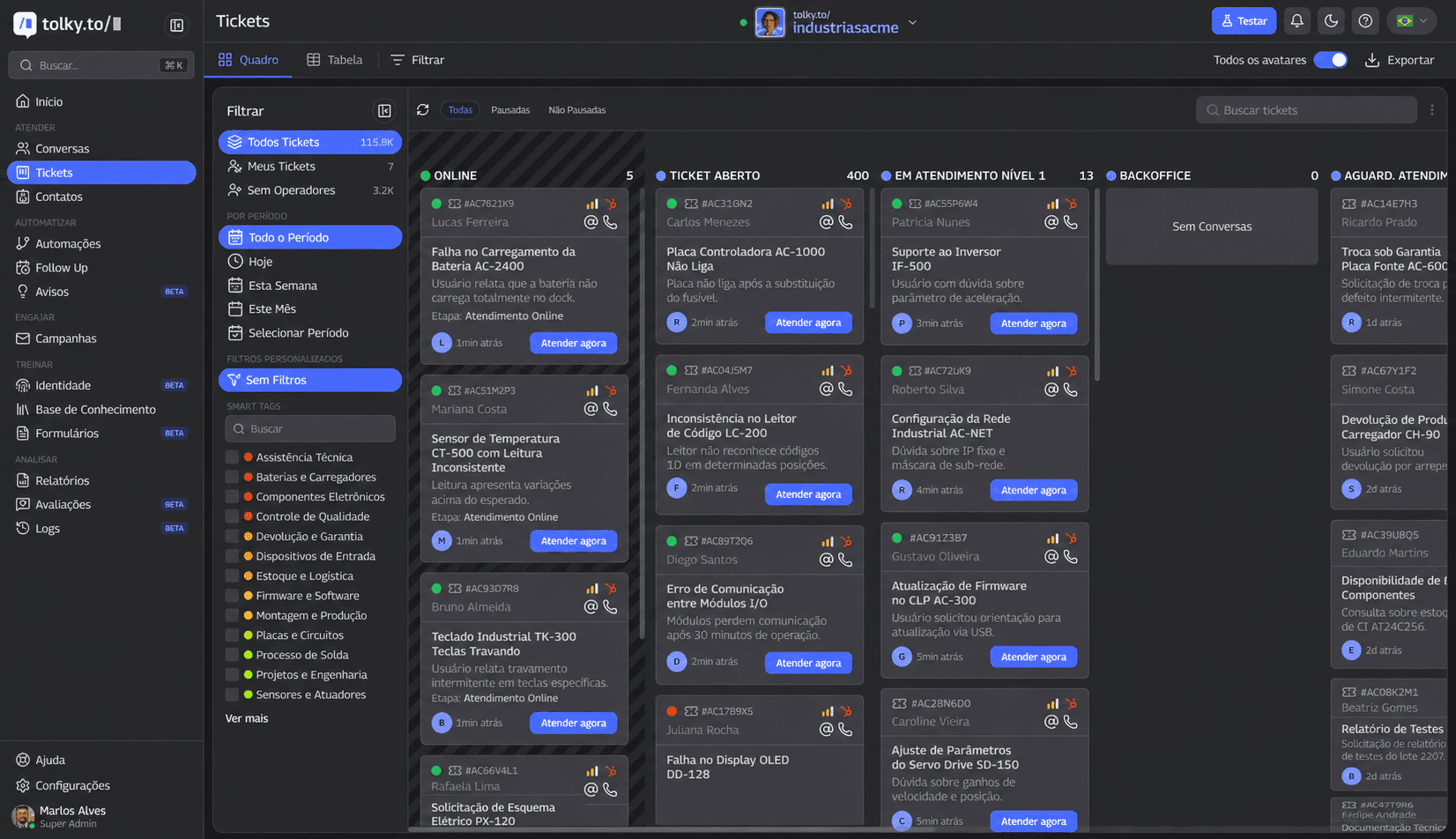
For outbound, Voice Campaigns call your base with a script and a goal, calling windows, retries, a do-not-call list that applies to every campaign, live transfer to a person and a real-time dashboard with goals, transfers and credits.
What Tolky does not do: it is not a voiceover or voice cloning tool, and it has no configurable audio retention period. If your operation must keep recordings for a set period, confirm with the team how that works for you.
Frequently asked questions
Will AI replace call center agents?
No. It absorbs repetitive calls, triage and hours with no staff, and agents keep the cases that need judgment. For regulated services in Brazil, the option to speak with a person is mandatory.
Which calls should you automate first?
High-volume calls with clear rules: invoice copies, status, hours, booking and confirmations. Leave complaints, negotiations and cancellations with people, with the AI handling only triage.
Is AI allowed in customer service under Brazil's Decree 13,135/2026?
Yes. The decree allows automated procedures, including AI, for triage and resolution, as long as the consumer has the option of human service. It replaced Decree 11,034/2022.
How do you know AI is working in the call center?
Compare FCR, abandonment and cost per resolved call before and after, and cross-check AI resolution against repeat calls. Listen to a sample of calls every week.
Can an agent join a call the AI is handling?
It depends on the platform. In Tolky, yes: the team follows the live transcript, can listen in and, when an agent joins the audio, the AI goes silent.
How much does AI for call centers cost?
It adds up the channel fee, voice and AI processing per minute, the platform and your team's time on transfers. Compare vendors by cost per resolved call, not price per minute.
Conclusion
AI for call centers works when it takes the first call and the repetitive work, always leaves the path to a human agent open and hands over every transfer with context. Start with one queue, measure FCR, abandonment and cost per resolved call, and expand with your team on board.
Explore Voice Customer Service, see Voice Campaigns, see the plans or talk to the team →. Let's talk?
Share
Tags
- ai for call centers
- ai agents for call centers
- voice ai for call centers
- ai in the call center
- #ai contact center
- #conversational ivr
- call center automation
- #conversational CRM
About the author

Co-founder of Tolky
Marlos Carmo is an AI entrepreneur and founder of Tolky, the conversational-era infrastructure and AI CRM that unifies intelligent service, multi-channel support (such as WhatsApp and voice), live CRM, and operational intelligence in a single ecosystem. He is a finalist for the SXSW Innovation Awards and a member of Francesco's Economy, a global network of young entrepreneurs focused on innovation and social impact. He works connecting Artificial Intelligence and digital transformation in projects for large organizations.
Next step
Want to bring this to your operation?
Tati, Tolky's AI assistant, understands your scenario in a few questions, suggests the best path and connects you with someone from the team, with full context.
Share