Outbound IVR: what it is, how it works, pricing and the AI version
What outbound IVR is, how automated calls with a recorded message and keypad options work, what they are used for, how they are priced, Brazil's rules and what AI changes.
TL;DR
Outbound IVR (called *URA reversa* in Brazil) is an automated outbound call: the system dials a list, plays a recorded message and asks the person to press a key to confirm, reach an agent or get a callback. It is used for collections, payroll loans, confirmations and surveys. The AI version replaces the recording and the keypad with a conversation that handles questions, pursues a goal and hands off to a person.
Share
If you have ever picked up your phone and heard "Hello, we have an offer for you, press 1 to speak with a consultant," you just received an outbound IVR call. The format is old, cheap to set up and still widely used in collections and lending. It is also a big reason people stop answering unknown numbers.
This guide explains how outbound IVR works, what it is used for, how vendors charge, what the rules in Brazil require and what changes with AI.
Updated November 2026.
What is outbound IVR?
Outbound IVR is an automated outbound calling system: instead of waiting for customers to call, the company dials a list, plays a recorded message and offers keypad options. The name comes from the traditional IVR, the interactive voice response menu that answers inbound calls. In the outbound version the flow is reversed: the machine calls and the customer responds.
In Brazil it is called URA reversa. The market also uses names like voice broadcast, voice blast or press-1 campaigns. The differences between them are covered in voice broadcast and in inbound vs outbound IVR.
How does outbound IVR work, step by step?
Outbound IVR works in five steps: list, dialing, message, keypress and destination. Each step is configured before the campaign and runs with no one on the line until the customer asks for an agent.


- Phone list. The company uploads its contact base, usually a spreadsheet with name, number and a data point such as the amount due or an appointment date.
- Dialing. The dialer calls many numbers at once within a set time window and retries those who did not answer.
- Recorded message. Whoever answers hears a prerecorded audio, sometimes with parts personalized through text-to-speech, such as a name or a due date.
- Keypad options. The person presses 1 to confirm, 2 to reach an agent, 9 to stop receiving calls, and so on.
- Destination. Depending on the key, the call goes to an agent queue, triggers a new payment slip, logs the answer or ends.
The report shows how many calls were answered and how many people pressed each key. The team only steps in at stage 5, which is what attracts companies with a large base and a small team.
What is outbound IVR used for?
Outbound IVR is used for simple notices and requests at high volume: collections, credit offers, appointment confirmations and short surveys. The table sums up the most common uses and where each one hits a wall.
| Use | Typical message | What the keypress does | Where it hits a wall |
|---|---|---|---|
| Collections | Overdue installment notice | Sends a payment slip or calls an agent | Questions about the amount need a person |
| Payroll loans | Available credit offer | Transfers to a consultant | Sector rules and high rejection |
| Appointment confirmation | Reminder of a visit or consultation | Confirms, cancels or reschedules | Rescheduling needs dialogue |
| Survey | Score from 1 to 5 | Records the score | No room for the why |
| Operational notice | Outage, delivery, schedule change | Repeats or ends | Cannot answer questions |
Collections and reminders
In collections, outbound IVR announces the installment, offers a new payment slip and transfers people who want a deal to a negotiator. To actually negotiate, it needs a person or something that can talk. See how AI helps here in AI for collections and in the collections area.
Payroll loans in Brazil
In Brazil's payroll-deductible loan market (consignado), outbound IVR calls to offer available credit and passes whoever presses the key to a consultant. It is also the most regulated use. Brazil's social security agency (INSS) states that financial institutions are prohibited from actively offering payroll loans to beneficiaries for 180 days after the benefit is granted, and that the benefit is blocked for this type of credit for 90 days (INSS, checked on November 20, 2026). Payroll-loan banks also take part in Não Me Perturbe, explained below. Validate your list and script with legal counsel before any campaign; see also financial services.
Confirmations and surveys
Clinics, schools and appointment-based businesses use outbound IVR to confirm attendance or collect a quick score, the least sensitive use. The limit shows up when the person wants to reschedule or explain the score: the menu has nowhere to go.
How much does outbound IVR cost?
The cost of outbound IVR has two parts: telephony, charged by duration or by number of calls, and the platform, charged by subscription, bundle or usage. Prices vary a lot across vendors and volumes, so this guide does not include a price table.
In practice, the three most common pricing models are:
- Per minute: you pay for talk time, sometimes with a minimum billing increment per answered call.
- Per call: a fee per attempt or per completed call, regardless of duration.
- Bundle or subscription: a monthly allowance of minutes or calls, with overage billed separately.
Compare by cost per result, not per minute: a cheap IVR that drops calls within seconds costs you in number reputation. For AI voice the math is similar: in Tolky, a campaign shows the credit estimate before it starts and the cost per goal reached while it runs. See the plans.
What are the rules in Brazil?
In Brazil, mass outbound calling falls under the telecom regulator Anatel's rules against abusive calls, mandatory authentication for large callers and the Não Me Perturbe (Do Not Disturb) registry. These are Brazilian rules; other countries have their own (such as do-not-call lists and robocall laws), so check the regulator where you call. The points below were checked at the official sources on November 20, 2026.
- Abusive calls. Since 2022, Anatel has issued precautionary measures requiring carriers to block users with an excessive daily volume of short calls. Since June 1, 2024, a short call is one lasting up to 6 seconds (Anatel, Abusive Calls).
- Authentication. Anyone making more than 500,000 calls a month must use call authentication since November 15, 2025, a rule upheld by Anatel's board (Anatel).
- Não Me Perturbe. Registration is free and blocks telemarketing from participating telecom carriers and financial institutions, including payroll-loan banks. The block takes effect within 30 days of the request (Não Me Perturbe). According to Anatel, it does not cover data confirmation, fraud prevention or collection calls.
What about the 0303 prefix?
The 0303 prefix was created in 2021 to identify outbound telemarketing in Brazil, but since Ruling No. 201 of August 14, 2025, using it has been optional (Anatel, 0303 prefix, checked on November 20, 2026). The agency replaced prefix identification with authentication of calls from large originators. There are public requests to make it mandatory again, so check Anatel's page before setting up your operation.
A practical warning: an outbound IVR that dials heavily and drops within seconds produces exactly the short-call pattern these measures target. Pacing, time windows, a do-not-call list and a message that respects the listener are part of compliance, not just experience. For personal data in your list, see LGPD.
What are the limits of classic outbound IVR?
The limit of classic outbound IVR is that it talks but does not listen: the same recording goes to everyone, and the only possible answer is a keypress. That creates four problems anyone running the model knows well.
- High rejection. Many people hang up as soon as they notice a recording, before hearing the offer.
- No questions answered. "Does that amount include interest?" does not fit in a keypad menu.
- A queue at the end of the funnel. Whoever presses "speak with an agent" lands in a queue; if the team is busy, the call is lost.
- Little learning. The report tells you how many pressed 1, not why the others hung up.
For a due-date reminder or an operational notice, it works. The problem starts when a company uses a notice format to negotiate, qualify or sell.
Outbound IVR with AI: what changes?
Outbound IVR with AI replaces the recording and the keypad with a voice agent that talks: it introduces itself, understands the spoken answer, handles objections and pursues a goal, handing off to a person when it makes sense. In Tolky, this format is called a voice campaign.


| Aspect | Classic outbound IVR | AI voice campaign |
|---|---|---|
| Message | Same recording for everyone | Script with stages, adapted to the answer |
| Customer response | Keypress | Natural speech |
| Questions and objections | No answer | Answers planned in the script |
| Goal | Pressing a key | Free-text goal, such as booking or qualifying |
| Handoff to a person | Queue at the end | Transfer during the call, with context |
| Record | Keypress count | Conversation transcript in the contact history |
| Dialing pace | Set in the dialer | Gradual calling and a do-not-call list across campaigns |
AI does not remove regulation or rejection. What changes is that when the person answers, the call becomes a useful conversation. To see how the agent works inside, read AI voice for customer service; for a comparison with dialers, see AI auto dialer.
Outbound IVR with WhatsApp: how does it work?
Outbound IVR with WhatsApp uses WhatsApp calls instead of regular phone lines, but the contact must authorize the business to call. Without that permission, an outbound WhatsApp call does not happen.
In Tolky, a campaign can call through WhatsApp, through phone lines or both. In combined mode, the AI tries WhatsApp and, when the contact has not given permission, calls through the phone line. The permission request goes out as a template or message, and the status (authorized, declined, pending) is visible. For how WhatsApp calls work, see WhatsApp Business calling.
Where does Tolky fit in?
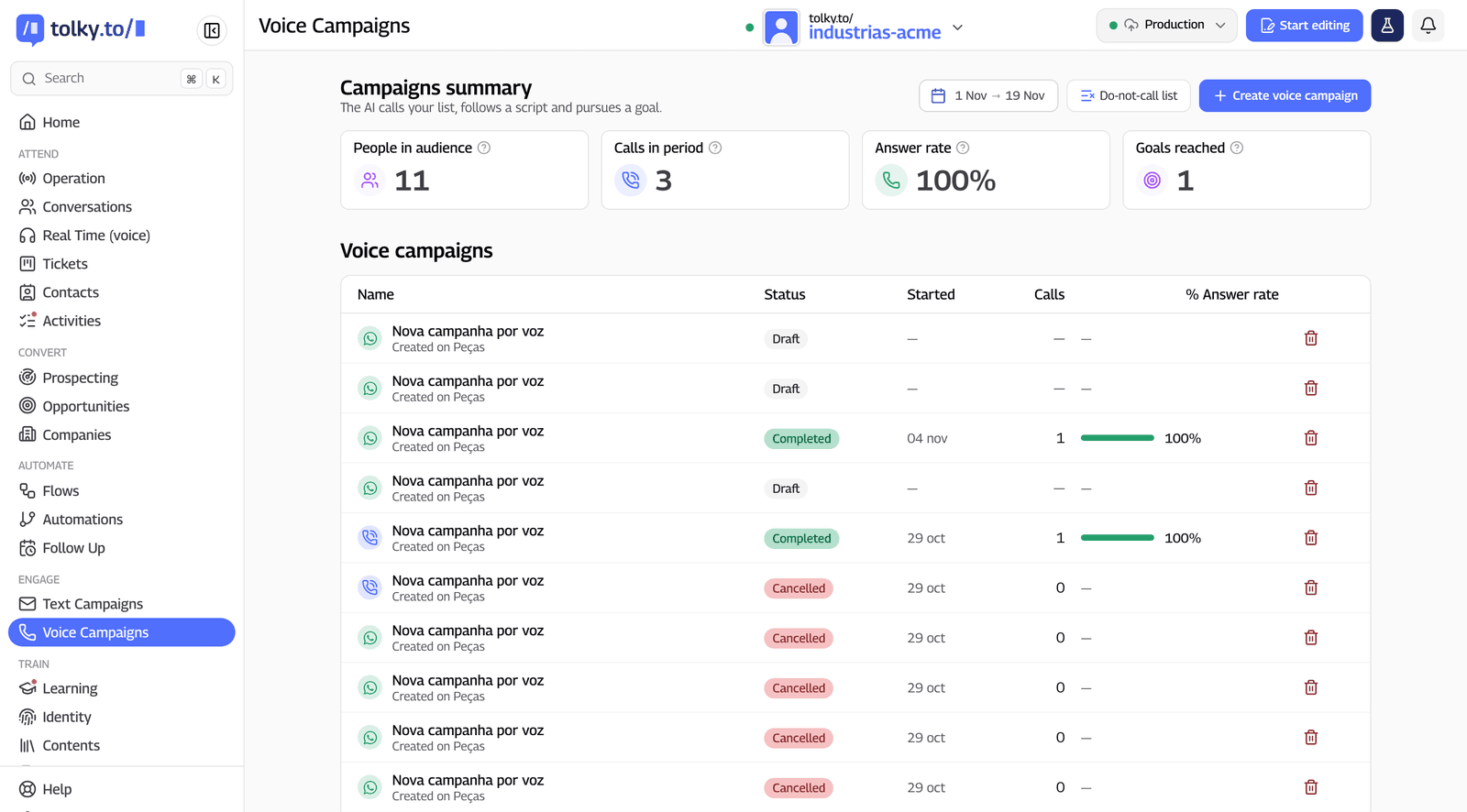
Tolky fits in with Voice Campaigns: the AI calls your list through WhatsApp or phone lines, follows a script and pursues a goal, with your team ready to take over. Voice is enabled on activation. The features are on the Voice Campaigns page.
- Goal and script. The goal is free text or a flow node. The AI generates the script (opening, permission, discovery, presentation, offer and close, with BANT or SPIN qualification and objections), and you rehearse by playing the lead.
- Time windows and retries. Time windows, new attempts at intervals and a voicemail message.
- Number protection. Gradual calling, skipping people called recently, a do-not-call list valid for all campaigns and an alert when the number may have been flagged as spam.
- People at the right moment. Transfer to a teammate during the call and a scheduled callback when the contact asks.
- Transparency. Every call starts with the transcription notice, which cannot be turned off.
- Cost under control. Credit estimate before starting, a daily spending cap and a real-time dashboard with answer rate, goals, transfers, average sentiment and credits.
When the customer is the one calling, the path is Voice Customer Service, with the same AI answering on WhatsApp, on the phone and on the website. What Tolky does not do: it is not a voiceover or voice cloning tool, and it does not replace legal review of your list and script.
Frequently asked questions
What is outbound IVR?
It is a system that automatically calls a contact list, plays a recorded message and offers keypad options, such as confirming, reaching an agent or opting out. It is the opposite of a regular IVR, which answers inbound calls.
What is the difference between outbound IVR and voice broadcast?
In practice, very little. Voice broadcast is usually just the recorded message with no interaction; outbound IVR normally adds keypad options and transfer to an agent.
Is outbound IVR legal in Brazil?
Outbound calls are allowed, but they follow rules: Anatel blocks excessive short-call volume, requires authentication from anyone making more than 500,000 calls a month, and consumers can sign up for Não Me Perturbe. Sectors such as payroll loans have their own rules, so check with legal counsel. Rules vary by country.
Is the 0303 prefix still mandatory in Brazil?
No. Since August 2025, Anatel has made 0303 optional and requires authentication for calls from large originators. Check the official page before setting up, as there are requests to make it mandatory again.
Is there outbound IVR with AI?
Yes. Instead of a recording and a keypad, a voice agent talks with whoever answers, handles questions, pursues a goal and hands off to a person when needed. In Tolky, these are Voice Campaigns.
Can outbound IVR run over WhatsApp?
Yes, as long as the contact authorizes the business to call on WhatsApp. In Tolky, combined mode tries WhatsApp and uses the phone line for contacts who have not authorized it.
Conclusion
Outbound IVR handles simple notices at high volume, but it does not talk, and that is where it loses people with questions or objections. An AI voice campaign keeps the scale and swaps the keypress for dialogue, with pacing rules, a do-not-call list and a person ready to take over. For the other side, when the customer calls you, see smart IVR and semantic IVR.
See Voice Campaigns, explore Voice Customer Service, see the plans or talk to the team →. Let's talk?
Share
Tags
- outbound ivr
- how outbound ivr works
- outbound ivr with ai
- ivr for collections
- outbound ivr whatsapp
- ai voice campaign
- #conversational CRM
Cited in
- AI auto dialer: types, pricing and how it differs from a voice agent
- AI for debt collection: voice agent calls and WhatsApp reminders
- Voice broadcasting and mass calling: the rules and what AI changes
- Inbound vs outbound IVR: differences, examples and when to use each
- Intelligent IVR: what it is, cognitive IVR and building one with AI
- AI voice agent for customer service: what it is and how it works
About the author

Co-founder of Tolky
Marlos Carmo is an AI entrepreneur and founder of Tolky, the conversational-era infrastructure and AI CRM that unifies intelligent service, multi-channel support (such as WhatsApp and voice), live CRM, and operational intelligence in a single ecosystem. He is a finalist for the SXSW Innovation Awards and a member of Francesco's Economy, a global network of young entrepreneurs focused on innovation and social impact. He works connecting Artificial Intelligence and digital transformation in projects for large organizations.
Next step
Want to bring this to your operation?
Tati, Tolky's AI assistant, understands your scenario in a few questions, suggests the best path and connects you with someone from the team, with full context.
Share