AI for marketing agencies: internal uses and services to sell
AI for marketing agencies on two fronts: where it cuts costs inside the agency (research, content, reporting) and where it becomes revenue as a client service, with risks and criteria.
TL;DR
AI for marketing agencies works on two fronts: inside the agency, it cuts costs in research, content production, reporting and the agency's own sales; outside, it becomes a client service, such as an AI agent on WhatsApp that answers, qualifies and reactivates leads. Choose tools by reviewable quality, data handling and integration, and manage the risks: client data, privacy law and Meta's rules.
Share
Most lists of "AI tools for marketing agencies" are about writing posts and generating images. For whoever runs the agency, the question is different: where does AI cut costs in-house, and where does it become revenue outside, on the client's account?
Both answers matter, but they weigh differently. Internal AI makes the agency faster, and the competition gets faster too. AI as a service changes what the agency sells: instead of only generating leads, it takes care of the service that turns a lead into a sale. This guide separates the two fronts, shows how to choose tools and which risks to manage before putting client data into any system.
Updated in November 2026.
What is AI for marketing agencies?
AI for marketing agencies is the use of artificial intelligence tools on two fronts: in the agency's internal operation, to produce and analyze faster, and in services sold to clients, such as AI agents that answer and qualify leads. The first cuts costs; the second creates recurring revenue.
The difference between them is who is accountable for the result. On the internal front, AI helps the team, and the agency reviews everything before delivery. On the service front, AI talks to your client's customers, so it needs rules, supervision and a platform built for that. What an agent is and how it works is covered in the guide on AI agents.
Where does AI cut costs inside the agency?
Inside the agency, AI cuts costs in four tasks: research, content production, reporting and the agency's own sales. In all of them, the tool drafts and the team reviews.


| Internal use | What AI does | Examples in Discover AI | What the team reviews |
|---|---|---|---|
| Market research and briefs | Summarizes sources, competitors and client documents | Perplexity, NotebookLM | Whether the source exists and says what the summary says |
| Content and scripts | Drafts, headline and ad variations | ChatGPT, Claude | Brand voice, facts and promises |
| Design and assets | Image variations and format adaptation | Canva Magic Studio | Art direction and usage rights |
| SEO | Technical and content suggestions | Semrush Copilot | Priority and real impact |
| Reports and data | Reads spreadsheets, builds charts and summarizes the period | Julius AI | Numbers checked at the source |
| Meetings | Transcribes and summarizes client meetings | tl;dv | Decisions and next steps |
The examples come from the Discover AI directory, where Tolky groups tools by area, with a description and the official link. Reports deserve special attention because they eat up team hours; the guide on AI report automation shows how to validate numbers before the meeting.
The fourth use is often forgotten: the agency's own sales. A lead who messages the agency's website or WhatsApp at night also goes cold. An AI agent that replies right away, asks the first questions and books a call with a partner is the same service the agency can sell later, and it works as a showcase.
How does AI become a service for the agency's clients?
AI becomes a service when the agency deploys and runs, on the client's account, an AI agent that answers leads on WhatsApp, qualifies them and reactivates those who stopped replying, and charges for it every month. This is the front that creates recurring revenue.
The three most direct services are:
- Lead response: an agent on WhatsApp through the official API replies right away, including after hours, answers questions based on what the client taught it and hands off to sales with the conversation's context.
- Qualification: the agent asks the questions that separate a hot lead from a browser and routes each one to the right place.
- Reactivation: automatic follow-up and segmented campaigns for leads who stopped replying, using Meta-approved templates and only for people who opted in.
These services go into the proposal as setup plus monthly operation, next to media and content. The guide on marketing agency services with AI shows how to package them, and the one on how to sell AI agents to businesses covers the sale. One limit belongs in the proposal: linking each sale to its source ad depends on the client's process or a custom integration.
How to choose AI tools for your agency
Choose AI tools by the quality you can review, by what happens to client data and by integration with what the agency already uses, not by the feature list. For agents that talk to end customers, add human supervision and testing before publishing.


| Criterion | Question to ask the vendor | Why it matters to the agency |
|---|---|---|
| Client data | Is submitted data used to train models? Can it be deleted? | The agency answers to the client for what it did with their data |
| Review and testing | Can you simulate conversations and compare versions before publishing? | An agent mistake reaches the end customer and becomes an account problem |
| Handoff to people | Does the agent transfer to sales with the history? | A hot lead can't get stuck with the AI |
| Official channel | Does it use the official WhatsApp API? | Unofficial integrations put the client's number at risk |
| Integration | Does it connect to the CRM, forms and systems via API or webhook? | Without integration, AI becomes an FAQ and data never reaches the report |
| Agency access | Can you monitor several accounts with access profiles and activity logs? | The agency needs to see and prove what happened |
For internal use, general-purpose tools work well, as long as no one pastes sensitive client data without permission. For client services, the rule changes: the agent needs a knowledge base, transfer rules and supervision, as described in the guide on AI-to-human handoff.
What are the risks of AI in a marketing agency?
The three main risks are misuse of client data, breaking privacy law and ignoring Meta's rules for AI on WhatsApp; a fourth, made-up answers, is controlled with testing and supervision. All of them reach the agency as a reputation problem.


- Client data: pasting a contact list, contracts or sales numbers into an open tool can expose information the client never authorized. Put in writing what can go into each tool.
- Privacy law: when the agency processes personal data on the client's behalf, it usually acts as the processor and the client as the controller, under Brazil's LGPD and similar laws elsewhere. The contract should say so, and the tool must make compliance possible.
- Meta's rules: since January 15, 2026, the WhatsApp Business Platform terms ban general-purpose AI assistants, where the AI is the product itself; agents that serve a company's customers remain allowed (terms checked by Tolky on November 19, 2026). The guide on WhatsApp's ban on general-purpose AI chatbots details what applies.
- Made-up answers: hallucination drops with a well-built knowledge base, testing before publishing and handoff to people when the AI doesn't know.
What does this change for your agency?
For your agency, internal AI protects margins and AI as a service creates a new revenue line, and together they change what you sell and how you prove results. In practice:
- Fewer hours per deliverable: research, drafts and reports take less time, and the team moves up to strategy and review.
- A recurring service: lead response, qualification and reactivation run every month and go into the retainer.
- Proof of results: with service running in the system, the meeting shows what happened to each lead, not just clicks.
- Data policy as an edge: an agency that explains where client data lives and who can access it earns trust in the sale.
- A path without becoming a tech company: you can start by referring a platform and move on to selling and implementing when the team is ready.
To reposition the whole agency, see marketing agency with AI; to build a dedicated practice, see AI automation agencies.
Where Tolky fits
Tolky is the platform for the service front: AI agents on WhatsApp through the official API, on webchat and other channels, with a CRM born from the conversation and handoff to the team with context. It doesn't replace the agency's internal tools; it's where the client's customer service runs.
What Tolky delivers: agents configured by mission (sales, support, engagement); simulations and versions before publishing, as the trustworthy AI page shows; a CRM with contacts, opportunities and pipeline; automatic Follow Up; access profiles and activity logs with export. Verified security controls are listed on the security page, and customer service on WhatsApp customer service.
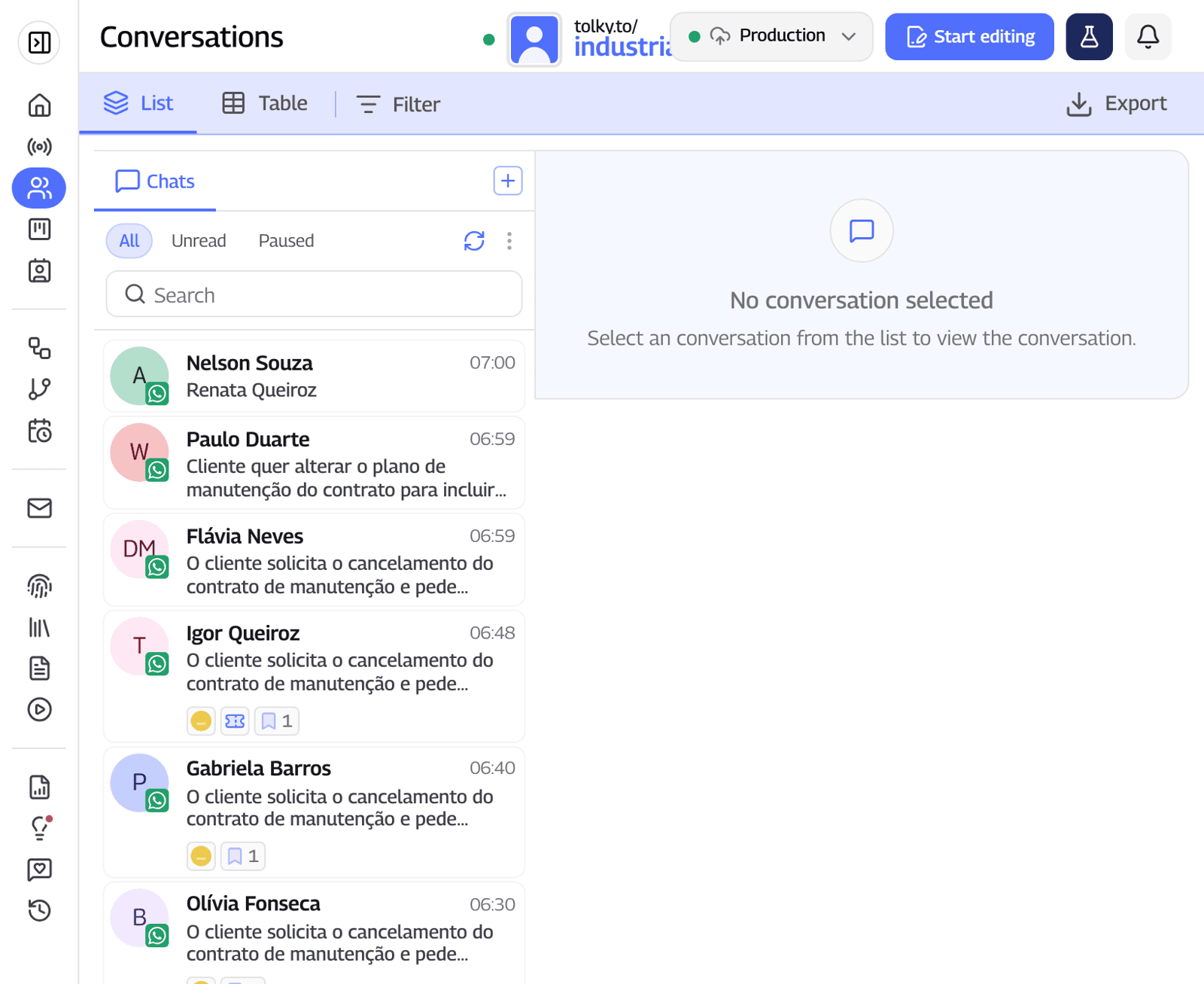
What Tolky doesn't do: it doesn't manage ads, doesn't automatically store the source ad of each lead and doesn't offer anonymization or configurable data retention.
Frequently asked questions
What is the best AI for marketing agencies?
There isn't just one. For research, content, design and reporting, general and specialized tools do the job, and the Discover AI directory lists options by area. To answer a client's leads on WhatsApp, the right fit is an agent platform with the official API, a CRM and supervision.
What is an AI agent for marketing agencies?
It's an agent that talks to people and performs tasks, such as answering, qualifying and scheduling. The agency can use it in its own sales and deploy it at clients as a recurring lead response and qualification service.
Will AI replace marketing agencies?
No. It makes execution cheaper, but strategy, review, brand voice and accountability for results stay with the agency. What changes is what the agency sells: fewer one-off pieces, more operation and results.
Can I use ChatGPT with my agency's client data?
Only with the client's permission and clear rules on what can go into the tool. Check the data policy of the plan your agency uses and avoid pasting personal data or confidential information unless necessary.
Does Meta allow AI agents on WhatsApp?
Yes, when they serve a company's customers. Since January 15, 2026, Meta bans on the API only general-purpose AI assistants, where the AI is the product itself.
Conclusion
AI for marketing agencies has two fronts. In-house, it saves hours in research, content, reporting and the agency's own sales, always with review. Outside, it becomes a client service, with agents that answer, qualify and reactivate leads on WhatsApp. Choose tools by what happens to data and by supervision, cover privacy law and Meta's rules in the contract and start with the front your team can already sustain.
Your agency can deliver this with Tolky
The Tolky Partner Program is for agencies that want to bring AI agents, CRM and WhatsApp campaigns to their own portfolio, with recurring revenue. On the Referral track, the agency introduces Tolky and registers the opportunity, and the Tolky team sells, contracts and serves the client, with a recurring commission for 12 months; when the team is ready, you can sell and implement under the Tolky brand or run the platform under your own brand and domain. Training and certification are free for program companies, and the Tolky team supports every initial project in 1:1 sessions.
Explore the Partner Program → Let's talk?
Share
Tags
- ai for marketing agencies
- best ai tools for marketing agencies
- ai agent for marketing agencies
- ai tools for agencies
- ai in marketing
- #whatsapp ai agent
- #partner program
- #conversational CRM
About the author

Co-founder of Tolky
Marlos Carmo is an AI entrepreneur and founder of Tolky, the conversational-era infrastructure and AI CRM that unifies intelligent service, multi-channel support (such as WhatsApp and voice), live CRM, and operational intelligence in a single ecosystem. He is a finalist for the SXSW Innovation Awards and a member of Francesco's Economy, a global network of young entrepreneurs focused on innovation and social impact. He works connecting Artificial Intelligence and digital transformation in projects for large organizations.
Next step
Want to bring this to your operation?
Tati, Tolky's AI assistant, understands your scenario in a few questions, suggests the best path and connects you with someone from the team, with full context.
Share