WhatsApp bans general-purpose AI chatbots? What applies in 2026
Since January 15, 2026, WhatsApp's terms bar general-purpose AI assistants from the API, and ChatGPT left the app. See what is allowed, what Brazil's CADE decided and what it means for your agent.
TL;DR
Since January 15, 2026, the WhatsApp Business Platform terms have barred AI providers whose main function is the AI itself, such as general-purpose assistants; that is why ChatGPT and Copilot left WhatsApp. AI agents that serve a company's own customers are still allowed. In Brazil, the antitrust authority CADE suspended the rule in January 2026 and upheld a daily fine against Meta in April, because Meta started charging these providers per message.
Share
On January 15, 2026, ChatGPT stopped replying on WhatsApp. The reason was a change in Meta's terms for the WhatsApp Business API, which closed the door on general-purpose AI assistants from other companies.
The news raised a question for anyone using AI in customer service: is my chatbot banned too? The short answer is no. This guide shows what the rule says, who it affects, what CADE decided in Brazil and how to tell whether your project is on the right side of it.
Updated in November 2026, with Meta's terms and CADE's decisions checked on November 19, 2026.
What does WhatsApp's rule say about AI chatbots?
The rule, in the "AI Providers" section of the WhatsApp Business Platform terms, prohibits providers and developers of AI technologies, such as large language models and general-purpose assistants, from accessing or using the platform when AI is the primary functionality of the service, rather than incidental or ancillary. Meta decides whether a service falls under the rule (WhatsApp Business Platform terms, last updated September 23, 2026).


Three terms settle almost every question:
- AI provider: whoever develops or provides the AI technology, such as an LLM or an assistant open to any question.
- Primary functionality: the product people are looking for is the conversation with the AI itself.
- Incidental or ancillary: the AI helps deliver another service, such as serving the customers of a store, a clinic or a bank.
The terms also include an exception for countries listed on a separate page, which is where the markets in which Meta was required to keep access open come in.
Why did Meta ban general-purpose AI chatbots?
Meta says the WhatsApp Business API exists to help businesses serve their own customers, not to distribute third-party AI assistants. The change was announced in October 2025 and took effect on January 15, 2026, according to TechCrunch, which spoke with a Meta spokesperson.
The backdrop is competition. Meta has its own assistant on WhatsApp, Meta AI, now running on the Muse Spark model. Authorities in Italy, the European Union and Brazil opened investigations precisely to assess whether the rule favors Meta AI.
Who left WhatsApp because of the rule?
OpenAI's ChatGPT and Microsoft's Copilot ended their WhatsApp service on January 15, 2026. Microsoft explained the exit on the Copilot blog on November 24, 2025; ChatGPT's exit was reported by the tech press.
In Brazil, the story took a different turn: three days before the date, CADE (the Administrative Council for Economic Defense, Brazil's antitrust authority) suspended the rule for the Brazilian market.
What did CADE decide about the rule in Brazil?
CADE suspended the rule in Brazil on January 12, 2026, as a preventive measure, upheld the suspension on March 4 and, on April 23, upheld a daily fine of R$ 250,000 (Brazilian reais) against Meta for charging AI providers a fee the measure did not allow. The administrative inquiry, number 08700.012397/2025-63, is investigating a possible abuse of dominant position to favor Meta AI.


| Date | What happened | Source |
|---|---|---|
| October 2025 | Meta announces the change to its terms | TechCrunch |
| December 24, 2025 | Italy's competition authority orders the terms suspended | AGCM |
| January 12, 2026 | CADE opens an inquiry and suspends the new terms in Brazil | CADE |
| January 15, 2026 | Rule takes effect; ChatGPT and Copilot leave | Meta's terms and Microsoft |
| March 4, 2026 | CADE's tribunal unanimously upholds the preventive measure | CADE |
| March 11, 2026 | Meta starts charging AI providers per message in Brazil | Meta documentation |
| April 23, 2026 | CADE upholds a daily fine of R$ 250,000 over the charge | CADE |
| June 9, 2026 | European Commission imposes interim measures and orders free access restored | European Commission |
In the March ruling, CADE's tribunal stated that the "total exclusion" of AI providers "would not prove proportionate." In April, it concluded that the per-message charge "contravened the express order of the preventive measure" and that complying with the decision requires access "without any additional charge."
What is the situation in November 2026?
As of November 19, 2026, we found no new CADE decision after April, and the inquiry remains open. Meta's pricing page for AI providers still lists a charge in Brazil, with no end date; in Italy and the rest of the European Union, Meta stopped charging on May 13, 2026. Since the case is ongoing, check the sources before you decide.
Is my customer service AI agent banned?
No: an AI agent that serves your company's customers uses AI as a means to another service, and that use is still allowed under the terms. That covers stores, clinics, schools, banks and service providers that answer questions, sell, book appointments or provide support with AI.
The table helps you place your project. It is a reading of the terms, not a decision by Meta; borderline cases call for checking with your API provider or with Meta itself.
| Project | Primary function | Likely reading |
|---|---|---|
| Support agent for an ecommerce store | Serving the store's customers | Allowed |
| Sales agent for a real estate agency | Qualifying leads and booking visits | Allowed |
| Agent that books appointments for a clinic | Scheduling and questions | Allowed |
| Assistant open to any question, sold as a product | The conversation with the AI itself | Banned by the terms; in Brazil, rule suspended by CADE |
| Service that resells access to an LLM over WhatsApp | The AI itself | Banned by the terms; in Brazil, rule suspended by CADE |
| A school's AI tutor, only for its own students | Teaching supported by AI | Borderline: check with Meta or your provider |
The practical test is to ask: if the AI went away, would there still be a service? If the answer is yes, the AI is ancillary. If the product ends along with the AI, it is the primary function.
How do you keep your AI agent within the rules?
Keep the agent focused on your business, use the official API through an authorized provider and document the scope of what the AI answers. These three steps also protect your number's quality and your customers' trust.
- Closed scope. The agent answers about your products, services, orders and policies, and declines requests outside of that. You set this up with guardrails and a good knowledge base.
- Official API. Use the official WhatsApp Business API through a BSP. Unofficial tools do not make a project allowed and also put the number at risk; see the risks of the unofficial API.
- Handoff to people. A customer service agent passes to the team whatever it cannot resolve. The handoff rules show how.
- Records. Keep the agent's scope, prompts and changes on file. This is part of AI governance in customer service and helps in any review by Meta.
How much does AI on WhatsApp cost after the rule?
For customer service agents, the rule created no new fee: you pay for the platform, the AI model and Meta's messages as before. The extra fee for AI providers applies only to those that qualify as providers, in the markets where Meta is required to keep access open.
The exception is Meta's own agent. Through the API, Meta Business Agent costs US$ 2.00 per million tokens, about 4 to 5 US cents per message, according to Meta's pricing page. The full cost breakdown of your own agent is in how much a WhatsApp AI agent costs.
Where does Tolky fit?
Tolky is a conversational AI CRM for businesses to serve their own customers on WhatsApp through the official API, with AI agents of defined scope, handoff to people and records in the CRM. That is the use Meta's terms allow: AI in service of the company's customer care.
- Agents by mission: support, sales and customer relationship, with allowed and forbidden topics. See the AI chatbot for WhatsApp.
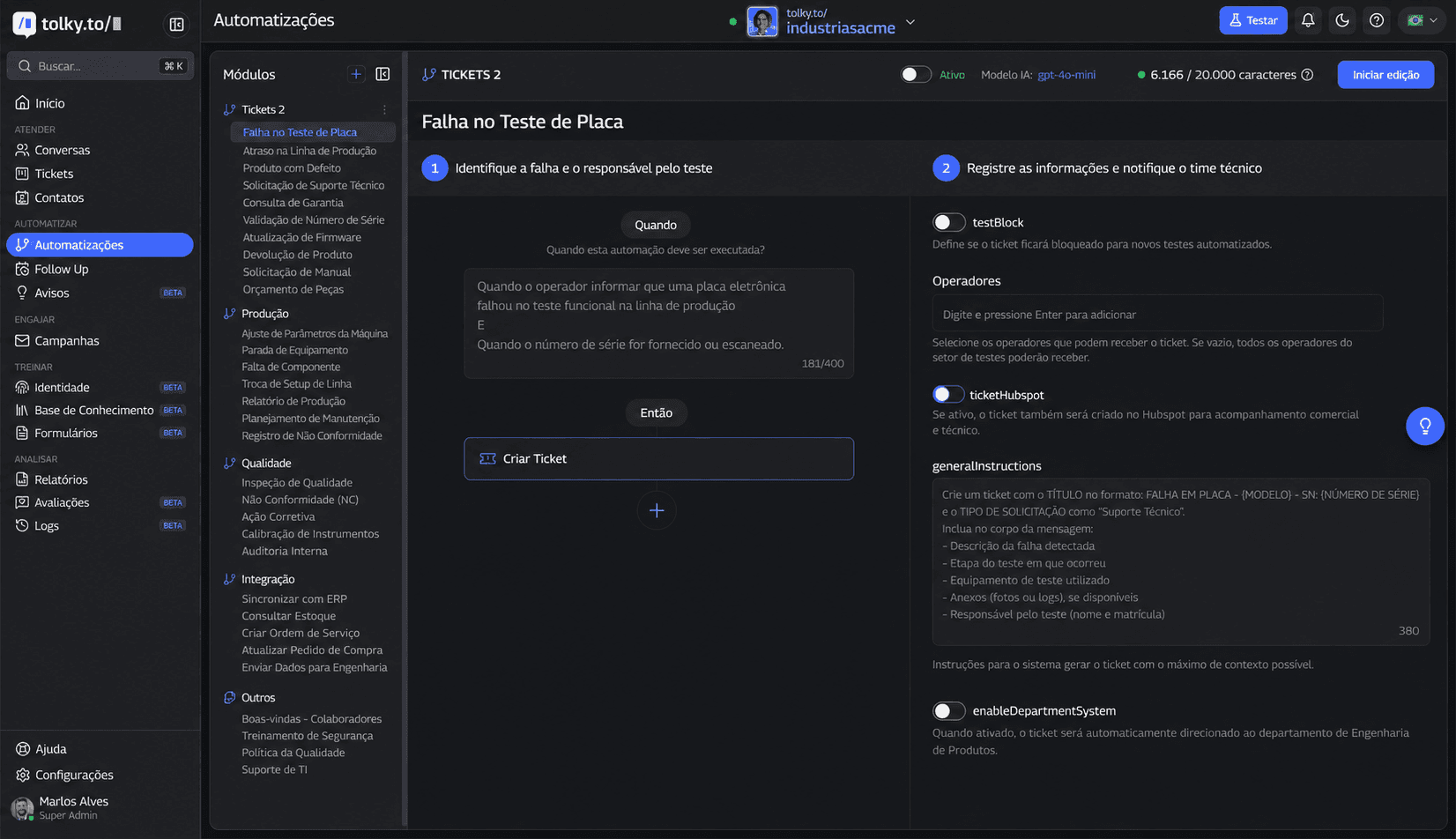
- Automations and tickets: the conversation becomes a task with an owner, as in the screenshot above. See the automation flows.
- Team and CRM: queues, history and customer records. See WhatsApp customer service.
What Tolky does not do: it is not meant for building a general-purpose AI assistant open to the public on WhatsApp, which is the case Meta's terms prohibit.
Frequently asked questions
Did WhatsApp ban AI chatbots?
Not all of them. Since January 15, 2026, the terms bar AI providers from the API when their main function is the AI itself, such as general-purpose assistants. Chatbots and AI agents that serve a company's customers are still allowed.
Why was ChatGPT removed from WhatsApp?
Because Meta's new rule for the WhatsApp Business API, in force since January 15, 2026, bars general-purpose AI assistants. ChatGPT and Copilot ended their WhatsApp service on that date.
Does the rule apply in Brazil?
CADE suspended the rule in Brazil on January 12, 2026 and upheld the suspension in March. Meta then started charging AI providers per message in the country, and in April CADE upheld a daily fine of R$ 250,000 over that charge. The inquiry remains open.
Can I use ChatGPT, Claude or Gemini for customer service on WhatsApp?
You can use these models as the engine of an agent that serves your company's customers through the official API. What the rule bars is offering the general-purpose assistant itself to the public on WhatsApp.
How do I know if my project is an AI provider?
Ask whether the service would still exist without the AI. If the AI helps serve a business's customers, it is ancillary and allowed; if the product is the conversation with the AI, it tends to be treated as a provider. When in doubt, check with your API provider or with Meta.
Is Meta AI still on WhatsApp?
Yes. Meta AI remains a general-purpose assistant inside WhatsApp, and that difference in treatment is exactly what CADE, the European Commission and the Italian authority are investigating.
Conclusion
Meta's rule removed general-purpose AI assistants from WhatsApp, but not the agents that serve businesses' customers. In Brazil, it is suspended by CADE, and the case is still open. For anyone serving customers on WhatsApp, the safe path is the same as before: official API, an agent with a clear scope, handoff to people and records.
See the plans, read how to build an AI agent for WhatsApp, learn about Meta AI on WhatsApp or talk to the team →. Let's talk?
Share
Tags
- whatsapp bans ai chatbots
- chatgpt removed from whatsapp
- whatsapp business api ai providers policy
- cade meta whatsapp ai
- are ai chatbots allowed on whatsapp
- whatsapp business api ai
- #whatsapp ai agent
- #conversational CRM
Cited in
- AI automation agency: what it is and how to start one in 2027
- White-label AI agent: how agencies sell AI under their own brand
- How to sell WhatsApp chatbots in 2027 without breaking Meta's rules
- GoHighLevel review for agencies: what it is, pricing and WhatsApp
- Voice AI on WhatsApp: an agent that takes calls and voice notes
- AI for marketing agencies: internal uses and services to sell
- n8n or a platform? How agencies should deliver AI agents
- GoHighLevel alternative for agencies: Tolky vs GoHighLevel compared
- Inbound vs outbound IVR: differences, examples and when to use each
- Meta AI for business: Meta AI, Meta Business Agent or Muse?
- What is Meta Muse? Models, API pricing and use in business
About the author

Co-founder of Tolky
Marlos Carmo is an AI entrepreneur and founder of Tolky, the conversational-era infrastructure and AI CRM that unifies intelligent service, multi-channel support (such as WhatsApp and voice), live CRM, and operational intelligence in a single ecosystem. He is a finalist for the SXSW Innovation Awards and a member of Francesco's Economy, a global network of young entrepreneurs focused on innovation and social impact. He works connecting Artificial Intelligence and digital transformation in projects for large organizations.
Next step
Want to bring this to your operation?
Tati, Tolky's AI assistant, understands your scenario in a few questions, suggests the best path and connects you with someone from the team, with full context.
Share