Marketing agency with AI: how to change the model and keep clients
How to turn a marketing agency into an AI marketing agency without losing clients: what AI takes and brings, the first new service, how to pitch it, the team and transition mistakes.
TL;DR
A marketing agency with AI uses artificial intelligence internally, to produce faster, and externally, delivering agents that answer and qualify the leads its media generates. The transition that keeps clients starts with a new service tied to the client's results, pitched account by account, with a team trained to run it. The costliest mistake is competing with AI on price instead of delivering AI.
Share
Your client starts asking whether AI can't do what the agency charges for. First as a joke, then in the retainer renegotiation. Posts, captions, ad variations and reports got faster to produce, and the person paying the bill noticed.
The answer that keeps the account is not competing with AI on price. It is delivering AI to the client where it moves their results: answering the leads your media generates. This guide shows how to make that business model shift without losing the clients you already have.
Updated in November 2026.
What changes in a marketing agency with AI?
A marketing agency with AI is an agency that uses artificial intelligence internally, to produce and analyze faster, and externally, delivering AI services that move the client's sales, such as agents that answer and qualify leads. The first half has become standard; the second half is what sets you apart.
Using AI only internally makes the agency more efficient, but it does not change what it sells. If the client pays for production hours and production got faster, the pricing conversation arrives sooner or later. Adding an external AI service changes the question: instead of "how much does a post cost", the client asks "how many leads became opportunities".
Internal uses are covered in AI for marketing agencies, and the full menu of what to sell is in marketing agency services with AI. This guide covers the external part, the one that changes the business model.
What does AI take from an agency, and what does it bring?
AI takes away the perceived value of repetitive production work and brings the chance to sell services tied to the client's sales, which the client cannot do alone. The trade is uncomfortable in the short term and favorable for whoever moves first.


| What AI pressures | Why it pressures | What AI opens as a service | Why the client pays |
|---|---|---|---|
| Post and caption production | The client sees tools generating text in seconds | AI agent that answers leads on WhatsApp | Leads answered in seconds, day and night |
| Ad variations | Ad platforms already suggest creatives and copy | Lead qualification logged in the CRM | Sales gets an opportunity with context, not a cold contact |
| Media reports | Automatic dashboards cover the basics | Reports that follow the lead after the click | The client sees what happened in the conversation, not just cost per lead |
| Account service hours | The client solves some questions with AI | Monthly operation of the agents | Someone reviews, adjusts and improves the agent every month |
The right-hand column has something in common: these services depend on method, configuration and follow-up. AI does not do them for the client on its own; someone has to design, test and run them. That someone can be your agency.
What should the first new service be?
The first new service of a marketing agency with AI should be answering the leads its own media generates, because that is where the agency already has data, already has the client's trust and already feels the problem in its reports. A paid lead that waits hours for a reply goes cold, and the client blames the media.
The path is familiar to anyone who runs paid traffic. The ad sends people to WhatsApp, the lead sends the first message and nobody replies in time. The guide on lead loss on WhatsApp shows where leads get lost, and the post on the hidden cost of slow response shows why response time weighs so much. The concept of speed to lead sums it up.
The service has three parts:
- An AI agent on WhatsApp that answers instantly, clears up frequent questions and asks the qualifying questions.
- CRM logging of every lead, with the conversation, the answers and the funnel stage.
- Handoff to sales with context when the lead is ready or asks for a person. The guide to AI-to-human handoff covers the rules.
One caution: linking the ad of origin to the final sale does not happen on its own. To close that loop, the client needs a logging process or a custom integration. Agree on this in the proposal, without promising automatic attribution. Ads that send people to WhatsApp are covered in click-to-WhatsApp ads.
How do you present the change to your current clients?
Present the change account by account, starting with the clients who already complain about lead quality, with a short free discovery session and a pilot proposal with a defined metric. A blanket announcement to every client creates more doubt than interest.
A sequence that works:
- Pick three clients. The ones with the most WhatsApp lead volume and the most complaints about conversion.
- Run a 30-minute discovery. How long leads wait, who replies, what happens after hours.
- Show it with the client's data. A demo with the client's real questions convinces more than any generic deck. The guide on how to sell AI agents to businesses details the demo.
- Propose a pilot. Fixed scope, short timeline and an agreed metric, such as first response time or qualified leads per week.
- Turn the pilot into a case. With results in hand, the conversation with the rest of your clients gets easier.
Do not hide what AI does not do. An AI agent resolves part of the conversations and hands the rest to people. A client warned upfront does not feel misled later.
What does this change for your agency?
For your agency, the shift trades part of the production revenue, which tends to be under pressure, for operations revenue tied to the client's results, which tends to last longer. The retainer stops being only about what the agency produces and starts to include what it runs.


In practice:
- A new line in the contract. Agent implementation, charged once, and monthly operations, charged with the retainer. The guide on how much to charge for a WhatsApp AI agent helps with pricing.
- A more defensible retainer. Running lead response is hard to swap for a tool, unlike a content package. The post on the agency retainer with AI shows how to build the package.
- Reports that reach the sale. With the lead in the CRM from the first message, the agency shows the conversation after the click, not just cost per lead.
- Less risk of losing the account. When lead response runs on a platform the agency operates, switching agencies is no longer a simple decision.
For the full business model, with niches, costs and risks, read the guide to the AI automation agency.
How do you prepare the agency team?
A marketing agency with AI needs three new skills on the team: selling the service, implementing the agent and running it day to day, and each one fits a different person. Nobody needs to become a developer.
| Role | What they learn | Who usually takes it on | Related certification in Tolky's program |
|---|---|---|---|
| Sales | Discovery, demo, proposal and responsible promises | Partner, account management or new business | Tolky Sales |
| Implementation | Agent design, knowledge base, WhatsApp, CRM, flows and data protection | Automation, CRM or technical media analyst | Tolky Implementation |
| Operations | Reading conversations, adjusting the knowledge base, monthly reports | Account management or planning | Tolky Implementation; on the white-label track, also White-label Operations |
Training can be quick when the platform offers a learning path and a practice account. In the Tolky Partner Program, certifications are online, free for program members, and the certificate is valid for 12 months. To see what AI needs before going live, the trustworthy AI page shows simulations and versions.
Which mistakes should you avoid in the transition?
The most common transition mistakes are competing with AI on price, promising full automation, launching to every client at once and using an unofficial WhatsApp API to cut costs. All of them cost the client's trust, which is the agency's main asset.


- Lowering production prices to compete with tools. Margins drop and the client still thinks it is expensive. Move the value to the service the tool cannot deliver.
- Promising AI handles everything. Promise a handoff with context to the client's team, not 100% automation.
- Launching to everyone at once. Without your own case, the agency sells theory. Start with a pilot.
- Building without the official API. A banned number is a lost client. See the risks in unofficial WhatsApp API.
- Leaving the agent without an owner after go-live. An agent without monthly review gets worse over time, and the blame comes back to the agency.
Where does Tolky fit?
Tolky is a conversational AI CRM that an agency can use to deliver lead response: an AI agent on WhatsApp through the official API, a built-in CRM and campaigns, in one platform. For the agency, the way in is the Partner Program.
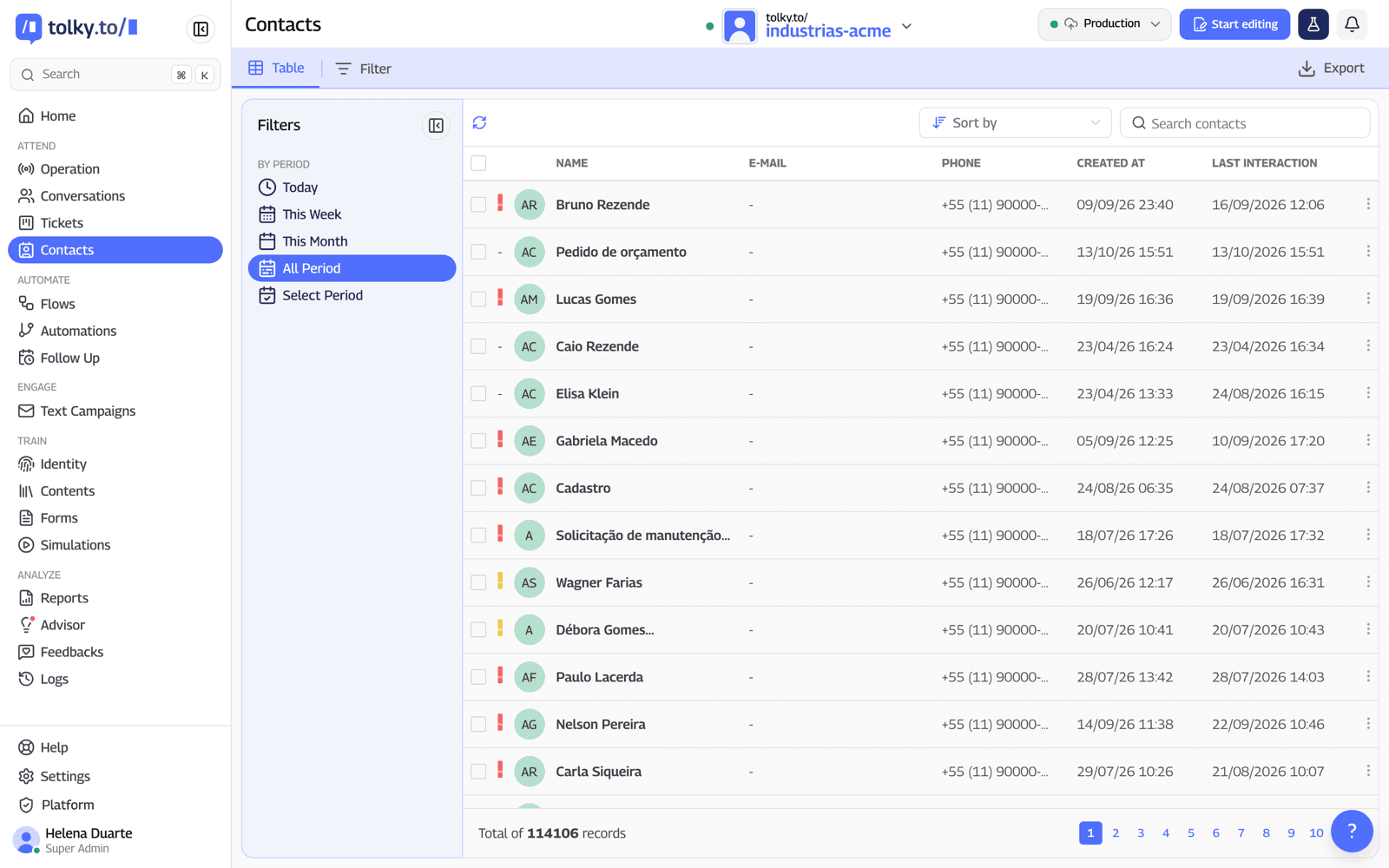
Every lead that arrives on WhatsApp becomes a contact in the CRM, with the conversation history, and can become an opportunity in the pipeline, with automatic Follow Up. The marketing page shows how this looks to your agency's client.
What Tolky does not do: it does not automatically capture the ad of origin of a click-to-WhatsApp lead, so linking the ad to the sale depends on a client process or a custom integration, to be confirmed in a demo. Instagram and SMS are coming soon.
Frequently asked questions
What is a marketing agency with AI?
It is an agency that uses artificial intelligence internally, to produce and analyze faster, and externally, delivering AI services tied to sales, such as agents that answer and qualify leads on WhatsApp.
Will AI replace marketing agencies?
AI replaces part of the production work, not the agency that understands the client's business. Agencies that deliver AI tied to results, such as lead response, gain a new service instead of losing what they had.
What is the first AI service a marketing agency should sell?
Answering the leads its own media generates: an agent that replies instantly on WhatsApp, qualifies and logs to the CRM. That is where the agency already has data and the client's trust.
How should an agency charge for AI services?
Separate implementation, charged once, from monthly operations, which goes with the retainer. The platform and Meta's per-message fees usually sit on the client's account.
Do I need to hire developers to become an AI marketing agency?
Not necessarily. On ready-made platforms, the agent is configured through its mission, knowledge base and rules. The team needs training in sales, implementation and operations.
How do I tell clients the agency now uses AI?
Tell them account by account, with a discovery session and a pilot proposal with a defined metric. Show what AI does and what it hands to people.
Conclusion
A marketing agency with AI keeps its clients when it stops competing with AI on production and starts delivering it where it moves the client's sales: answering the leads its media generates. Start with three clients, prove it with a pilot, train the team in sales, implementation and operations, and turn the result into a new recurring line in the contract.
Your agency can deliver this with Tolky
The Tolky Partner Program is for agencies that want to bring AI agents, CRM and WhatsApp campaigns to their own clients, with recurring earnings. On the Solution track, your agency sells, implements and supports clients under the Tolky brand and charges for its own implementation and operations services; the other tracks are referring Tolky or running the platform under your own brand. Training and certification are free for program members, and the Tolky team supports every initial project in 1:1 sessions.
Explore the Partner Program → Let's talk?
Share
Tags
- marketing agency with ai
- ai marketing agency
- ai digital marketing agency
- ai advertising agency
- ai for marketing agencies
- ai lead response
- whatsapp ai agents
- #conversational CRM
About the author

Co-founder of Tolky
Marlos Carmo is an AI entrepreneur and founder of Tolky, the conversational-era infrastructure and AI CRM that unifies intelligent service, multi-channel support (such as WhatsApp and voice), live CRM, and operational intelligence in a single ecosystem. He is a finalist for the SXSW Innovation Awards and a member of Francesco's Economy, a global network of young entrepreneurs focused on innovation and social impact. He works connecting Artificial Intelligence and digital transformation in projects for large organizations.
Next step
Want to bring this to your operation?
Tati, Tolky's AI assistant, understands your scenario in a few questions, suggests the best path and connects you with someone from the team, with full context.
Share