
Blog
Guides
AI for Customer Onboarding: How to Automate Without Losing Quality
Onboarding is where most customers are lost not due to product failure, but due to process failure. See how onboarding automation with AI reduces early churn without eliminating human warmth in the stages that truly matter.

Marlos Carmo
May 23, 2026
·
8 min read

TL;DR
Streamline customer onboarding and slash Time-to-Value (TTV) with **AI-driven onboarding automation**. Learn how autonomous agents validate documents, orchestrate initial tech configurations, and deliver personalized user training instantly.
Share
An uncomfortable fact for any Head of Customer Success: the majority of contracts that will be canceled in the next six months have already given clear signals in the first 30 days. The customer did not activate the core feature. Did not complete the configuration checklist. Went two days without responding to onboarding team emails. And by the time someone noticed, the window for intervention had already closed.
The problem is rarely a lack of goodwill from the teams. It is operational capacity. A CS team of 8 people cannot actively monitor 200 customers in simultaneous onboarding with the necessary depth. Something falls. And what falls, almost always, are the customers who seemed to be doing fine.
Customer onboarding automation with AI is not an answer for cutting CS costs it is an answer for doing what human teams cannot do at scale: follow up with all customers, all the time, without leaving any behind.
Customer Onboarding Flows: Manual vs. AI-Driven
| Onboarding Phase | Legacy Manual Process | AI-Automated Process |
|---|---|---|
| Document & KYC Verification | Hours or days of manual reviews | Instant verification using vision/OCR agents |
| Account Setup & Provisioning | Analyst configures workspace and permissions | Instant setup via secure API integrations |
| Training & Activation | Generic video links or scheduled webinars | Personalized, interactive AI guides step-by-step |
| Time-to-Value (TTV) | High (waiting for manuals/meetings) | Extremely low (user completes setup in minutes) |
Why Onboarding Is the Point of Highest Churn Risk
Onboarding is the period of highest vulnerability in any B2B relation. The customer has just made a purchase decision, but has not yet experienced the promised value. The product is new, the customer's team is learning, and any friction a slow response, a confusing step, a missed deadline is interpreted as confirmation that the decision was wrong.
Retention studies in SaaS show that customers who do not complete onboarding in the first 30 days are three to four times more likely to churn than those who reach their first value milestone within the expected window. The concept of "time-to-value" is not just a pretty metric to present to the board it is the most reliable predictor of renewal.
The paradox is that the onboarding period is exactly when CS teams have the least information about the customer because the relationship has just started and the most responsibility over the outcome.
What an AI Agent Can Do in Onboarding
An AI agent for onboarding is not a passive assistant that answers questions only when the customer asks. It is an active orchestrator that monitors progress, triggers actions, collects information, and alerts humans at the right time.
The core functions are divided into four categories:
Data collection and validation. The onboarding process typically starts with a series of details the company needs from the customer: integrations, account configurations, team details, communication preferences. An AI agent can conduct this collection in natural language via WhatsApp or through the product itself much more efficiently than static forms. The completion rate of critical details typically doubles when collection is conversational.
Contextual material delivery. Instead of triggering the onboarding email sequence for all customers at the same cadence, the agent adapts what it sends based on what the customer has done. If the customer completed step 2 but skipped step 1, the agent detects this and sends the right content, in the right order, with the correct timing.
Proactive milestone monitoring. The agent continuously monitors the customer's progress indicators login, feature activation, expected minimum usage and acts when it detects inactivity or delay. A message like "I noticed you haven't configured the CRM integration yet, can I help?" sent 48 hours after the expected deadline has a much greater impact than any marketing email.
Intelligent handoff to humans. When the agent identifies a customer at risk due to persistent inactivity, questions that escape the knowledge base, or explicit frustration it alerts the responsible CS representative with a complete briefing: what has been done, what is pending, and what the customer has expressed so far. The human enters the conversation already informed, without needing to ask what has already been asked.
How the Automated Onboarding Flow Works in Practice
To make it concrete: imagine a B2B software company that has just signed a contract with a new medium-sized client. The workflow with an active AI agent can look like this:
Day 0 Welcome and initial collection. The agent gets in touch immediately after the signature, presents the onboarding process in simple language, and starts collecting the data needed to configure the account. Without waiting for the first human contact, which often takes 24 to 48 hours.
Days 1 to 5 Activation tracking. The agent monitors whether the customer accessed the product, completed the initial steps, and has recurring questions. It sends support content based on the observed behavior.
Day 7 Progress checkpoint. The agent checks whether the customer reached the first value milestone. If yes, it confirms and presents the next step. If not, it diagnoses the reason (lack of access, technical doubt, internal priority) and triggers the corresponding action.
Days 14 and 30 Health review. The agent collects feedback from the customer, evaluates the engagement level, and prepares a summary for the responsible CS manager with recommended actions for the coming weeks.

Where the Human Needs to Be Present
Automating onboarding does not mean replacing the CS with the agent. It means freeing the CS for the steps that only humans can do well.
Kickoff meetings. The first formal meeting with the customer when expectations are aligned, the team is presented, and the product is demonstrated is a relationship-building interaction that no agent can replace with quality. The agent prepares the ground before and documents it after.
Identified risk situations. When the agent detects that a customer is stuck, frustrated, or has expectations out of alignment, the handoff to the human CS must be immediate and surgical. The CS enters at the right moment, with the right context, and with the clear goal of saving the relationship.
Strategic customization decisions. Enterprise customers with custom onboarding journeys need human attention in decisions involving specific configurations, complex integrations, or product adaptations. The agent supports these stages with documentation and tracking, but does not decide for them.
The Impact on Churn: What the Numbers Show
The relationship between onboarding quality and long-term retention is one of the most solid data points in CS. Companies that implement structured and monitored onboarding report a 20 to 40% reduction in early churn (first 90 days).
The mechanism is direct: customers who reach the first perceived value within the expected window develop a sense of investment in the product they have already configured, integrated, and taught their team. The psychological cost of abandoning grows with each completed step. Well-executed onboarding is preventive retention.
Automation enters here not to replace the quality of human onboarding, but to ensure that no customer is left without attention due to lack of team operational capacity.
How Tolky Orchestrates the Onboarding Flow
Tolky acts as the central orchestrator of onboarding flows connecting the customer's product, the CRM, the communication tools, and the CS team into a cohesive operation.
The Tolky agent monitors the customer's progress triggers, fires messages via the preferred channel (WhatsApp, email, in-product chat), collects structured information via conversational forms, and feeds the CRM with the updated state of each customer in real time. The CS manager opens the dashboard in the morning and has a precise status for each customer in onboarding: what has been done, what is pending, and which customers need attention today.
It is not automation that replaces human attention. It is automation that makes human attention possible at scale.
Early churn is a process problem before it is a product problem. Customers who cannot complete onboarding successfully rarely complain they simply leave, with the feeling that the product was not for them. Onboarding automation with AI does not solve product problems, but it ensures that no customer reaches the wrong conclusion due to a lack of support at the right moment.
Want to see how Tolky can structure the onboarding flow of your operation? Talk to our team we map the current process and show what can be automated without losing relationship quality.
Suggested internal links:
- How to Implement AI in Customer Service Without Losing the Human Touch
- ROI of Automation with AI: How to Measure the Return of Intelligent Agents
- How AI Agents Can Transform Enterprise Operations in 2025
Alt text for featured image: Customer Success professional tracking onboarding panel with progress indicators and customer activation.
Editorial note: A real data point from a Tolky client case with measurable early churn reduction would significantly strengthen the central argument. Alternatively, data from CS reports like Gainsight's or Totango's on the onboarding/retention correlation would further support the impact section.
Share
Tags
B2B automated onboarding
AI in customer activation process
AI agent for onboarding
reduce churn with onboarding automation
customer onboarding automation with AI
Cited in
AI in Customer Service: How Companies Are Automating Support, Sales, and Relationships
Report Automation with AI: Fewer Spreadsheets, More Decisions
Generative AI for HR: Automation in Recruitment and Internal Onboarding
Process Automation with LLMs: Real Use Cases in B2B Companies
ROI of AI Automation: How to Measure the Return of Intelligent Agents
Marlos Carmo
Founder of Tolky
Marlos Carmo is an AI entrepreneur and founder of Tolky, the conversational-era infrastructure and AI CRM that unifies intelligent service, multi-channel support (such as WhatsApp and voice), live CRM, and operational intelligence in a single ecosystem. He is a finalist for the SXSW Innovation Awards and a member of Francesco's Economy, a global network of young entrepreneurs focused on innovation and social impact. He works connecting Artificial Intelligence and digital transformation in projects for large organizations.
Read also
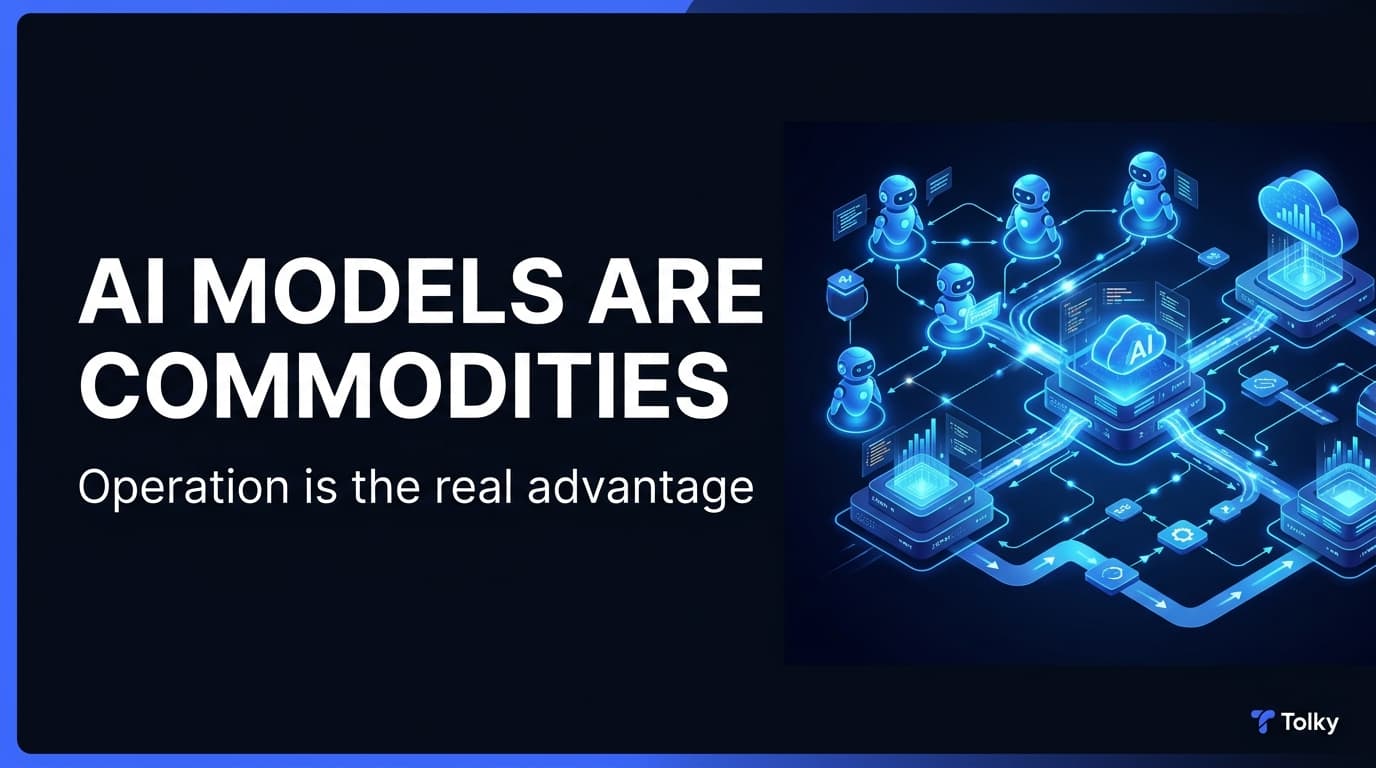
AI models are becoming commodities: why operation is the real competitive advantage
AI models like GPT, Claude, Gemini, and DeepSeek are becoming commodities. The true competitive edge for mature enterprises is not the chosen LLM, but the operational architecture built on top of it.
Marlos Carmo
July 23, 2026
·
16 min read
Guides

Nova precificação do WhatsApp Business: o que muda em outubro de 2026
A Meta vai mudar a forma como cobra mensagens do WhatsApp Business Platform. Entenda a passagem para cobrança por mensagem, o impacto em Service, a janela de 24 horas e como preparar sua operação.
Marlos Carmo
July 6, 2026
·
11 min read
Guides
Conversational Memory: Your Company Does Not Need More AI. It Needs to Remember Better.
Conversational memory is the ability to turn customer conversations into live context, useful history and operational intelligence for sales, service, CX and management.
Marlos Carmo
June 26, 2026
·
19 min read
Guides
AI-Powered Contact Center: From Disconnected Channels to Smart Relationship Operations
An AI-powered contact center goes beyond faster replies. Learn how to unify channels, tickets, automation, and humans into a single smart relationship operation.
Marlos Carmo
June 12, 2026
·
18 min read
Guides