
Blog
Guides
Conversational Memory: Your Company Does Not Need More AI. It Needs to Remember Better.
Conversational memory is the ability to turn customer conversations into live context, useful history and operational intelligence for sales, service, CX and management.

Marlos Carmo
June 26, 2026
·
19 min read

TL;DR
**Conversational memory** is the layer that turns service history, customer context, promises, sentiment, tickets, preferences, events and next steps into operational intelligence. AI without memory talks. AI with memory builds relationships. The next competitive advantage will not be only the best AI model, but the best memory about customers.
Share
Imagine knowing a customer for five years and still having to ask their name every time they contact you.
Now replace "name" with the reason for the last complaint, the proposal sent, the sales objection, the promise made, preferred channel, urgency level, active contract, expected deadline, last ticket, churn risk and agreed next step.
That is the reality of many companies investing in AI.
They have records, phone numbers, emails, orders, contracts and a CRM full of fields. But when the customer shows up on WhatsApp, chat, email or a call, the operation asks everything again. The salesperson relies on personal memory. The agent searches across three systems. The manager discovers the issue too late. The customer feels that nobody knows who they are.
Conversational memory is a company's ability to turn every customer conversation into live, actionable context shared by humans, systems and AI. It is not just chat history. It is a strategic layer that records what happened, interprets why it happened, preserves what was agreed and delivers the right context to the next interaction.
The best AI in the world keeps forgetting everything if the company forgets too.
That is why the biggest competitive advantage of the next decade will not be who owns the best AI model. It will be who owns the best memory about customers.
Why companies remember so little about their own customers
B2B companies often believe they know customers because they have structured data: company ID, legal name, decision-maker email, active plan, purchase history and a few CRM notes.
But relationships do not live only in fields.
Relationships live in what was said during a hard conversation. In the promise a salesperson made before closing. In the objection that almost blocked the deal. In the complaint pattern that returns before renewal. In the customer's preference for voice notes instead of email. In the tension that appeared in the last support case. In the real reason behind a low NPS.
These signals exist every day in sales conversations, support interactions, meetings, tickets, WhatsApp messages, emails and calls.
But in many operations they die inside the conversation.
The CRM keeps formal data. WhatsApp keeps the messages. The helpdesk keeps the tickets. The salesperson keeps the memory. The agent keeps tacit context. Management gets aggregated reports that show volume, but not the story.
Customers hate repeating stories. When a customer has to repeat the same story to sales, support, finance and customer success, the issue is not the agent's politeness. It is the company's lack of organizational memory.
Data is not memory
History is not memory.
A company can have a lot of data and still have little memory. It can have CRM, ERP, service desk, spreadsheets, recordings, transcripts and dashboards, but still fail to answer: "What is happening with this customer, why does it matter and what is the next best step?"
| Layer | What it stores | Limitation | When it becomes memory |
|---|---|---|---|
| Database | Structured records, fields, IDs, events | Shows isolated facts | When it connects events to meaning and action |
| CRM | Accounts, contacts, opportunities, stages and tasks | Depends on human updates | When it is automatically fed by real conversations |
| Service history | Messages, tickets, protocols and prior records | Requires manual reading and stays stuck in the channel | When it is summarized, classified and delivered as context |
| Customer context | Reason, intent, sentiment, urgency, preference and journey stage | Often stays in someone's head | When it becomes available to the whole operation |
| Conversational memory | History, context, learnings and actionable next steps | Requires governance, integration and well-designed AI | When every conversation makes the company smarter |
Data says what exists. Memory helps explain what it means.
A database knows the customer opened three tickets. Conversational memory understands that the three tickets share the same root cause, that the customer was promised a fix, that the contract renews in 45 days, that the sponsor is irritated and that the next interaction should be treated as churn risk.
The leap is not storing more. It is remembering better.
The problem with forgotten conversations
Every company loses knowledge every day.
A salesperson leaves and takes months of account nuance with them. A service agent changes roles and nobody knows which customers needed special care. A lead starts on WhatsApp, continues by email, books a meeting and later returns through website chat as if they were a new person. A customer complains about something already promised, but nobody can find the commitment.
These losses look small one by one. In aggregate, they erode revenue, trust and productivity.
Forgotten conversations create:
- Rework: the customer repeats data, the team reopens investigations and the company pays twice for the same context.
- Broken promises: commitments are scattered across messages, informal notes and individual memory.
- Disconnected sales: follow-ups lose precision because nobody remembers the real objection.
- Impersonal service: the answer may be correct, but the journey is ignored.
- Shallow management: dashboards count contact volume, but do not reveal cause, risk and opportunity.
Conversations are company assets. When those assets are trapped in inboxes, personal phones, loose notes or disconnected systems, the company loses more than efficiency. It loses relationship.
The conversation ends.
The memory remains.
Every conversation should enrich the company
Talking to a customer should not only resolve a request. It should make the company smarter.
Every conversation contains signals. Some are explicit: pricing questions, delivery complaints, integration requests, cancellation intent. Others are subtle: impatience, tone changes, competitor comparisons, recurring problems, hesitation to move forward, excitement about a specific feature.
When those signals are captured, classified and connected to the right customer, they feed sales, service, product, marketing, CX and operations.
A strong conversational memory system makes sure:
- the next salesperson knows the objection that already appeared;
- the human agent receives a summary before taking over;
- the CRM is filled from the conversation, not from goodwill;
- managers see top contact reasons by segment;
- product teams detect pain patterns before they become churn;
- marketing learns which arguments customers actually use;
- AI responds based on relationship history, not generic content.
Companies do not only need to talk better.
They need to remember better.
What is conversational memory
Conversational memory is the infrastructure that turns customer interactions into persistent, interpretable and actionable context.
It brings together history, preferences, events, sentiment, tickets, last contacts, promises, SLAs, contact reasons, interactions across any channel, automatic summaries, context delivered to humans and continuous relationship learning.
In practice, conversational memory includes:
- Complete history of messages, tickets, meetings, emails and relevant events.
- Customer preferences, such as channel, time, language, response format and level of detail.
- Relationship events, such as purchase, renewal, complaint, upgrade, downgrade, onboarding and reactivation.
- Sentiment and risk signals, such as frustration, urgency, recurring issues or cancellation intent.
- Tickets and SLAs, connecting conversation to ownership, priority and deadline.
- Contact reasons, consistently classified for operational analysis.
- Promises and next steps, preserving what the company committed to do.
- Automatic summaries, so humans do not need to read dozens of messages before acting.
- Context delivered to humans, especially in AI-to-human handoffs.
- Continuous learning, so recurring patterns become management intelligence.
AI without memory talks.
AI with memory builds relationships.
How Conversational AI uses memory
Conversational AI with memory is not a bot with prettier answers. It is an operational layer that can consult, interpret and update customer context while it talks.
With conversational memory, AI can:
- Remember who the customer is, recent history and journey stage.
- Consult CRM, tickets, orders, contracts, knowledge base and relationship events.
- Summarize what happened so a human can take over without starting over.
- Prioritize conversations by urgency, account value, SLA, sentiment or risk.
- Alert teams about churn, sales opportunity, overdue promise or critical customer.
- Recommend the next action, argument, channel and owner.
- Fill the CRM with data collected naturally during the conversation.
- Generate follow-up based on what was agreed, not generic cadence.
- Identify risks in natural language, recurring tickets and satisfaction drops.
- Identify opportunities for upsell, cross-sell, expansion, renewal and reactivation.
When AI transfers to a person and that person asks everything again, the experience failed. Conversational memory fixes that break.
Why this changes sales
B2B sales is applied memory.
A good seller wins because they remember context, understand the account, connect pains, return to objections, respect timing and show up with the right argument at the right moment.
At scale, this memory often depends on individuals. If the seller is organized, the CRM improves. If the seller leaves, part of the relationship disappears.
Conversational memory changes sales through:
- Upsell: expansion signals appear in support, usage, questions and success conversations.
- Cross-sell: AI detects adjacent needs mentioned by the customer.
- Retention: dissatisfaction signals stop hiding in tickets.
- Renewal: sellers enter with fulfilled promises, open risks and value history.
- Follow-up: the next message references the actual agreement and objection.
- Churn: recurring complaints and negative sentiment become alerts.
- NPS and CSAT: perception becomes connected to the history that produced it.
Who controls memory controls the relationship.
Why this changes service
Service without memory is repetition under pressure.
The customer explains the problem. The agent asks for data. The customer changes channel. Another agent asks again. AI answers part of the issue, but does not know what was promised in the previous ticket.
Conversational memory reduces operational friction:
- Less repetition: the customer does not retell the story at every transfer.
- Lower average handling time: the agent starts with summary, history and probable diagnosis.
- More resolution: AI consults context and systems before answering.
- Fewer transfers: triage understands reason, urgency and responsible area.
- More personalization: the response considers contract, history, preference and moment.
In an AI service center, the goal is not only speed. It is continuity.
The future will be memory, not prompts
For a while, companies treated AI as a prompt competition. The best instruction would create the best answer. That mattered, but it will not be the major differentiator.
Everyone will have access to strong models. Everyone will generate text, summarize documents, classify messages, answer questions and create basic agents. What will not be equally distributed is operational memory quality.
The next competitive advantage will not be artificial intelligence.
It will be accumulated intelligence.
That intelligence depends on reliable data, preserved context, clear processes, accessible memory and governance over what can be remembered, for how long and for what purpose.
Prompts improve answers. Memory improves relationships.
How Tolky sees conversational memory
At Tolky, conversational memory is not a side feature. It is part of the operational architecture.
The platform brings together AI, tickets, history, integrations, humans, automations, channels and governance to create organizational memory. Conversations arrive through WhatsApp, web, voice and other channels. AI understands intent, checks context, records data, opens tickets, summarizes interactions and hands off to humans when needed.
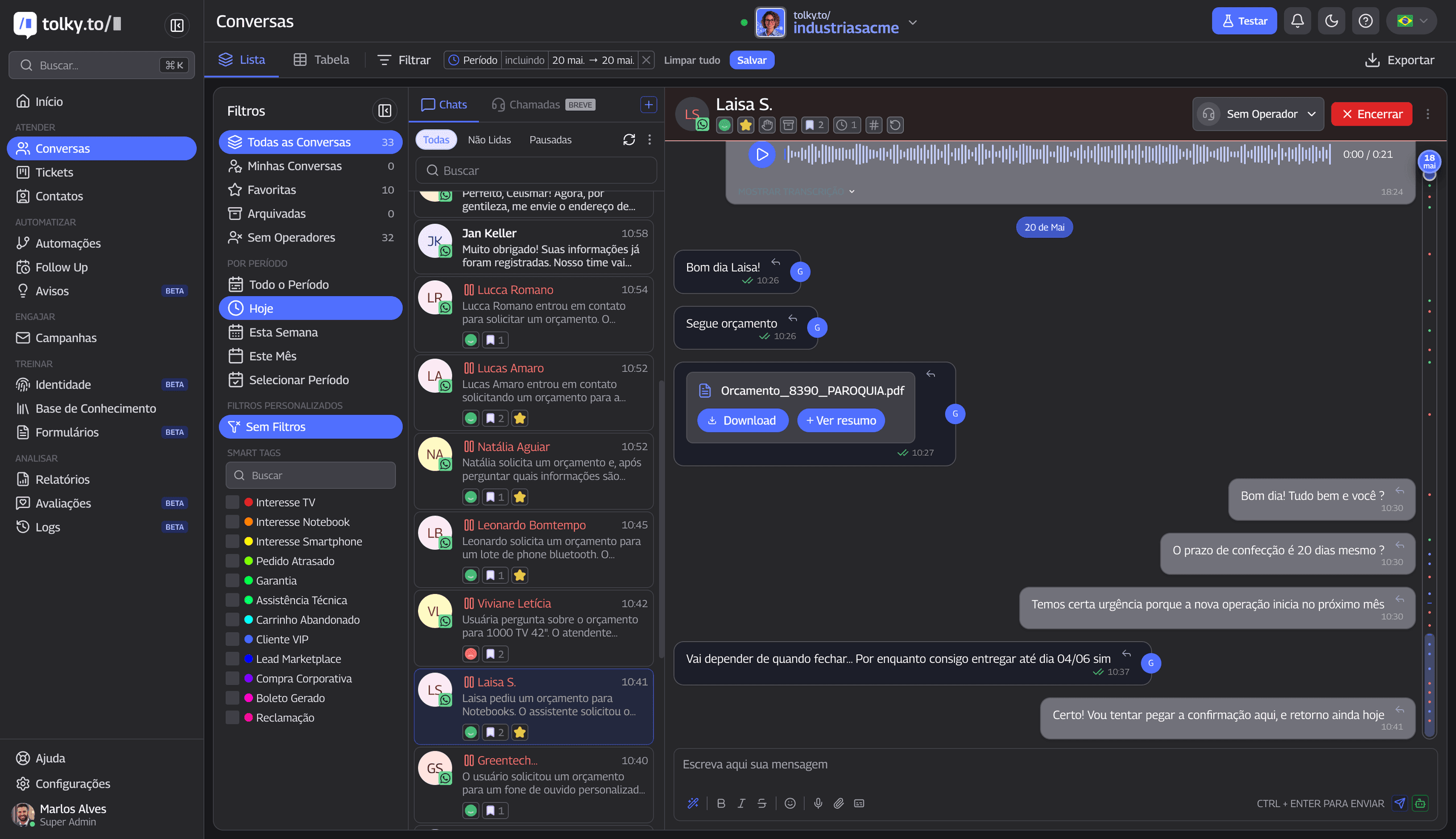 Tolky conversations panel: unified history allows AI and humans to work with the same context
The goal is not just automating replies. It is making each interaction enrich the company's understanding of that customer.
That is where AI CRM, omnichannel service, automation and management intelligence come together.
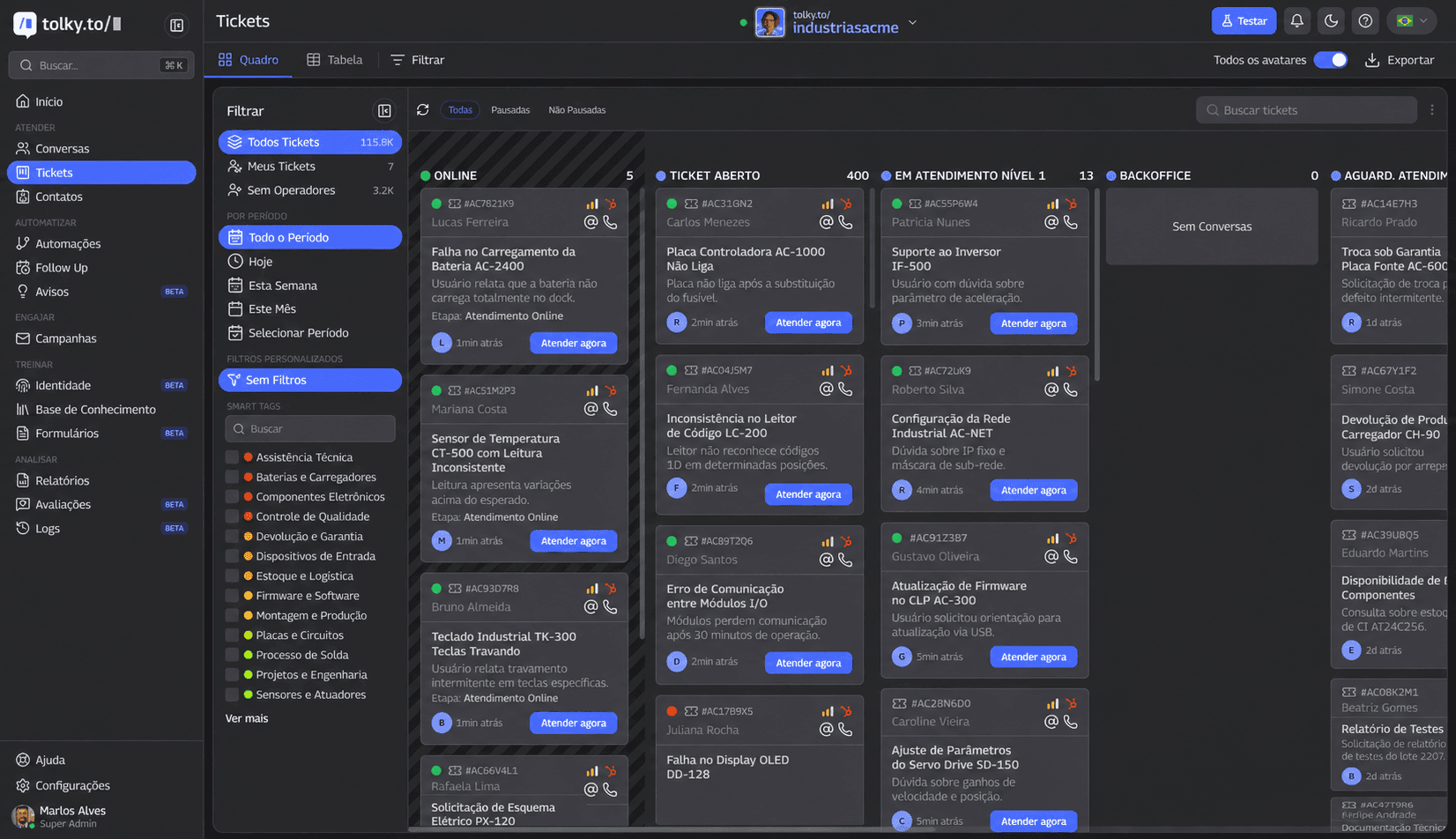 Tolky ticket management: conversation, priority, SLA and owner connected to customer context
Traditional CRM vs Conversational Memory
| Dimension | Traditional CRM | Conversational Memory |
|---|---|---|
| Records | Stores structured customer data | Connects records to the live relationship history |
| History | Depends on manual notes and tasks | Captures conversations, tickets, events and summaries automatically |
| Context | Fragmented across people, channels and systems | Delivers actionable context to AI, humans and managers |
| Learning | Mostly pipeline reports | Detects objection, contact reason, risk and opportunity patterns |
| AI | Usually an add-on assistant | Uses memory to remember, consult, prioritize, recommend and act |
| Automation | Triggers rule-based tasks | Automates next steps based on what was discussed |
| Relationship | Depends on individual discipline | Preserves continuity across channels and owners |
| Follow-up | Based on tasks or cadence | Based on real commitments, objections and customer timing |
| Sales | Organizes opportunities | Enriches qualification, expansion, renewal and risk prediction |
| Service | Weak connection to support channels | Unifies omnichannel service, SLA, tickets and customer history |
| Governance | Controls CRM fields and permissions | Controls memory, access, retention, audit and AI usage |
Does your company have conversational memory?
- Does the customer repeat information when changing channels?
- Do sellers remember everything in their own heads?
- Is history trapped in WhatsApp, email or someone's phone?
- Does the next owner know everything that happened before?
- Is there an automatic summary before human handoff?
- Are next steps and promises recorded with owner and deadline?
- Does AI know the customer or only answer from FAQ?
- Do channels share context?
- Are tickets, SLA and contact reasons connected to the conversation?
- Is the CRM filled automatically from interactions?
- Can management see patterns of objections, churn and opportunity?
- Is there governance over what AI can remember and use?
If most answers are "no", your company may have data, but it does not yet have memory.
Metrics for conversational memory
| Metric | What it measures | Why it matters |
|---|---|---|
| Time to context | How long it takes human or AI to understand the case | Shows whether context is accessible |
| Time to resume | Time needed to continue an interrupted conversation | Measures continuity across channels and owners |
| Information repetition rate | How often the customer repeats data or story | Reveals customer friction |
| Average resolution time | Time until the request is solved | Shows memory impact on efficiency |
| Transfers per interaction | Handoffs between areas | Detects poor triage and insufficient context |
| History quality | Completeness, clarity and usefulness of records | Shows if history is actionable |
| First contact resolution | Percentage solved without recontact | Indicates whether context and autonomy work |
| Context delivered to human | Handoffs with summary, reason and next steps | Measures AI-human collaboration quality |
| Overdue promises | Commitments not fulfilled on time | Exposes relationship governance failures |
| Risk signals detected | Churn, frustration or recurrence alerts | Connects service to retention and revenue |
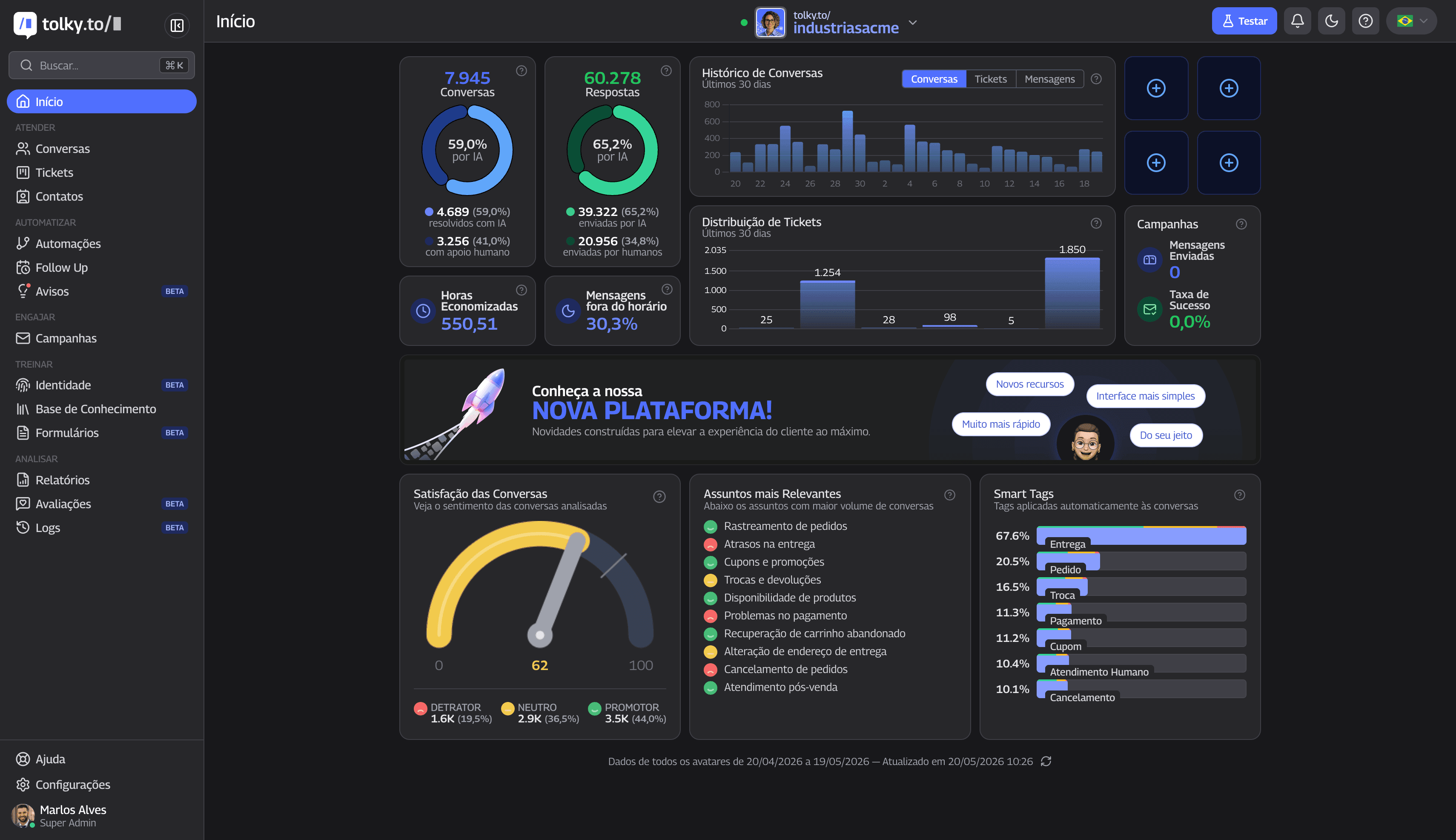 Tolky dashboard with conversation, ticket, channel and productivity metrics in real time
How to start building conversational memory
- Choose a critical journey: inbound sales, level 1 support, onboarding, renewal or WhatsApp service.
- Map what must be remembered: contact reason, objection, promise, SLA, preference, sentiment and next steps.
- Integrate the minimum systems: CRM, service channel, tickets, knowledge base and reports.
- Define governance rules: access, retention, audit, privacy and human escalation.
- Automate summaries and records: reduce dependency on manual updates.
- Measure before and after: repetition, time to resume, FCR, AHT, CSAT, conversion and churn.
The goal is not to store everything. It is to remember what improves the next decision.
FAQ
What is conversational memory?
Conversational memory is a company's ability to turn customer conversations into actionable history, context, learnings and next steps. It connects service, sales, CRM, tickets, channels and AI so each new interaction reflects the accumulated relationship.
Is conversational memory the same as chat history?
No. Chat history is the sequence of messages. Conversational memory interprets that history and identifies contact reason, sentiment, promises, preferences, risks, opportunities and next steps.
What is the difference between CRM and conversational memory?
Traditional CRM organizes accounts, contacts, opportunities and tasks. Conversational memory connects those records to real conversations, tickets, channels and customer signals.
How does Conversational AI use memory?
Conversational AI uses memory to recognize customers, consult history, summarize interactions, prioritize service, recommend actions, fill CRM fields, generate follow-ups and alert risks.
Does conversational memory help sales?
Yes. It improves qualification, follow-up, upsell, cross-sell, renewal, retention and churn prediction by preserving objections, promises, intent signals and next steps.
Does conversational memory help customer service?
Yes. It reduces repeated information, lowers resolution time, improves handoffs, reduces transfers and makes service more personal.
Does conversational memory require replacing the CRM?
Not always. It can connect to the existing CRM and enrich records with conversations, summaries, tickets, contact reasons and next steps.
How do I measure conversational memory?
Measure time to context, repetition rate, time to resume, history quality, first contact resolution, transfers, human handoff context, overdue promises and detected risk signals.
Is conversational memory safe for privacy regulations?
It can be, with governance. Companies need purpose, legal basis, retention, access, audit, data minimization and clear limits for AI usage.
Why will conversational memory become a competitive advantage?
Because AI models will become widely accessible. The differentiator will be the quality of data, context, processes and accumulated customer memory.
Suggested internal links
- What is AI CRM? Complete guide
- AI service center
- Conversational AI is not chatbot
- AI integration with CRM
- WhatsApp is not CRM
- How to implement AI in service without losing the human touch
- AI governance in customer service
Image suggestions
- Customer memory map with WhatsApp, ticket, CRM, meeting and follow-up connected.
- Before and after: isolated channels versus centralized conversational memory.
- AI-human handoff with automatic summary.
- Memory dashboard with contact reasons, overdue promises, churn signals and opportunities.
- Living CRM enriched automatically by real conversations.
5 LinkedIn posts
Post 1
Your company may not need more AI.
It may need memory.
Most companies already store records, phone numbers, emails, orders and contracts. But they lose what truly sustains relationships: promises, objections, preferences, sentiment, recurring problems and next steps.
AI without memory talks.
AI with memory builds relationships.
Post 2
History is not memory.
History shows what was said.
Memory understands what matters, what was agreed, which risk exists, which opportunity appeared and what next step must happen.
Post 3
Customers hate repeating stories.
When a customer explains everything again after moving from WhatsApp to email, support to sales, or AI to human, they do not see "channels".
They see a company that forgot them.
Post 4
Everyone will have access to strong AI models.
Few companies will have strong data, context, processes and governance over their conversations.
The next competitive advantage will not be artificial intelligence.
It will be accumulated intelligence.
Post 5
Conversations are company assets.
Every support case reveals pain. Every sales objection reveals market. Every repeated complaint reveals product. Every missed follow-up reveals process.
The conversation ends. The memory remains.
5 Instagram carousels
Carousel 1: Does your company forget customers?
- Does your company forget customers?
- It knows the name, but forgets the context.
- It knows the order, but forgets the promise.
- It knows the contract, but forgets the objection.
- That is not lack of data.
- It is lack of conversational memory.
- AI without memory talks.
- AI with memory builds relationships.
Carousel 2: History is not memory
- History is not memory.
- History: "the customer sent 12 messages".
- Memory: "the customer complained for the third time about the same issue".
- History stores events.
- Memory connects meaning.
- Who controls memory controls the relationship.
Carousel 3: What AI must remember
- What should Conversational AI remember?
- Who the customer is.
- Why they contacted you.
- What was promised.
- Which tickets are open.
- What the account sentiment is.
- What the next step is.
- Without it, AI answers. With it, AI relates.
Carousel 4: Signs your operation lacks memory
- Signs your operation lacks memory.
- Customers repeat data on every channel.
- Sellers rely on their own heads.
- Promises live in WhatsApp.
- Human handoff starts from zero.
- CRM is always outdated.
- Management sees volume, not cause.
- The problem is forgetting.
Carousel 5: The future will be memory
- The future will be memory.
- AI models will become similar.
- The difference will be context.
- Data.
- Process.
- Governance.
- Accumulated customer intelligence.
- Companies need to remember better.
10 impact lines
- The best AI in the world keeps forgetting everything if the company forgets too.
- Customers hate repeating stories.
- History is not memory.
- Conversations are company assets.
- Who controls memory controls the relationship.
- The next competitive advantage will not be artificial intelligence. It will be accumulated intelligence.
- Companies do not only need to talk better. They need to remember better.
- The conversation ends. The memory remains.
- Data says what exists. Memory explains what it means.
- Prompts improve answers. Memory improves relationships.
Prompts for article illustrations
- "A cinematic B2B SaaS editorial image showing a customer relationship memory graph, with conversation bubbles, CRM records, support tickets and timeline events connected by glowing lines, dark premium interface, realistic workstation, no text."
- "Split-screen illustration: disconnected spreadsheets, chat windows and CRM fields versus unified customer timeline with messages, tickets, sentiment and next steps connected, modern B2B SaaS dashboard, no readable text."
- "Customer support operator receiving an AI-generated context summary before taking over a conversation, omnichannel inbox interface, WhatsApp-style messages, calm professional enterprise environment, no readable text."
Share
Tags
conversational memory
Conversational AI
AI CRM
conversational CRM
customer service history
customer context
omnichannel service
customer relationships
intelligent service
WhatsApp for business
Marlos Carmo
Founder of Tolky
Marlos Carmo is an AI entrepreneur and founder of Tolky, the conversational-era infrastructure and AI CRM that unifies intelligent service, multi-channel support (such as WhatsApp and voice), live CRM, and operational intelligence in a single ecosystem. He is a finalist for the SXSW Innovation Awards and a member of Francesco's Economy, a global network of young entrepreneurs focused on innovation and social impact. He works connecting Artificial Intelligence and digital transformation in projects for large organizations.
Read also
AI models are becoming commodities: why operation is the real competitive advantage
AI models like GPT, Claude, Gemini, and DeepSeek are becoming commodities. The true competitive edge for mature enterprises is not the chosen LLM, but the operational architecture built on top of it.
Marlos Carmo
July 23, 2026
·
16 min read
Guides

AI CRM: Why the Next CRM Will Be Conversational and Integrated
Traditional CRM organizes records but fails due to manual input. AI CRM revolutionizes this by turning WhatsApp conversations into automated operational intelligence. Understand this new logic.
Marlos Carmo
June 17, 2026
·
21 min read
Strategy

Behind the Scenes of Conversational AI at Scale: What Powers Millions of B2B Interactions
Scaling Conversational AI isn't just about choosing a model. Understand the infrastructure, tickets, management, and governance behind millions of conversations.
Marlos Carmo
June 22, 2026
·
14 min read
Strategy
AI Governance in Customer Service: How to Scale Conversations with Control, Security, and Quality
Quick replies are not enough. Learn how to implement AI governance to mitigate risks, integrate with CRM/ERP, and gain complete control over your operation.
Marlos Carmo
June 18, 2026
·
20 min read
Strategy