WhatsApp automation flowsthat connect the conversation to the rest of the company.
Tolky Flows is a visual automation editor: a trigger starts the path, conditions decide where to go, and the next steps call the AI agent, update the CRM, notify the team or connect another system, all from a WhatsApp conversation.
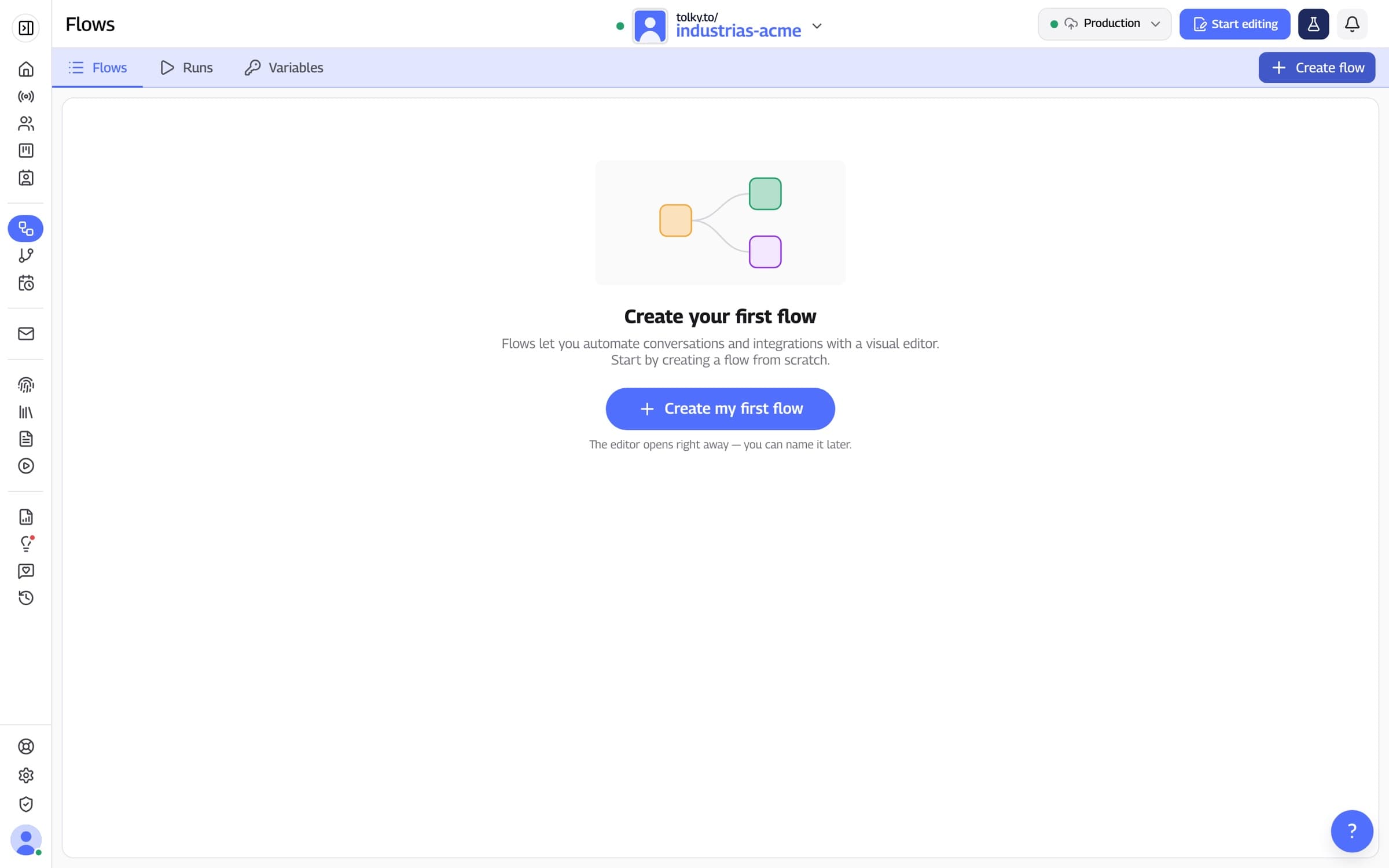
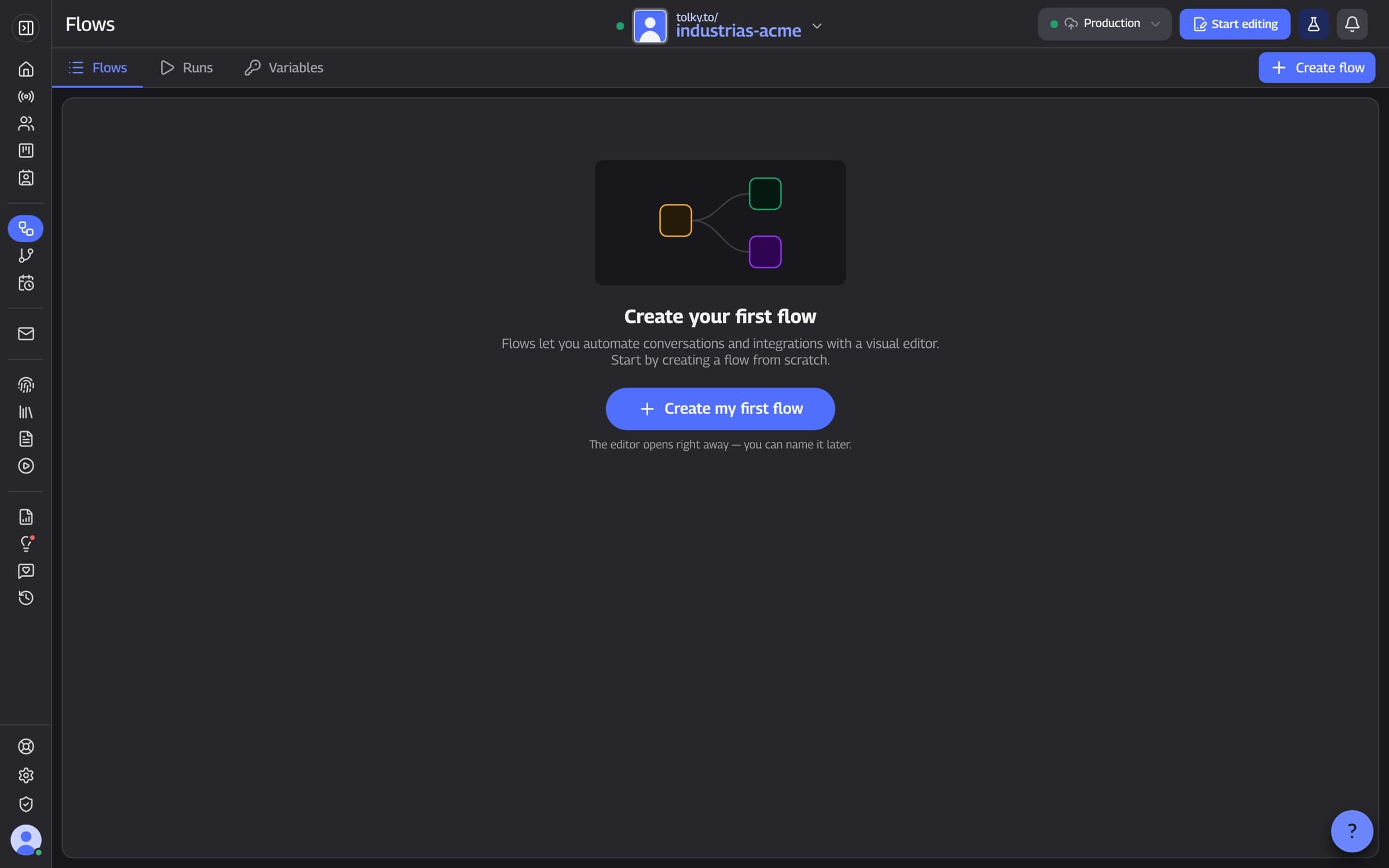
What a WhatsApp automation flow is
WhatsApp automation flow is a sequence of steps the platform runs on its own when something happens, such as a customer message or a call from another system. In Tolky, you build the flow in the visual editor, connect the steps and publish. The run follows the path you drew, and the AI joins only the steps where you place it.
At a glance
- How you build it
- Visual editor, with an AI assistant that creates or adjusts the flow from a written request
- Triggers
- Customer message, a call from another system (webhook), manual start and CRM pipeline events
- Connections
- 1,000+ apps, HTTP requests, webhooks, REST API and MCP tools
From trigger to published flow
Step 01
Pick the trigger
A customer message, a call from another system, a pipeline event or a manual start.
Step 02
Build the path
Conditions, multiple paths by rule, loops over items, waits and the AI agent step.
Step 03
Connect and act
Apps, HTTP requests, CRM, team notifications, a WhatsApp message or a transfer to a person.
Step 04
Test and publish
Test the flow, see the output of each step and follow the run history.
Step 01
Pick the trigger
A customer message, a call from another system, a pipeline event or a manual start.
Step 02
Build the path
Conditions, multiple paths by rule, loops over items, waits and the AI agent step.
Step 03
Connect and act
Apps, HTTP requests, CRM, team notifications, a WhatsApp message or a transfer to a person.
Step 04
Test and publish
Test the flow, see the output of each step and follow the run history.
What Flows do on WhatsApp
Seven groups of capabilities, all in the platform today. Each one has a page or a guide to go further.
01
Triggers
The flow starts when something happens
The Receives message trigger starts the flow when the customer writes, with an optional condition. The Receives data from outside (webhook) trigger starts when another system calls the flow's address, and there is also a manual start for testing. In CRM flows, the start can be a deal created, a stage entered, a win or a loss.
Customer message, with an optional condition
Inbound webhook with protection against repeated calls
Pipeline events: deal created, stage, won and lost
02
Conditions and time
Decide, branch and wait
The Decision (if / then) step follows one path or another depending on the condition you define. Multiple paths by rule sends each item down the first rule that matches, and Repeat for each item goes through a list. The Wait step pauses the flow for a set time, until a date or until the customer replies.
If / then decision and multiple paths by rule
Loop over each item in a list
Wait for a time or until the customer replies
03
AI agent
The AI joins where you place it
The Agent step uses an AI agent to answer or decide at that point in the flow, with the knowledge base and limits you configured. The Instructions for AI step tells the AI what to reply to the customer in the ongoing conversation.
AI agent as a flow step
Instructions for the AI in the ongoing conversation
Same knowledge base as customer service
04
Apps
1,000+ apps one step away
The Integration step connects Tolky to 1,000+ apps, such as Pipedrive, Slack, Gmail, Google Sheets, Stripe and Notion, and runs actions in them with data from the conversation. There is also a dedicated step for Google Calendar. Connectors are being released gradually: confirm with the team when they reach your account.
Tool account connected in a few clicks
Fields filled with conversation and contact data
Google Calendar to create, find or change events
05
API, webhooks and MCP
When the case calls for code
The Fetch or send data step makes an HTTP request to any API, and Reply to caller returns the result to the system that triggered the webhook. Tolky's REST API has a public reference at docs.tolky.to. MCP tools are used by the AI agent, and the limits on API and MCP integrations depend on the plan.
HTTP request with conversation variables
Inbound webhook and reply to the caller
Advanced code, for technical use, when there is no other way
06
Actions in operations
The flow acts on service, the CRM and the team
After deciding, the flow moves the ticket, transfers to a human agent or closes the conversation. It creates a deal, moves a stage, marks a win or loss, applies a tag and creates a task in the CRM. It notifies the team by email or WhatsApp, sends a message to the contact and calls another flow.
Transfer to human pauses the AI in the conversation
CRM steps: deal, stage, tag and task
WhatsApp message: approved template or free text
07
Building and control
Build, test and track
An AI assistant takes requests in plain language to create or adjust the flow. You test the flow, each step shows its run output, and the history keeps every run. n8n flows can be imported, and Tolky flows can be exported in n8n format, with caveats on steps that have no equivalent.
AI assistant to build and adjust
Test and output of each step, run history
Import and export in n8n format
Automation without conversation or Tolky Flows: what changes
The table compares a generic automation tool, which does not know the conversation, with Tolky Flows, which are built inside customer service.
| Situation | Generic automation tool | Tolky Flows |
|---|---|---|
| The trigger is a customer message | Needs a connector for the messaging channel | The Receives message trigger is native, inside the same service |
| I need AI in the middle of the path | Call to an AI service set up separately | AI agent step, with the account's knowledge base |
| The case needs a person | Alert outside the conversation | Transfer to human pauses the AI and carries the history |
| Update the sales pipeline | CRM integration built by hand | CRM steps: create deal, move stage, win or loss, tag and task |
| Connect another system | Ready-made connector or code | 1,000+ apps, HTTP requests, webhooks and REST API |
| I already have n8n flows | Rebuild from scratch | Imports the n8n JSON to review in the visual editor |
Frequently asked questions
It is a sequence of steps that runs on its own when something happens, such as a customer message or a call from another system. In Tolky, you build the flow in the visual editor, with a trigger, conditions and actions, and it acts on WhatsApp customer service.
No. The editor is visual and an AI assistant builds or adjusts the flow from a written request. There is an advanced code step, for technical use, but it is optional.
Transfer rules are written in plain language and carried out by the AI during the conversation. A Flow is a visual design that follows the path you defined, and the AI takes part only in the steps where you place it.
A customer message, a call from another system by webhook, a manual start and CRM pipeline events, such as deal created, stage entered, won and lost.
Yes. Flows have an Integration step with 1,000+ apps, HTTP requests to any API, webhooks and REST API, and the agent uses MCP tools. The native integration is with HubSpot. There is no native integration with Salesforce or Pipefy.
Yes. Tolky imports an n8n flow's JSON for review in the visual editor and exports flows in n8n format, with caveats on steps that have no equivalent. There is no ready-made connector for Zapier or Make.
You run the flow in test mode and see the output of each step. Once published, you follow the run history with the detail of each node.
Tolky bills per conversation. The Individual plan is free, with 150 conversations a month; Starter costs $90 a month and Professional $450 a month. Meta's WhatsApp fees are charged separately. Availability of each feature by plan is on /pricing.
The same feature, other angles.
Feature
WhatsApp CRMHow Tolky's CRM works on WhatsApp: contacts with history, pipeline, proposals and activities filled in from conversations, with a native HubSpot integration.
Feature
WhatsApp bulk messagingHow Tolky runs text campaigns on WhatsApp, Teams and email, and voice campaigns: audience from a spreadsheet, personalized messages, the 24-hour window and AI on replies.
Pricing
Plans and pricingBilled per conversation, with a free plan to start. Meta's WhatsApp fees are charged separately.
Your next flow canstart from the conversation.
Book a demo and watch a Tolky flow connect a WhatsApp message to your CRM, your team and your systems.