AI for law firm intake on WhatsApp: bar rules, privacy and setup
How to use AI for law firm intake and client service on WhatsApp: what the Brazilian Bar allows, what to automate, what stays with the lawyer, confidentiality, LGPD and a setup checklist.
TL;DR
AI for law firm intake means using an AI agent on WhatsApp to screen new contacts, collect information and documents, answer administrative questions and hand the conversation to a lawyer with a summary. Under Provision 205/2021 of the Brazilian Bar (OAB), a chatbot is allowed to make communication easier and collect information, as long as it keeps the service personal and does not answer legal questions in the lawyer's place. Legal advice, strategy and any promise of outcome always stay with the lawyer.
Share
WhatsApp has become the front door of many law firms: people asking at 11:00 p.m. whether they have a claim, clients wanting a case update, photos of documents. In many firms, the person replying is a partner on their own phone.
AI helps with that volume, but legal work has its own rules: professional confidentiality, bar limits on advertising and solicitation, and sensitive personal data. This guide shows what to automate, what stays with the lawyer and how to set it up without ethical risk. It uses Brazil's rules (OAB and LGPD) as the reference; outside Brazil, check your own bar or law society. It is informational content, not legal advice.
Updated November 2026.
What is AI for law firm intake and client service?
AI for law firm intake is an AI agent that talks to clients and prospects on WhatsApp to organize the contact: it identifies the matter, collects information and documents, answers administrative questions and hands off to a lawyer with the history. It works at the front desk, not on the case.
Unlike a menu chatbot, the agent understands text and voice notes written the way people write, and answers with what the firm has added: practice areas, address, hours and documents for each type of matter. When the conversation needs legal analysis, it brings in a person. The glossary separates the two steps: triage and handoff.
What does the Brazilian Bar allow for AI and WhatsApp?
The Brazilian Bar (OAB) allows law firms to use a chatbot to make communication easier and to collect information and documents, as long as it does not remove the personal nature of the service or the lawyer's decision-making power and responsibilities. That is what the Annex of OAB Provision 205/2021 says, checked on November 19, 2026. Its example is answering a prospective client's first questions.
The same annex sets the limit: apps may not be used "indiscriminately to automatically answer legal questions from non-clients". The AI can explain how the firm works, but it cannot tell a stranger whether they are owed damages.
OAB Recommendation 001/2024, on generative AI in legal practice, checked on the same date, adds three points:
- Transparency: the chatbot does no work reserved to lawyers, and the person must be told they are talking to a machine (item 2.4).
- A person available: clients have the right to talk to a human being when they ask (item 4.3).
- A carefully chosen vendor: it must protect the information and allow the data not to be used to train its systems (item 2.2).
In 2025, the OAB set up a working group to revise Provision 205/2021. As of November 19, 2026, the text published on the OAB website is still the 2021 version.
What does this change for outbound messages and campaigns?
A law firm's outbound messages can only go to clients and to people who asked for or authorized them, without offering services or soliciting clients. Provision 205/2021 bans direct mail to the public at large, and the OAB Code of Ethics and Discipline (art. 46, sole paragraph) allows messages to specific recipients, as long as they do not offer services.
On WhatsApp, Meta's rules add to this: outside the 24-hour window, only an approved template, and only to people who gave opt-in. A hearing notice, a pending document request and a meeting reminder are client communication. A purchased list and a message like "you may be entitled to a review" are solicitation. See the guide to the 24-hour window and WhatsApp templates.
What to automate and what stays with the lawyer
The AI handles what is repetitive and administrative; anything that needs legal analysis, a decision or a promise stays with the lawyer. Use the table as a starting point to adjust with the partners.


| Situation | What the AI does | What stays with the lawyer |
|---|---|---|
| First contact | Says it is an AI and asks about the matter | Deciding whether to take the case |
| Triage by practice area | Identifies the area and routes to the right queue | Assessing the merits |
| "Do I have a claim?" | Explains that a lawyer does the analysis and collects the account | All legal advice |
| Meeting request | Collects the preferred day and time | Confirming in the calendar |
| Sending documents | Receives, reads and organizes what was requested | Reviewing and using them in the case |
| "How is my case going?" | Answers with what the firm added or integrated | Explaining decisions and next steps |
| Fees | Says fees are discussed in the meeting | Proposal and engagement letter |
| Urgency (arrest, hearing, deadline) | Flags priority and calls a person right away | Responding immediately |
The AI never gives an opinion, strategy, odds of success or damage calculations. Promising outcomes is also banned by art. 6 of Provision 205/2021.
How does new-case intake on WhatsApp work?
New-case intake is the sequence of questions that turns a loose message into a matter ready for a lawyer to assess. Done by AI, it runs at any hour and reaches the lawyer as a summary.
- Identification: name, city and preferred contact method, with notice that this is a virtual assistant.
- Area and matter: "I was fired and never got my severance" becomes employment law.
- Urgency: a deadline, hearing or arrest makes the AI hand off right away.
- Other party: their name, so the firm can run a conflict check before accepting.
- Documents: the list defined for that area, sent through WhatsApp itself.
- Routing: the meeting request and summary go to the practice area's queue.
Tolky does not book slots in the firm's calendar on its own: the AI collects the preference and the team confirms in the system it already uses. Flows include a Google Calendar step, in gradual release; confirm availability with the team.
Document collection and handoff with context
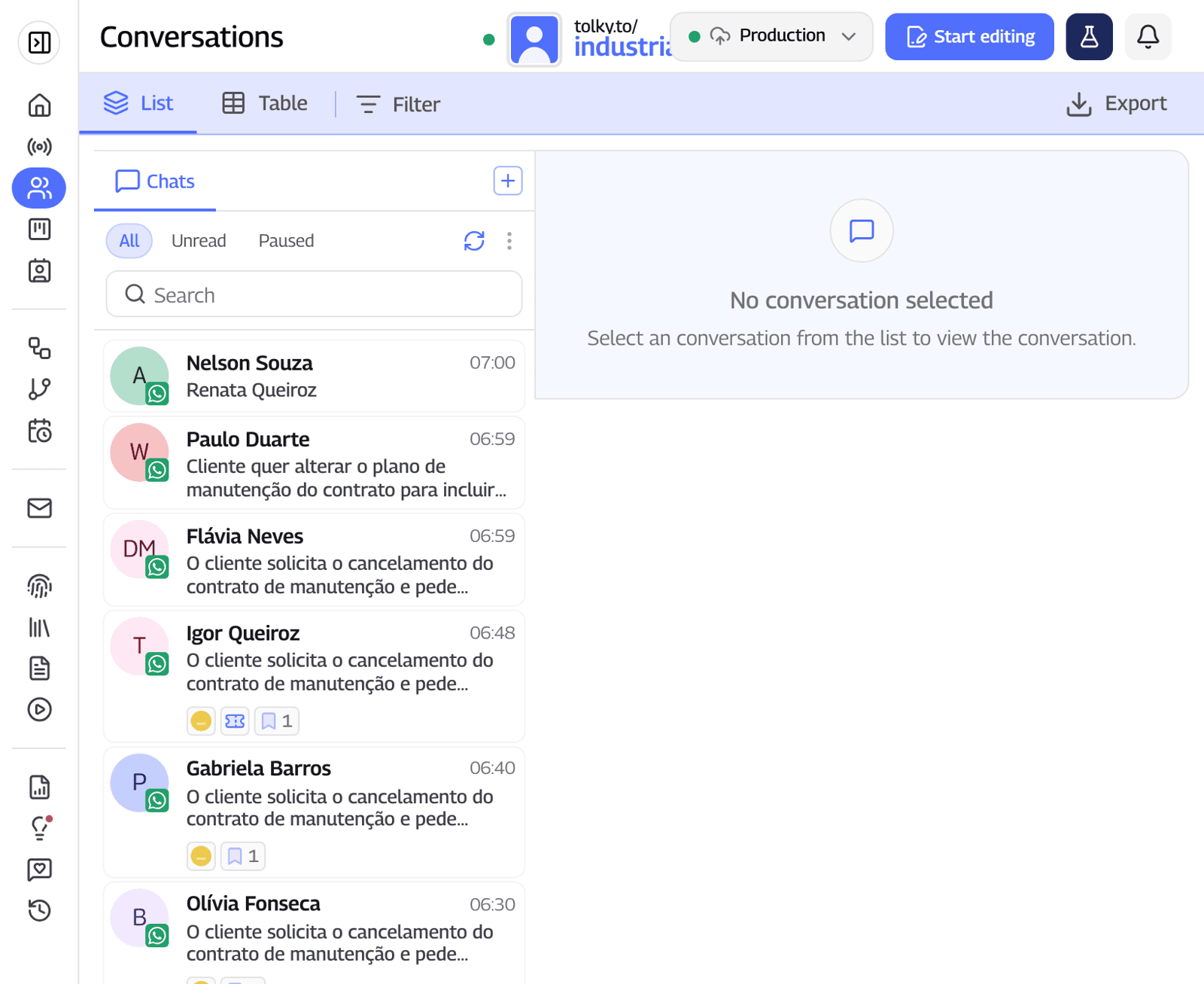
The AI reads the images, PDFs and voice notes clients send on WhatsApp, organizes the data in forms and gives the lawyer a conversation that is already summarized.
For delicate data, such as an ID number or health information in a social security case, Tolky lets you mark a form as sensitive: the data is encrypted with AES-256 and only people with permission can see it.
At handoff, the lawyer gets the history and the summary, and the client does not repeat anything. The rules for when to hand off are in the guide to AI-to-human handoff.
Case updates: what can the AI answer?
The AI answers about case status only with information the firm has added or integrated, and only after confirming it is talking to the right client. It does not interpret decisions or predict outcomes.
- Explaining stages in general terms, such as what a settlement hearing is.
- Sharing the latest recorded status, when the firm's case management system is integrated through the API or Flows. Without integration, the AI only knows what is in the knowledge base.
- Reminding clients of documents and appointments the lawyer has already requested.
What a decision means, whether to appeal and sealed cases go to the lawyer. Confirm identity before discussing any matter. Checks with an ID and a selfie have their own requirements, covered in the guide to liveness checks with a selfie and ID.
Attorney-client confidentiality and LGPD in AI conversations
Professional confidentiality covers everything a client says on WhatsApp, including the part handled by AI, and Brazil's LGPD calls for extra care with sensitive data. Articles 35 and 36 of the OAB Code of Ethics and Discipline say confidentiality is the lawyer's duty, is a matter of public order and that lawyer-client communications are presumed confidential.


Under Brazil's General Data Protection Law (LGPD), checked on November 19, 2026, health, racial origin, religious belief, sex life and biometric data, among others, are sensitive personal data (art. 5, II). In family, social security and criminal matters, they show up in the first message. The law allows processing for the regular exercise of rights in legal proceedings (art. 11, II, "d") and calls for the minimum necessary (art. 6, III).
- Ask only what is needed in triage; the full account belongs in the meeting.
- Limit who sees what, with access profiles by practice area.
- Choose a vendor that shows its controls, as Recommendation 001/2024 asks.
- Set the legal basis with your data protection officer, not with the vendor.
Tolky lists its controls on Security and privacy: encrypted connections, encrypted sensitive forms, access profiles, an exportable audit log and the trace behind every AI answer. It does not offer anonymization or configurable retention. To assess vendors, see security and privacy in AI platforms and AI governance in customer service.
Law firm setup checklist
Setup starts with the rules and only then moves to the technology.
| Step | What to do | Who decides |
|---|---|---|
| 1. Rules | What the AI answers, declines and when it hands off | Partners |
| 2. Notice | A first message saying it is an AI and how to reach a person | Partners |
| 3. Knowledge base | Areas, address, hours and documents per type of matter | Staff |
| 4. Triage | Questions per area, urgency and conflict check | Lawyers in each area |
| 5. Access | Profiles per area and who sees sensitive data | Responsible partner and DPO |
| 6. Official number | WhatsApp through Meta's official API | Management |
| 7. Testing | Simulate hard conversations before opening | Lawyers |
| 8. Review | Read a sample of conversations each week in month one | Responsible partner |
To write the knowledge base and instructions, use the guide on how to train an AI agent with a knowledge base.
Common mistakes in law firm WhatsApp automation
The costliest mistake is letting the AI answer legal questions; the second is using WhatsApp for solicitation.
- Hiding that it is an AI, against item 2.4 of Recommendation 001/2024.
- Telling a non-client "you have a claim", the kind of automatic answer Provision 205/2021 bans.
- Bulk messages to cold contacts, which break the direct mail rule and hurt number quality.
- Asking for the full story during triage, piling up sensitive data with no need.
- Using a partner's personal phone, with no central history and no clear path to a person.
Where Tolky fits in legal client service
Tolky is an AI conversational CRM: AI agents serve clients on official WhatsApp, the website and voice, log everything in the CRM and hand the conversation to the lawyer with context. The industry summary is on AI for law firms.
In the Brazilian judiciary, the National Council of Justice (CNJ) uses Tolky for citizen service, with handoff to specialists with context: see the CNJ case. For high-volume litigation, Antifraud looks for signs of document fraud and abusive litigation in case files, with the method described in how to document signs of abusive litigation.
The Individual plan is free, but WhatsApp starts on Starter (US$ 90, or R$ 500, a month, 500 attendances and 2 users). Campaigns, automatic follow-up and departments are on Professional, from US$ 450 (R$ 2,500) a month. Meta's fees are not part of the plan; current prices are on pricing.
What Tolky does not do: it is not case management software, it does not check court systems without an integration and it does not give legal advice. Instagram and SMS are coming soon.
Frequently asked questions
Can a lawyer use a chatbot or AI on the firm's WhatsApp?
Yes, in Brazil. OAB Provision 205/2021 allows chatbots to make communication easier, answer a prospective client's first questions and collect information and documents. It cannot automatically answer legal questions from non-clients.
Can the AI give legal advice to clients?
No. Opinions, strategy and odds of success belong to the lawyer. The AI explains how the firm works, collects the account and documents and hands off to a person.
What is the best CRM for lawyers who serve clients on WhatsApp?
A good legal CRM for WhatsApp keeps each client's history, has access profiles by practice area, logs the team's actions and hands off from AI to lawyer with a summary. Also check that it uses the official API and that the vendor shows how it handles data.
Can a law firm send bulk WhatsApp messages?
Not to solicit clients: Provision 205/2021 bans direct mail to the public at large. Messages to clients and to people who asked or authorized them are allowed, without offering services, using an approved template outside the 24-hour window.
How do you keep attorney-client confidentiality with AI?
Limit access by practice area, ask only for the data you need, mark sensitive forms and choose a vendor that shows its controls. Confidentiality remains the lawyer's duty.
How much does it cost to automate a law firm's WhatsApp?
It depends on volume and team size. On Tolky, WhatsApp starts on Starter, at US$ 90 (R$ 500) a month, and Meta's fees are charged separately.
Conclusion
AI for law firm intake works when it stays at the front desk: triage, documents, administrative questions and handoff with context. Legal work stays with the lawyer, clients know they are talking to an AI and outbound messages respect bar and Meta rules. Start with the rules, then the tool.
See pricing, visit the AI for law firms page, read about security or talk to the team →. Let's talk?
Share
Tags
- ai for law firm intake whatsapp
- law firm whatsapp automation
- ai legal client service whatsapp
- legal crm whatsapp
- crm for lawyers
- oab provision 205/2021
- attorney-client confidentiality and LGPD
- #conversational CRM
About the author

Co-founder of Tolky
Marlos Carmo is an AI entrepreneur and founder of Tolky, the conversational-era infrastructure and AI CRM that unifies intelligent service, multi-channel support (such as WhatsApp and voice), live CRM, and operational intelligence in a single ecosystem. He is a finalist for the SXSW Innovation Awards and a member of Francesco's Economy, a global network of young entrepreneurs focused on innovation and social impact. He works connecting Artificial Intelligence and digital transformation in projects for large organizations.
Next step
Want to bring this to your operation?
Tati, Tolky's AI assistant, understands your scenario in a few questions, suggests the best path and connects you with someone from the team, with full context.
Share