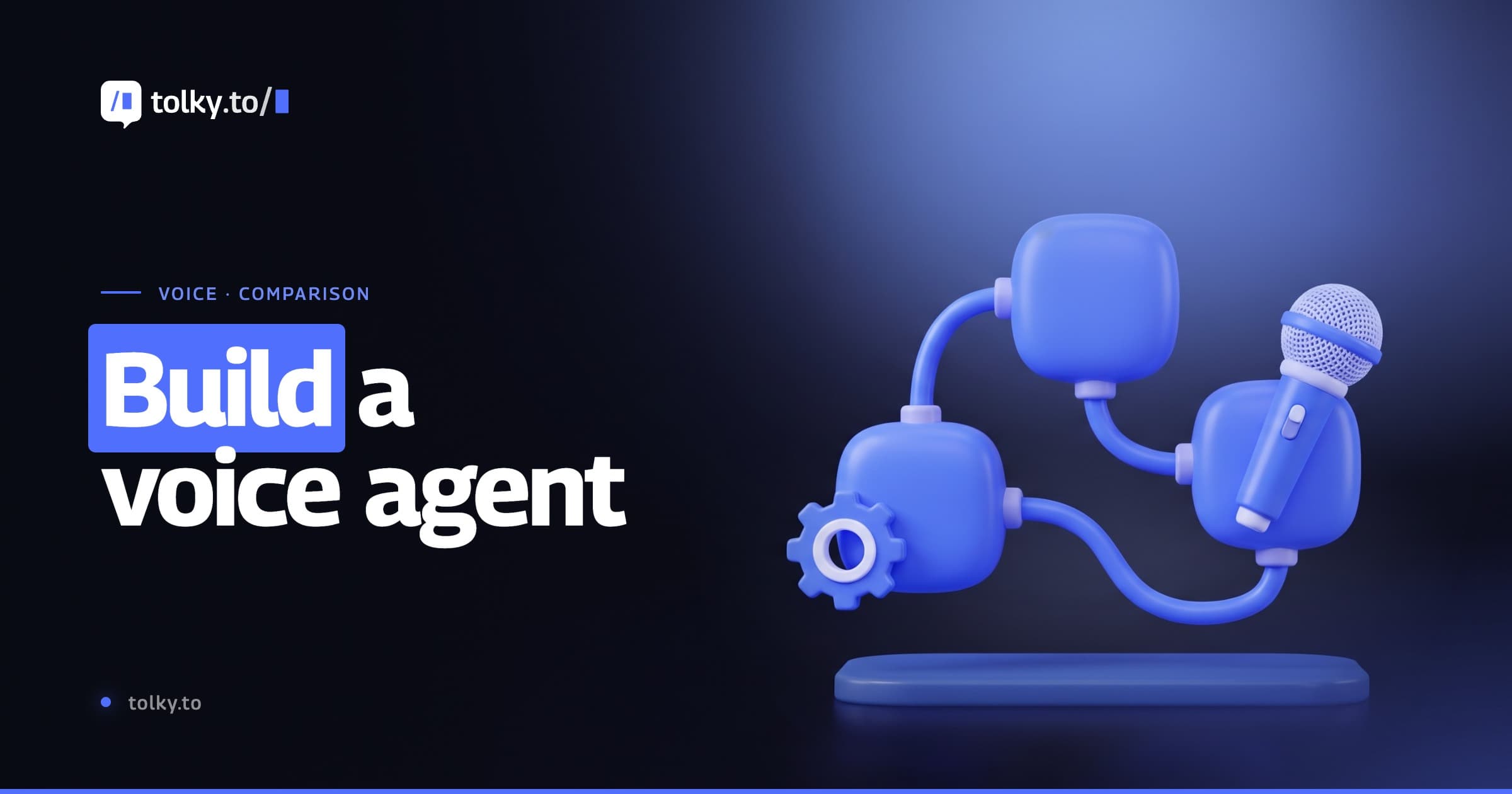
Build a voice agent with n8n, ElevenLabs or Vapi, or use a platform?
How to build a voice agent with n8n, ElevenLabs, Vapi, Retell or Gemini: what each piece does, how each one charges, what you still have to build and when a ready platform pays off.
TL;DR
An n8n voice agent almost always relies on another tool for the audio: ElevenLabs Agents, Vapi, Retell or a real-time model like Gemini Live handle the speech, while n8n orchestrates the systems around the call. Building gives you full control; a ready platform ships phone numbers, WhatsApp, CRM, human handoff and a live dashboard without you building each piece.
Share
Anyone who has built a text agent in n8n usually wants the next step: the same agent answering the phone. The search leads to ElevenLabs, Vapi, Retell, Synthflow and Gemini, and the real question shows up fast: build it all yourself or use a ready platform?
This guide is for technical people and agencies: what each piece does, how each tool charges, what is left to build around the agent and when each path is the right one, including when the answer is not Tolky.
Updated in November 2026.
What is a voice agent built with n8n, ElevenLabs or Vapi?
A self-built voice agent combines a voice platform, which listens and speaks on the call, with an orchestrator like n8n, which fetches data and writes the outcome to your systems. Each part comes from a different vendor, and you wire them together.
The audio side repeats three steps on every turn: transcribe speech into text (STT), decide the reply with a language model and generate the voice (TTS). It all has to be fast, because high latency makes people think the call dropped.
If the concept is new to you, start with the guide to AI voice agents for customer service. This one is about the build.
What does each tool do?
n8n orchestrates workflows; ElevenLabs Agents, Vapi, Retell and Synthflow are voice agent platforms; Gemini Live is a real-time voice model; and telephony comes from a SIP provider or an account such as Twilio. The facts below were checked against each vendor's official docs on November 20, 2026.
n8n: the orchestrator
n8n describes itself as a fair-code licensed workflow automation tool that combines AI features with business process automation (n8n docs). Its AI section covers LLMs, agents, tools, memory and MCP servers, but not real-time audio.
So in a voice agent, n8n sits behind the voice platform: it receives a webhook during the call to check a calendar or an order, and another one at the end to store the transcript. The text version, step by step, is in AI agent for WhatsApp with n8n.
ElevenLabs Agents
The ElevenLabs Agents overview says the platform coordinates four components: a speech-to-text model, the language model of your choice, a low-latency text-to-speech model and a proprietary turn-taking model. It also lists SIP trunking, a native Twilio integration and batch outbound calls.
The WhatsApp integration covers messages, voice notes and inbound and outbound calls, and business-initiated calls require the user's permission, requested through a template. On the API pricing page, billing is per minute with minutes included per tier, and real-time models are listed with LLM usage on top.
Vapi, Retell and Synthflow
Vapi presents itself as the developer platform for building voice AI agents: each assistant combines a transcriber, a model and a voice, picked from dozens of providers. Per its pricing page, there is a per-minute hosting fee, provider costs pass through with no markup and the phone carrier charges separately.
Retell defines itself as a platform to build, test, deploy and monitor AI voice and chat agents, with calls arriving by phone number, SIP trunk or web, plus an API. Its pricing is per minute, broken into voice engine, LLM, text to speech and telephony. Synthflow describes itself as an enterprise conversational AI platform with a visual flow builder and APIs, sold as an annual agreement, with no per-minute rate and no free plan.
Gemini Live and real-time models
The Gemini Live API offers real-time, low-latency voice conversation, lets users interrupt the model at any time, speaks 70 languages and calls functions. The page does not describe its own telephony: calls come in through partner integrations. Searching for a "Gemini voice agent" means picking the model, and you still need everything else.
| Tool | Role in the voice agent | How it charges (official page, Nov 20, 2026) |
|---|---|---|
| n8n | Orchestrates workflows, webhooks and integrations | Does not handle audio; voice cost comes from the other piece |
| ElevenLabs Agents | Voice agent platform with WhatsApp, SIP and Twilio | Per minute with included minutes; LLM on top for some models |
| Vapi | Developer voice platform | Per-minute fee plus providers at cost; telephony separate |
| Retell | Voice and chat agent platform | Per minute, by component (voice, LLM, TTS, telephony) |
| Synthflow | Enterprise voice platform | Annual agreement, no per-minute rate |
| Gemini Live API | Real-time voice model | Google API usage; telephony through partners |
What do you need to build around the voice agent?
The voice platform handles the conversation; nearly everything else, from the phone number to the customer history, is on you when you build. This is where most budgets go wrong.


- Numbers and telephony. Buying or porting numbers, setting up the SIP trunk, deciding which agent answers each number.
- WhatsApp. Calls through the Calling API require an official account and, for business-initiated calls, the contact's permission, according to Meta's documentation (checked on November 20, 2026).
- CRM and history. The transcript has to land on the customer record, next to text conversations, or the team works blind.
- Human handoff. Handoff rules, an agent queue and what happens when the assigned person does not pick up.
- Live dashboard. Seeing calls in progress, listening in and joining the audio.
- Do-not-call list. In Brazil, Não Me Perturbe lets people block telemarketing from participating carriers and financial institutions; on top of that, your own list has to apply to every campaign. Rules vary by country, so check yours.
- Privacy and support. Voice and transcripts are personal data: Brazil's LGPD, Law 13.709/2018, requires a stated purpose, minimum necessary data and transparency (art. 6). And someone has to answer when something breaks at 7:00 p.m. on a Friday.
Each item is one more workflow, screen or contract.
Build or use a ready platform?
Building gives you control of every provider and of the code; a ready platform trades some of that control for a system that already ships with channels, CRM, handoff and a dashboard. The table shows where each path weighs more.


| Criterion | Build (n8n + voice platform) | Ready customer service platform |
|---|---|---|
| Choice of STT, LLM and voice | Full, swap any time | Within the platform's options |
| Time to first call | Fast for a demo, long for production | Configuration, no integration code |
| Phone, WhatsApp and website | You integrate each channel | Already integrated |
| History and CRM | Your own workflow to store it | Transcript in the contact history |
| Handoff and agent on the line | You build the rule and the queue | Built in |
| Outbound campaigns and do-not-call list | You build dialer, schedules and list | Built in, when the platform offers it |
| Cost | Several invoices, many in dollars | One invoice, less provider freedom |
| Support in your language | Varies by tool | Check during the demo |
The same debate for text agents is in n8n or a platform for agencies.
When is building the right call?
Building with n8n and a voice platform is the best choice when the voice agent is the product, when you need to control every provider or when the use case is very specific. In those cases Vapi, Retell, ElevenLabs Agents or Gemini Live are excellent tools, and forcing a ready platform would be a mistake.
- You sell voice. An agency or SaaS embedding voice in its own product needs an API, SDKs and provider freedom, the audience Vapi and Retell describe.
- You need a specific provider. A brand voice or your own model calls for a platform that lets you swap each piece.
- The use case is narrow. A bot that only confirms attendance and writes the result to a spreadsheet can be simpler to build.
- You have a team to maintain it. Building is cheap in month one and expensive in month twelve if nobody looks after the workflows.
Synthflow, sold on an annual agreement, tends to suit large operations that want a dedicated voice vendor.
When does a ready platform make more sense?
A ready platform pays off when voice is one more channel for service or sales, and what matters is the resolved customer, not the tech stack. In that case, what is left to build (CRM, handoff, dashboard, campaigns) becomes the whole project.
Signs you are building a platform by accident
- The workflow that stores transcripts already has more nodes than the agent.
- The team wants to listen to live calls and you are designing a screen.
- The client wants outbound campaigns with schedules and a do-not-call list.
- Several invoices arrive and nobody knows the cost per resolved call.
If two or more show up, compare before you write the next workflow. The guide on how to choose a voice AI platform has the demo checklist.
Common mistakes when building a voice agent
The most common mistake is testing a five-minute browser demo and budgeting production off of it. A real call has noise, accents, interruptions and slow systems.
- Looking only at price per minute. Telephony, LLM, voice and hosting are billed separately; add them up and divide by resolved calls.
- Forgetting interruptions. Without well-tuned barge-in, the customer talks over the AI and it keeps going.
- Slow webhooks. If n8n takes seconds to answer during the call, the pause shows up in the conversation.
- No way out to a person. Every call needs a transfer path with the reason and the transcript. See the AI-to-human handoff rules.
- Scattered data. Transcript, contact and audio in different tools make privacy compliance harder.
Where Tolky fits
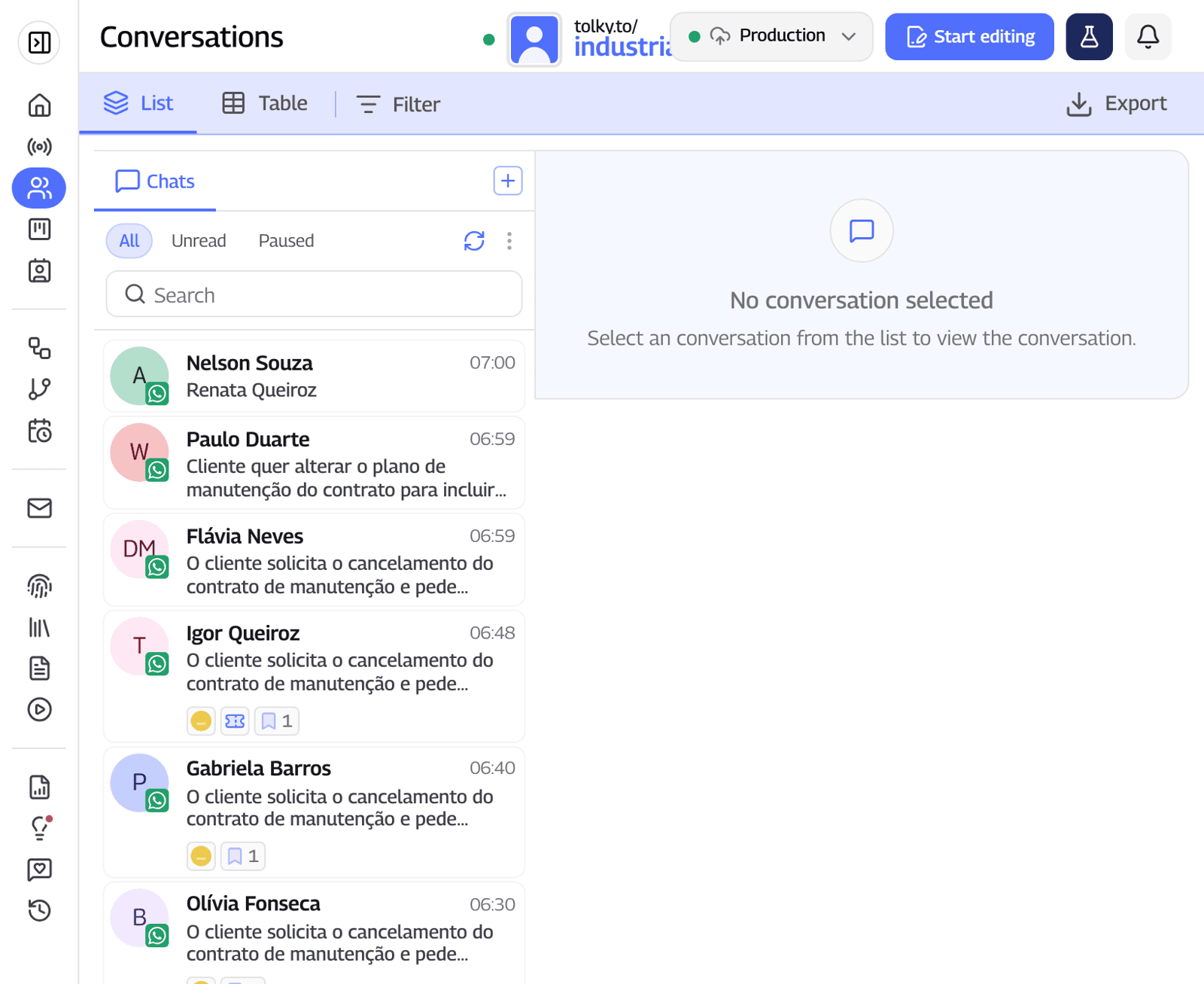
Tolky is a conversational AI CRM where the same agent answers by text and by voice, with Voice Service covering WhatsApp, telephony and voice on the website, on activation. You configure it; you don't integrate it.
- Channels. Calls over WhatsApp, over telephony (each number with its own agent) and by voice on the website.
- Conversation. Voice and regional accent with preview, greeting, interruptions allowed and two modes: cascade or real time.
- People on the line. The team follows live calls and can listen in; when an operator joins the audio, the AI goes silent. If the assigned person does not answer, the call rings other operators.
- History. The real-time transcript stays in the contact history, next to text conversations, in the same CRM.
- Integrations. If you already run workflows in n8n, keep them: there is a REST API, webhooks, HTTP requests, MCP tools and over 1,000 apps in the Flows Integration node (integrations).
To call your list, Voice Campaigns follow an AI-generated script with time windows, a do-not-call list and a daily spending cap.
What Tolky is not: a voice cloning or narration tool, or a stack for building your own voice product. If that is the goal, with control over every STT, LLM and TTS provider, Vapi, Retell or ElevenLabs Agents will likely serve you better.
Frequently asked questions
Can you build a voice agent with n8n alone?
Not in a practical way. n8n orchestrates workflows and agents, but its AI docs do not cover real-time audio. For the call itself you need a voice platform or a real-time model, and n8n handles the integrations.
Can ElevenLabs Agents take WhatsApp calls?
Yes. According to the ElevenLabs docs checked on November 20, 2026, the WhatsApp integration covers messages, voice notes and inbound and outbound calls. For business-initiated calls, the user must grant permission, requested through a template.
What is the difference between Vapi and Retell?
Both are voice agent platforms with an API and per-minute billing. Vapi emphasizes picking your providers, with their costs passed through; Retell breaks billing down by component and also offers chat agents.
Is building a voice agent cheaper than using a platform?
For the first test, almost always. In production, it depends on what is left to build around it. Compare by cost per resolved call, including maintenance hours.
Does Tolky integrate with n8n?
Yes, through the REST API, webhooks and HTTP requests: an n8n workflow can send and receive data from the platform. Tolky Flows can also import an n8n workflow JSON for review, with caveats on steps that have no equivalent.
Conclusion
Building a voice agent with n8n plus ElevenLabs, Vapi, Retell or Gemini is the right call when voice is your product and you have a team to maintain it. When voice is one more channel for service or sales, a ready platform saves you from building numbers, WhatsApp, CRM, handoff and a dashboard from scratch. Do the math by cost per resolved call.
Explore Voice Service, see Voice Campaigns, see the plans or talk to the team →. Let's talk?
Share
Tags
- n8n voice agent
- elevenlabs voice agent
- vapi voice agent
- retell ai
- synthflow
- gemini voice agent
- voice ai
- #conversational CRM
About the author

Co-founder of Tolky
Marlos Carmo is an AI entrepreneur and founder of Tolky, the conversational-era infrastructure and AI CRM that unifies intelligent service, multi-channel support (such as WhatsApp and voice), live CRM, and operational intelligence in a single ecosystem. He is a finalist for the SXSW Innovation Awards and a member of Francesco's Economy, a global network of young entrepreneurs focused on innovation and social impact. He works connecting Artificial Intelligence and digital transformation in projects for large organizations.
Next step
Want to bring this to your operation?
Tati, Tolky's AI assistant, understands your scenario in a few questions, suggests the best path and connects you with someone from the team, with full context.
Share