Voice AI platform for customer service: how to choose (checklist)
How to choose a voice AI platform for customer service and sales: the criteria that matter, a checklist to run during the demo, questions for the vendor and the most common mistakes.
TL;DR
A voice AI platform for customer service is the system that answers and places calls with an AI agent, unlike a voice generator or cloning tool for videos. To choose one, test during the demo the voice and accents in your language, speech understanding, latency, interruptions, channels, human handoff, call history and cost per resolved call.
Share
Search for "voice AI platform" and you get two lists mixed together: tools that generate or clone voices for videos and platforms that answer customer calls. Both use speech synthesis, but they solve different problems, and buying the wrong one costs months.
This guide is for anyone buying a platform for voice customer service or sales: criteria, a demo checklist, questions for the vendor and common mistakes. It is not a "best of" list; it is a method to evaluate any vendor, Tolky included. The examples come from Brazil, where Tolky operates, and Brazilian Portuguese, but the method works in any language.
Updated in November 2026.
What is a voice AI platform for customer service?
A voice AI platform for customer service is the system that puts an AI agent on inbound and outbound calls, understanding what the customer says, replying with a synthetic voice and handing off to a person when the case calls for it. It combines speech recognition, a language model, speech synthesis, calling channels and the team's tools.
A voice generator, on the other hand, turns finished text into audio for a video, podcast or ad. It does not listen to anyone, does not answer the phone and does not log anything in the customer history.
| Question | Voice generator or cloning tool | Voice AI platform for customer service |
|---|---|---|
| What it delivers | An audio file from a script | A call with a real-time conversation |
| Listens to the customer | No | Yes, transcribes and understands |
| Channels | Audio export | Phone, WhatsApp and website |
| People in the operation | Video editor or voice talent | Agents who monitor and take over calls |
| Where the outcome lives | A folder of files | Contact history and CRM |
| How you measure it | Audio quality | Resolved calls and cost per resolution |
The concept is covered in AI voice agents for customer service, and use cases by department in voice agents for companies.
Which criteria matter when choosing a voice AI platform?
The criteria that weigh most are voice quality in your language, speech understanding, response speed, channels, handoff to people, call history, compliance and cost per resolved call. Price per minute and the size of the voice catalog matter less than they seem.
Voice and accents in your customers' language
The voice has to sound natural in your customers' language, with correct pronunciation of names, amounts and addresses. In Brazil that means Brazilian Portuguese with regional accents; elsewhere, the accents your callers actually have. Check how the voice reads a price like "R$ 1.250,90" and a postal code.


Check the transcription too: a good platform understands accents, slang and street noise without losing the request, and follows the language the caller speaks.
Understanding, latency and interruptions
Latency is the time between the customer finishing a sentence and hearing the reply; long pauses make people hang up. Barge-in is the ability to stop talking when the customer interrupts.
Both depend on the architecture. In cascade mode, the platform transcribes, thinks and synthesizes in sequence, which gives you control; in real-time mode, the model listens and speaks at the same time, which makes the conversation more fluid. Ask which modes the vendor offers and test both.
Channels: phone, WhatsApp and website
A voice AI platform can answer on a regular phone line via SIP telephony, on WhatsApp calls and by voice on the website, in the browser. In Brazil, where many people tap the call button inside WhatsApp, that channel matters. For a business to call on WhatsApp, the contact must grant permission first, according to Meta's documentation checked on November 20, 2026; see the guide to the WhatsApp Business Calling API.
People on the line, history and campaigns
AI does not resolve everything, so the platform needs handoff to an agent with the reason, a team following live calls and an operator who can join the audio when needed. The transcript has to land in the contact history, next to text conversations, or the team works without context.
If you will also call your list (collections, win-back, confirmations), check whether the same platform runs voice campaigns with a script, time windows, retries and a do-not-call list.
Checklist: how to test each criterion in the demo
A demo is worth it when you actually call, with your own questions and your own accent, not when you watch a recorded video. Bring this checklist and tick each row.


| Criterion | How to test it in the demo | Red flag |
|---|---|---|
| Voice in your language | Ask it to read an amount, a postal code and a customer's name | Number read in the wrong language or garbled syllables |
| Accents | Speak with another regional accent or hand the phone to a colleague | The AI keeps asking you to repeat |
| Latency | Ask something that requires checking a system | Long silence with no holding phrase |
| Interruptions | Cut the AI off mid-sentence | It keeps talking over you |
| Channels | Call by phone, by WhatsApp and from the website | Only one channel works in the demo |
| Handoff | Say "I want to talk to a person" | No transfer, or a transfer with no context |
| Operator on the line | Ask someone on the team to join the call | The AI keeps talking at the same time |
| History | Open the contact after the call | Transcript in another system or missing |
| Campaigns | Ask to see a script rehearsal and the do-not-call list | Inbound only |
| Cost | Ask for an estimate for one campaign or a typical month | Price per minute only, no view by outcome |
Repeat the test with people from operations: whoever answers the phone every day notices what the buyer misses.
What compliance and privacy rules should the platform support?
The platform has to help you comply with privacy law, the customer service rules of your industry and good practice for outbound calls, because voice and transcripts are personal data. Responsibility is your company's, but the system can make it easier or harder. The rules below are Brazilian; they vary by country, so check yours.
- LGPD. Brazil's Law 13.709/2018 requires a stated purpose, minimum necessary data and transparency with the data subject (art. 6). See LGPD in the glossary.
- Customer service with AI. Brazil's Decree 13.135/2026, which regulates customer service for federally regulated services and Central Bank supervised financial platforms, allows AI for triage and resolution as long as the consumer can choose real-time service by a person (art. 3). It also caps service at five levels and requires keeping recordings and messages for at least 90 days (art. 19). Checked on November 20, 2026.
- Outbound calls. A notice that the call is transcribed, a respected do-not-call list and reasonable hours. Telecom rules on caller identification change over time, so confirm the current ones with your phone provider.
In the demo, ask where transcripts are stored, who has access and how the team logs a request not to be called. The security page lists the controls Tolky publishes.
How do you compare the cost of voice AI platforms?
Compare by cost per resolved call, adding channel, voice and AI processing, platform and team time, not by price per minute alone. Each vendor bundles these parts differently.
- Channel. The carrier's rate on telephony and Meta's rate on business-initiated WhatsApp calls.
- Voice and AI. Transcription, model and synthesis, billed per minute or bundled into credits.
- Platform. Subscription, license or contract.
- Team. Hours to configure, review calls and take over transfers.
An illustrative example: if platform A costs less per minute but resolves 4 out of 10 calls, and platform B costs more but resolves 7 out of 10, B may come out cheaper per resolved call, because it sends fewer calls to the team. To estimate your case, use the customer service ROI calculator and see Tolky's plans.
Questions to ask the vendor
Good questions take the conversation off the sales script and show how the platform behaves in your daily operation. Bring these to the meeting:
- Which voices and accents are available in my customers' language, and can I hear them before publishing?
- How does the transfer work when the assigned agent does not pick up?
- Does the transcript stay in the contact history or in another system?
- How do you handle WhatsApp call permission and the contacts who did not grant it?
- How do I keep my number from being flagged as spam during a campaign?
- Does support answer in my language, during which hours and on which channel?
If the answer is "it depends" to more than half, ask to see it working.
Common mistakes when choosing a voice AI platform
The most common mistake is choosing the nicest voice from a recorded demo and later finding out the operation needs handoff, history and campaigns. The voice is the part you hear; the rest is what makes the call get resolved.
- Confusing a voice generator with a customer service platform. Narration does not answer the phone.
- Testing only in the browser. The phone has noise and compression that a website demo does not show.
- Ignoring WhatsApp. In markets like Brazil, many customers prefer to call there.
- Forgetting the way out to a person. Without good handoff, the AI becomes a friendlier IVR.
- Building without a team to maintain it. If you plan to assemble tools yourself, first read build a voice agent with n8n, ElevenLabs or Vapi.
Where Tolky fits
Tolky is a conversational AI CRM with Voice Service, where the same agent that answers by text handles calls over WhatsApp, telephony and voice on the website, on activation. It is one of the options this checklist helps you evaluate.
- Voice. Voice with preview, regional accent, greeting and shorter replies, in cascade or real-time mode.
- Natural conversation. Customers can interrupt the AI, and the real-time transcript follows the language the caller speaks.
- People on the line. The team follows live calls and can listen in; when an operator joins the audio, the AI goes silent. If the assigned person does not answer, the call rings other operators.
- Single history. The transcript stays in the contact history, next to text conversations.
- WhatsApp with permission. Tolky sends the permission request, shows the status (granted, declined, pending) and uses regular telephony for those who have not granted it.
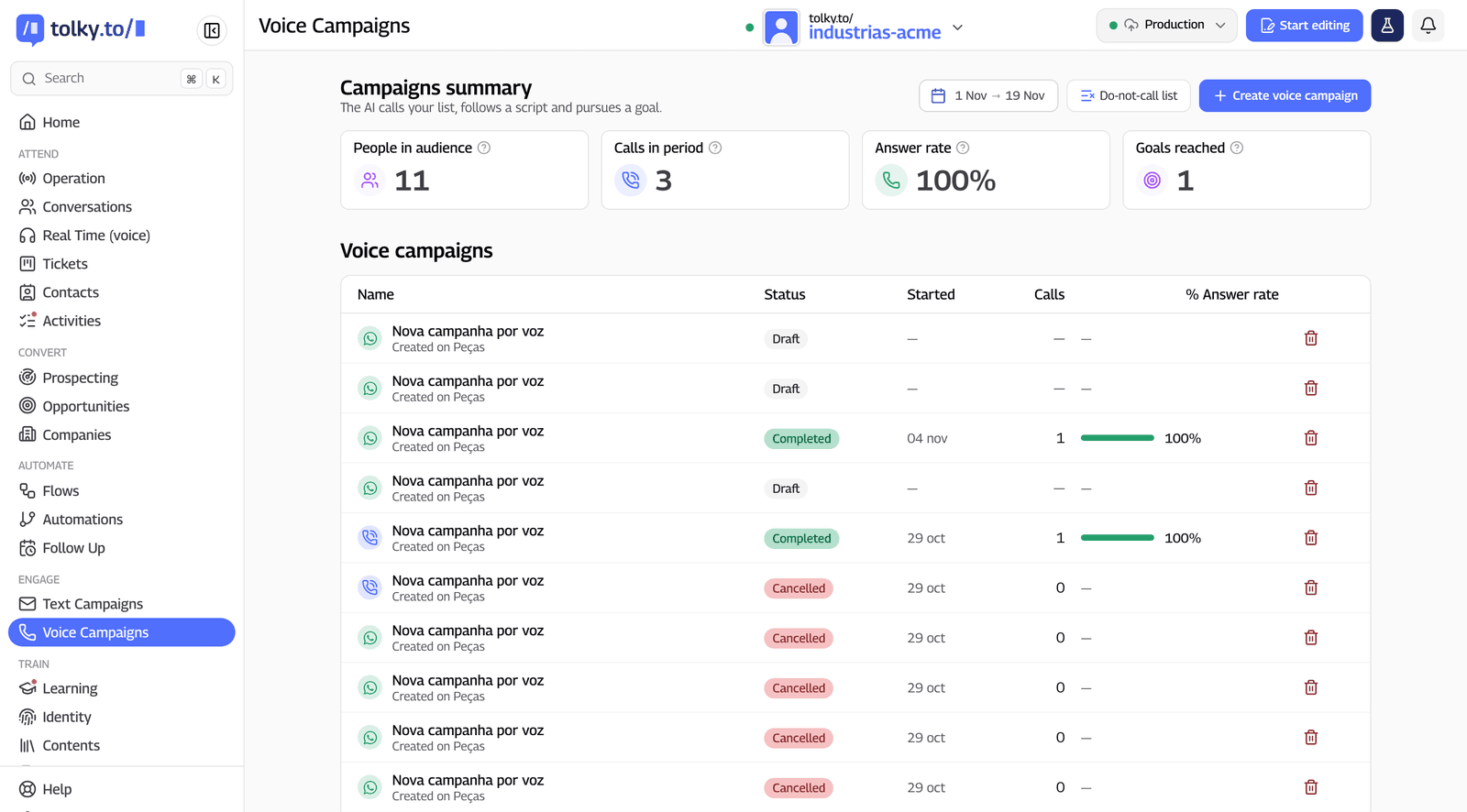
To call your list, Voice Campaigns follow an AI-generated script with rehearsal, time windows, a do-not-call list valid for every campaign, a credit estimate, a daily spending cap and a real-time dashboard. Every campaign call starts with the transcription notice, which cannot be turned off.
What Tolky does not do: it is not a voice cloning or narration tool, and voice is not on by default, because it requires activation. If you need audio recordings kept for a set period, check with the team how that works in your case.
Frequently asked questions
What is the difference between a voice AI platform and a voice generator?
A voice generator turns text into audio for videos, ads or podcasts. A voice AI platform for customer service listens to the customer, holds a real-time conversation, checks systems and hands off to a person, logging the call in the history.
Is there good voice AI in Brazilian Portuguese?
Yes, several platforms offer voices and transcription in Brazilian Portuguese. Quality varies with accent, noise and the type of information, so test with real numbers, names and addresses during the demo.
What is the best voice AI for customer service?
It depends on your channels, your volume and how much you need handoff, history and campaigns. The best one resolves the most calls at the lowest cost per resolution in your case, measured in a test with real calls.
Can voice AI answer WhatsApp calls?
Yes. Meta's Calling API lets businesses receive and place calls on WhatsApp, and a voice agent can answer them. For the business to call, the contact must grant permission first.
Do I need to tell callers they are talking to an AI?
It is the recommended practice, and saying the call is transcribed supports the transparency that privacy laws like Brazil's LGPD ask for. For regulated customer service in Brazil, Decree 13.135/2026 requires that consumers can reach a person in real time.
Conclusion
Choosing a voice AI platform starts by separating customer service from narration. Then test the voice, accent, latency, interruptions, channels, handoff and history during the demo, ask about compliance and support, and compare by cost per resolved call.
Explore Voice Service, see Voice Campaigns, see the plans or talk to the team →. Let's talk?
Share
Tags
- voice ai platform
- best voice ai for customer service
- voice ai in portuguese
- ai voice agent platform
- #ai voice agent
- voice customer service
- #voice campaigns
- #conversational CRM
About the author

Co-founder of Tolky
Marlos Carmo is an AI entrepreneur and founder of Tolky, the conversational-era infrastructure and AI CRM that unifies intelligent service, multi-channel support (such as WhatsApp and voice), live CRM, and operational intelligence in a single ecosystem. He is a finalist for the SXSW Innovation Awards and a member of Francesco's Economy, a global network of young entrepreneurs focused on innovation and social impact. He works connecting Artificial Intelligence and digital transformation in projects for large organizations.
Next step
Want to bring this to your operation?
Tati, Tolky's AI assistant, understands your scenario in a few questions, suggests the best path and connects you with someone from the team, with full context.
Share