
Blog
Strategy
Butterfly Funnel: Why B2B Growth Doesn't End with the Sale
Traditional funnels focus only on acquisition. The Butterfly Funnel extends the customer journey to retention, service, and expansion. Connect sales and success with AI.

Marlos Carmo
June 17, 2026
·
18 min read

TL;DR
The **Butterfly Funnel** is a strategic model that redefines growth, showing that the sale is not the finish line but the balancing point of a customer's journey. The left wing maps acquisition (attraction, qualification, closing), while the right wing maps retention (onboarding, support, expansion, advocacy). Integrating this journey on channels like WhatsApp with **Conversational AI** and **AI CRM** automates service and drives expansion without losing the human touch.
Share
Consider the following sales routine: the marketing team works hard to generate qualified leads. The sales team puts all their effort into meetings and demos to handle objections and, finally, close the deal. The gong rings in the office, commissions are calculated, and the team celebrates hitting the target.
But what happens the next day?
In many B2B organizations, the newly acquired client enters a vacuum. They are handed over to the support or onboarding team with zero history of their previous sales conversations. They must explain, for the second or third time, what their business challenges are, what was agreed upon during the close, and what project goals they expect to achieve.
When a company loses context after the sale, it starts losing the customer.
The mistake is not in the teams' dedication, but in the mental model that guides the business. Relying solely on the traditional sales funnel, where the journey ends in a cone shape, ignores the fact that modern business profitability and sustainability depend on post-sales. The Butterfly Funnel exists to design and organize this continuous journey.
What is the Butterfly Funnel
The Butterfly Funnel (or Butterfly Model) is a customer lifecycle framework that replaces the classic linear acquisition cone with a two-dimensional cycle. It resembles a butterfly, where the two wings represent distinct stages, both of which are equally important for the company's financial health.
The left wing represents the traditional marketing and sales funnel: attraction, capture, engagement, qualification, and closing the deal.
The right wing represents the post-sales and expansion cycle: onboarding (client activation), support, service, Customer Success (CS), retention, upsell/cross-sell (expansion), and, finally, advocacy (referrals).
The central point connecting both wings — the body of the butterfly — is the sale. The Butterfly Funnel shows that the sale is not the finish line, but the balancing point of a continuous and profitable relationship.
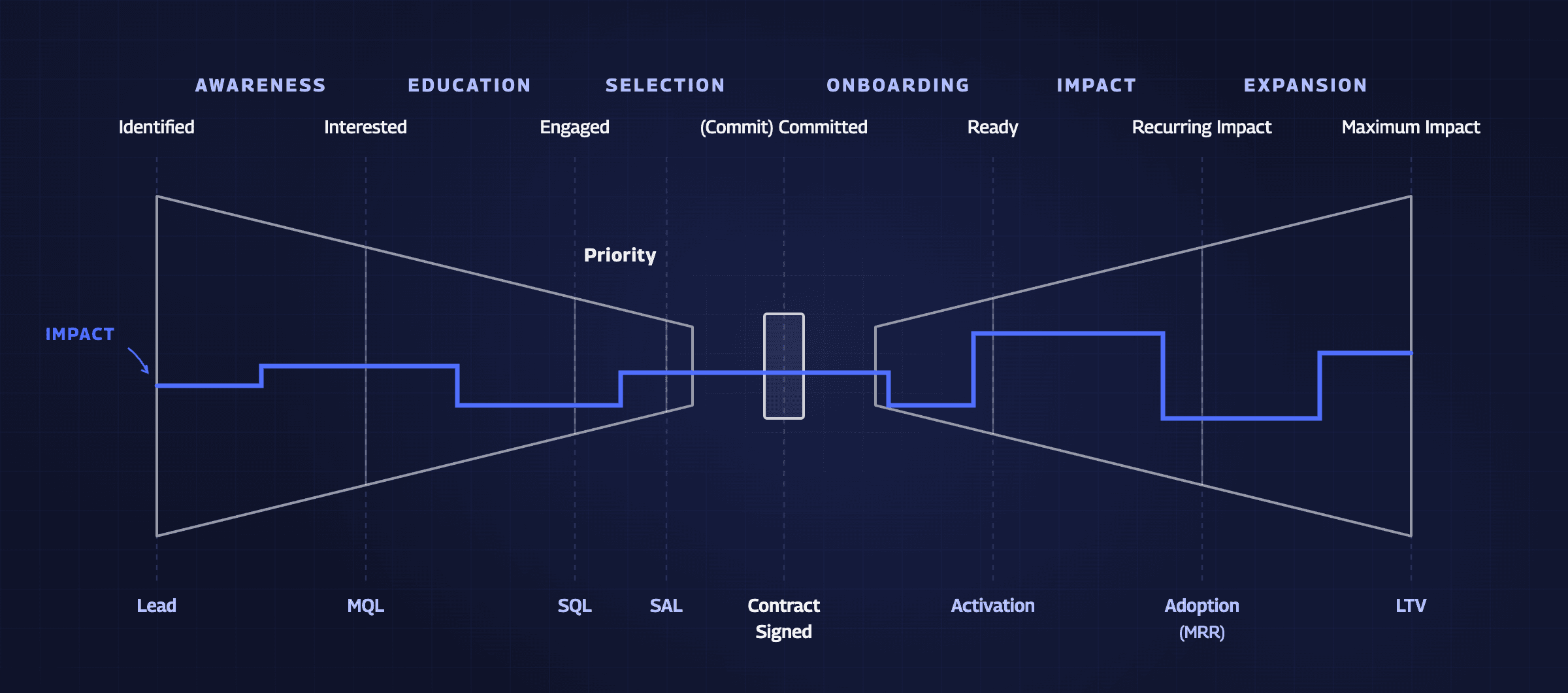 Butterfly Funnel: The complete B2B customer lifecycle, dividing the journey into acquisition (left wing) and retention (right wing), with the sale at the center
Why the Traditional Funnel is Limited for Relationship-Driven Businesses
The traditional marketing and sales funnel (often represented by the AIDA model: Attention, Interest, Desire, and Action) was designed at a time when commerce was purely transactional. You bought a physical product, the transaction was complete, and the brand had little relation with the buyer until they needed a new product years later.
For the B2B market, technology companies, SaaS (Software as a Service) providers, recurring services, and relationship-based businesses, this old funnel has become obsolete and dangerous for several reasons:
- It ignores Customer Acquisition Cost (CAC): Acquiring a new customer is 5 to 25 times more expensive than retaining an existing one, according to data published by the Harvard Business Review. Relying only on new customers to grow is inefficient in the long run.
- It disregards Recurring Revenue: The real profit of a subscription model or recurring contract does not occur in the setup fee or the first month, but over the years the client remains active (LTV — Lifetime Value).
- It creates Organizational Silos: The traditional funnel separates marketing, sales, and service. The customer, however, does not see these divisions. To them, the brand is one. When they feel like they are talking to different companies when switching departments, their trust in the brand drops.
The customer does not live in departments. They live a single, continuous journey.
The Sale as the Center of the Journey, Not the End
In the Butterfly Funnel, the sale is redefined. Instead of being the end of the process, it is treated as the beginning of the operational relationship.
The sale is not the end of the funnel. It is the middle of the butterfly.
When the customer signs the contract or makes their first purchase, they hand over their most precious asset to your company: trust. They are paying for a promise made by sales to be delivered by operations.
If operations fail in the first few weeks (onboarding), the client experiences "buyer's remorse," increasing the chances of early cancellation (churn). If the company sees conversion as the finish line, the sales team is encouraged to bring in customers at any cost, even those without the ideal customer profile (ICP), leading to financial waste post-sales.
The Left Wing: Attraction, Capture, Qualification, and Conversion
The left wing of the butterfly encompasses the go-to-market strategy. It is responsible for preparing the ground and guiding the prospect to the purchasing decision:
- Attraction and Capture: Involves grabbing the target market's attention through content marketing, SEO, paid traffic, and social media. The goal is to turn anonymous visitors into identified contacts (leads).
- Lead Qualification: This is when the company validates if the lead fits the ideal customer profile (ICP) and has real buying intent. In modern operations, this triage can be handled autonomously by AI agents on WhatsApp, ensuring speed.
- Conversion and Closing: The sales team (or the self-service flow) conducts sales demos, handles objections, and closes the deal.
The left wing generates initial demand and inserts new relationships into the corporate base.
The Right Wing: Onboarding, Service, Support, Retention, Expansion, and Referrals
The right wing is the engine that enables the healthy growth and financial scalability of any recurring business:
- Onboarding (Activation): A critical period where the customer learns to use the tool or service and reaches their first success milestone (Time to Value).
- Service and Support: The day-to-day relationship. Involves resolving operational doubts, solving technical incidents, and ensuring service stability.
- Retention: Planned actions to keep the customer satisfied and prevent cancellation. Includes engagement analysis and preventive customer success follow-ups.
- Expansion (Upsell/Cross-sell): Offering more value to the current customer through higher plans, new features, or additional services.
- Referrals (Advocacy): The peak of the relationship, where the customer becomes a brand advocate and refers new business, feeding back into the left wing of the butterfly.
Traditional Funnel vs Butterfly Funnel: What Is the Difference?
Look at the comparison table below to understand the shift in paradigm between the two models:
| Aspect | Traditional Funnel (Linear Cone) | Butterfly Funnel (Continuous Cycle) |
|---|---|---|
| Primary focus | Acquiring new leads and closing sales | LTV, retention, satisfaction, and base expansion |
| Journey view | Linear with an end point (the sale) | Two-dimensional, continuous, and open-ended |
| Role of the sale | Finish line and final goal of the operation | Central transition point to actual operations |
| Role of customer service | Passive and reactive cost center | Intelligence generator and retention driver |
| Data usage | Focused on lead conversion rates | Focused on chat history and NPS/CSAT |
| Relationship | Transactional, focused on closing the deal | Consultive, focused on sustaining and growing the account |
| Growth | Dependent on new marketing investments | Sustainable, generated by expansion and referrals |
| Department integration | Teams work in isolation (silos) | Full integration (Marketing, Sales, CS, and Support) |
Why Companies Lose Money by Ignoring Post-Sales
B2B growth based solely on acquisition is like trying to fill a leaky bucket. No matter how much water (leads) you pour into the top, if the bucket does not retain the liquid, you will spend more and more energy to keep the level stable.
Ignoring post-sales leads to quiet and severe costs:
- Erosion of Profit Margin: If a customer cancels their contract before paying back what the company spent to acquire them (CAC), the operation on that account loses money.
- Overloaded Reactive Support: The lack of a structured onboarding process forces the client to learn by trial and error, generating a huge volume of repetitive Level 1 support tickets.
- Damaged Brand Reputation: Frustrated post-sales customers don't just cancel; they share their negative experience in the market, making it more expensive to acquire new leads.
Marketing generates demand, sales converts, service sustains, and relationships expand.
How Customer Service and Relationships Become Growth Engines
Mature companies do not view support and service as a necessary evil or a cost center for complaints. On the contrary: customer service is the main source of organic commercial opportunities.
When support resolves a critical issue quickly and politely, it creates a positive emotional connection with the customer. This satisfaction reduces price sensitivity and opens the door for expansion discussions.
In addition, by analyzing support conversations, a company can identify which clients are using the solution heavily and could benefit from advanced plans, generating qualified upsell opportunities for sales in a much more natural way than a cold sales pitch.
The Role of Conversational AI in Each Stage of the Butterfly Funnel
Artificial intelligence acts as the muscle that supports and scales operations across the entire Butterfly Funnel:
- In Attraction and Qualification (Left Wing): AI agents talk to leads from ads on WhatsApp instantly 24/7, answering FAQs and performing triage to deliver ready leads to the sales team.
- In Closing (The Body): Tools analyze conversations to suggest to the salesperson the most effective arguments and custom proposals.
- In Onboarding and Service (Right Wing): AI guides the customer through their first steps, sends interactive reminders, and resolves over 70% of support queries autonomously on WhatsApp.
- In Expansion and Retention (Right Wing): AI monitors support chat patterns to predict churn risks and alert CS proactively, and triggers contextual upsell campaigns based on real usage.
How WhatsApp, Webchat, and Voice Connect Acquisition, Sales, and Success
WhatsApp has established itself as the central channel for customer relationships in many markets. However, B2B clients also browse your website, use your platform's chat, or call the office for urgent support.
If these touchpoints are scattered, the Butterfly Funnel breaks.
The secret to a frictionless journey is channel unification. When the company centralizes the WhatsApp API, website chat, and voice channels under the same conversational intelligence:
- The lead starts by asking a question on the website chat.
- Moves to WhatsApp to receive the proposal and close the deal.
- Performs onboarding and asks technical support questions in the same WhatsApp chat.
- Receives proactive campaigns and updates in the same thread.
For the client, it is a single, personalized conversation with the brand, preserving context regardless of which agent or bot handles the chat.
Why History and Context Are Essential for a Continuous Journey
Nothing frustrates a customer more than repeating information. When support asks "What is your operating system?" or "What plan do you have?", the company is transferring the work the system should do automatically to the client.
Maintaining context means ensuring that:
- The onboarding team knows exactly what business pain points the lead mentioned to the salesperson.
- The support agent sees what tickets were opened before starting a new reply.
- The upsell representative checks if the client had recent support issues before sending an offer.
Preserving history turns isolated interactions into a coherent relationship.
How AI, Automation, and Human Teams Work Together
Scale and quality in modern service require a precise balance between technology and human touch.
AI handles data volume, the 5-second initial response speed, and Level 1 support queries. Automation ensures repetitive tasks (like onboarding emails, invoice notifications, and pipeline stage updates) happen on time.
Human agents are saved for the most crucial journey milestones: consultative sales meetings, closing high-value accounts, emotional support during critical issues, and managing complex success plans.
A smart operation combines these three factors: AI greets the client and handles daily tasks; if it detects complexity, it transfers the chat to the human representative along with a summary of the conversation.
How Tickets, Campaigns, Reports, and Integrations Support the Funnel
Managing both wings of the Butterfly Funnel at scale requires structured capabilities:
- Ticket Management: Turns all support and post-sales requests into trackable records with defined SLAs, ensuring no request is forgotten.
- Relationship Campaigns: Allows sending active contextual messages on WhatsApp (like product tips, birthday wishes, or NPS surveys) based on the customer's lifecycle.
- Reports and Sentiment Analysis: Turns text and audio chats into performance data, showing which channels convert best and what topics cause friction.
- System Integrations (CRM/ERP): Connects the conversational AI to internal databases, allowing the AI to check balances, order statuses, and update pipelines instantly.
The Role of AI CRM in Managing the Entire Journey
An AI CRM is the category of software designed specifically to manage the Butterfly Funnel.
Unlike traditional sales CRMs that only track the left wing (acquisition), AI CRM acts as the single source of truth for the customer's entire relationship. It stores real chats, qualifies leads actively, organizes support queues, and automates post-sales under one unified dashboard.
With an AI CRM, the wall separating sales from support disappears. Both teams collaborate on the same platform, viewing the same chats and sharing context in real-time to maximize retention and revenue per account.
Indicators to Measure the Butterfly Funnel
Results-oriented management requires measuring the efficiency of both wings of the butterfly:
Left Wing: Acquisition Indicators
- Customer Acquisition Cost (CAC): Total investment to win a new customer.
- Speed to Lead: Response speed on the first touchpoint.
- MQL to SQL Conversion Rate: Percentage of leads qualified for sales.
- Opportunities Created: Number of ready leads delivered to the sales team.
Center: Transition Indicator
- Close Rate: Percentage of proposals that turn into sales.
Right Wing: Retention and Expansion Indicators
- Activation Rate (Time to Value): Speed and percentage of clients reaching their first milestone.
- Customer Retention Cost (CRC): Investment to keep the base active.
- AI Resolution Rate: Percentage of queries solved by Conversational AI.
- Retention Rate: The company's ability to keep customers active.
- Churn Rate: Volume of accounts or revenue lost per period.
- Expansion Rate (Upsell/Cross-sell): Revenue growth generated from active clients.
- Referral Rate (NPS/Advocacy): Volume of qualified leads generated from referrals.
Common Mistakes When Applying the Butterfly Funnel
Avoid these mistakes when transitioning your B2B business to the Butterfly Funnel model:
- Separating sales and support channels: Using different WhatsApp numbers and isolated systems, forcing the customer to switch channels and repeat their pain points.
- Only measuring acquisition: Focusing board meetings solely on sales numbers, ignoring churn rates and post-sales complaints.
- Automating without proper human handoff: Creating bots that fail on complex questions and offer no easy way to speak to a human.
- Failing to record sales context: Not documenting implementation expectations created during sales, leading to misalignments in onboarding.
How to Implement the Butterfly Funnel in a B2B Operation
Follow this four-step roadmap to start your transition:
1. Align Leadership and Shared Goals
Break down the walls between sales, marketing, and support directors. Establish shared goals: sales is measured by retention in the first 90 days; support is rewarded for identifying upsell opportunities in chats.
2. Map the Customer's Conversational Journey
Design the lifecycle under your primary channel (like WhatsApp). Define how the lead enters, how AI qualifies, how sales answers, how onboarding activates, and how support resolves issues.
3. Implement a Single Platform (AI CRM)
Adopt a platform like Tolky that connects the official WhatsApp API with your AI layer, human support, and CRM, centralizing all history under one customer view.
4. Create Preventive Relationship Campaigns
Don't wait for the client to contact support. Program automated post-sales campaigns with value-packed messages based on where they are in their lifecycle.
Checklist: Is Your Company Looking at the Whole Journey?
Evaluate your B2B operation with these questions:
- Do customers use the same official WhatsApp number to talk to sales and support?
- Are expectations created by the sales rep during closing passed to the onboarding team automatically?
- Can the support agent view proposals and pricing terms before replying to a client?
- Does the company run preventive NPS surveys and automated follow-ups post-sales?
- Do customers skip repeating their details and issues when switching departments?
- Does the AI answer repetitive questions 24/7 on WhatsApp, reducing the human support queue?
- Does sales leadership track expansion MRR generated from current customers?
- Is there real-time integration between WhatsApp, sales CRM, support tickets, and ERP?
How Tolky Sees Customer Relationships Beyond the Sale
At Tolky, we believe B2B growth lies in closing the operational gap between sales and post-sales. Technology should bring people closer and optimize processes, not create cold barriers.
We view the Butterfly Funnel not just as a marketing concept, but as the essential architecture to govern future customer operations. By combining Conversational AI with human handoff, ticket management, and unified context, our platform allows your team to serve each customer personally and at scale.
The sale is just the beginning of customer success. Managing this journey with intelligence and proximity turns relationships into long-term operational retention.
Conclusion: Sustainable Journey Expansion
If your company invests heavily in winning new sales but has no visibility into what happens after the contract is signed, you are leaving a huge portion of your potential growth revenue on the table.
Intelligent customer relationships do not end with the sale. The Butterfly Funnel suggests an integrated look at the journey, ensuring attraction leads to the right sale, sales triggers the right onboarding, onboarding creates satisfied customers, and satisfaction drives expansion and recurring referrals.
If you want to turn WhatsApp, webchat, and your support channels into a unified conversational operation guided by the Butterfly Funnel, talk to the Tolky team of experts. We will help you design and automate the complete customer journey.
FAQ: Frequently Asked Questions About the Butterfly Funnel
1. What is the Butterfly Funnel?
The Butterfly Funnel is a customer lifecycle model that splits the journey into two wings: the left wing focuses on acquisition (attraction, qualification, sales) and the right wing focuses on retention and account growth (onboarding, support, expansion, referrals).
2. What is the difference between the traditional funnel and the Butterfly Funnel?
The traditional funnel is linear and ends at the sale. The Butterfly Funnel is a continuous cycle, treating the sale as the center and giving equal weight to onboarding, success, support, and expansion.
3. Why is the sale at the center of the Butterfly Funnel?
The sale is at the center because it marks the transition from prospect to customer. It is the moment where initial commercial trust must be translated into operational success delivered by the company.
4. How do you apply the Butterfly Funnel in B2B?
Application requires integrating marketing, sales, and success teams under the same platform and data governance. The company must structure onboarding, monitor support SLAs, and identify upsell/cross-sell triggers.
5. How does Conversational AI help in the Butterfly Funnel?
AI supports the whole cycle: it qualifies ad leads on WhatsApp (left wing), monitors commercial sentiment (center), and resolves support tickets, guides onboarding, and flags churn risk (right wing).
6. How can WhatsApp support acquisition and post-sales?
Being the channel where the customer is already active, WhatsApp centralizes the journey: the lead asks sales questions, receives proposals, completes onboarding, and opens support tickets in the same thread.
7. What is the role of customer service in company growth?
Service is the anchor of your active customer base. By resolving issues quickly and keeping customers satisfied, support reduces churn and creates opportunities for expansion and referrals.
8. How do you measure retention and expansion in the Butterfly Funnel?
By tracking post-sales metrics like Customer Retention Rate, activation rate in onboarding, expansion revenue (upsell MRR), Net Promoter Score (NPS), and referral rates.
9. Does the Butterfly Funnel replace the sales funnel?
It does not replace it; it complements it. The Butterfly Funnel includes the sales funnel on the left wing and adds the retention and growth wing on the right, providing a complete view of the lifecycle.
10. How does Tolky help in the complete customer journey?
Tolky unifies digital channels (WhatsApp API, webchat, and voice) under the same Conversational AI platform, allowing the AI to qualify leads, solve support queries, and preserve context for human agents.
Share
Tags
butterfly funnel
customer journey
customer retention
customer success
customer experience
conversational AI
AI CRM
post-sales
Marlos Carmo
Founder of Tolky
Marlos Carmo is an AI entrepreneur and founder of Tolky, the conversational-era infrastructure and AI CRM that unifies intelligent service, multi-channel support (such as WhatsApp and voice), live CRM, and operational intelligence in a single ecosystem. He is a finalist for the SXSW Innovation Awards and a member of Francesco's Economy, a global network of young entrepreneurs focused on innovation and social impact. He works connecting Artificial Intelligence and digital transformation in projects for large organizations.
Read also

AI CRM: Why the Next CRM Will Be Conversational and Integrated
Traditional CRM organizes records but fails due to manual input. AI CRM revolutionizes this by turning WhatsApp conversations into automated operational intelligence. Understand this new logic.
Marlos Carmo
June 17, 2026
·
21 min read
Strategy

The Complete Guide to Customer Experience (CX) in 2026: Strategies, Tools, and AI
Discover what Customer Experience (CX) is and why it is the main competitive differentiator for companies in 2026. Learn how to structure the customer journey, measure results, differentiate CX from CS, and use AI to scale personalized service.
Marlos Carmo
June 6, 2026
·
19 min read
Guides
The Hidden Cost of Slow Response: How Delays Destroy Sales and Operations
Response time in customer service is not a secondary metric — it is an indicator of commercial maturity. Understand the hidden cost of delays, how they affect sales, leads, and operations, and what changes with AI, tickets, and well-structured SLAs.
Marlos Carmo
June 9, 2026
·
26 min read
Guides
AI models are becoming commodities: why operation is the real competitive advantage
AI models like GPT, Claude, Gemini, and DeepSeek are becoming commodities. The true competitive edge for mature enterprises is not the chosen LLM, but the operational architecture built on top of it.
Marlos Carmo
July 23, 2026
·
16 min read
Guides