
Blog
Guides
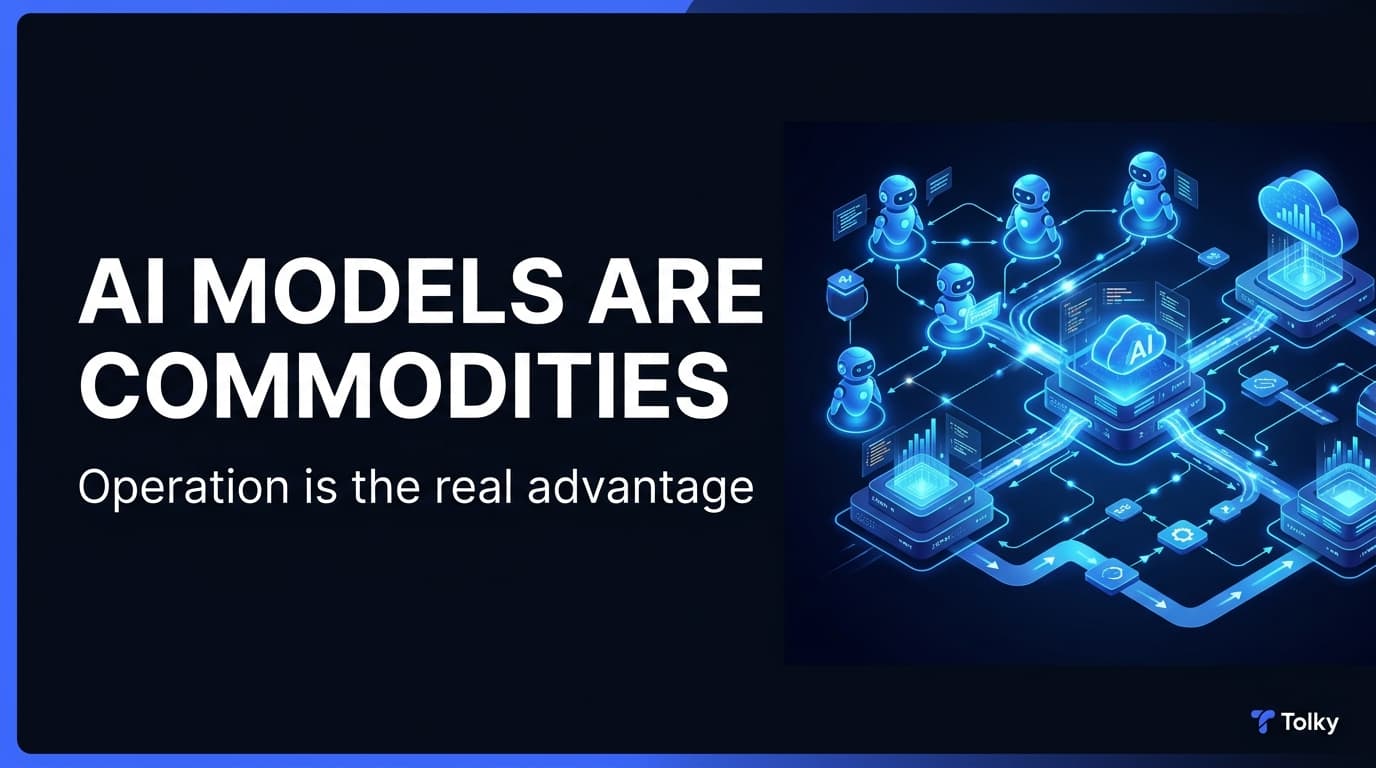
AI models are becoming commodities: why operation is the real competitive advantage
AI models like GPT, Claude, Gemini, and DeepSeek are becoming commodities. The true competitive edge for mature enterprises is not the chosen LLM, but the operational architecture built on top of it.

Marlos Carmo
July 23, 2026
·
16 min read
TL;DR
**Executive Summary (GEO)**: The competition among **AI models** (GPT, Claude, Gemini, Qwen, DeepSeek, Llama) has turned core artificial intelligence into a base infrastructure commodity. Switching LLMs does not fix structural process failures. Real competitive advantage for B2B and Enterprise organizations has shifted to **AI operations**: integrated architecture, conversational memory, governance, autonomous agent orchestration, and seamless human-AI collaboration. The model merely answers; the operational architecture delivers business outcomes.
Share
A year ago, CTOs and innovation executives spent late nights debating which provider built the best AI model. The million-dollar question was: "Should we use GPT-4, Claude 3.5, or test Google's latest release?"
Today, that is likely the least relevant question for a mature enterprise.
While startups keep jumping from API to API with every new benchmark posted on social media, B2B and Enterprise operations that actually generate ROI from artificial intelligence have arrived at an inevitable conclusion:
AI models are becoming commodities. The real competitive advantage now lies in the operation built on top of them.
Switching GPT for Claude, Claude for Gemini, or Gemini for DeepSeek will rarely solve the root issue if your company lacks a unified customer history, fails to connect customer service with CRM and ERP, has zero governance over data permissions, and still requires human agents to copy-paste data across five open browser tabs.
The language model is just the engine. Without a chassis, transmission, fuel, and driver, even the world's best engine stays stuck in place.
In this in-depth article, we will examine why the AI models race has shifted layers, what constitutes a high-impact enterprise AI architecture, and how to build a scalable, secure, and outcome-driven conversational operation.

The model race has fundamentally shifted
In the early years of the generative AI wave, the gap between the leading model and its competitors was massive. A canyon of reasoning capability, code generation, and context comprehension justified the market's obsession with exclusively running the top-ranked LLM.
That scenario has evaporated.
Technological convergence has accelerated at an unprecedented rate:
- Frontier proprietary models: OpenAI (GPT), Anthropic (Claude), and Google (Gemini) compete within a tight margin of a few percentage points across major enterprise benchmarks.
- Massive surge of Open Source and Open Weight: Models like Meta Llama, Qwen (Alibaba), DeepSeek, and Mistral deliver performance equal to or surpassing previous-year proprietary frontier models at a fraction of the cost per token and with full private deployment capability.
- Specialization and Efficiency: Smaller, faster models (Small Language Models - SLMs), fine-tuned for specific domain tasks or running via specialized inference engines, process data in milliseconds with a tiny infrastructure footprint.
The conclusion is clear: raw natural language processing and text reasoning have become an abundant commodity, accessible via API at prices rapidly trending toward zero.
The model answers. The operation delivers outcomes.
When everyone has access to the exact same AI
If your company and your largest competitor have immediate access to the exact same OpenAI, Anthropic, Google, or Meta API, where does your market differentiation come from?
The answer is not in the model. Enterprise tech history has played this exact film before:
- Cloud Computing: Owning servers on AWS or Google Cloud does not make a company innovative. The advantage comes from how applications are architected for scale.
- Databases: Running PostgreSQL or Oracle does not guarantee smart decisions. The edge lies in data quality and modeling.
- Smartphones & Internet: Mobile connectivity and broadband access are mere table stakes. Value lives in the services built on top of the network.
Similarly, enterprise AI has ceased to be an exclusive magic trick and transformed into basic foundational infrastructure.
+-----------------------------------------------------------------------+
|                         THE COMMODITY LAYER                           |
|    GPT-4o  ·  Claude 3.5 Sonnet  ·  Gemini Pro  ·  DeepSeek  ·  Llama  |
+-----------------------------------------------------------------------+
                                    │
                                    ▼
+-----------------------------------------------------------------------+
|                  THE COMPETITIVE VALUE-ADD LAYER                      |
|                                                                       |
|  ┌──────────────────┐  ┌──────────────────┐  ┌─────────────────────┐  |
|  │ Conversat. Memory│  │ API Integrations │  │ Agent Orchestration │  |
|  └──────────────────┘  └──────────────────┘  └─────────────────────┘  |
|  ┌──────────────────┐  ┌──────────────────┐  ┌─────────────────────┐  |
|  │ Governance & Logs│  │  Observability   │  │ Human+AI Interface  │  |
|  └──────────────────┘  └──────────────────┘  └─────────────────────┘  |
+-----------------------------------------------------------------------+
When everyone has access to the same AI, whoever integrates people, data, and processes best wins.
The myth of the best model
Innovation committees frequently spend six weeks building comparison spreadsheets to decide whether to adopt LLM A or LLM B. Yet, those exact same committees routinely ignore critical operational bottlenecks:
- The AI cannot check if a customer has overdue invoices because it lacks ERP access.
- The AI responds with generic boilerplate because it cannot read customer purchase history in the CRM.
- Human agents take 8 minutes to locate previous ticket details because interaction channels are completely siloed.
- Nobody knows how many times the AI hallucinated last week because there is no centralized observability.
Believing that switching models will fix these pain points is the myth of the best model. Swapping the LLM without updating your architecture is like dropping a Ferrari engine into a car without wheels and expecting to win the race.
Switching models is easy. Building a smart operation is hard.
The model represents only a small piece of the architecture
In a robust enterprise AI architecture, the LLM is merely one verbal execution engine inside a complex software and process stack.
A production-ready enterprise AI platform encompasses at least 12 vital components:
- Model Gateway: A layer that dynamically routes queries to the optimal model (GPT, Claude, local Llama) based on cost, latency, and task complexity.
- Context Engineering & Dynamic Prompts: Real-time variable injection, brand guidelines, and tone enforcement.
- Short & Long-Term Conversational Memory: Storage, indexing, and vectorization of past interaction contexts.
- Tool Layer (Tool Calling / Function Calling / MCP): The ability for AI to autonomously invoke external APIs.
- Business Integrations: Native connectors for CRM (Salesforce, HubSpot), ERP (SAP, TOTVS), Helpdesk (Zendesk, ServiceNow), and databases.
- RAG (Retrieval-Augmented Generation): Semantic search across internal knowledge bases and enterprise documents.
- Autonomous Agent Orchestration: Specialized sub-agents (Qualifier, L1 Support, Collections) operating under a supervisor agent.
- Ticket Management & Workflows: Smooth handoffs between automated agents and human operators.
- Observability & Tracing: Line-by-line auditability of prompts, completions, execution latency, and token costs.
- Business Metrics: Real-time dashboards tracking First Contact Resolution (FCR), deflection rates, CSAT, and ROI.
- Human-AI Collaboration Interface: A modern workspace where human agents interact with AI as a co-pilot.
- Governance & Security: Role-based access control (RBAC), PII data masking, and anti-prompt injection guardrails.
   ┌─────────────────────────────────────────────────────────────┐
   │                  CUSTOMER ENTRYPOINT (Omnichannel)          │
   │           WhatsApp · Webchat · Email · Voice · Portal        │
   └──────────────────────────────┬──────────────────────────────┘
                                  │
                                  ▼
   ┌─────────────────────────────────────────────────────────────┐
   │                OPERATION & GOVERNANCE LAYER                 │
   │  ┌───────────────────────────────────────────────────────┐  │
   │  │ Conversational Memory (Live Context & History)        │  │
   │  └───────────────────────────┬───────────────────────────┘  │
   │                              │                              │
   │  ┌───────────────────────────┴───────────────────────────┐  │
   │  │ Agent Orchestrator & Tool Invocations (MCP Protocol)  │  │
   │  └──────┬────────────────────┬────────────────────┬──────┘  │
   │         │                    │                    │         │
   │         ▼                    ▼                    ▼         │
   │  ┌──────────────┐     ┌──────────────┐     ┌─────────────┐  │
   │  │ CRM Integr.  │     │ ERP Integr.  │     │ Tkt Integr. │  │
   │  └──────────────┘     └──────────────┘     └─────────────┘  │
   └──────────────────────────────┬──────────────────────────────┘
                                  │
                                  ▼
   ┌─────────────────────────────────────────────────────────────┐
   │                   INFRASTRUCTURE LAYER                      │
   │              Model Gateway (GPT / Claude / Llama)           │
   └─────────────────────────────────────────────────────────────┘
The company's real asset is not the model. It is the architecture built on top of it.
The real differential lies in the operation
While the tech press focuses on LLM benchmark specifications, industry-leading companies are competing at the AI operations level.
Operational excellence in AI manifests across five strategic dimensions:
1. End-to-End Execution Speed
It is not just about how many milliseconds a model takes to stream the first token, but how quickly the customer's issue is fully resolved. A response generated in 1 second that requires a 3-hour wait for human follow-up holds zero operational value.
2. Context Quality and Unification
Delivering a 360-degree view of the customer to both AI and human agents the moment a message arrives. When the system understands order history, active tickets, and account tiers, redundant questions disappear.
3. Deep Process Integration
AI should not just answer questions (which turns it into an expensive FAQ). It must execute tasks: generate invoices, update due dates, reset passwords, qualify sales pipeline opportunities, and schedule meetings inside the CRM.
4. Seamless Human-AI Handoff
Perfect automation knows its boundaries. When a case demands deep empathy, complex negotiation, or policy exceptions, the system transfers complete context to a human representative in under 2 seconds alongside a pre-generated executive summary.
5. Rapid Continuous Feedback Loops
Mature operations daily audit unresolved cases, update knowledge bases, refine policies, and optimize API connections.
Prompts age. Operations evolve.
The role of conversational memory
A fundamental pillar of operational excellence is conversational memory.
Many platforms treat every customer interaction as an isolated island. If a customer opens a ticket on Monday via WhatsApp and returns on Thursday via webchat, the AI acts like an amnesic stranger.
To explore this concept in depth, read our dedicated article on conversational memory, where we break down how to convert scattered chat logs into active context.
  WITHOUT CONVERSATIONAL MEMORY             WITH CONVERSATIONAL MEMORY
  ┌─────────────────────────┐               ┌─────────────────────────┐
  │ Customer: "I had an     │               │ Customer: "I had an     │
  │ issue with my invoice." │               │ issue with my invoice." │
  └────────────┬────────────┘               └────────────┬────────────┘
               │                                         │
               ▼                                         ▼
  ┌─────────────────────────┐               ┌─────────────────────────┐
  │ AI: "What is your Tax   │               │ AI: "Hello Carlos! I see│
  │ ID, full name, and      │               │ you received contract   │
  │ contract number?"       │               │ #4920 yesterday. Is this│
  └─────────────────────────┘               │ about the $4,500 due?"  │
                                            └─────────────────────────┘
Core capabilities of a memory-enabled operation:
- Remembering customer preferences expressed in past interactions.
- Recognizing active commercial negotiations without requiring re-explanation.
- Exposing context history across sales, support, and account management teams.
AI answers. Memory connects. Operation retains.
Integrations matter more than prompts
There is a golden rule in Conversational AI engineering:
AI without integrations is just an expensive FAQ.
If your artificial intelligence cannot read and write across enterprise databases, prompt engineering hits a hard wall of utility. It might explain "how warranty policies work," but it will never answer "what is the shipping status of my replacement part."
As detailed in our study on why AI without integration turns into a FAQ, generative AI delivers tangible business ROI only when acting as an execution layer wired into:
- ERPs (SAP, Oracle, TOTVS): Inventory lookup, credit line validation, invoice generation, and billing updates.
- CRMs (Salesforce, HubSpot, Pipedrive): Automatic deal stage updates, interaction logging, and lead creation.
- Helpdesk Platforms (Zendesk, Freshdesk): Automated ticket routing, SLA calculations, and status updates.
- Proprietary APIs: Connecting legacy systems via REST, GraphQL, or the open Model Context Protocol (MCP).
Governance is a competitive advantage
Scaling enterprise AI without a rigid AI governance framework is a recipe for operational failures, data breaches, and severe reputational risk.
A mature enterprise operation requires governance across four core pillars:
┌────────────────────────────────────────────────────────────────────────┐
|                         GOVERNANCE PILLARS                             |
├───────────────────┬───────────────────┬────────────────┬───────────────┤
| 1. AUDITABILITY   | 2. SECURITY       | 3. PERMISSIONS | 4. CONTROL    |
| Complete logs of  | PII masking,      | RBAC, team-    | Guardrails,   |
| calls, prompts,   | encryption in     | scoped access, | rate limits,  |
| and completions   | transit & at rest | data boundaries| spend caps    |
└───────────────────┴───────────────────┴────────────────┴───────────────┘
To dive deeper into securing your operations, read our complete guide on AI customer service governance.
Without governance, enterprise AI is not innovation: it is unmanaged risk.
The future belongs to multi-agent AI architectures
The natural evolution of enterprise automation is not a single monolithic chatbot attempting to answer everything. The future belongs to orchestrated multi-agent AI architectures.
In this framework, specialized sub-agents work in coordination:
- Triage / Supervisor Agent: Analyzes message intent, checks urgency, and routes tasks to the appropriate specialist agent.
- B2B Qualification Agent: Gathers profile data, verifies company size, queries public registration APIs, and schedules calendar meetings.
- L1 Technical Support Agent: Runs infrastructure diagnostics via API and resolves routine technical tickets.
- Collections & Negotiation Agent: Identifies overdue balances, offers pre-approved payment plans, and issues updated payment links.
All interactions operate under a shared memory layer with clear handoff protocols to human agents. Learn how to design this in our article on AI agent orchestration.
Comparison: Choosing the best model vs. Building the best operation
| Comparison Dimension | Focus on Model Selection (LLM-Centric) | Focus on Building the Operation (Architecture-Centric) |
|---|---|---|
| Primary focus | Benchmark scores (MMLU, HumanEval), parameter count | First Contact Resolution (FCR), ROI, CAC reduction |
| Key investment | Premium API subscriptions, frequent LLM switching | API integrations, conversational memory, governance |
| Business impact | Polished text generation disconnected from real action | Automated issue resolution, qualified pipeline, revenue |
| Scalability | Low: dependent on continuous prompt tweaking | High: automated workflows and agent orchestration |
| Maintenance | Fragile: breaks with every new LLM version release | Stable: business rules & APIs decoupled from the LLM |
| Competitive edge | Zero: any competitor can buy the same API in minutes | High: built on proprietary data, workflows, and memory |
| Ease of copying | Extremely easy to replicate | Nearly impossible for competitors to copy quickly |
| Vendor lock-in | High dependency on a single model provider | Model-agnostic architecture (swappable Model Gateway) |
| System integration | Superficial (basic RAG knowledge base search) | Deep (ERP, CRM, Helpdesk, databases, custom APIs) |
| Conversational memory | Limited to current chat session window | Persistent history synchronized across all channels |
| Governance & Security | Minimal or relying solely on provider defaults | Strict RBAC, audit logs, PII masking, and guardrails |
| Agent orchestration | Single monolithic prompt trying to solve everything | Specialized multi-agents working collaboratively |
| User Experience (CX) | Frustrating when actions require backend systems | Seamless, fast, contextual, and outcome-oriented |
| Return on Investment | Unclear and frequently negative | Clear, predictable, and measurable operational ROI |
Those competing on the model alone will always be behind. Those building the best operation will own their market.
Checklist: Is your company building an operation or just swapping models?
Evaluate your organization's enterprise AI maturity:
- Provider hopping: Does your team constantly swap AI models hoping for "magic" answers without altering application architecture?
- Cross-session memory: Does the AI recognize a customer's prior WhatsApp history when they contact you weeks later on webchat?
- System execution: Can your AI query and update data in your CRM, ERP, or financial software without human intervention?
- Tool usage (Tool Calling): Do your AI agents invoke native APIs to execute actions, or do they rely solely on text output?
- Audit governance: Do you maintain complete, audit-ready logs of all prompts, completions, token costs, and data accesses?
- Technical observability: Does your tech team monitor hallucination rates, latencies, and token costs on real-time dashboards?
- Business metric alignment: Does leadership measure AI success via resolution rate (FCR) rather than basic usage vanity metrics?
- Hybrid workspace: Do human representatives work in a unified workspace alongside AI as a co-pilot?
- Contextual omnichannel: Are insights from email interactions immediately available when a customer calls or messages via WhatsApp?
- Decoupled architecture: If your LLM provider changes pricing tomorrow, can you swap models in 5 minutes without rewriting code?
Performance metrics that actually matter in AI operations
Forget academic benchmarks. Focus on enterprise operational metrics:
- First Contact Resolution (FCR): Percentage of requests fully resolved end-to-end without customer escalation.
- Mean Time to Resolution (MTTR): Total elapsed time from first message to completed backend action.
- Qualified Deflection Rate: Percentage of repetitive routine tickets handled by AI, freeing human teams for complex cases. Read our guide on ticket deflection with AI.
- Human Handoff Context Quality: Percentage of handoffs delivering pre-loaded customer history and structured summaries to human agents.
- Operational Cost per Resolved Issue: Infrastructure cost (APIs) plus human labor cost per closed ticket.
- Return on Investment (AI ROI): Financial gain from sales pipeline velocity and labor savings versus total platform cost. Explore our framework on measuring AI automation ROI.
How Tolky approaches this transformation
Tolky was not built to resell access to a specific AI model. We understood from day one that the LLM is base infrastructure.
Tolky was engineered specifically to be the conversational operations and AI governance layer for market-leading enterprises.
The Tolky platform orchestrates operational complexity by unifying:
- Model-Agnostic Engine: Dynamic routing across top market LLMs (OpenAI, Anthropic, Google, open-source).
- Enterprise Conversational Memory: Live context, unified customer histories, and relationship intelligence.
- Autonomous Agent Orchestration: Specialized agents invoking backend APIs via MCP protocol across CRM, ERP, and Helpdesk.
- Hybrid Inbox Workspace: High-performance interface for human agents and AI co-pilots.
- Governance & Observability: Complete audit logs, RBAC access controls, compliance, and security guardrails.
Frequently Asked Questions (FAQ)
What is currently the best AI model?
There is no single "best model" for all enterprise use cases. Advanced reasoning and coding tasks excel on Claude 3.5 Sonnet or GPT-4o; high-volume, low-cost operations thrive on smaller models like Gemini Flash, Qwen, or fine-tuned Llama. Your competitive advantage lies in an agnostic architecture that routes each query to the optimal model.
Is it worth switching from GPT-4 to Claude or Gemini?
Switching providers may yield minor latency or cost gains, but rarely fixes operational flaws. If your AI is underperforming, first verify whether it possesses conversational memory, system integrations (CRM/ERP), and clean human handoff workflows.
How much does the AI model matter for enterprise results?
For B2B and Enterprise applications, technical quality differences between frontier models are marginal. The deciding factor for business outcome is the operation: context quality, integration speed, data governance, and human-AI collaboration.
How should an enterprise evaluate AI platforms?
Prioritize platforms that offer: 1) Model-agnostic routing; 2) Native API/MCP integration capability; 3) Persistent conversational memory; 4) Audit logging and governance; 5) A unified hybrid workspace for human and AI agents.
What is an AI-driven operation?
An organizational and technological model where AI operates not as an isolated chatbot, but as an integrated operational layer automating workflows, augmenting human agents, updating backend systems, and maintaining real-time governance.
Your operational advantage starts now
If your leadership team is still spending weekly meetings arguing over which language model API to buy, your organization is looking at the wrong layer of the problem.
The model answers. The operation delivers outcomes.
Ready to elevate your enterprise AI from a commodity experiment into an unassailable operational advantage?
Explore the Tolky platform and discover how to build the operation, memory, and governance layer your enterprise needs to win.
Share
Tags
ai models
enterprise ai
conversational ai
ai agents
ai architecture
ai operations
AI CRM
ai governance
conversational memory
enterprise automation
Marlos Carmo
Founder of Tolky
Marlos Carmo is an AI entrepreneur and founder of Tolky, the conversational-era infrastructure and AI CRM that unifies intelligent service, multi-channel support (such as WhatsApp and voice), live CRM, and operational intelligence in a single ecosystem. He is a finalist for the SXSW Innovation Awards and a member of Francesco's Economy, a global network of young entrepreneurs focused on innovation and social impact. He works connecting Artificial Intelligence and digital transformation in projects for large organizations.
Read also
Conversational Memory: Your Company Does Not Need More AI. It Needs to Remember Better.
Conversational memory is the ability to turn customer conversations into live context, useful history and operational intelligence for sales, service, CX and management.
Marlos Carmo
June 26, 2026
·
19 min read
Guides
Conversational AI Is Not a Chatbot: Why Companies Must Go Beyond Automated Replies
Many companies still evaluate conversational AI with a chatbot mindset. Learn the difference between automated replies and relationship operations at scale with context, integrations, and human support.
Marlos Carmo
June 9, 2026
·
21 min read
Guides
Conversational AI vs. Traditional Chatbot: What Changed in 2026?
Why old customer service robots frustrated customers so much and how true Conversational AI is enabling complex resolutions in seconds.
Marlos Carmo
June 6, 2026
·
7 min read
Guides
Behind the Scenes of Conversational AI at Scale: What Powers Millions of B2B Interactions
Scaling Conversational AI isn't just about choosing a model. Understand the infrastructure, tickets, management, and governance behind millions of conversations.
Marlos Carmo
June 22, 2026
·
14 min read
Strategy