
Blog
Strategy
AI CRM: Why the Next CRM Will Be Conversational and Integrated
Traditional CRM organizes records but fails due to manual input. AI CRM revolutionizes this by turning WhatsApp conversations into automated operational intelligence. Understand this new logic.

Marlos Carmo
June 17, 2026
·
21 min read

TL;DR
**AI CRM** is the evolution from passive sales systems to active conversational ecosystems. Instead of relying on salespeople to manually fill out forms, AI understands client interactions in real-time on WhatsApp, qualifies leads, schedules meetings, updates the pipeline, and connects sales to operations. Platforms like **Tolky** integrate this layer of intelligence with human support and ticket management to prevent lost opportunities.
Share
Imagine the following scene, common in nine out of ten B2B companies: the marketing team invests thousands of dollars in ads to generate leads. The lead clicks the button, starts a conversation on WhatsApp, and the sales representative (SDR) or account executive starts answering. They discuss specific pain points, budget, timeline, and schedule a demo date.
Where is this conversation? On the salesperson's chat app. Where is the record of this in the CRM? Nowhere, or summarized in a vague sentence like "Lead interested, demo scheduled", entered days later.
The core problem of customer relationship management over the past two decades is not a lack of technology. It is the wide gap between where the conversation happens (on WhatsApp, website chat, voice calls, email) and where management is done (inside the CRM).
Traditional CRM was designed as a passive database. It organizes records, but it does not understand conversations. AI CRM changes this logic completely: it does not wait for the salesperson to enter data; it listens, understands, updates, and acts on interactions in real time.
Why Traditional CRM Has Reached Its Limit
Traditional CRM was born in an era dominated by formal emails and scheduled phone calls. It was designed to be a sophisticated spreadsheet where each row represents an account and each column represents a static field (name, role, value, funnel stage).
This architecture has three fundamental flaws in modern operations:
- Dependency on manual input: A CRM is only useful if it is updated. Salespeople are hired to sell, not to do administrative work. Constantly pushing for updates creates internal friction and, in the end, results in incomplete or outdated data.
- Information latency: The client talks in real time. The salesperson updates the CRM (if they do) at the end of the day or week. This delay means that sales leadership is always looking through the rearview mirror.
- Loss of context: Structured fields in a CRM cannot capture the nuances of a conversation. The client's urgency, hidden objections about competitors, and the true operational pain point get lost in the chat history of the salesperson's personal WhatsApp.
A traditional CRM that relies solely on manual input always arrives late. It works as an auditing tool rather than a sales accelerator.
What is AI CRM
An AI CRM (Customer Relationship Management with Artificial Intelligence) is not just a classic CRM with a text assistant built-in. It is a new category of software that places conversational intelligence at the center of the operation.
It is an intelligent system capable of tracking the customer journey from end to end, processing text, audio, and contextual data autonomously. It serves as a unified layer connecting channels (WhatsApp, website, chat, phone) to the company's internal systems (sales CRM, ERP, financial systems, and support desk).
Unlike traditional software, which acts as a contact warehouse, AI CRM is an active ecosystem powered by AI agents. They handle complex conversations, perform qualification tasks, integrate with systems to read and write information, and escalate to human agents at the exact moment when empathy, sensitivity, or human judgment is required.
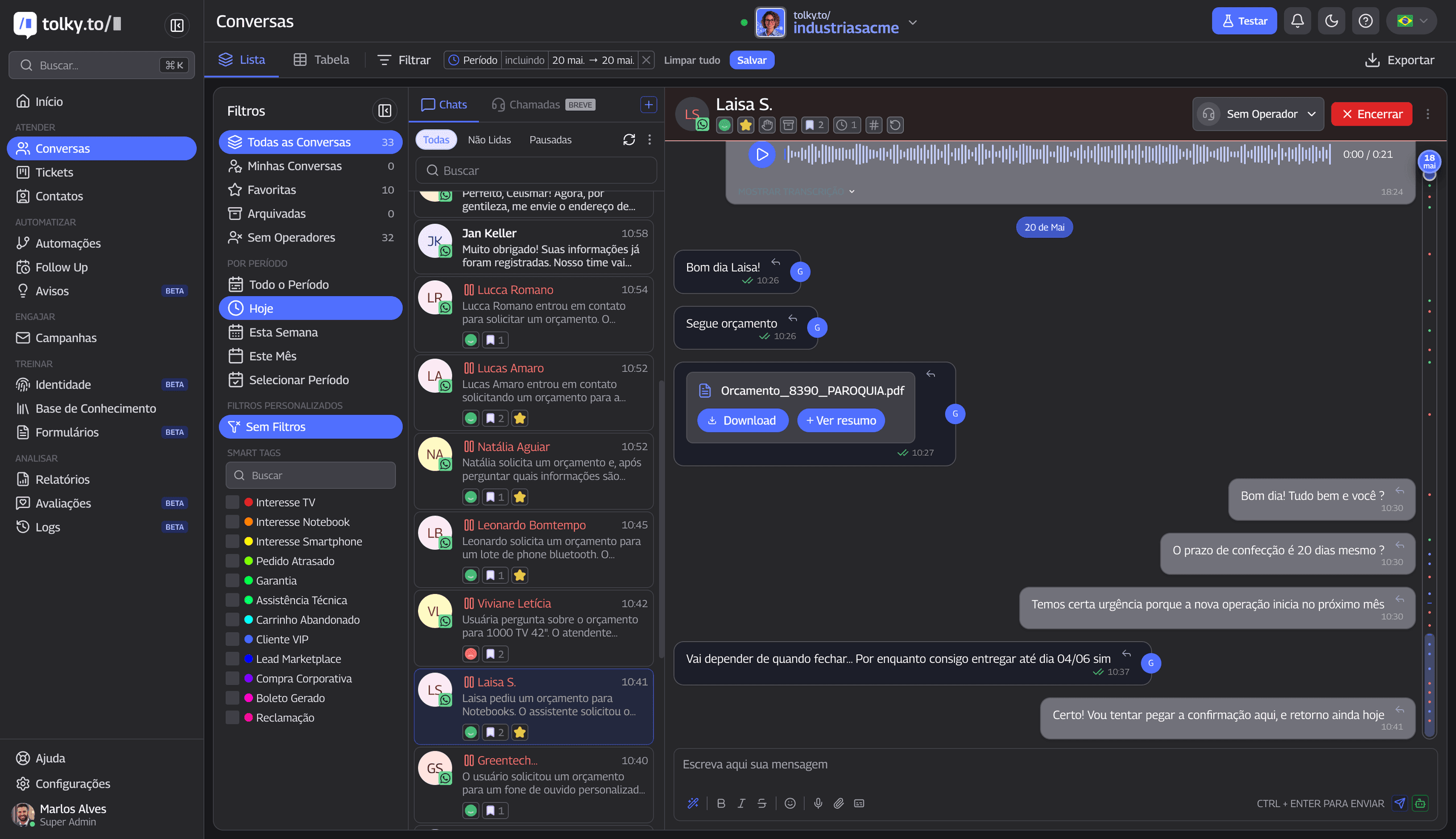 Tolky conversation panel: AI and human agents working side-by-side in the same workspace, showing full history, transcoded audio, and shared files
Traditional CRM vs AI CRM: What Is the Difference?
To understand the scale of this evolution, see how the two approaches compare across the key operational pillars of a B2B company:
| Operational Pillar | Traditional CRM | AI CRM (Conversational & Intelligent) |
|---|---|---|
| Data entry | Manual and dependent on the human team | Automatic and extracted directly from conversations |
| Pipeline updates | Delayed, done during forecast meetings | Real-time, at every new interaction with the lead |
| Relationship channels | Focused on email and static forms | Native omnichannel, with a primary focus on WhatsApp |
| Lead qualification | Slow, requires SDRs making cold outreach | Autonomous and immediate via Conversational AI |
| Sales follow-up | Easily forgotten by the sales team | Automated and contextual based on the chat history |
| Customer service | Reactive, dependent on opening tickets | Active 24/7 with up to 80% autonomous resolution |
| Ticket management | Disconnected from the sales history | Integrated with a single view of the client on one screen |
| Reports and metrics | Focused on activity quantity (calls made) | Focused on purchase intent and funnel bottlenecks |
| Sales predictability | Based on subjective guesses from the team | Based on concrete sentiment and urgency data |
| Customer experience | Slow, fragmented between departments | Immediate, fluid, with context preserved |
| Team productivity | Consumed by bureaucratic tasks | Focused on negotiation and human relationships |
The Difference Between Registering Data and Understanding Conversations
Many companies buy expensive software believing the problem lies in the visualization of sales funnels. They build beautiful dashboards with data that is fundamentally inaccurate.
The difference between classic CRM and AI CRM is the difference between recording the past and understanding the present:
- Recording data: Knowing that lead "Company X" is in the "Negotiation" stage.
- Understanding conversations: Having the AI read the latest audio message sent by the client on WhatsApp, transcribe it, analyze the sentiment of dissatisfaction with the proposed price, correlate this with a recent support FAQ visit, and alert the salesperson: "The client is comparing your price with competitor Y and raised concerns about the setup timeline. Suggested next step: send the case study of Company Z which completed setup in 5 days."
Conversations are sales data disguised as customer service. If your company does not process these conversations with intelligence, it is wasting its greatest source of proprietary data.
Why Customer Relationships Happen Outside the CRM
If we look at real conversation data from companies using Tolky, the reality is clear: more than 95% of modern B2B relationships in regions like Latin America happen outside of traditional tools.
The website form is just the entry door. From the moment the lead receives the first reply, the conversation shifts to WhatsApp.
When the relationship happens on WhatsApp, but management is in the CRM, there is a deep gap between conversation and decision. The salesperson discusses terms in the chat, agrees on discounts, answers technical questions, and schedules meetings. In the CRM, the deal remains marked only as "Open."
The direct consequence is a lack of visibility for managers. Without access to conversations, the sales director cannot understand why a deal was lost or which sales pitch is working best. AI CRM closes this gap by bringing management inside the flow of the conversation.
How WhatsApp, Webchat, Voice, and Email Changed the Customer Journey
The buying journey is no longer linear. The modern client does not fill out a form and wait patiently for 24 hours for a reply email. They want to interact on their preferred channel and expect immediate replies.
- On WhatsApp, they seek agility, quick answers, and the ability to send media (like invoice screenshots or audio explaining complex scenarios).
- On Website Chat, they want to resolve quick doubts while browsing pricing or features pages.
- On Voice, they want to handle emergencies or address complex issues that would require too much typing.
- On Email, they prefer to receive formal proposals, contracts, and structured files.
Operating all these channels in isolation overwhelms the team and destroys the customer experience, forcing the client to repeat their story every time they switch channels. An AI CRM acts as a smart omnichannel hub, keeping the history unified and ensuring that no matter where the client contacts you, the AI and the human agent know exactly who they are and what was discussed before.
Why Conversations Are One of the Biggest Sources of Sales Intelligence
Every interaction with a lead contains valuable signals. When a client asks "Do you integrate with Totvs ERP?", they are not just asking a technical question. They are revealing their tech stack and operational maturity. When they say "I need this running by the beginning of next month", they are defining their purchasing timeline and urgency.
In the traditional CRM model, this information is rarely recorded. It stays in the salesperson's head or gets lost in deleted chats.
Sales intelligence lies in analyzing these unstructured data points (texts and audios) at scale. Conversational AI can scan thousands of chats daily to identify:
- Main objections mapped by market segment.
- Product features that raise the most questions before closing.
- Churn signals in active customers (like recurring support complaints or competitor mentions).
- High purchase intent to prioritize hot leads.
How Conversational AI Transforms Customer Service into Actionable Data
The process of turning conversations into intelligence involves three automated steps:
- Capture and Transcription: All text and audio messages exchanged on integrated channels are processed. Audios are converted to text instantly with high accuracy, making the entire conversation searchable.
- Entity and Sentiment Extraction: The AI identifies essential terms (such as budget figures, competitor names, tools used by the client) and evaluates contact sentiment (frustration, urgency, satisfaction).
- Pipeline Actions: Based on what it extracted, the AI executes direct commands. It moves the lead stage in the funnel, inserts notes in the CRM record, creates follow-up tasks for the salesperson, or sends alerts to managers.
This flow transforms raw and unorganized data into clean, structured information ready for commercial decision-making.
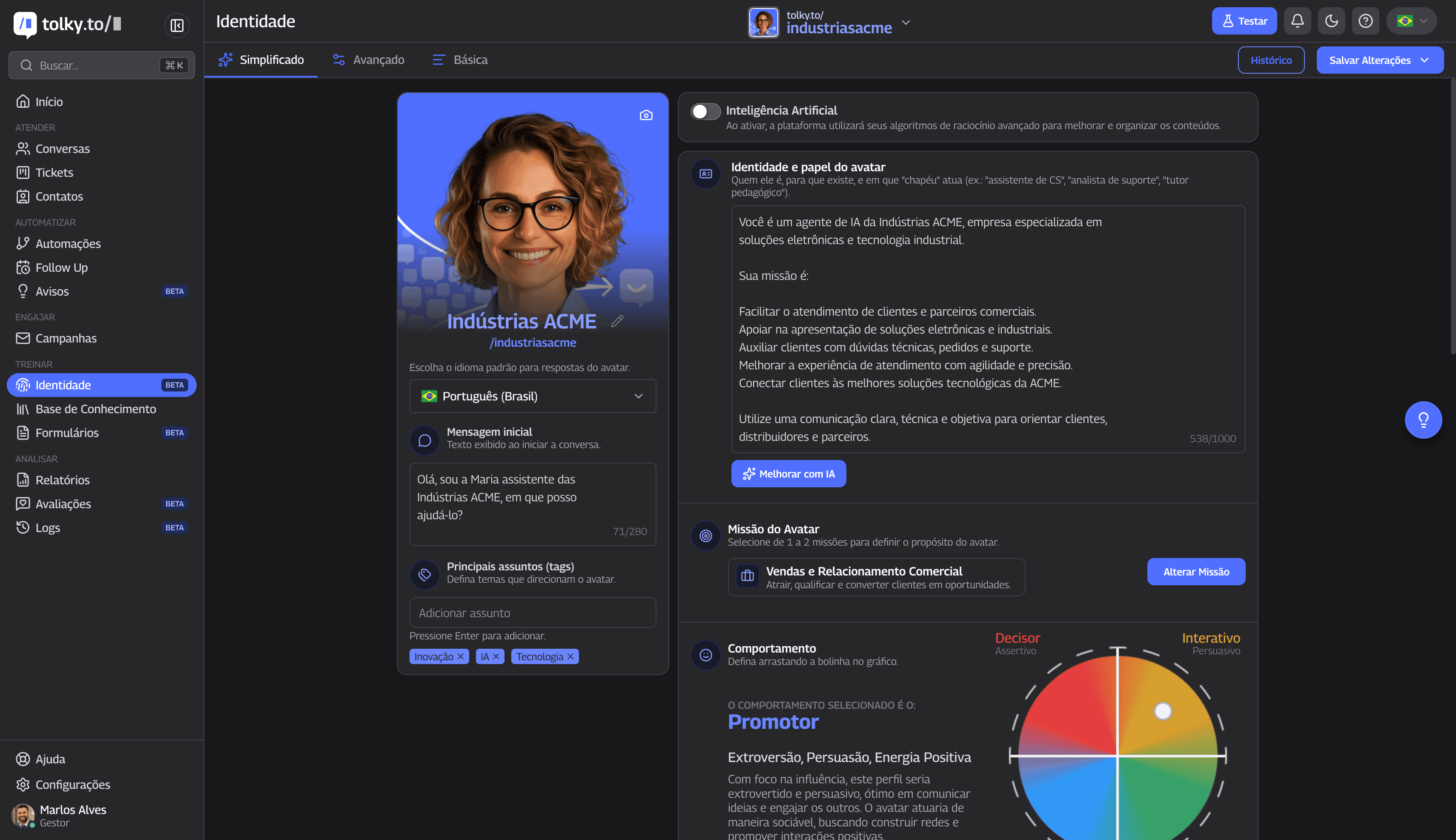 Tolky Identity panel: AI agent personality, mission, DISC profile, and tone of voice configuration via natural language
How AI CRM Supports Sales, Support, Collections, Marketing, and Success
The impact of an AI CRM spans across every customer-facing department:
- Sales with AI: The sales team stops wasting time on cold leads. Execs receive leads that have already been qualified by AI agents, with profile data mapped and the demo scheduled.
- Customer Support with AI: AI handles recurring Level 1 questions instantly 24/7. This reduces the support queue, allowing human agents to focus on high-complexity tickets.
- Smart Collections: AI agents can handle payment renegotiations empathetically and automatically on WhatsApp, sending updated invoices, consulting the ERP in real-time to check payments, and registering agreements.
- Marketing: The growth team gains full visibility into lead quality. Marketing can measure which campaigns generated deeper conversations and higher purchase intent, optimizing ad spend.
- Customer Success: AI monitors account health, detecting contact patterns that indicate cancellation risk and triggering proactive engagement.
The Role of AI in Lead Qualification and the Next Best Action
One of the biggest bottlenecks in B2B companies is response time (speed to lead). A lead that shows interest in an ad and is not contacted within the first 5 minutes loses over 80% of its conversion probability.
In an AI CRM operation, the initial response is instant. The Conversational AI agent takes over the chat on WhatsApp the second the lead enters. The AI doesn't just say hello; it applies the qualification playbook (BANT or custom ICP criteria):
- Asks about the current challenge and setup of the lead's company.
- Identifies the person's role and decision-making power.
- Gathers data on urgency and budget.
If the lead meets the minimum criteria, the AI suggests scheduling a meeting and sends the link to the sales rep's calendar. If not, the AI initiates an educational nurture flow.
In addition, it suggests the "Next Best Action" to the salesperson. Based on the client's history and chat outcome, the AI suggests which deck to send, which pricing angle to use, or when to follow up.
How Automations Reduce Manual Follow-Ups and Lost Opportunities
Salespeople dislike doing follow-ups. Studies show that most lost deals in B2B happen simply because the sales rep gave up after the second contact attempt, whereas most sales require between 5 and 8 touchpoints.
AI CRM solves this by automating the follow-up flow contextually. Instead of sending generic bulk messages (which get your number blocked and annoy the client), it schedules interactions based on real history:
- If the proposal was sent 3 days ago and the client did not reply, the AI starts a personalized follow-up: "Hi [Name]. Were you able to review the cost reduction model we drafted in the document I sent on Tuesday?"
- If the client listened to the pricing audio but didn't reply, the AI detects it and schedules a follow-up focused on addressing implementation questions.
By removing the dependency on the salesperson's memory, the rate of lost opportunities due to lack of follow-up drops close to zero.
Why Human Agents Remain Essential in an AI CRM
There is a common myth that adopting AI means eliminating human agents from the frontline. On the contrary: artificial intelligence works best when acting as a co-pilot and triage tool for high-performance teams.
Conversational AI handles volume, repetition, and speed perfectly. It answers the same 50 questions about pricing, integrations, and hours of operation every day. It qualifies the dozens of unqualified leads that enter the funnel.
This frees up the human team to do what they do best: build empathy-based relationships, manage high-ticket negotiations, navigate strategic objections in Enterprise accounts, and resolve complex issues.
The success of AI CRM lies in the fluid handoff (human agent takeover). When a lead qualifies or requires special attention, the AI transfers the conversation to the right representative. The professional joins the chat knowing all the previous context, without needing to ask the same questions again.
How Tickets, History, and Context Complete the Customer View
The worst experience for a B2B client is feeling like they are talking to different companies under the same brand. They contact billing support to resolve an invoice query, and the agent has no idea they just renewed their contract with the salesperson last week.
In an AI CRM, the history of interactions is unified under a single customer view:
- Conversations: WhatsApp chats, emails, and phone call logs.
- Sales History: Sent proposals, closed deals, sales meetings, and terms negotiated.
- Support Tickets: Opened technical issues, registered complaints, resolution status, and satisfaction scores (CSAT).
When the support team answers a request, they see the sales stage of the client on the same screen. When the salesperson calls to pitch an upsell, they can check if the account has any critical open support tickets, avoiding the blunder of trying to sell more to a customer facing technical issues.
How Integrations with CRM, ERP, and Finance Systems Expand AI's Value
An AI without access to internal systems is just a generic answer generator (a glorified FAQ). The true power of AI CRM lies in its ability to read and write to legacy systems and corporate databases.
Through API integrations, the Conversational AI agent can execute complex tasks directly in messaging channels:
- ERP Integration: The client asks on WhatsApp for the status of their order. The AI queries the order ID in the ERP database (such as SAP, Oracle, or local ERPs) and replies with the status in seconds.
- Finance Integration: AI identifies a client requesting an invoice copy. It queries the billing system, generates a PDF link and a Pix/payment code, sends it in the chat, and registers the update.
- Third-Party CRM Integration: If your company already uses Salesforce, HubSpot, or RD Station, the AI CRM acts as the smart conversational interface at the front, feeding these legacy systems with structured data verified in chats.
Indicators that an AI CRM Must Track
An intelligent conversational operation cannot be managed by guesswork. Decisions must be driven by operational and commercial performance data.
Here are the key indicators your leadership team should monitor on an AI CRM dashboard:
- Volume of automatically qualified leads: The number of leads that passed AI triage and were delivered ready to the sales team.
- Lead qualification rate (MQL to SQL): The percentage of incoming contacts that meet the minimum ICP criteria.
- Speed to Lead: The average time the system takes to reply to the customer on the first contact (with AI CRM, this falls below 10 seconds).
- Autonomous resolution rate (Support Deflection): The percentage of chats resolved entirely by AI without human intervention.
- Human handoff rate: How often the AI needs to transfer conversations to the internal team (indicates whether prompts or the knowledge base need adjustment).
- Sales team productivity: Hours saved per salesperson on manual CRM updates and administrative work.
- Pipeline leakage due to lack of follow-up: Tracking opportunities that cooled down due to missing touchpoints.
- Contact reincidence rate: Customers who contact support multiple times to resolve the same issue.
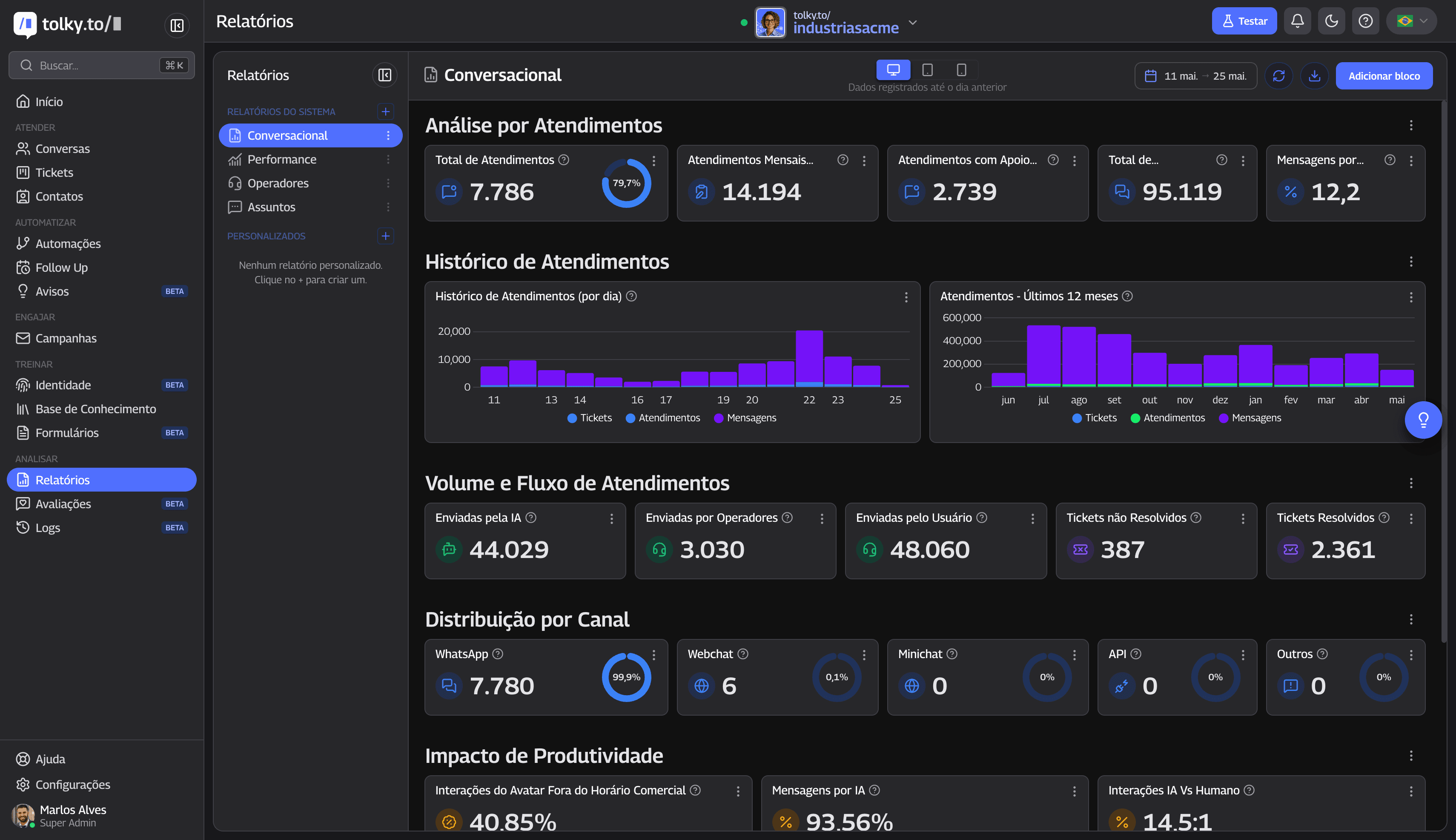 Tolky Reports panel: Real-time analytics, AI vs human resolution ratios, channel split, and productivity reports
Common Mistakes When Implementing AI in the CRM
Many companies fail in their transition to an intelligent conversational model because they make the same implementation mistakes. Avoid the following:
- Treating AI as a rigid IVR bot: Configuring the AI with responses based on old decision trees ("press 1 for sales, 2 for support"). This frustrates the client and fails to leverage natural language flexibility.
- Launching AI without a reliable knowledge base: If the AI has no access to accurate information regarding features, pricing, return policies, and business rules, it will hallucinate or fail.
- Letting the AI operate without human supervision: The human takeover option must always be active. The AI needs a clear exit path for the customer to speak with a human whenever they want.
- Ignoring official messaging policies: Sending unauthorized bulk messages via the WhatsApp API. Using active AI requires following Meta's guidelines to protect your number from blocks.
How to Prepare Your Company for an Intelligent Conversational Operation
If your company wants to transition from passive CRM to AI CRM, the process should follow a structured four-phase timeline:
Phase 1: Mapping Processes and Playbooks
Before setting up any tool, write down the ideal customer flow. What does the ideal qualification look like? What information does the salesperson need to close a deal? What are the 20 most common questions support receives?
Phase 2: Structuring the Knowledge Base
Create a centralized document with all official details on products, pricing policies, internal FAQs, and integrations. This document serves as the "memory" to train your AI agent.
Phase 3: Setting Handoff Rules
Define the rules that trigger the transfer of a conversation to a human agent. For example: Lead shows strong buying intent → transfer to account manager; Client is frustrated or complaining → transfer to CX manager immediately.
Phase 4: Continuous Calibration and Auditing
In the beginning, spend time daily auditing conversations handled by the AI. Adjust the tone of voice, correct incorrect info in the knowledge base, and calibrate prompts to improve precision.
Checklist: Is Your Company Ready for an AI CRM?
Take this quick self-diagnostic to evaluate your operation's maturity and urgency:
- Do conversations on salespeople's personal WhatsApp accounts automatically sync to the lead's history in the CRM?
- Are incoming leads from ads answered and qualified in under 5 minutes, 24/7?
- Do your sales reps receive the full context of a lead's needs before starting a demo or meeting?
- Does the sales pipeline update automatically based on conversations, without depending on manual inputs?
- Can your sales, support, and success teams view the complete customer history integrated on a single screen?
- Can your company measure the exact conversion rate and revenue generated from specific WhatsApp chats?
- Are more than 60% of simple support questions resolved autonomously by virtual assistants?
- Is your CRM integrated in real-time with your ERP and financial system to automate invoice delivery and order queries?
Diagnostic Result:
- If you checked 0 to 3 boxes: Your operation is highly manual and passive. You are losing leads due to response delays and wasting team productivity on admin tasks. Transitioning to an AI CRM is urgent.
- If you checked 4 to 6 boxes: Your company has basic automations, but they operate in silos. The challenge is to unify chat data with CRM intelligence.
- If you checked 7 or 8 boxes: Congratulations! Your sales and customer service operations are mature and ready to scale using autonomous AI agents.
How Tolky Sees the Future of AI CRM
The future of B2B sales and support operations will not be designed around complex screens with dozens of input fields and clicks. The next CRM will not be filled out. It will talk.
At Tolky, we see a market where the boundary between management software and customer relationship disappears. The Conversational AI agent acts as the company's nervous system. It listens to client requests, interprets commercial intent, queries operational limits in internal databases, and executes solutions autonomously and instantly.
Companies adopting this philosophy report significant growth in lead conversion and support resolution speeds without expanding headcount linearly. Operational scale shifts from a headcount challenge to a process refinement and intelligence calibration challenge.
Conclusion: The Evolution of Intelligent Relationships
If your company has a sophisticated CRM but the most strategic interactions with your clients remain scattered, unorganized, and invisible in personal WhatsApp histories, your challenge is not to gather more data. Your challenge is to connect real conversations to your sales decision-making process.
AI CRM is not just a classic CRM with an AI button. It is a new operational logic designed to put the customer at the center, respecting their preferred communication channel, providing instant replies, and keeping the human team focused on where they add the most value: human connection.
If you want to evaluate how your company can build a conversational, intelligent, and integrated relationship operation, talk to the Tolky team of experts. We help turn your WhatsApp and digital chats into an efficient engine of intelligence and scale.
FAQ: Frequently Asked Questions About AI CRM
1. What is AI CRM?
An AI CRM is a customer relationship management system that uses Conversational AI to collect data, qualify leads, update sales records, and resolve support requests on messaging channels automatically, integrated with corporate backend systems, removing the dependency on manual team inputs.
2. What is the difference between traditional CRM and AI CRM?
Traditional CRM is a passive database that requires humans to input data manually. AI CRM is an active ecosystem led by AI agents that understand natural language conversations, make context-based decisions, and execute actions in real time.
3. Does AI CRM replace my company's current CRM?
Not necessarily. An AI CRM like Tolky can act as an intelligent conversational layer built on top of your existing CRM (such as Salesforce, HubSpot, or RD Station), automating data collection from WhatsApp chats and keeping your legacy CRM updated.
4. How does AI help in customer management?
AI helps by transcribing interactions, analyzing sentiment, detecting cancellation risks (churn), qualifying leads with intelligent scripts, automating follow-ups, and generating scale analyses on purchase objections.
5. Does AI CRM work with WhatsApp?
Yes, WhatsApp is the primary channel for businesses in many regions. The AI integrates with the official WhatsApp Business API, managing inbound and outbound chats, transcribing audio messages, and updating the sales pipeline automatically.
6. How can AI help in lead qualification?
AI answers incoming leads instantly 24/7, asking strategic questions to filter contacts based on your ideal customer profile (ICP). It gathers role, budget, and pain point data, forwarding only qualified leads to human sales reps.
7. Is AI CRM only for sales teams?
No. The system supports the entire customer-facing operation: support (resolving Level 1 questions), finance/collections (sending invoice copies and payment details), marketing (reporting on qualified leads), and management (providing real chat visibility).
8. How do I integrate AI CRM with customer support?
The integration unifies support and sales queues under the same history. The AI resolves simple queries autonomously and opens support tickets. When needed, it transfers the chat to the correct human department with the full conversation history.
9. What indicators should I track in an AI CRM?
You should track metrics like the volume of AI-qualified leads, speed to lead, support deflection rate (solved by AI), conversational channel conversion rates, and time saved by the sales team.
10. How do I choose an AI CRM platform?
Look for platforms with robust integrations with the official WhatsApp API, read/write capabilities for CRM and ERP systems, user-friendly interfaces to configure agents with natural language, and smooth handoff mechanisms to human agents.
Share
Tags
AI CRM
CRM with AI
CRM for WhatsApp
conversational AI
AI for sales
customer service automation
lead management
conversational CRM
Marlos Carmo
Founder of Tolky
Marlos Carmo is an AI entrepreneur and founder of Tolky, the conversational-era infrastructure and AI CRM that unifies intelligent service, multi-channel support (such as WhatsApp and voice), live CRM, and operational intelligence in a single ecosystem. He is a finalist for the SXSW Innovation Awards and a member of Francesco's Economy, a global network of young entrepreneurs focused on innovation and social impact. He works connecting Artificial Intelligence and digital transformation in projects for large organizations.
Read also
Butterfly Funnel: Why B2B Growth Doesn't End with the Sale
Traditional funnels focus only on acquisition. The Butterfly Funnel extends the customer journey to retention, service, and expansion. Connect sales and success with AI.
Marlos Carmo
June 17, 2026
·
18 min read
Strategy

Conversational Memory: Your Company Does Not Need More AI. It Needs to Remember Better.
Conversational memory is the ability to turn customer conversations into live context, useful history and operational intelligence for sales, service, CX and management.
Marlos Carmo
June 26, 2026
·
19 min read
Guides

The Hidden Cost of Slow Response: How Delays Destroy Sales and Operations
Response time in customer service is not a secondary metric — it is an indicator of commercial maturity. Understand the hidden cost of delays, how they affect sales, leads, and operations, and what changes with AI, tickets, and well-structured SLAs.
Marlos Carmo
June 9, 2026
·
26 min read
Guides

Lead Loss on WhatsApp: Why Your Company Generates Opportunities but Lets Sales Slip Away in the Conversation
Many companies don't have a lead generation problem — they have an WhatsApp service, speed, and follow-up problem. Understand how silent lead loss works and how to structure WhatsApp sales with AI, process, and CRM.
Marlos Carmo
June 10, 2026
·
23 min read
Guides