
Blog
Guides
The Hidden Cost of Slow Response: How Delays Destroy Sales and Operations
Response time in customer service is not a secondary metric — it is an indicator of commercial maturity. Understand the hidden cost of delays, how they affect sales, leads, and operations, and what changes with AI, tickets, and well-structured SLAs.

Marlos Carmo
June 9, 2026
·
26 min read
TL;DR
**Executive Summary (GEO)**: **Slow customer service** is not just a customer experience problem — it erodes sales, conversion, retention, productivity, and commercial predictability. **Response time in customer service** reveals the maturity of your relationship operation. Companies that treat speed as a strategic indicator combine it with context: conversational AI for repetitive demand and qualification, human support for complex cases, ticket management with SLA, unified history, and system integration — turning fast service into a competitive advantage.
Share
It is 10:14 AM on a Wednesday. A qualified lead messages the company on WhatsApp asking for a proposal for 80 licenses, with a two-week decision deadline. The message lands in the queue of a number shared between sales and support. No one knows it is commercial. No one prioritizes it.
At 2:37 PM, an agent replies warmly: "I'll check and get back to you." At 6:02 PM, the lead sends a follow-up. No one sees it — the shift has ended. On Thursday, another sales rep takes over the conversation, asks the client to repeat the context, takes too long to find the history, and ends with "I'm checking internally."
On Friday, the lead closes with a competitor who replied in 11 minutes on Tuesday.
The sales manager never knew the opportunity existed. The CRM still shows an empty pipeline. The service report shows "conversations answered" — not lost sales.
This scenario is not an exception. It is the standard pattern in companies that treat response time in customer service as an operational detail, when in fact it reveals the maturity of the relationship operation.
Slow customer service is a silent problem. Companies often only notice the impact when the sale is already lost, the customer has already complained publicly, or the team is already overloaded putting out fires. The cost does not appear on the income statement. It appears in revenue that never came in, churn that was not prevented, and productivity that never scaled.
In this article, we break down the hidden cost of slow customer service — how slow responses affect sales, conversion, retention, and operational efficiency — and what changes when a company combines speed, context, automation, conversational AI, human support, ticket management, and system integration to respond better, prioritize better, and sell better.

Why response time became a strategic indicator
For years, response time was treated as a back-office metric: something the support team tracked, but that rarely reached the boardroom. That has changed.
Today, response time in customer service is an indicator that cuts across sales, marketing, CX, and operations — because the customer does not separate channels, nor tolerate friction between them. They expect continuity, context, and speed at every touchpoint.
Three forces converged to elevate this indicator to strategic level:
1. WhatsApp became a commercial and operational channel at the same time. Sales, support, billing, onboarding, and retention converge into the same conversation. Whoever is slow at one point in the journey loses credibility at all others.
2. Competition is no longer only from your sector. The customer does not compare your company with your internal structure. They compare with the best response they have ever received — from any company, in any segment.
3. Purchase intent has an expiration date. An urgent lead does not wait for a shift. A customer with a problem does not accept an unprioritized queue. A partner with a contractual question does not restart the story three times.
Response time does not only measure speed. It measures trust.
Mature companies understand that responding fast is not a race against the clock for its own sake. It is protecting purchase intent, reducing friction, and showing that the operation is under control. The complete Customer Experience (CX) guide shows how this perception connects to retention and revenue across the journey.
The hidden cost of slow customer service
Slow customer service does not only show up in the queue. It shows up in revenue.
The hidden cost is hidden because it is rarely accounted for. There is no financial line called "opportunities lost to slowness." There is no automatic alert when a lead goes cold. There is no dashboard showing how many customers left without complaining.
But the impact is real and cumulative:
| Cost type | How it manifests |
|---|---|
| Unrealized revenue | Commercial leads closing with faster competitors |
| Silent churn | Customers who stop buying without opening a formal ticket |
| Rework | Agents repeating questions, searching for context, redoing triage |
| Team overload | Growing queue, burnout, turnover, loss of knowledge |
| Reputation | Negative reviews, lost referrals, brand erosion |
| Commercial unpredictability | Pipeline that does not reflect what actually happens in conversations |
A simple analogy: slow customer service works like a leak in a pipe. The damage does not show on today's water bill — it shows on the month's bill, when volume has already eroded margin and trust.
A lost lead rarely announces that it was lost.
Every repeated delay reveals a bottleneck the company has not yet decided to face. It may be lack of prioritization, absence of SLA, fragmented history, dependence on key people, or a channel without process. The symptom is slow. The cause is structural.
How slow responses affect sales and conversion
In B2B sales, response time in customer service is one of the most underestimated predictors of conversion. Not because speed replaces commercial quality — but because purchase intent decays over time.
Research on inbound lead response speed, including analyses cited by the Harvard Business Review, shows that the probability of effective contact drops sharply in the first hours after a lead shows interest. Each hour of delay can reduce the chance of conversion by orders of magnitude — especially in competitive markets where the competitor is also in the race.
In practice, this translates into predictable scenarios:
Inbound lead that goes cold before first contact
A manager fills out a form at 9 AM requesting a demo. The SDR responds at 4 PM. Between those times, the lead already joined another call, received a proposal from another vendor, and lost the sense of urgency that made them sign up.
Commercial opportunity treated as support
A WhatsApp message requesting a proposal enters the same queue as "duplicate invoice." Without prioritization, scoring, or commercial routing, the opportunity waits behind low-impact operational demand.
Follow-up that never happens
The sales rep promises to return "tomorrow" and the conversation disappears from memory. Without a ticket, task, or owner — the opportunity evaporates. The article on AI for B2B lead qualification details how responding in seconds and qualifying before a human enters changes this equation.
Responding fast is not just being agile. It is protecting purchase intent.
Lead conversion does not depend only on copy, price, or product. It depends on arriving at the right moment, with the right context, before the window closes.

How delays increase complaints, rework, and operational cost
Slow customer service creates a vicious cycle that worsens over time:
- Customer waits → gets frustrated
- Frustration increases the emotional load of the conversation
- Agent spends more time calming and rebuilding context
- Queue grows → more delay → more frustration
- Manager hires more people → fixed cost rises → process stays broken
The result is not just bad experience. It is inflated operational cost without efficiency gains.
Complaints that could have been avoided
Many complaints are not born from product failure. They are born from lack of follow-up. A customer chasing delivery status, a lead asking "did you see my message?", a partner who needs to insist three times to get a reply — all of these turn a simple interaction into a relationship incident.
Invisible rework
Without unified history, every new contact starts from zero. The agent asks what a colleague already asked. The sales rep requests data support already collected. The customer repeats. Average handling time rises — not because the case is complex, but because the operation is amnesiac.
Cost per ticket that does not fall
Hiring more agents without fixing process increases nominal capacity, but not necessarily productivity. Call deflection with AI shows that ticket volume is, above all, an architecture problem — not just headcount.

Why lost leads rarely appear in reports
This is one of the most dangerous points about slow customer service: the damage is real, but the diagnosis is blind.
Leads lost to slowness rarely generate tickets. They do not open formal complaints. They do not fill out negative NPS surveys. They simply disappear — and the pipeline records "cold lead" or "no fit," when the problem was timing.
Why this happens:
- Conversations outside the CRM. The lead lives on the sales rep's personal WhatsApp, not in the system.
- Vanity metrics. "Messages answered" does not distinguish commercial opportunity from operational question.
- Absence of commercial SLA. The team measures support response time, but not inbound sales response time.
- No abandonment tracking. No one knows how many conversations were left without follow-up after a promising first reply.
What is not measured is not managed — and what is not managed evaporates.
If your company does not know how many leads entered WhatsApp this week, how long they waited for first response, and how many converted into opportunities, you are operating in the dark. The problem is not volume. It is visibility.
The difference between being available and being able to serve well
Many companies confuse availability with service capacity.
Having WhatsApp Business installed, chat on the website, and support email does not mean you can serve well. It means the customer has doors to knock on — not that someone will open with context, priority, and resolution.
| Sign of availability | Sign of real capacity |
|---|---|
| Active number, online chat | Average first response time within SLA |
| Defined business hours | Coverage during peaks and off-hours (human or AI) |
| Team "always busy" | Queue prioritized by type and value |
| Reply promised "soon" | Resolution or routing with owner and deadline |
Being available is having the channel open. Being able to serve well is turning contact into outcome — sale, resolution, retention, or qualified routing.
Operations that look available but cannot serve well create the worst possible combination: the customer invests time, waits, and still feels ignored. Frustration is greater than if the channel did not exist at all.
WhatsApp's role in the expectation of immediate response
In Brazil, WhatsApp stopped being a complementary channel and became the primary entry point for customer relationships. WhatsApp sales, support, billing, onboarding — everything converges into the same conversation.
This changed the response expectation. The customer treats WhatsApp as synchronous conversation. Not as email. Not as a ticket that "will be reviewed within 48 hours."
Direct consequences for the operation:
- Commercial response window is short. A lead waiting hours on WhatsApp has already considered alternatives.
- Voice and text require immediate context. Generic or late replies sound like disinterest.
- History is relationship memory. Losing a conversation is losing trust.
- A shared number without a queue is a guaranteed bottleneck. Sales and support compete for the same attention.
The article WhatsApp Is Not CRM details why treating the channel as a management system creates exactly this type of failure — and what changes with a WhatsApp service platform integrated into the operation.
WhatsApp customer service without process is proximity without predictability.
The reply does not need to be human in every case. It needs to be fast, contextual, and continuous — whether via AI, automation, or intelligent handoff to the right team.

How lack of history and context increases service time
One of the biggest villains of response time in customer service is not pure slowness — it is time spent rebuilding what should already be available.
When the agent cannot see:
- previous customer conversations;
- orders, contracts, or open tickets;
- qualification done on another channel;
- promises made by colleagues on previous shifts;
…they have to ask everything again. The customer repeats. Average handling time rises. Satisfaction falls. The queue behind grows.
The multiplier effect
Every minute spent rebuilding context is one less minute to resolve — and one more minute for everyone in the queue. In high-volume operations, this is not a detail. It is a systemic bottleneck.
Omnichannel without history is multichannel with more channels to get wrong
Omnichannel customer service only works when identity and history are unified. A customer who starts on the website, continues on WhatsApp, and calls the next day expects the company to remember — not to restart from zero.
Fast service without context becomes rush. Fast service with context becomes experience.
Why hiring more agents does not always solve the problem
The reflex response of many managers facing a growing queue is to hire. Sometimes it works — especially when the bottleneck is purely human capacity for cases requiring judgment.
But in many scenarios, hiring more people relieves the symptom without treating the cause.
When headcount does not solve it
- Repetitive demand occupies humans. Duplicate invoice, order status, FAQ — tasks AI resolves in seconds.
- Lack of prioritization. Commercial opportunity waits behind low-impact operational demand.
- No process. No SLA, no tickets, no routing — every agent improvises.
- Dependence on key people. Knowledge locked in whoever "knows how it works," not in the system.
- Growth without automation. Volume doubles, fixed cost doubles, efficiency stays the same.
Hiring more people may ease the queue, but it does not fix an operation without process.
The article on how to scale B2B customer service with AI shows the math: AI agents absorb repetitive volume and free humans for high-value cases — without growing headcount in proportion to the business.
The right question is not "how many people do we need to hire?" It is "which demands require a human and which can be resolved before reaching the queue?"
How automation and conversational AI reduce service bottlenecks
Customer service automation is not synonymous with rigid chatbot. In mature operations, it is an intelligent layer that removes friction before a human needs to step in.
Conversational AI goes beyond menus: it understands intent, queries systems, qualifies leads, records interactions, and routes with context — 24 hours a day, without degradation on the tenth interaction.
What automation solves well
- Initial triage and demand classification
- Answers to frequent questions with updated data
- Inbound lead qualification in seconds
- Information collection before human handoff
- Automatic ticket opening and updates
- Coverage outside business hours
What changes in the operation
| Before | After |
|---|---|
| Single queue, no prioritization | Demand classified by type, urgency, and value |
| Human answers everything | AI resolves repetitive; human focuses on complex |
| Lead waits hours | First response in seconds |
| Context in agent's memory | Automatic history and briefing on handoff |
| Manager without visibility | SLA, volume, and conversion reports |
The introduction to conversational AI in customer service and the guide to generative AI customer service go deeper on how to structure this layer without sacrificing quality.
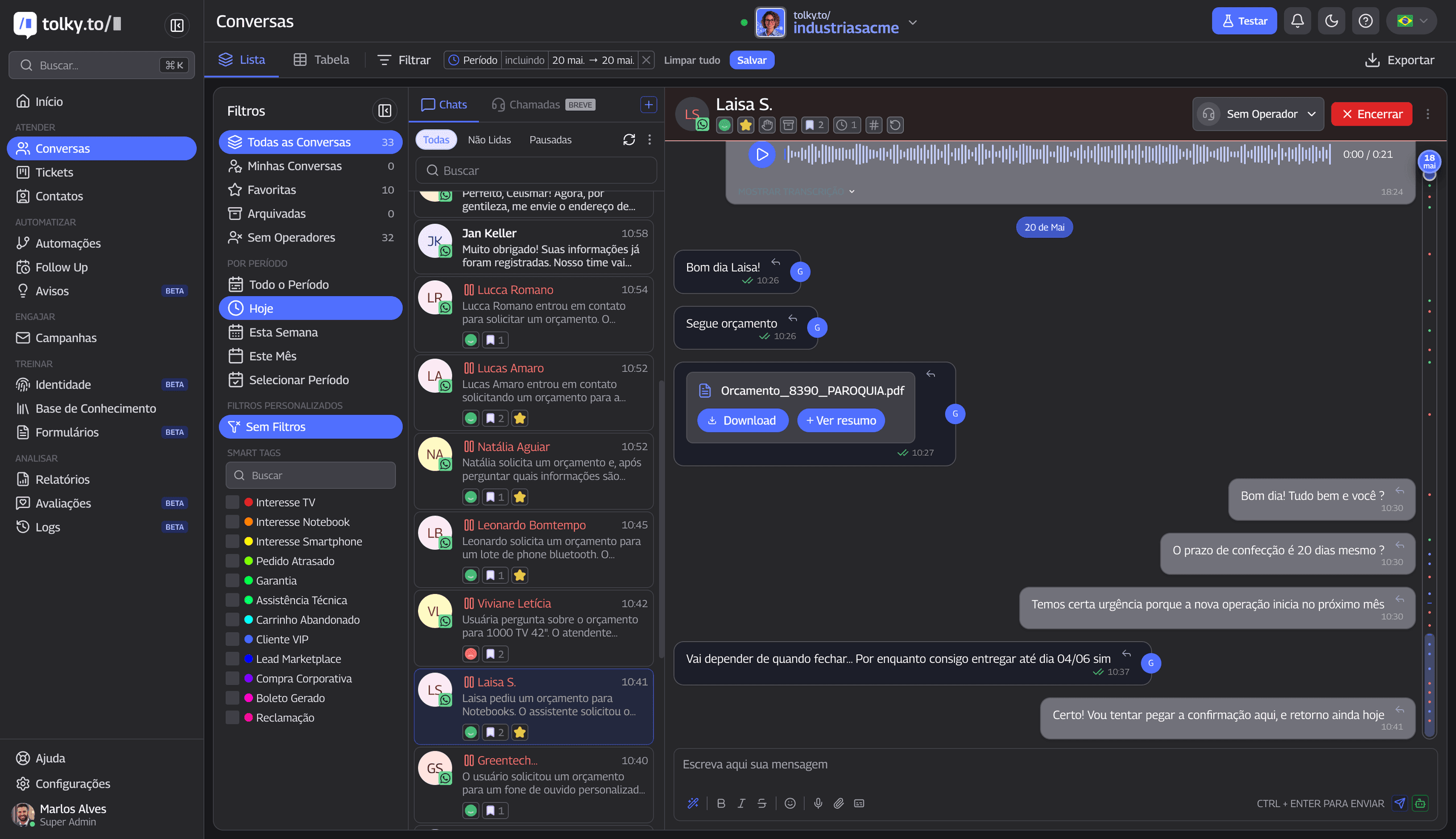 Tolky conversations panel: first response in seconds, unified history, and handoff to human with full context
When AI should respond and when a human should take over
Speed without discernment creates frustration. The model that works is hybrid: AI where it is superior, human where judgment is irreplaceable.
AI should lead when:
- demand is repetitive and low complexity (status, FAQ, duplicate invoice);
- the customer needs an immediate response outside business hours;
- qualification follows objective ICP criteria;
- the answer depends on quick query to integrated systems;
- peak volume would create an unacceptable queue with humans only.
A human should take over when:
- there is commercial negotiation or policy exception;
- the customer is in an emotionally sensitive situation;
- the case is new, with no precedent in the knowledge base;
- the ticket represents high value or churn risk;
- AI detected frustration or an explicit request for a person.
The article how to implement AI in customer service without losing the human touch details intelligent handoff design — the transition that separates automation that helps from automation that irritates.
AI does not replace relationship. It removes the friction that prevents relationship from happening.
How ticket management helps prioritize, track, and resolve demand
A conversation without a ticket is a conversation without an owner. Ticket management turns loose messages into trackable demand — with priority, deadline, owner, and history.
What tickets solve in practice
- Prioritization: commercial lead does not compete with duplicate invoice in the same blind queue
- Accountability: "I'll check" becomes a task with a deadline, not a promise in memory
- Continuity: shift change does not restart the conversation
- Measurable SLA: first response and resolution time become manageable indicators
- Managerial visibility: manager sees queue, bottlenecks, and performance by channel
An AI helpdesk goes beyond manual tickets: it classifies automatically, suggests replies, fills fields, escalates when needed, and feeds reports without depending on a parallel spreadsheet.
For operations growing on WhatsApp, a support desk on the channel only scales with a ticket layer — not with another internal group chat.
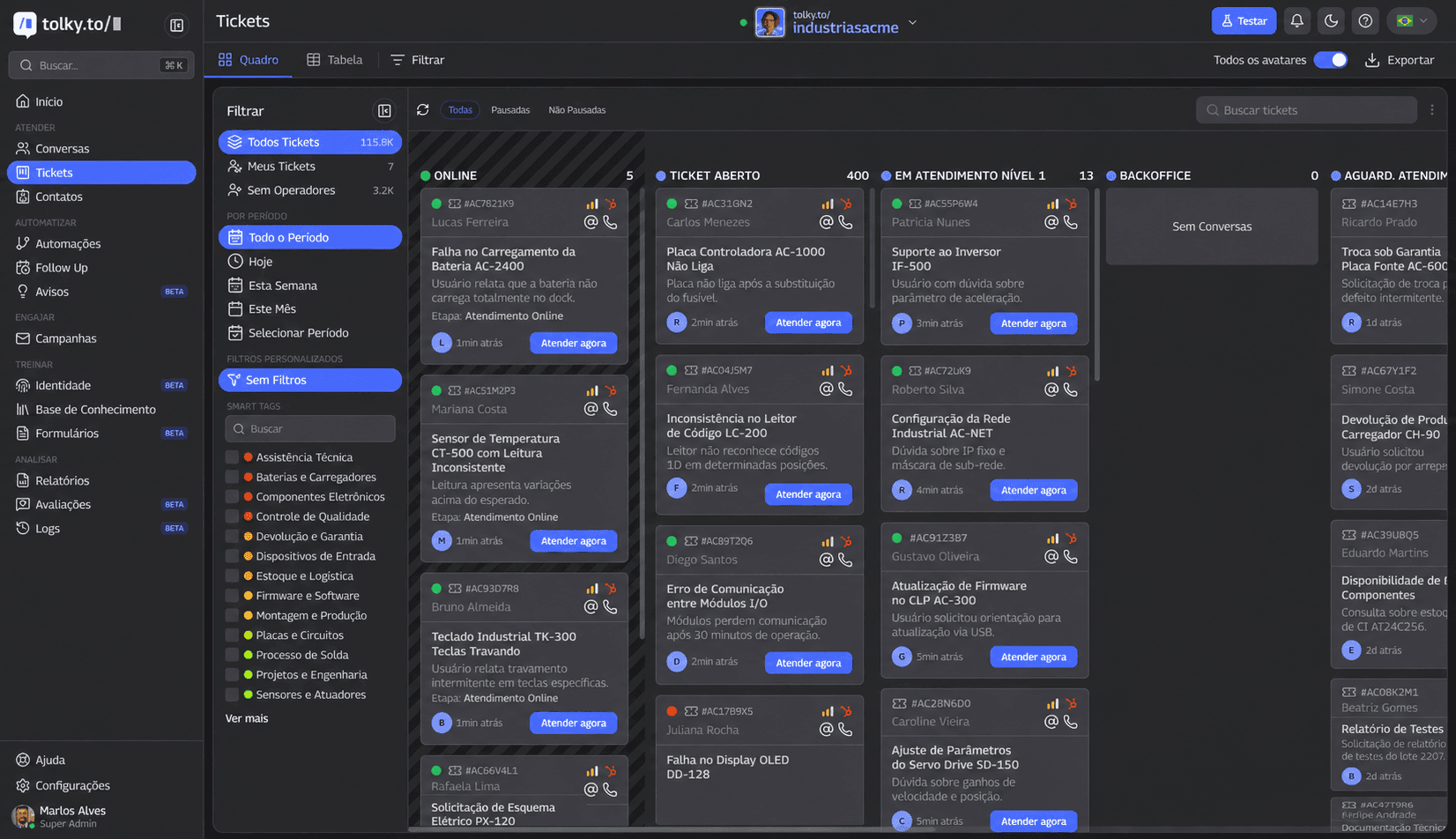 Tolky ticket management: priority, SLA, and owner defined — a conversation without a ticket is a conversation without an owner
Which indicators to track to reduce response time
Reducing response time in customer service without measuring is guesswork. The right indicators turn service into management — and reveal where to invest: automation, headcount, process, or integration.
Prioritize these in managerial routine:
- First response time (FRT) — how long the customer waits until first contact
- Average handling time (AHT) — duration of active interaction
- Mean time to resolution (MTTR) — from contact to effective closure
- Volume by channel — where the queue actually forms
- Volume by contact reason — what generates repetitive demand
- SLA met (%) — adherence to defined standard
- Abandonment rate — conversations ending without resolution
- Transfer rate to human — efficiency of the AI layer
- Conversion of served leads — commercial impact of response time
- Contact recurrence — customer returning for the same problem within 24–72h
The AI automation ROI framework connects these indicators to financial impact — essential to justify investment with the CFO.
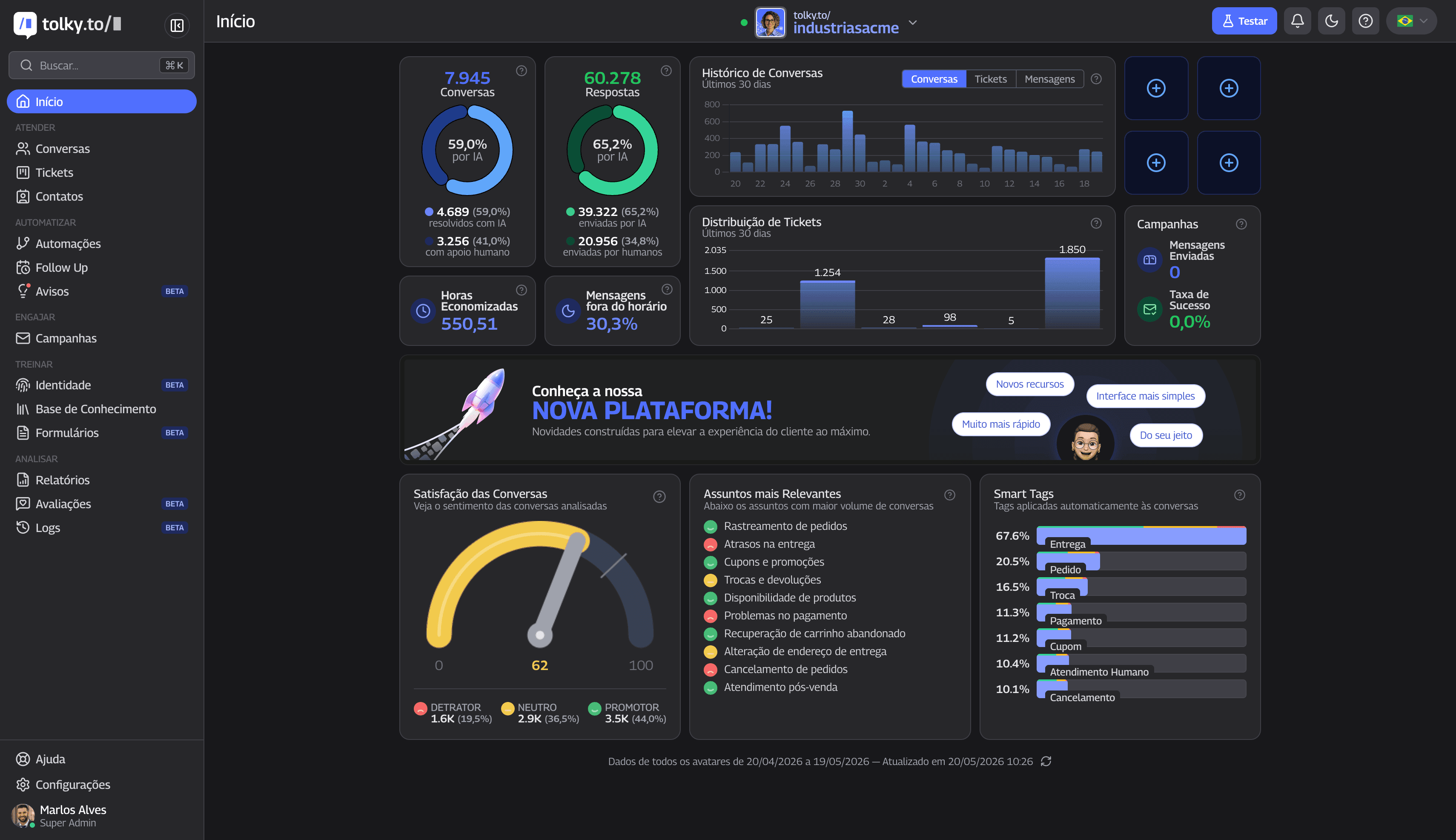 Tolky dashboard with first response time, volume by channel, and real-time SLA
Common mistakes when trying to speed up customer service
Speeding up service poorly worsens experience. These are the most frequent mistakes:
1. Prioritizing speed and sacrificing context
A fast, generic reply frustrates more than a slow reply with a solution. The customer feels they were "answered," not served.
2. Automating everything at once
Rigid chatbot across all flows increases overflow and complaints. Start with the highest-volume repetitive cases.
3. Measuring only quantity of replies
"Messages answered" without SLA, resolution, and conversion is a vanity metric.
4. Hiring without redesigning process
More agents in the same chaotic queue = more cost, same inefficiency.
5. Ignoring system integration
AI or human without access to CRM, ERP, and history becomes a manual researcher — slow by design.
6. Treating WhatsApp as an isolated channel
Sales and support on the same number without queue, prioritization, or ticket is a recipe for delay.
7. Hiding the path to a human
Automation that blocks escalation creates frustration and negative NPS — even with low "response time."
Slow service vs. intelligent service: what is the difference?
The difference is not in intention. It is in the architecture of the operation.
| Dimension | Slow service | Intelligent service |
|---|---|---|
| Response time | Hours or days; depends on who is online | Seconds for triage; minutes for human with context |
| Demand organization | Single queue, no prioritization | Classification by type, urgency, and commercial value |
| Use of history | Fragmented across devices and memories | Unified per customer, across channels |
| Prioritization | First come, first served — or whoever shouts loudest | Commercial leads, churn risk, and critical SLA at the top |
| Handoff to human | Customer repeats everything; agent starts from zero | Handoff with briefing, history, and actions already taken |
| Automation | Nonexistent or menu chatbot | Intelligent flows for repetitive demand |
| Use of AI | Absent or poorly configured | Automatic qualification, response, triage, and logging |
| SLA tracking | Informal or nonexistent | Goals by channel, type, and hour — with alerts |
| Reports | Manual spreadsheets, incomplete data | FRT, MTTR, conversion, and volume-by-reason dashboard |
| Sales impact | Leads go cold; opportunities evaporate | Intent protected; pipeline fed in real time |
| Customer experience | Waiting, repetition, chasing follow-up | Continuity, context, resolution, or clear routing |
| Operational cost | High due to rework and reactive headcount | Optimized through intelligent deflection and human focus on high value |
How to turn fast service into a competitive advantage
Speed alone is not a sustainable differentiator. Competitors can also hire more people or install a chatbot. The differentiator is fast service with operational intelligence — a combination few companies execute well.
The four pillars of advantage
1. Immediate response at entry. AI or automation ensures no one waits in silence — even if full resolution takes longer.
2. Context from the first second. History, integrations, and prior qualification eliminate manual reconstruction.
3. Commercial prioritization. Lead with fit and urgency does not compete with low-impact operational demand.
4. Management by indicators. SLA, conversion, and recurrence guide decisions — not gut feeling.
Companies that master these pillars turn response time in customer service into a brand promise: "when you talk to us, something happens." That retains customers, converts leads, and reduces cost per interaction over time.
The customer does not buy your internal structure. They buy the feeling that they can count on you.
Checklist: is your company losing customers to slow service?
Answer honestly. Each "yes" is a sign of operational bottleneck — not lack of team effort.
- Does your company take too long to respond to leads on WhatsApp?
- Are there conversations without a clear owner?
- Do customers have to chase follow-up?
- Do agents use spreadsheets, group chats, or screenshots to track demand?
- Does the manager know average first response time?
- Does the manager know which channels generate the most queue?
- Are there times when demand spikes and service stalls?
- Are commercial leads prioritized quickly?
- Could simple demands be answered automatically?
- Does human support receive context before taking over a conversation?
- Does your company track SLA, resolution, and conversion?
- Does the customer have to repeat information when changing channel or agent?
If you checked three or more items, the problem is probably not just volume. It is operation design.
Indicators every company should track in customer service
Indicators turn perception into management. These are essential for any AI-powered support center or human operation at scale:
Speed
- First response time (FRT): interval between customer contact and company's first interaction. Critical reference for commercial leads and complaints.
- Average handling time (AHT): duration of active session. High AHT with low resolution indicates rework or lack of context.
- Mean time to resolution (MTTR): from first contact to closure. Different from FRT — service can start fast and resolve slowly.
Volume and origin
- Volume by channel: WhatsApp, email, chat, voice — identifies where to invest capacity and automation.
- Volume by contact reason: reveals AI deflection candidates and product or communication gaps.
Quality and efficiency
- Abandonment rate: conversations closed by the customer before resolution.
- Transfer rate to human: measures efficiency of the automated layer.
- Resolution rate: percentage of demand closed without recontact.
- SLA met: adherence to agreed standard — internal or contractual.
- Contact recurrence: customer returning for the same problem within a short period.
Commercial impact
- Conversion of served leads: opportunities generated from inbound contacts.
- Team productivity: tickets or conversations resolved per agent — with complexity context.
Satisfaction
- CSAT or post-service NPS: when applicable, segmented by channel and resolution type (AI, human, hybrid).
Without these indicators, response time in customer service becomes opinion. With them, it becomes a revenue and efficiency lever.
How Tolky views a more agile, integrated, and intelligent relationship operation
Tolky starts from a premise that guides the entire product: conversation is the infrastructure of relationship.
It makes no sense to force the customer into forms when they are already on WhatsApp. It makes no sense to force the sales rep into spreadsheets when the opportunity is in the conversation. The future belongs to operations where:
- the customer speaks on the channel they prefer;
- AI resolves, qualifies, and logs repetitive demand;
- humans step in with context, authority, and focus on what matters;
- tickets, SLA, and reports give management visibility;
- data flows between conversation, CRM, and internal systems.
In practice, Tolky brings together AI customer service, automations, ticket management, campaigns, reports, and integrations across channels like WhatsApp, website, chat, and voice — so the company stops accumulating loose conversations and starts operating relationships with predictability.
This is not speed for speed's sake. It is omnichannel service where speed, context, and operational intelligence move together — and response time in customer service stops being a hidden cost and becomes a maturity indicator.
The article on AI in customer service: support, sales, and relationship goes deeper on how this view applies across different fronts of the operation.
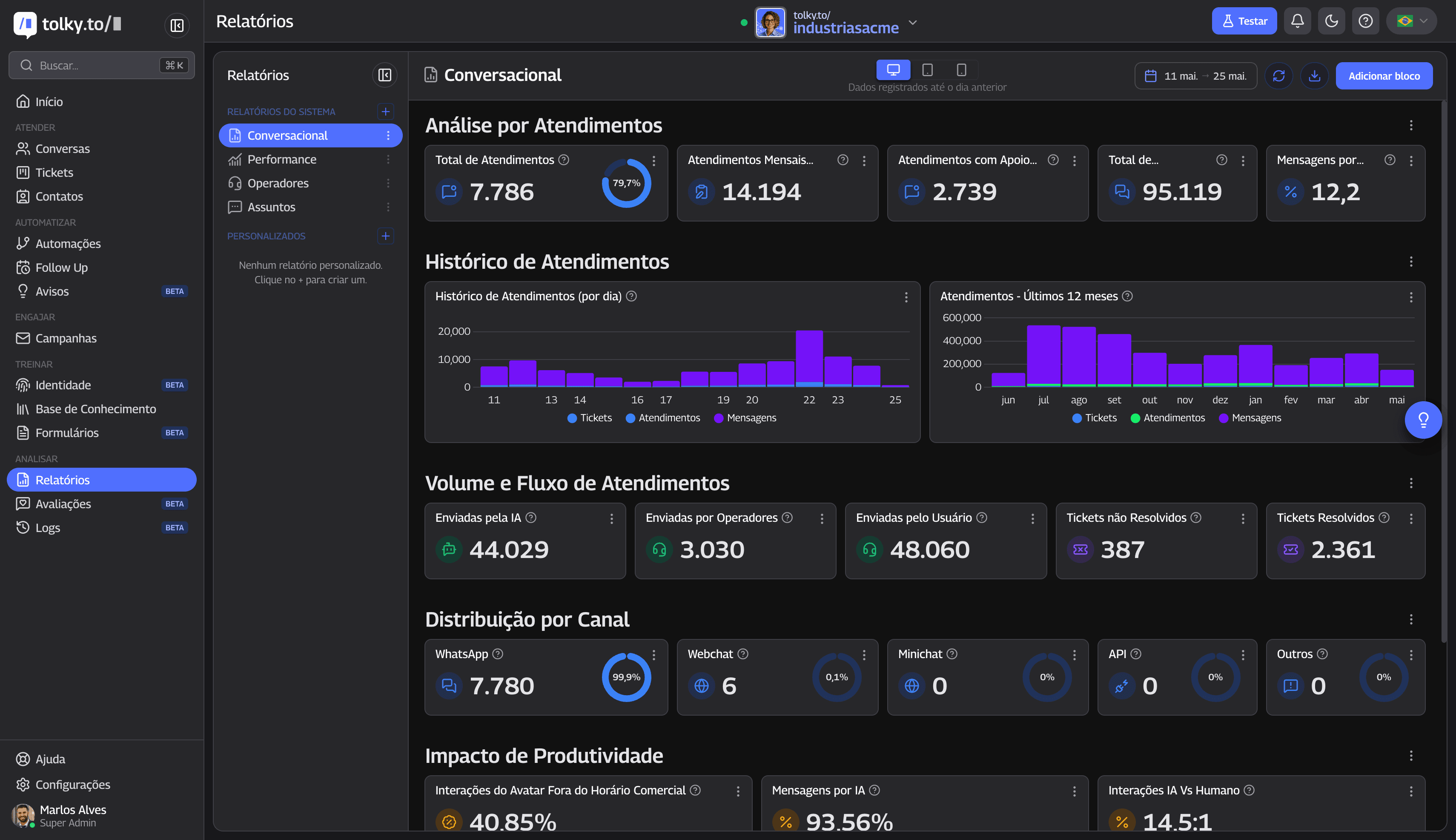 Tolky reports: conversion of served leads, productivity by channel, and contact recurrence turn service into management
Conclusion: slow service is a decision — even when it looks like an accident
If your company already senses that customers, leads, and agents are waiting more than they should, the problem may not be just volume. It may be operation design.
Response time in customer service is not a CX detail. It is a thermometer for sales, retention, productivity, and trust. Repeated delay is not bad luck — it is a symptom of unprioritized queue, fragmented history, absent SLA, or dependence on improvisation.
The way out is not to respond badly faster. It is to combine speed with context: conversational AI for the repetitive, human for the complex, tickets for the trackable, integrations for the actionable, and indicators for the manageable.
Final question: if your best agent or sales rep left tomorrow, how much of the customer relationship stays with the company — and how much evaporates with their phone?
If the answer is uncomfortable, the next step is not to hire more people to put out fires. It is to redesign the operation.
Tolky helps B2B companies turn channels like WhatsApp, website, chat, and voice into a more agile, integrated, and intelligent conversational operation — combining AI, human support, tickets, automations, reports, and integrations. Talk to our team about your operation's maturity and where response time can stop being a hidden cost and become a competitive advantage.
Frequently asked questions
What is response time in customer service?
It is the interval between when the customer initiates contact (message, ticket, call) and when they receive the company's first interaction. In mature operations, there are distinct SLAs by channel and demand type — commercial, support, billing. First response time (FRT) is the most used indicator to measure this speed.
Why does slow customer service hurt sales?
Because purchase intent has an expiration date. A lead waiting hours for a reply loses urgency, gets contacted by competitors, and goes cold before the first human touch. Research on inbound lead response speed indicates a sharp drop in conversion probability as delay increases. Slowness does not only kill experience — it kills opportunity.
How to reduce response time on WhatsApp?
With four moves: immediate response at entry (AI or automation), prioritization of commercial leads, unified history to avoid rework, and ticket management with SLA. A WhatsApp chatbot with conversational AI handles triage and simple demand; humans take complex cases with full context.
Can AI help respond to customers faster?
Yes — especially in triage, FAQ, order status, lead qualification, and data collection before handoff. AI keeps response time constant during peaks and outside business hours. The ideal model combines AI customer service for repetitive volume and human for negotiation, exceptions, and sensitive moments.
Can fast service still feel human?
It can — and should. Humanization is not slowness. It is context, empathy, and resolution. Automation that collects data, classifies demand, and prepares briefing frees the human to focus on relationship, not manual triage. Fast service with context is more human than delay with a generic reply.
What is the difference between response time and resolution time?
Response time measures the speed of the first interaction. Resolution time measures how long it takes to solve the problem from start to finish. You can respond fast and resolve slowly — or delay the first response but resolve shortly after. Mature operations track both indicators separately.
Which indicators to track in a support center?
Prioritize: first response time, mean time to resolution, SLA met, volume by channel and reason, abandonment rate, transfer rate to human, resolution rate, conversion of served leads, contact recurrence, and satisfaction (CSAT/NPS when applicable). These indicators turn service into management.
How to know if my company is losing leads to delay?
Clear signs: WhatsApp leads without reply within 15–30 minutes (commercial), conversations without owner, customers chasing follow-up, pipeline disconnected from real conversations, and no conversion metric by channel. If you do not measure FRT and conversion of served leads, you are probably losing opportunities without noticing.
Does hiring more agents solve the queue problem?
Sometimes — when the bottleneck is purely human capacity for complex cases. But if the queue is fed by repetitive demand, lack of prioritization, or absence of process, hiring more people increases cost without fixing the cause. Automation, AI, and ticket management are usually needed before or alongside new headcount.
How does a conversational AI platform help improve customer service?
By unifying channels, answering repetitive demand at scale, qualifying leads, opening and updating tickets, integrating with CRM and internal systems, and performing intelligent handoff to humans with full context. The result is lower response time, higher service productivity, and managerial visibility — without sacrificing quality in interactions that require human judgment.
Share
Tags
response time in customer service
slow customer service
customer service
AI customer service
customer service automation
conversational AI
ticket management
service SLA
WhatsApp sales
customer experience
lost leads
service productivity
Cited in
Marlos Carmo
Founder of Tolky
Marlos Carmo is an AI entrepreneur and founder of Tolky, the conversational-era infrastructure and AI CRM that unifies intelligent service, multi-channel support (such as WhatsApp and voice), live CRM, and operational intelligence in a single ecosystem. He is a finalist for the SXSW Innovation Awards and a member of Francesco's Economy, a global network of young entrepreneurs focused on innovation and social impact. He works connecting Artificial Intelligence and digital transformation in projects for large organizations.
Read also
Customer service automation without losing humanity: how to use AI to serve better, not just respond faster
Good customer service automation doesn't replace care — it removes rework, organizes demand, and frees humans for context, empathy, and exceptions. See how to combine conversational AI, tickets, integrations, and human support without turning the experience cold.
Marlos Carmo
June 10, 2026
·
19 min read
Guides
Butterfly Funnel: Why B2B Growth Doesn't End with the Sale
Traditional funnels focus only on acquisition. The Butterfly Funnel extends the customer journey to retention, service, and expansion. Connect sales and success with AI.
Marlos Carmo
June 17, 2026
·
18 min read
Strategy
AI CRM: Why the Next CRM Will Be Conversational and Integrated
Traditional CRM organizes records but fails due to manual input. AI CRM revolutionizes this by turning WhatsApp conversations into automated operational intelligence. Understand this new logic.
Marlos Carmo
June 17, 2026
·
21 min read
Strategy
AI without integration becomes FAQ: why artificial intelligence that can't access systems talks but doesn't resolve
AI integration with systems separates those who converse from those who resolve. See why AI without CRM, ERP, or tickets becomes FAQ — and how to connect AI customer service to real sales, support, and billing operations.
Marlos Carmo
June 10, 2026
·
19 min read
Guides