Sales CRM: how to choose a CRM system for your sales pipeline
How to choose a sales CRM: what it does for your funnel and pipeline, the features that matter, a step-by-step selection and rollout plan and the metrics that show whether deals are moving.
TL;DR
A sales CRM is the system that organizes leads and deals into funnel stages, each with an owner, a value, a next step and a loss reason. To choose one, start with your process and the channel where customers talk to you, compare features against a criteria table and roll it out in a few weeks, tracking conversion by stage, sales cycle and speed-to-lead.
Share
Most sales teams do not lose deals for lack of leads. They lose them because the lead waited hours for a reply, because a proposal stalled and nobody noticed, or because the rep who owned the account left and took the history with them on their phone.
A sales CRM fixes that kind of loss when you choose it based on how your team actually sells, not on the slickest demo. This guide covers what a sales CRM system does for your funnel, the features that matter, a step-by-step rollout, the metrics to track and what changes when the sale starts on WhatsApp.
Updated in November 2026.
What is a sales CRM?
A sales CRM is the system that records every lead and every deal in a funnel stage, with an owner, a value, the conversation history and a next step, so the team knows what to do today and the manager knows what will close this month. It is the sales side of a CRM; for the big picture, start with what is a CRM.
The difference from a general CRM is focus. A sales CRM revolves around deals and stages: who is negotiating, how much it is worth, how long it has been stuck and why it was lost. Support and marketing can use the same system, but the central question here is "what does this deal need to move forward?".
How a sales CRM organizes your funnel and pipeline
A sales CRM turns the funnel into a stage board: each deal is a card that moves from entry to won or lost, and all those cards together are the pipeline. The sales funnel describes the buyer's journey; the pipeline shows open deals and the value in each stage.


A simple pipeline for a consultative sale usually has five to seven stages, for example (illustrative):
- New lead: came in through the website, WhatsApp or a referral.
- Qualified: has a matching need, budget and timeline.
- Discovery or meeting: the team understands the problem.
- Proposal sent: with price and terms.
- Negotiation: adjustments to price, timeline or scope.
- Won or lost: with the reason recorded.
Two rules keep the pipeline from becoming decoration. Each stage needs a clear exit criterion ("meeting held", "proposal under review"), and every open deal needs a next activity with a date. Without them, the board shows the past and does not help you sell.
Which features matter in a sales CRM system?
The features that matter most in a sales CRM are automatic conversation logging, a configurable pipeline, tasks with due dates, conversion reports and integrations with the tools your team already uses. Almost every vendor has a long feature list; the table below helps separate the essentials from the extras.
| Criterion | What to ask the vendor | Why it matters |
|---|---|---|
| Conversation logging | Do WhatsApp, email and phone conversations land in the CRM on their own? | If reps have to copy them, the history is incomplete |
| Configurable pipeline | Can I have more than one pipeline, with its own stages, probabilities and loss reasons? | Different sales need different pipelines |
| Tasks and reminders | Does the system create the next activity and flag deals that stalled? | A deal with no next step goes cold |
| Automation | Can I move stages, assign leads and send messages by rule? | Takes repetitive work off the team |
| Reports | Does it show conversion by stage, sales cycle, goals and loss reasons? | Without reliable numbers, there is no forecast |
| Integrations | Does it connect to email, calendar, ERP and my other tools, natively or through an API or webhooks? | Avoids rework and duplicate data |
| Pricing model | Does it charge per user, per contact or by conversation volume? | Sets the cost as the team or volume grows |
| Access control | Does it have access profiles and a log of who changed what? | Protects the database and each rep's accounts |
If most of your sales happen over messaging, also compare the vendors in the list of the best WhatsApp CRMs of 2026, which includes entry prices and limits for each.
How to choose and roll out a sales CRM, step by step
Choosing a sales CRM takes a few weeks when you go in this order: process, criteria, trial and a gradual rollout. Jumping straight to demos usually ends with a system nobody updates.


- Map your current funnel. Write the stages as they happen today, with the exit criterion for each.
- List your lead sources. Website, WhatsApp, phone, referrals, events. The CRM needs to capture all of them.
- Shortlist three vendors using the criteria table. Drop any vendor that cannot log your main sales channel.
- Test with real data. Have two or three reps use the trial with real leads for two weeks.
- Migrate only what is useful. Active contacts and open deals go in; old lists without history can wait.
- Roll out in stages. Pipeline and tasks first, then automations and reports. Name a CRM owner.
In the first week, review with the team what got in the way: a field nobody fills in comes off the form, a stage nobody uses comes out of the pipeline.
Which metrics should you track in a sales CRM?
The metrics that show whether your funnel is healthy are conversion rate by stage, sales cycle length, speed-to-lead, average deal size and loss reasons. They all come out of the CRM without a side spreadsheet, as long as stages are kept up to date.


| Metric | How to calculate it | What it reveals |
|---|---|---|
| Conversion rate by stage | Deals that moved forward ÷ deals that entered the stage | Where the funnel leaks |
| Sales cycle | Average days between deal creation and win | How long cash waits for each sale |
| Speed-to-lead | Time between the lead's contact and the company's first reply | Whether the team answers while interest is hot |
| Average deal size | Won revenue ÷ number of won deals | Whether your customer mix is shifting |
| Win rate | Won deals ÷ closed deals | End-to-end team efficiency |
| Loss reasons | Count by recorded reason | What to fix in product, price or process |
Speed-to-lead deserves special attention if you sell over messaging: a lead asking a question on WhatsApp may be talking to more than one company at the same time. The guide on lead loss on WhatsApp shows where those leads disappear.
When the funnel starts on WhatsApp
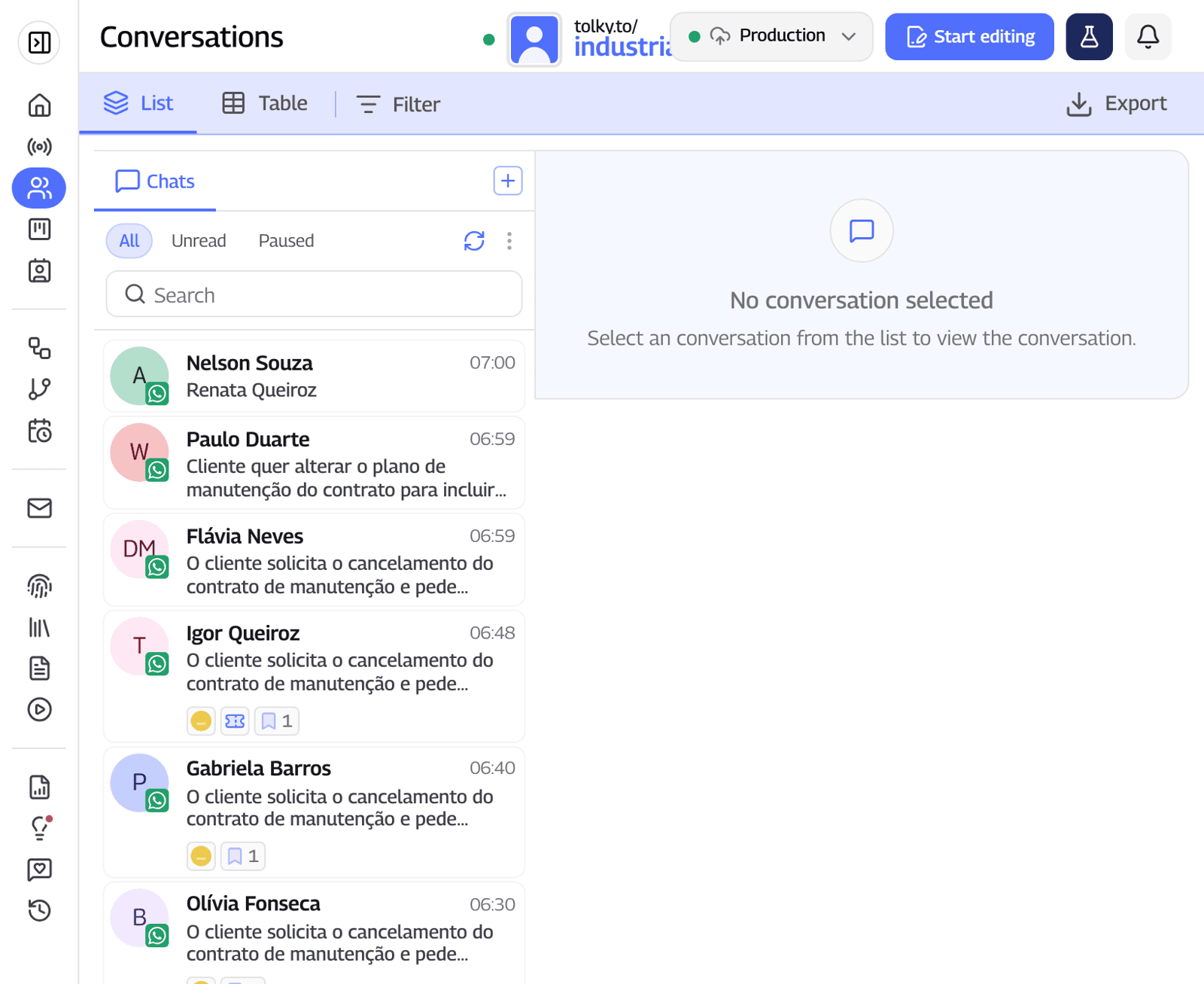
When the first conversation happens on WhatsApp, the sales CRM has to start from the conversation: the lead comes in, gets qualified and becomes a deal without anyone copying messages into another system. Otherwise the pipeline stays empty while sales happen on someone's phone.
Three things change the choice in this case:
- Fast replies at any hour. An AI agent can answer, handle questions and qualify leads after hours, then hand off to a rep with full context. The guide on AI for B2B lead qualification shows how to set the criteria.
- Follow-up with history. Resuming a stalled conversation based on what the customer already said works better than a generic message. See lead follow-up on WhatsApp.
- An official, shared number. With the official API, the team answers from the same number and the history stays with the company, not on each rep's device.
How much does a sales CRM cost?
The cost of a sales CRM depends more on the pricing model than on the list price: most charge per user per month, some per contact, and conversational CRMs often charge by conversation volume. There are free plans with user limits to get started.
Before comparing prices, run three numbers:
- The whole team. Count every rep, manager and SDR who will use the system, not just the closers.
- Conversation volume. If pricing is per conversation or per contact, estimate your peak month, not the average.
- Costs outside the subscription. Onboarding, paid integrations and, if you use the official WhatsApp API, Meta's per-message fees.
The guides on Pipedrive pricing and HubSpot CRM pricing cover the official prices of two well-known sales CRMs, and the list of the best free CRMs of 2026 shows where to start at no cost.
Where Tolky fits and what it does not do
Tolky is an AI conversational CRM: AI handles WhatsApp, website, voice and email, and its own CRM records the deal, stages and activities from the conversation, with the team reviewing. It is an option for teams whose sales start or happen in conversation.


In Tolky's CRM, pipelines are configurable, with probability and expected time per stage, loss reasons and goals per person. There are deals with proposals and monthly, quarterly or annual billing, bulk actions, automatic Follow Up and pipeline reports. The WhatsApp CRM and the sales page show the full flow. Pricing is per attendance: Starter at US$90 a month with 500 attendances and 2 users, Professional at US$450 with 1,000 attendances and 10 users, according to the pricing page on November 19, 2026.
What Tolky does not do: it has no native integration with Salesforce, Pipedrive or RD Station; the only native one is HubSpot, and other tools connect through the API, webhooks or the Flows Integration node. Instagram and SMS are coming soon. If your sales happen almost entirely over email and meetings, a traditional per-user CRM may be the better choice.
Frequently asked questions
What is the difference between a sales CRM and a regular CRM?
A sales CRM is a CRM used with a focus on deals, funnel stages and revenue forecasting. A full CRM also covers post-sale, support and marketing; many companies use the same system for everything.
What is the difference between a sales funnel and a sales pipeline?
The funnel describes the buyer's journey, from discovery to purchase. The pipeline shows the team's open deals in each stage, with value and owner. A CRM organizes both.
How long does it take to roll out a sales CRM?
For small teams, a few weeks: one to map the funnel and configure, two of testing with real data, plus migrating open deals. ERP integrations and more complex automations can take longer.
Which metrics should a sales CRM show?
At minimum, conversion rate by stage, sales cycle, speed-to-lead, average deal size, win rate and loss reasons. With those six, you can see where the funnel leaks and what to fix.
Do I need a sales CRM if I sell on WhatsApp?
Yes, if more than one person handles customers or you cannot say how many deals are open. WhatsApp keeps the conversation, but not the stage, value, next step or loss reason.
Conclusion
The best sales CRM is the one your team uses every day and that shows, without a side spreadsheet, where the funnel leaks. Map your process, compare vendors with clear criteria, test with real leads and track conversion, cycle length and speed-to-lead from week one. If your sales start in conversation, prioritize a system that logs the conversation on its own.
See the plans, explore Tolky's CRM, learn what a CRM is or talk to the team →. Let's talk?
Share
Tags
- sales crm
- crm system
- crm system for sales
- how to choose a crm
- sales pipeline
- sales funnel
- #whatsapp crm
- #conversational CRM
About the author

Co-founder of Tolky
Marlos Carmo is an AI entrepreneur and founder of Tolky, the conversational-era infrastructure and AI CRM that unifies intelligent service, multi-channel support (such as WhatsApp and voice), live CRM, and operational intelligence in a single ecosystem. He is a finalist for the SXSW Innovation Awards and a member of Francesco's Economy, a global network of young entrepreneurs focused on innovation and social impact. He works connecting Artificial Intelligence and digital transformation in projects for large organizations.
Next step
Want to bring this to your operation?
Tati, Tolky's AI assistant, understands your scenario in a few questions, suggests the best path and connects you with someone from the team, with full context.
Share