How to follow up with leads on WhatsApp: cadence and templates
How to follow up with leads on WhatsApp: a starting cadence, what changes outside the 24-hour window, message templates for each stage, when to stop and how to measure.
TL;DR
A WhatsApp follow-up is the check-in message that brings back a lead who stopped replying, with context from the earlier conversation. Inside the 24-hour window, the business can write freely; outside it, only with a Meta-approved template, in the right category and with a per-message cost. A short cadence with a clear exit, stopping at the first sign of disinterest, protects both the sale and the number's quality.
Share
The lead asked for a price, got the answer and went quiet. At most companies, what happens next depends on one salesperson's memory: someone remembers to check in tomorrow, or nobody does. A WhatsApp follow-up is what separates a stalled opportunity from a lost one.
But WhatsApp has its own rules: pushing too hard lowers the number's quality, free-form messages are not accepted after 24 hours, and every template has a cost. This guide covers a starting cadence, templates for each stage, when to stop, how to automate with AI and how to measure.
Updated in November 2026.
What is a WhatsApp lead follow-up?
A WhatsApp lead follow-up is the check-in a business sends after an earlier interaction, such as a quote request or a proposal, to answer questions, remind the lead of the next step and keep the deal moving. The full definition is in the follow-up glossary entry.
It differs from a campaign in one way: a follow-up continues a conversation that already exists, with one specific lead. That is why the message has to mention what was discussed. "Hi, how are you?" is not a follow-up; "You asked for the annual plan quote on Tuesday. Any questions about the timeline?" is.
Most sales lost on WhatsApp come from a lack of follow-through, not a lack of interest. The diagnosis is in the guide on losing leads on WhatsApp; here the focus is how to bring them back.
What follow-up cadence should you use on WhatsApp?
A WhatsApp follow-up cadence works best when it is short, spaced out and ends with a clear exit: three to five touches over about a week, plus a later re-engagement only for people who opted in. The table is a starting point, not a universal rule. An impulse purchase calls for gaps of hours; a B2B sale that needs internal approval calls for days.


| Touch | When (from the lead going quiet) | Goal | Message type |
|---|---|---|---|
| 1 | Minutes after the lead's first message | Reply fast and qualify | Free-form, window open |
| 2 | 2 to 4 hours without a reply | One closed question | Free-form, window open |
| 3 | Before 24 hours since their last message | Bring something new or useful | Free-form, window open |
| 4 | 2 to 3 days later | Pick up with context | Approved template |
| 5 | 7 days later | Close politely | Approved template |
| Re-engagement | 30 to 90 days later | Check whether interest is back | Marketing template, opt-in only |
The intervals are illustrative. The first touch matters more than all the others: speed to lead decides whether the lead is still interested. Every step in the cadence needs a reason; if touch 4 brings nothing new, it becomes nagging.
What does the 24-hour window change in a follow-up?
The 24-hour window decides whether a follow-up can be a free-form message or has to be a Meta-approved template. According to Meta's documentation on sending messages, checked on November 18, 2026, the window opens when the customer messages or calls, resets with each new message from them and, once it closes, only pre-approved templates can be sent.
- Inside the 24-hour window: a free-form message written for that lead.
- Outside the window: only an approved template, sent to people who gave opt-in.
- The category follows the content: under Meta's template categorization, utility is non-promotional and tied to a user action or request; picking a sale back up or re-engaging is marketing.
Two details weigh on sales follow-ups. Meta may limit how many marketing templates a person receives, based on their recent engagement; a blocked message comes back with error 131049, and the guidance is to wait at least 24 hours before trying again. Marketing sent while the window is open does not count toward that limit. The same page says WhatsApp does not currently deliver marketing templates to US phone numbers (per-user limits, checked on November 18, 2026).
A lead who arrives from a click-to-WhatsApp ad also opens a free entry point window when the business replies in time: for up to 7 days, messages are not charged (Android and iOS only). That changes the cost, not the template rule.
The full rules on categories and quality are in the guide to the 24-hour window, templates and campaigns.
How much does a follow-up outside the window cost?
Meta charges each delivered template by the recipient's country and the category, and in Brazil marketing costs about nine times as much as utility. Under the rate card in effect since October 1, 2026, checked on November 17, 2026, a marketing template to a Brazilian number costs US$ 0.0625 and a utility template US$ 0.0068 (WhatsApp Business Platform pricing). Since the same date, free-form replies inside the window are also charged, with 1,000 free service messages per number each month.
Illustrative example: 400 stalled leads in Brazil get touches 4 and 5 as marketing templates. That is 800 × US$ 0.0625 = US$ 50.00 for the month. Rates vary by country, so run your own numbers in the WhatsApp API cost calculator.
Follow-up message templates for each stage
A good follow-up message mentions what was discussed, asks one question and offers a way out. The examples are illustrative. For ready-made templates with the category marked, use the library of WhatsApp message templates.
First contact
The lead just wrote and the window is open. Reply within minutes, introduce yourself and ask a question that moves qualification forward.
Hi Marina, this is Ana, the AI assistant at Example Clinic. I saw you asked about teeth whitening. To give you the right price, is it for you or for someone else?
If the lead came from a form and has not written yet, the first contact is a template, such as "Reply to an ad lead" in the welcome messages collection.
No reply
The lead read the message and did not answer. Within the 24 hours, send something short with a closed question.
Marina, I held two assessment slots for this week: Thursday at 10:00 or Friday at 16:30. Does either work for you?
Avoid "Hey, still there?". That kind of message puts pressure on the customer and adds nothing new.
Proposal sent
The open question is usually price, timeline or internal approval. Outside the window, this is a template, usually marketing.
Hello {{1}}, we sent the {{2}} proposal on {{3}}. Any questions about the timeline or terms? If you need another version for internal approval, I can prepare it.
Re-engagement
The lead went cold weeks ago. Write only to people who opted in, acknowledge the time that passed and ask if it still makes sense.
Hello {{1}}, we talked in {{2}} about {{3}}. Does it still make sense for you? If anything changed, I can adjust the proposal.
This is the "Lead that went cold" template from the customer win-back collection. For e-commerce, see abandoned cart.
When should you stop following up on WhatsApp?
Stop at the first opt-out request, at the first clear sign of disinterest and at the end of the cadence, with no exceptions. Pushing generates blocks and reports, and Meta uses blocks, reports, mutes and archives from the past seven days to measure the number's quality (Meta's documentation, checked on November 18, 2026).
- Opt-out request: "stop", "unsubscribe", "not interested". Record the opt-out in the CRM and remove the contact from every cadence and campaign.
- Negative reply: "already bought" or "not the right time". Say thanks and ask if you can check back on a date.
- End of the cadence: after the last touch, the conversation goes to re-engagement or to the archive.
- Issue solved: if the lead bought through another channel, any follow-up feels careless.
- Quality signal: if blocks rise after a step, cut the volume and rewrite the message.
A low number quality rating reduces the reach of the whole operation, not just sales.
How do you automate follow-ups with AI without sounding like a bot?
AI writes good follow-ups when it works from the real conversation, follows one instruction per stage and stops when the customer replies or asks to opt out. Old automation sent the same fixed sentence to everyone, in the middle of the night. With AI, the message can mention the product, the question and the lead's last sentence.


- Context before copy. The AI reads the history and the CRM data before writing.
- One instruction per stage. Touch 2 asks, touch 4 brings something new, the last one closes.
- Quiet hours. Nothing goes out overnight; the message waits.
- A stop rule before sending. Check whether the lead asked not to be contacted or the issue is already solved.
- A person when the case calls for it. A price objection or negotiation goes to a salesperson with the summary. See the rules for AI to human handoff.
AI also helps earlier, by deciding who gets the full cadence and who goes to nurturing. See AI for B2B lead qualification.
How do you measure WhatsApp lead follow-up?
Measure follow-up by the replies and conversions at each stage, and by the cost and quality signals it creates. Without per-stage numbers, you cannot tell whether touch 5 sells or just annoys.
| Metric | How to calculate | What it shows |
|---|---|---|
| Reply rate per touch | Replies ÷ delivered messages, per stage | Which stages start conversations |
| First response time | Time of reply − time of the lead's message | Whether touch 1 goes out fast |
| Conversion per stage | Meetings or sales ÷ leads who got that stage | Where follow-up drives revenue |
| Opt-outs and blocks | Opt-outs and blocks ÷ messages sent | Whether the cadence is too pushy |
| Cost per recovered lead | Template spend ÷ leads who replied again | Whether the stage pays for itself |
Compare the conversion rate of leads who got follow-up with those who did not, over the same period, and review the cadence every month.
Where does Tolky fit in follow-up?
Tolky is a conversational AI CRM with automatic Follow Up: when the customer stops replying, the AI waits the set time and sends a message to pick the conversation back up, written from what was already said. The feature sits in the automation group of the dashboard, and the contact's history lives in Tolky's CRM.
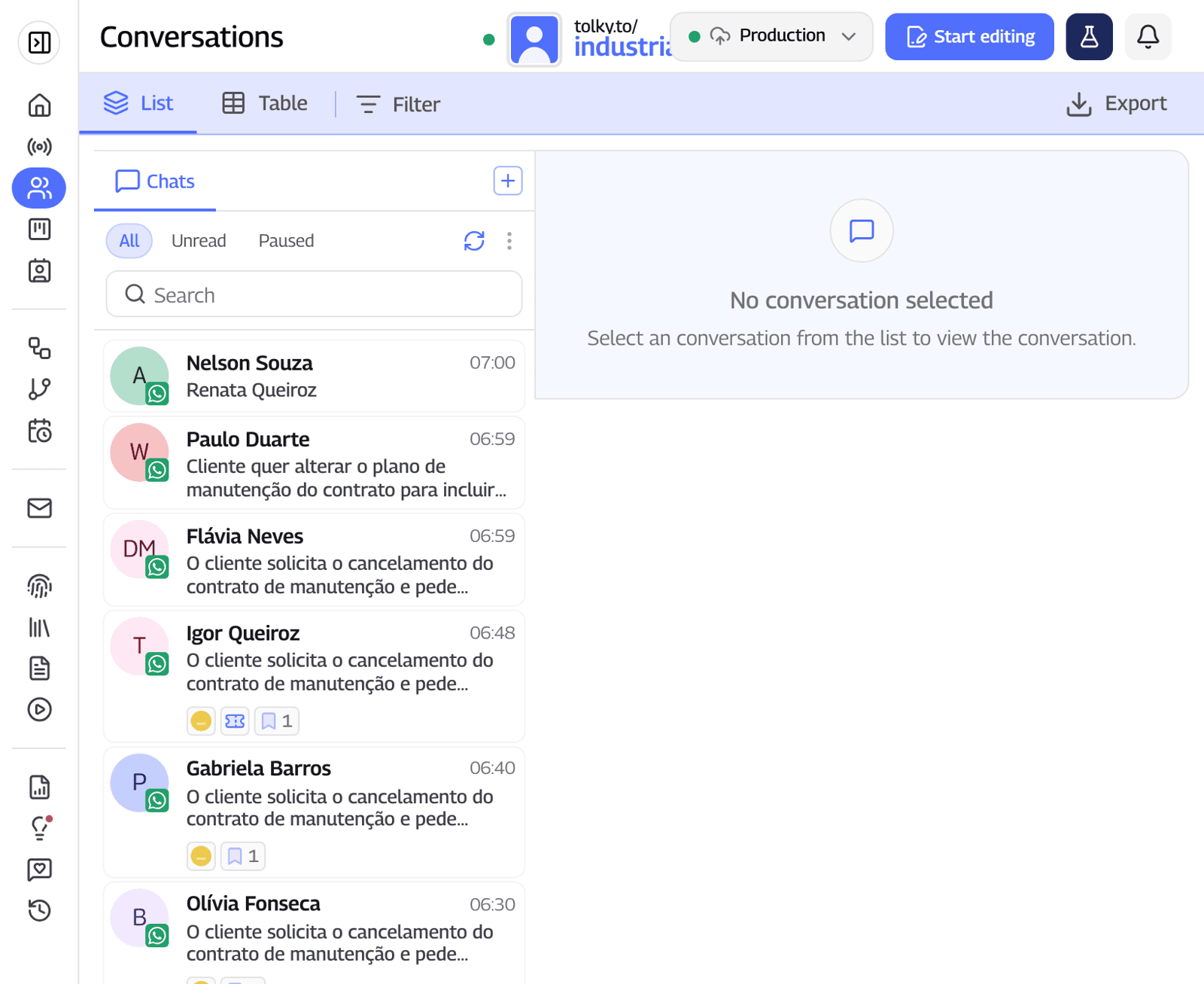
What Follow Up does, checked in the dashboard on November 18, 2026:
- When it starts: in every conversation where the customer stops replying, or only in the ones an automation picks.
- How long it waits: 7 minutes to 7 days without a reply before each attempt, with one or more attempts in sequence.
- What it says: one instruction per attempt, with optional sample phrases. The AI writes from the conversation and can call agents, such as a CRM lookup, first.
- When it holds back: during quiet hours (21:00 to 08:00 Brasília time by default) and when the sending rule says no, such as a customer who asked not to be contacted.
- When it stops: if the customer replies, the rest does not go out. Outside the 24-hour window, the conversation restarts with an approved template.
The feature also appears in the AI chatbot for WhatsApp.
What Tolky does not do for you: collect opt-in, choose the template category or pay Meta's fees, which are outside the plan. Instagram and SMS are still coming soon.
Frequently asked questions
How many follow-up messages should you send on WhatsApp?
As a starting point, three to five touches over about a week, with the last one closing the conversation. After that, only re-engagement, weeks later and for people who opted in. Adjust by the reply rate of each stage.
Can you follow up on WhatsApp after 24 hours with no reply?
Yes, but only with a Meta-approved template and to people who gave opt-in. Within 24 hours of the customer's last message, the message can be free-form.
Is a WhatsApp sales follow-up marketing or utility?
Picking a sale back up or re-engaging a lead is marketing under Meta's categorization. Utility is non-promotional and tied to a specific customer request. A utility template with sales appeal can be reclassified.
How much does a follow-up outside the window cost?
It depends on the recipient's country and the category. Under Meta's rate card in effect since October 1, 2026, a delivered template to a Brazilian number costs US$ 0.0625 for marketing and US$ 0.0068 for utility. The platform is billed separately.
How do you follow up without being pushy?
Mention what was discussed, ask one question, bring something new in each touch and give a clear exit in the last one. Respect quiet hours and stop at the first opt-out request.
Can AI handle the follow-up on its own?
It can pick up stalled conversations with context from the history, within the rules you set. Negotiation and sensitive cases should go to a person, with the conversation summary.
Conclusion
Following up with leads on WhatsApp means a short cadence, messages with context and stopping at the right time. Inside the 24-hour window, write freely; outside it, use the right template and count the cost. Measure each stage and cut what does not convert.
See the plans, explore Tolky's CRM, use the message templates or talk to the team →. Let's talk?
Share
Tags
- how to follow up with leads on whatsapp
- whatsapp follow-up
- follow-up cadence
- follow-up message templates
- whatsapp 24-hour window
- lead re-engagement
- ai follow-up
- #conversational CRM
Cited in
- WhatsApp automation for business: what to automate and how to start
- WhatsApp bulk messaging: broadcast lists, the API and the rules
- Best WhatsApp CRM in 2026: 10 Tools Compared on Price and AI
- WhatsApp 24-hour window, templates and campaigns without blocks
- AI for customer service: how to use it on WhatsApp in 7 steps
About the author

Co-founder of Tolky
Marlos Carmo is an AI entrepreneur and founder of Tolky, the conversational-era infrastructure and AI CRM that unifies intelligent service, multi-channel support (such as WhatsApp and voice), live CRM, and operational intelligence in a single ecosystem. He is a finalist for the SXSW Innovation Awards and a member of Francesco's Economy, a global network of young entrepreneurs focused on innovation and social impact. He works connecting Artificial Intelligence and digital transformation in projects for large organizations.
Next step
Want to bring this to your operation?
Tati, Tolky's AI assistant, understands your scenario in a few questions, suggests the best path and connects you with someone from the team, with full context.
Share