
Blog
Guides
Customer Service Software and Platforms: How to Choose the Best Option for Your Business
Choosing the right customer service software or customer service platform is a critical step for your operation's efficiency and scale. Learn the differences between traditional solutions and the new conversational platforms integrated with Artificial Intelligence.

Marlos Carmo
June 4, 2026
·
8 min read
TL;DR
Compare the role of traditional customer service software with modern omnichannel customer service platforms. We analyze the essential criteria for selection (omnichannel, integrations, reporting) and how artificial intelligence has evolved these tools from simple ticket registration systems into high-performance autonomous AI agents.
Share
In the modern corporate landscape, the quality of the customer experience has become the main competitive differentiator for any brand. With hyper-connected consumers demanding near-instant responses, relying on shared email inboxes, multiple mobile phones, or spreadsheets to manage contacts is not only inefficient — it is a real risk of lost revenue.
Faced with this, the search for a centralized solution is gaining momentum in companies. However, terms like customer service software and customer service platforms often appear mixed up in market research, leaving support, sales, and customer success leaders confused about which path to follow.
In this comprehensive and in-depth guide, we explain the fundamental difference between these concepts, the crucial technical criteria for evaluating market alternatives, and how generative Artificial Intelligence (AI) has completely transformed customer service dynamics, raising the operational standard from static tools to autonomous virtual agents.
What Differentiates Customer Service Software from a Customer Service Platform?
Although they seem like synonyms at first glance, these two terms represent different stages of technological evolution and operational maturity.
Traditional Customer Service Software (Legacy Helpdesk)
Historically, customer service software was born with the primary goal of organizing and cataloging internal or external demands in the form of "tickets." The central focus of these tools is administrative control:
- Ticket creation and closing: Assignment of unique protocol numbers.
- Linear queues and workflows: Routing messages from one department to another manually or semi-automatically.
- SLA (Service Level Agreement) Control: Measuring the time the team takes to respond to and resolve a request.
Although they work very well for internal IT support or detailed operational audits, these solutions fail to provide an excellent end-customer experience. They transform the conversation — which should be dynamic and fluid — into a bureaucratic and slow process. The customer sends a message and has to wait hours for an email with the answer.
Modern Customer Service Platforms (Omnichannel & Conversational)
On the other hand, customer service platforms have evolved with a focus on the conversational experience and channel centralization. Instead of simply generating a protocol number and isolating the conversation, the platform unifies the customer journey:
- Authentic Omnichannel: Total integration of channels such as WhatsApp, Instagram, Facebook Messenger, Webchat, Email, and Phone on a single screen. If the customer starts the conversation on WhatsApp and then sends a direct message on Instagram, the interaction history is continuous and shared.
- Relationship Focus: The interface prioritizes dynamic real-time chat, allowing quick responses, sending media, audios, and much more human and dynamic interactions.
- Automation and Orchestration: They allow the integration of triage bots, workflow automations, and, more recently, AI agents that resolve demands autonomously before transferring to human agents.
For businesses looking to drive sales, accelerate support, and delight customers, a customer service platform is the ideal choice, as it reduces friction and puts active conversation at the center of the business process.
Fundamental Criteria for Evaluating Your Customer Service Platform
With dozens of alternatives available in the customer service software market, making the wrong choice can be costly: tied annual contracts, time-consuming implementation, and, worse, frustration for your own service team.
To avoid these problems, evaluate the software considering the following fundamental pillars:
1. Real Channel Centralization (Omnichannel)
Beware of systems that claim to be "multichannel" but only display isolated windows for each communication channel. A professional customer service platform needs to consolidate the history in a unified way. This means that, regardless of the channel chosen by the customer today or tomorrow, your team's operator will have immediate access to past interactions, preventing the customer from having to repeat data or re-explain their case from scratch.
2. Secure Data Integrations and Robust APIs
No customer service software should operate as an isolated island. The tool needs to connect to the systems your company already uses on a daily basis:
- Sales and Marketing CRMs: Connections with HubSpot, Salesforce, RD Station, and Pipefy to instantly update the sales funnel, register qualified leads, and keep relationship history up to date.
- ERPs and Databases: Synchronization with internal management systems to query order status, billing, and registration data.
- Payment Gateways: Connection with Stripe, Asaas, Pagar.me, or similar to allow operators — or the intelligent agent itself — to query defaults or automatically generate payment links and invoice copies.
3. Metric Dashboards and Advanced Reports (Analytics)
What cannot be measured cannot be improved. The operations manager needs real-time visibility into the health of support and the sales team. Look for tools that offer intuitive dashboards with indicators such as:
- First Response Time (FRT): How long the customer waits in queue before the first human contact.
- Average Handling Time (AHT): The total duration of each interaction from start to finish.
- First Contact Resolution (FCR): Percentage of problems resolved in the very first interaction.
- Integrated Customer Satisfaction Surveys (NPS and CSAT): Automatic delivery of evaluation forms after ending the chat, providing automated qualitative reports on employee performance.
4. Usability and Operator Interface (UX)
The customer service tool is the "home" of your support team for 8 hours a day. If the interface is confusing, slow, or full of unnecessary clicks, operator performance will drop drastically. Good usability reduces the training time needed for new team members and avoids mental fatigue in operations.
5. Stability, Security, and Compliance (GDPR/LGPD)
Customer service data traffic involves highly confidential customer information, such as social security numbers, emails, phone numbers, and sometimes financial data. Ensure that the customer service platform meets strict security standards:
- Data encryption at rest and in transit.
- Full compliance with privacy laws, such as LGPD in Brazil and GDPR in Europe.
- Detailed audit logs (who accessed which conversation, who exported reports, etc.).
The AI Revolution in Customer Service Software
If you searched for customer service software a few years ago, the only form of automation available would be rigid rule-based chatbots. These bots, although useful for initial numeric menus ("Press 1 for finance, 2 for support"), quickly became a source of immense customer frustration when any question went off the exact script of pre-programmed keywords.
Today, generative artificial intelligence based on Large Language Models (LLMs) redefines what a customer service platform is capable of. Automation has moved from simple triage to cognitive AI agents.
Here are the essential technologies that make customer service truly intelligent:
Secure RAG (Retrieval-Augmented Generation)
RAG allows generative AI to query qualified external databases (such as your company's documentation, product manuals, and return policies) to formulate precise and secure answers. Instead of letting the model invent information freely (hallucinations), RAG strictly limits the AI's knowledge to the company's official data. The customer asks a complex question in natural language, the AI searches for the specific answers in authorized internal files, and answers with perfect grammatical clarity, without the risk of inventing conditions or lying about prices.
Function Calling (Autonomous Action Execution)
Modern intelligent agents do not just read texts and answer questions; they act directly in systems. With Function Calling technology, artificial intelligence analyzes the customer's request (e.g., "I need to extend my invoice due date by 3 days") and executes the request by communicating directly with the billing gateway through APIs in a controlled manner, generating the new document and sending it in the chat immediately.
Dynamic Hybrid Handoff with Context
AI does not completely replace the human factor; it works as a high-speed copilot. When the artificial intelligence detects that a case is too complex, involves critical complaints, or requires refined human empathy, it performs the smart transition of the call to a human operator. The big advantage is that the agent does not receive a blank screen: the AI provides an executive summary of the case, highlighting what the customer asked, what data has already been collected, and the reason for the transfer. Average handling time drops, and customer satisfaction rises.
Why Tolky is the Right Choice for Your Operation?
If your goal is to deploy a robust, scalable customer service platform equipped with the highest artificial intelligence technology without facing months of complex development and implementation, Tolky was tailormade for your business.
- No-Code Implementation: Connect channels, configure service routes, integrate systems, and create your intelligent virtual agents in a purely visual, intuitive, and fast way.
- Enterprise AI Agents with RAG: Say goodbye to static, boring robots. Create artificial intelligence assistants integrated with your process manuals, PDFs, and practical guides, offering precise answers in seconds.
- Ready for the Future of WhatsApp (Meta's BSUID and usernames for 2026): Our architecture is already in full compliance with the new guidelines of the Meta WhatsApp business ecosystem, protecting your database against the loss of identification of old users.
- Unified Analytics Dashboards: Rich metrics of conversations, human team productivity, performance of AI agents, and customer satisfaction rates directly on your screen for fast strategic decision-making.
Adopting outdated customer service software costs you customers, time, and daily efficiency for your team. Migrating to a modern, conversation-oriented platform with artificial intelligence is the key to positioning your company ahead of the competition and offering the agile support that today's market demands.
Suggested internal links:
Share
Tags
customer service software
customer service platforms
customer support
conversational ai
helpdesk
customer relations
service management
Marlos Carmo
Founder of Tolky
Marlos Carmo is an AI entrepreneur and founder of Tolky, the conversational-era infrastructure and AI CRM that unifies intelligent service, multi-channel support (such as WhatsApp and voice), live CRM, and operational intelligence in a single ecosystem. He is a finalist for the SXSW Innovation Awards and a member of Francesco's Economy, a global network of young entrepreneurs focused on innovation and social impact. He works connecting Artificial Intelligence and digital transformation in projects for large organizations.
Read also
Your Company Might Be Using AI to Scale Chaos: Why Conversational AI is About Management, Process, and Governance
Putting AI into customer service without processes and governance only speeds up disorganization. Learn why mature conversational AI requires control, ownership, and tickets.
Marlos Carmo
June 11, 2026
·
18 min read
Strategy
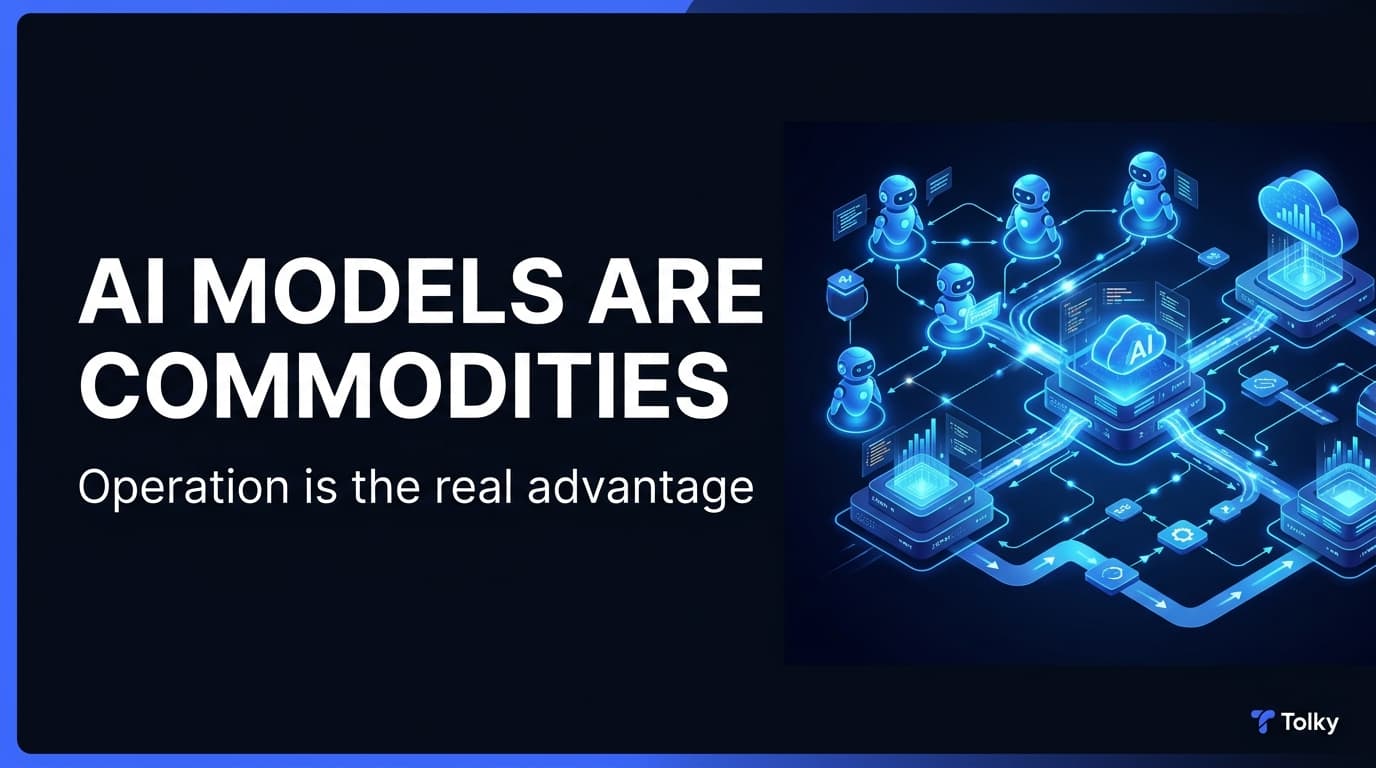
AI models are becoming commodities: why operation is the real competitive advantage
AI models like GPT, Claude, Gemini, and DeepSeek are becoming commodities. The true competitive edge for mature enterprises is not the chosen LLM, but the operational architecture built on top of it.
Marlos Carmo
July 23, 2026
·
16 min read
Guides

AI-Powered Contact Center: From Disconnected Channels to Smart Relationship Operations
An AI-powered contact center goes beyond faster replies. Learn how to unify channels, tickets, automation, and humans into a single smart relationship operation.
Marlos Carmo
June 12, 2026
·
18 min read
Guides
Customer service automation without losing humanity: how to use AI to serve better, not just respond faster
Good customer service automation doesn't replace care — it removes rework, organizes demand, and frees humans for context, empathy, and exceptions. See how to combine conversational AI, tickets, integrations, and human support without turning the experience cold.
Marlos Carmo
June 10, 2026
·
19 min read
Guides