
Blog
Guides
Tolky as a Blip Alternative: A Feature-by-Feature Comparison for 2026
Blip is one of the most established enterprise conversational platforms in Brazil. But for operations that need AI that reasons, a native CRM and go-live without a technical team, an AI CRM delivers more. A feature-by-feature comparison.

Marlos Carmo
June 3, 2026
·
13 min read

TL;DR
Blip is a robust Brazilian enterprise conversational platform for building and operating WhatsApp chatbots with custom NLU and granular flow control. Tolky is an AI CRM with agents that reason in natural language, understand any message, update the CRM automatically and evolve without technical team dependency. The difference is architectural: bot-building platform vs. AI agent ecosystem.
Share
Blip holds a consolidated position in the Brazilian conversational platform market. It is a Brazilian company with a significant installed base, especially among mid-size and large companies that needed structured WhatsApp chatbots before the "AI CRM" category existed as an alternative. The platform's robustness, extension marketplace and certified partner network made Blip a reference for enterprise operations that needed fine-grained control over conversational flows.
But the technological landscape has shifted rapidly. LLMs with natural language reasoning capability made a completely different approach possible: instead of mapping every possible scenario in a builder and training an NLU to recognize intents, it is now possible to define an agent that understands any message by nature, reasons about context and acts autonomously.
This shift raises the central question of this comparison:
For a B2B operation that needs conversational support and sales at scale, when does a bot-building platform make sense and when does an AI CRM with reasoning agents deliver more?
The 30-Second Summary
| Dimension | Tolky | Blip |
|---|---|---|
| Category | Conversational AI CRM | Bot-building and operation platform |
| AI architecture | Generative AI agents that reason | Custom NLU with trained intents and entities |
| Free understanding | Any message, no prior mapping | Limited to trained intents and entities |
| Integrated CRM | Native, automatic updates | No CRM, integrates via API or marketplace |
| Configuration | Natural language, operations team | Technical builder, NLU, certified partner |
| Go-live time | Days | Weeks to months |
| Evolution without engineering | Yes, team updates agents | No, new scenarios require technical mapping |
| LGPD compliance | Native, data in Brazil | Supported, Brazilian platform |
| Cost model | Per conversation volume | Per MAU (monthly active users) + implementation |
Both platforms are solid, but for operationally different problem profiles. The rest of this guide details where each difference shows up in practice.
What Blip Is
Blip was founded in 2015 by Take, a company from Belo Horizonte, and grew to become one of the largest conversational platforms in Latin America. In 2022 it became independent and today serves large companies in telecoms, retail, financial services and government.
The core product is a bot-building and operation platform: you create bots using the Blip Builder, define intents and entities in the NLU module, map the conversational flows and publish to WhatsApp Business API and other channels. The ecosystem includes:
- Blip Builder: visual and code-based editor for building conversational flows
- Blip NLU: natural language processing module to train intent recognition
- Blip Desk: human support panel for cases the bot does not resolve
- Blip Marketplace: third-party extensions for integrations and additional features
- Analytics: volume, CSAT, flow performance and active user analysis reports
Blip's architecture is powerful for operations that need granular control over every step of the conversation. To cover a new scenario, you return to the builder, map the flow, train the NLU for the new intent and publish. It is a cycle that requires a technical team or certified partner.
Blip was built for an era when chatbots needed to be programmed for every possible case. It is excellent at that model. The cost appears when the operation grows and the number of scenarios to map exceeds the team's capacity to maintain them.
Where Blip Is Strong
- Granular flow control. For operations that need full traceability of every bot decision, with specific business rules and complex conditional logic, Blip offers a level of control that generative AI platforms do not easily replicate.
- Regulated industries. Banks, insurers and telecoms with regulatory compliance and audit requirements benefit from the ability to trace every node of the conversational flow.
- Partner ecosystem. A consolidated network of certified partners in Brazil with experience in complex enterprise implementations.
- Brazilian platform. Data processed in Brazil by default, Portuguese support and deep local market knowledge.
What Tolky Is
Tolky was built on a different premise. Instead of a builder where you map every scenario, it is an AI CRM where generative AI agents operate autonomously: they understand any natural language message, query systems, make contextual decisions and log everything in the CRM automatically.
The fundamental difference is in how each platform handles variation in conversation:
- In Blip, variation requires more mapping: each new intent, entity or flow the bot needs to cover demands technical work before the bot knows how to respond.
- In Tolky, variation is the natural state: the agent was designed to understand free language, so an unexpected question does not break anything. The agent reasons about context and responds appropriately to what was said.
Tolky's agents are specialized by function:
- SDR Agent: qualifies leads in natural language, interprets unexpected answers and delivers only fit leads to the team.
- CRM Agent: logs every interaction in the CRM automatically, without anyone opening the system.
- Sales Agent: answers product questions and routes at the right moment.
- Closer Agent: generates personalized proposals and handles objections in natural language.
- Outbound Agent: runs active prospecting in real two-way conversations.
- Support Agent: resolves tickets autonomously, queries the ERP and escalates with full context.
Each agent has identity defined in natural language: mission, tone of voice, scope and behavioral profile. No builder. No NLU to train. No technical partner required.
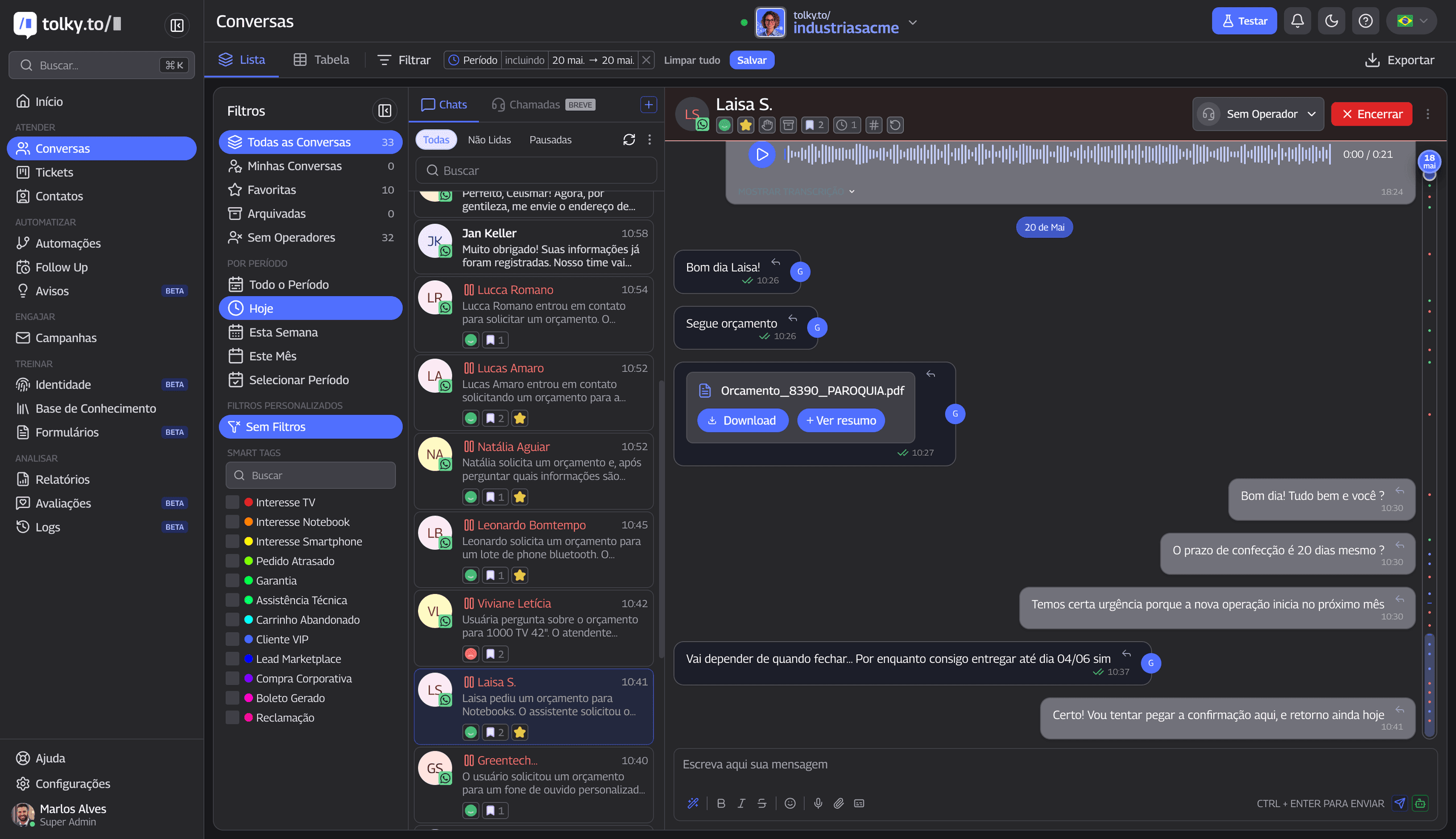 Tolky conversations dashboard: AI and human team operating in the same ecosystem, with full history, transcribed audio and documents visible inline
In Blip, covering a new scenario means returning to the builder, mapping the flow, training the NLU and publishing. In Tolky, the agent understands the new scenario by nature, because it reasons about language, not rules.
The Core Difference: Scripts vs. Reasoning
The most important divergence point between the two platforms is the nature of the intelligence operating in conversations.
| Conversation situation | Blip (NLU + flow) | Tolky (generative AI agent) |
|---|---|---|
| Recognized and mapped intent | Executes the flow correctly | Executes with additional context |
| Unmapped intent | Fallback or "I didn't understand" | Interprets and responds contextually |
| User mixes two topics | Needs multi-intent flow | Agent follows naturally |
| Complex question with multiple factors | Requires conditional builder logic | Agent weighs and decides |
| New use case emerges in operation | Requires development cycle | Team updates instruction in minutes |
| Prior conversation context | Available with variable configuration | Persistent by default, automatic access |
For operations with very predictable and stable flows, Blip's approach works well. For operations where customers ask open questions, mix topics and change direction mid-conversation, the reasoning-based architecture delivers a more fluid experience without demanding constant development cycles.
The Hidden Cost of Continuous Mapping
One of the least visible operational differences at purchase time is the ongoing maintenance cost of a flow-based platform.
Every product change, every new campaign, every new type of question customers start asking, every policy change: all of this potentially requires an update in the builder. For fast-moving operations, this means a constant cycle of:
- Identifying the bot gap (feedback from the support team)
- Opening the builder, mapping the new flow or intent
- Training the NLU with new examples
- Testing, validating and publishing
- Monitoring to verify the new flow did not break an existing one
In Tolky, this cycle is replaced by an instruction update in natural language, done by the operations team in minutes. When the product changes, the instruction changes. When a new question pattern emerges, the agent already understands it because it uses reasoning, not pattern recognition.
For companies that launch new products frequently, change policies often or serve multiple segments with different behaviors, the operational cost of maintaining a bot platform grows alongside complexity. Tolky grows in volume without growing in maintenance complexity.
The Problem of Having No CRM
Like ManyChat, Blip has no native CRM. The platform focuses on the conversational layer: building, publishing and operating bots. To log lead data, customer history and relationship context, you need to integrate with an external CRM via the Blip API or marketplace extensions.
In practice this means:
- Conversation history in Blip, business data in the CRM: separate systems for the team to navigate
- Each integration between Blip and CRM requires development and maintenance
- When Blip updates its API, integrations need to be validated
- The CRM only reflects what the integration was configured to pass, not everything that happened in the conversation
In Tolky, the CRM is the same ecosystem where agents operate. Every conversation qualifies, logs and updates automatically. The rep who opens the record finds the full interaction history, without anyone needing to configure an integration.
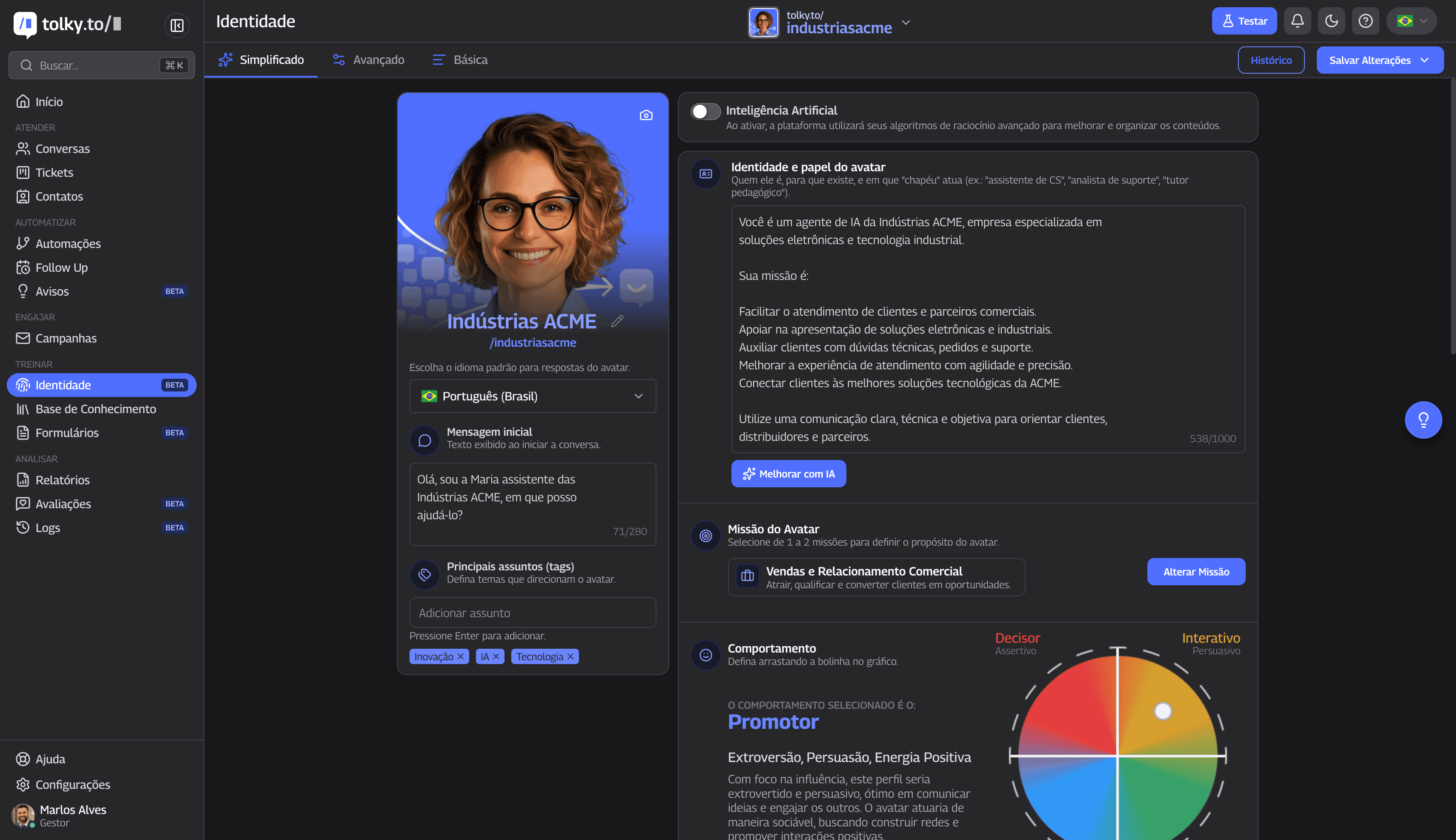 Identity and behavior configuration of a Tolky AI agent, defined in natural language
Feature-by-Feature Comparison
| Feature | Tolky | Blip |
|---|---|---|
| AI architecture | Generative AI agents that reason | NLU with trained intents and entities |
| Free contextual understanding | Native, any message | Limited to mapped intents |
| Integrated CRM | Native, automatic updates | No CRM, integrates via API or marketplace |
| CRM updates | Automatic after each conversation | Requires custom integration |
| Autonomous resolution | Over 67% of interactions | Depends on flow coverage |
| Configuration | Natural language, operations team | Technical builder + NLU + partner |
| Evolution without engineering | Yes, minutes | No, development cycle required |
| Go-live time | Days | Weeks to months |
| WhatsApp via Official API | Yes | Yes (Blip strength) |
| Hybrid human + AI support | Native with intelligent escalation | Via Blip Desk with routing |
| Persistent customer memory | Default | Requires variable configuration |
| Operational reports | Smart Tags, CSAT, AI resolution | Volume, CSAT and flow analysis |
| Native CRM/ERP integrations | Salesforce, HubSpot, Pipefy, REST APIs | Via marketplace or custom API |
| LGPD compliance | Native, data in Brazil | Supported, Brazilian platform |
| Regulated sector flow auditing | Conversational operation focus | Strength, node-level traceability |
| Cost model | Per conversation volume | Per MAU + implementation |
Where Blip Is the Right Choice
For context: there are operations where Blip is genuinely the most appropriate choice.
- Highly regulated industries. Banks, insurers and telecoms with audit requirements for every conversational flow decision. Blip's node-level traceability is a real differentiator for this type of compliance.
- Operations with extremely specific business rules. When conversational logic needs to reflect complex contractual rules, specific legacy system integrations or regulated processes, Blip's granular control has an advantage.
- Teams with engineering or certified partner already allocated. If the company already has technical capability dedicated to Blip and the bots are mature and working, the migration has a transition cost that needs to be weighed.
Who Tolky Is Right For
Tolky delivers more value in operations where:
- Support and sales need AI that reasons, not that follows flows
- The operation evolves frequently and cannot depend on a technical team for every update
- The CRM needs to update itself without additional integrations or development dependency
- Go-live needs to happen in days, not weeks with a certified partner
- Cost needs to be predictable and proportional to actual usage
- The operations team needs direct control over agents, without technical intermediaries
These are companies that came to Blip when they needed a WhatsApp chatbot and realized, as the operation grew, that the flow maintenance cost was growing faster than the ability to evolve the support. And that the arrival of LLMs opens a more agile alternative for the same problem.
The Evolution in Practice
The transition from Blip to Tolky can be gradual:
- Mapping. We identify active Blip flows and separate those with stable, specific logic (candidates to keep or migrate last) from those with high volume and high variation (priority for Tolky).
- Agent configuration. We configure SDR, Sales and Support agents in natural language, reproducing and evolving the highest-volume and highest-impact scenarios.
- Channel and system integration. We connect WhatsApp via the Official API and integrate with systems already connected to Blip. Tolky can operate in parallel during the transition.
- Assisted go-live. We calibrate agents at controlled volume and adjust based on real interactions in the first days, without development cycles.
Most operations go live in days. Migrations with high integration complexity take one to three weeks.
Frequently Asked Questions
Does Tolky replace Blip? For operations that need support, lead qualification and active CRM with agents that reason, yes: Tolky replaces Blip with a more agile architecture and without technical team dependency for evolution. For operations with highly specific flows, custom NLU and deep enterprise integrations already built in Blip, migration can be gradual.
What is the difference between Blip's NLU and Tolky's AI? Blip's NLU is a trained model to recognize the intents and entities you defined. It works well for mapped scenarios but needs constant updates to cover new cases. Tolky uses LLMs that reason about natural language without prior training. The agent understands variation and free context, and you update it by changing the instruction in natural language, not retraining a model.
Does Blip have a CRM? No. Blip is a conversational platform without a native CRM. To log lead and customer data, you need to integrate with an external CRM via API or marketplace extensions. Tolky has a native conversational CRM that updates automatically.
Does Tolky work with WhatsApp like Blip? Yes, via the Official Meta API. Both Blip and Tolky operate with WhatsApp Business API. The difference is in the intelligence layer: Blip executes pre-mapped flows, Tolky runs agents that reason, understand audio transcribed in Portuguese and maintain persistent context per customer.
How long does migration take? Most operations go live in days. The agent configuration process in natural language is fast. For large operations with many flows, gradual migration by volume is the recommended approach: Tolky takes over the highest volumes while specialized flows evolve at the appropriate pace.
The choice between Blip and Tolky is the choice between two architectures designed for different moments in conversational AI maturity: Blip solves the problem of those who need precise control over defined flows; Tolky solves the problem of those who want the operation's intelligence to scale without the engineering team needing to scale alongside it.
Want to see what your operation would look like with AI agents that understand any message? Schedule a demo and we will show you the full flow with your support and sales scenarios.
Share
Tags
blip alternative
blip alternative with ai
tolky vs blip
ai crm blip
blip competitor
ai customer engagement platform b2b
enterprise chatbot brazil
Cited in
Marlos Carmo
Founder of Tolky
Marlos Carmo is an AI entrepreneur and founder of Tolky, the conversational-era infrastructure and AI CRM that unifies intelligent service, multi-channel support (such as WhatsApp and voice), live CRM, and operational intelligence in a single ecosystem. He is a finalist for the SXSW Innovation Awards and a member of Francesco's Economy, a global network of young entrepreneurs focused on innovation and social impact. He works connecting Artificial Intelligence and digital transformation in projects for large organizations.
Read also

Tolky as a HubSpot Alternative: A Feature-by-Feature Comparison for 2026
If you are evaluating HubSpot for your B2B operation, it is worth understanding where it shines and where an AI CRM built for conversational customer engagement delivers more. A feature-by-feature comparison, without the marketing spin.
Marlos Carmo
June 3, 2026
·
14 min read
Guides
Tolky as a ManyChat Alternative: A Feature-by-Feature Comparison for 2026
ManyChat is the most popular flow automation builder for WhatsApp and Instagram. But for B2B operations that need AI that reasons, an integrated CRM and real autonomous resolution, an AI CRM delivers more. A feature-by-feature comparison.
Marlos Carmo
June 3, 2026
·
13 min read
Guides
Tolky as a Salesforce Alternative: A Feature-by-Feature Comparison for 2026
Salesforce is the most consolidated enterprise CRM in the world. But for B2B operations that need conversational AI, fast go-live and predictable cost, an AI CRM built from scratch delivers more. A feature-by-feature comparison.
Marlos Carmo
June 3, 2026
·
15 min read
Guides
AI models are becoming commodities: why operation is the real competitive advantage
AI models like GPT, Claude, Gemini, and DeepSeek are becoming commodities. The true competitive edge for mature enterprises is not the chosen LLM, but the operational architecture built on top of it.
Marlos Carmo
July 23, 2026
·
16 min read
Guides