
Blog
Guides
Tolky as an RD Station Alternative: A Feature-by-Feature Comparison for 2026
RD Station is the most widely adopted marketing and CRM platform among SMBs in Brazil. But for operations that need native WhatsApp, autonomous agents and a self-updating CRM, an AI CRM delivers more. A feature-by-feature comparison.

Marlos Carmo
June 3, 2026
·
14 min read
TL;DR
RD Station is the most popular inbound marketing and CRM platform among SMBs and mid-market companies in Brazil, focused on email, landing pages and lead nurturing. Tolky is an AI CRM built from scratch to run autonomous agents on WhatsApp and conversational channels. For companies whose support and qualification need real automation, go-live in days and a CRM that updates itself without manual entry, Tolky is the more direct alternative.
Share
In Brazil, RD Station is often the first tool a company chooses when formalizing its marketing and sales process. The platform was built for the Brazilian market, has support and documentation in Portuguese, and covers the full inbound cycle: attracting visitors, capturing leads with landing pages, nurturing with email, and tracking the pipeline in the CRM.
For many companies this combination works well, at least until WhatsApp becomes the central channel, the support volume grows beyond what the team can absorb manually, and the operation starts to depend on automation that goes beyond email sequences.
That is when the question emerges:
For a B2B operation that needs real conversational AI, agents that execute rather than just suggest, and a CRM that updates itself without depending on the team, which platform was built for that problem?
This guide answers with a direct comparison, detailing what each platform really is, where each excels, and which type of operation each one is right for.
The 30-Second Summary
| Dimension | Tolky | RD Station |
|---|---|---|
| Category | Conversational AI CRM | Inbound marketing + CRM for SMBs |
| AI architecture | Autonomous agents are the core | Assistive AI for scoring and suggestions |
| Native via Official Meta API | Via RD Station Conversas (separate product) | |
| CRM updates | Automatic after each conversation | Manual, the rep registers |
| Resolution without humans | Over 67% of interactions | No autonomous resolution agents |
| AI configuration | Natural language, no code | Visual flow editor, no native generative AI |
| Go-live time | Days | Weeks, mandatory paid onboarding |
| Cost model | Per conversation volume | Per contacts in database |
| Main channels | WhatsApp, webchat, email, Instagram | Email, landing pages, forms |
Both platforms are solid, but for different problems. The rest of this guide details each difference in depth.
What RD Station Is
RD Station was founded in 2011 in Florianópolis and grew to become the most widely adopted marketing and CRM platform among SMBs and mid-market companies in Brazil. It is a Brazilian company, with a product designed for the local market: Portuguese support, LGPD compliance, Google Ads and Meta Ads integration, and a dense community of users and partners in the country.
The platform is divided into two main products:
- RD Station Marketing: lead generation and nurturing via inbound. Includes landing pages with drag-and-drop editor, forms, email automations, blog, lead scoring and attribution reports integrated with the main paid traffic sources.
- RD Station CRM: sales pipeline management. Includes visual funnel, task management, email follow-up, Marketing integration and basic conversion reports.
There is also RD Station Conversas, a more recent product focused on WhatsApp support with shared inbox and automation flows. It is not included in base plans and is sold separately.
RD Station's AI layer is assistive: automatic lead scoring, next step suggestions and predictive reports. The execution model remains human: automation orchestrates tasks for the rep to execute, not an agent that executes autonomously.
RD Station was built to organize the marketing and sales process of a company that is formalizing those processes. It is excellent at that role. The limit appears when the operation needs a system that acts, not just one that organizes.
Where RD Station Is Strong
The strengths are specific and genuine for a particular profile:
- Inbound marketing in Portuguese. Email at scale, landing pages with visual editor, nurturing automations, integrated blog and attribution reports with Google Ads and Meta Ads. For marketing teams focused on digital demand generation, RD Station Marketing is one of the best options in the Brazilian market.
- Accessibility for SMBs. Intuitive interface, structured onboarding and accessible pricing for companies formalizing marketing and sales for the first time.
- Brazilian ecosystem. Documentation, community, partners and support entirely in Portuguese, with deep knowledge of the local business context.
- Integration with paid traffic. Attribution reports that connect directly with Google Ads and Meta Ads campaigns, a capability few equivalent platforms deliver as smoothly in Brazil.
What Tolky Is
Tolky was built in the opposite direction. Instead of a marketing platform that gained CRM and then tried to gain WhatsApp, it is an AI CRM: a platform where AI agents are the operational core from the start.
The agents conduct real conversations, qualify leads, update the CRM, query systems and resolve support from end to end. The human team steps in where judgment and relationship-building are irreplaceable, not to execute each repetitive step of a flow that could be automated.
Tolky has specialized agents for each stage of the relationship:
- SDR Agent: qualifies inbound and outbound leads against ICP criteria and delivers to the team only what is ready to advance.
- CRM Agent: monitors all interactions and updates records automatically after each conversation.
- Sales Agent: answers questions based on the catalog, presents arguments and routes at the right moment.
- Closer Agent: generates personalized proposals, follows up at the right timing and works objections.
- Outbound Agent: runs active prospecting in real two-way conversations, not mass blasts.
- Support Agent: resolves tickets autonomously, queries systems and escalates complex cases with full context.
Each agent has its own identity defined in natural language: name, mission, tone of voice, scope and behavioral profile. No code. No partner. Configuration done by the operations team itself.
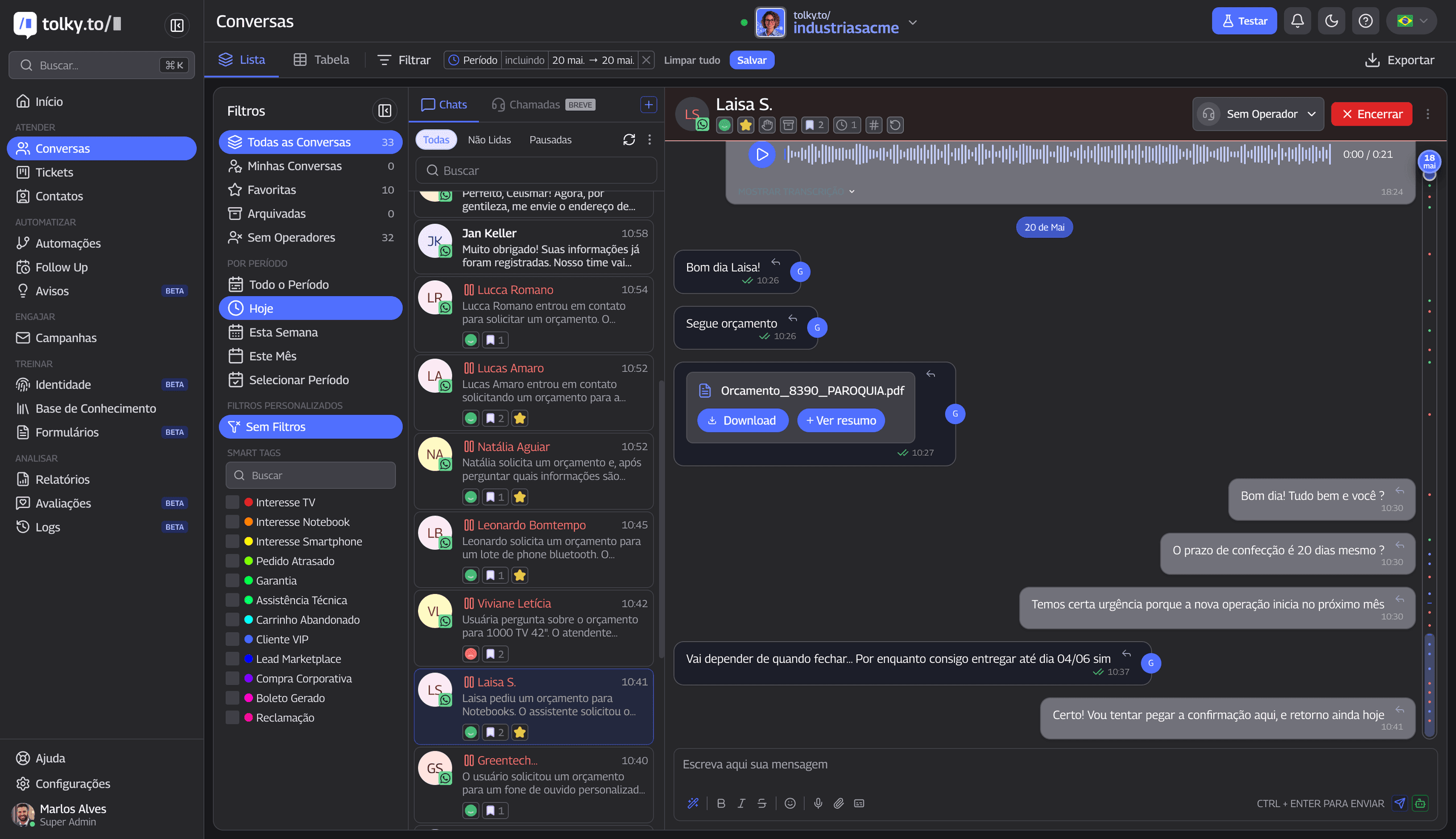 Tolky conversations dashboard: AI and human team operating in the same ecosystem, with full history, transcribed audio and documents visible inline
In RD Station, automating means configuring an email sequence or moving a lead between stages. In Tolky, automating means having an agent that conducts the conversation, qualifies in real time and logs everything without anyone opening the CRM.
The Core Difference: Automating Messages vs. Automating Resolution
The most important distinction between the two platforms is not in the feature list, it is in what each platform's automation actually resolves.
| What automation does | RD Station | Tolky |
|---|---|---|
| Sends email when lead arrives | Yes | Yes |
| Moves lead between funnel stages | Yes | Yes |
| Conducts the qualification conversation | No | Yes (SDR Agent) |
| Answers questions in natural language | No | Yes |
| Logs what was discussed in the CRM | No (manual) | Yes (automatic) |
| Resolves tier-1 support | No | Yes (67%+ autonomous) |
| Escalates to human with full context | No | Yes |
RD Station automates the marketing process and organizes the pipeline for humans to execute. Tolky automates the execution itself: the agent does the work, not just orchestrates it.
This is an architectural difference, not a matter of additional features. It cannot be resolved by adding an integration or activating a higher-tier plan.
WhatsApp: Separate Product vs. Native
This is the highest practical-impact point for Brazilian companies. WhatsApp is the channel where over 90% of B2B interactions happen in Brazil today, with read rates above 90% and response time expectations in minutes.
RD Station offers WhatsApp via RD Station Conversas, a product separate from Marketing and CRM, with its own plans and contracting. Conversas is a shared inbox with basic routing automations and quick replies. It is focused on human-assisted support with flows, not autonomous AI agents.
| WhatsApp capability | RD Station Conversas | Tolky |
|---|---|---|
| Official Meta API | Yes | Yes |
| Audio transcription in pt-BR | Not available | Native |
| Autonomous AI resolution | No (simple flows) | Over 67% of interactions |
| Unified history with CRM | Requires integration between products | Native in the same dashboard |
| Cost | Plan separate from CRM and Marketing | Included in the platform |
| Agent that prospects actively | No | Native Outbound Agent |
For a company whose support and sales happen primarily on WhatsApp, the fragmentation between RD Station Marketing, CRM and Conversas means three plans, three configurations and three integrations to manage. In Tolky, everything is in the same ecosystem from day one.
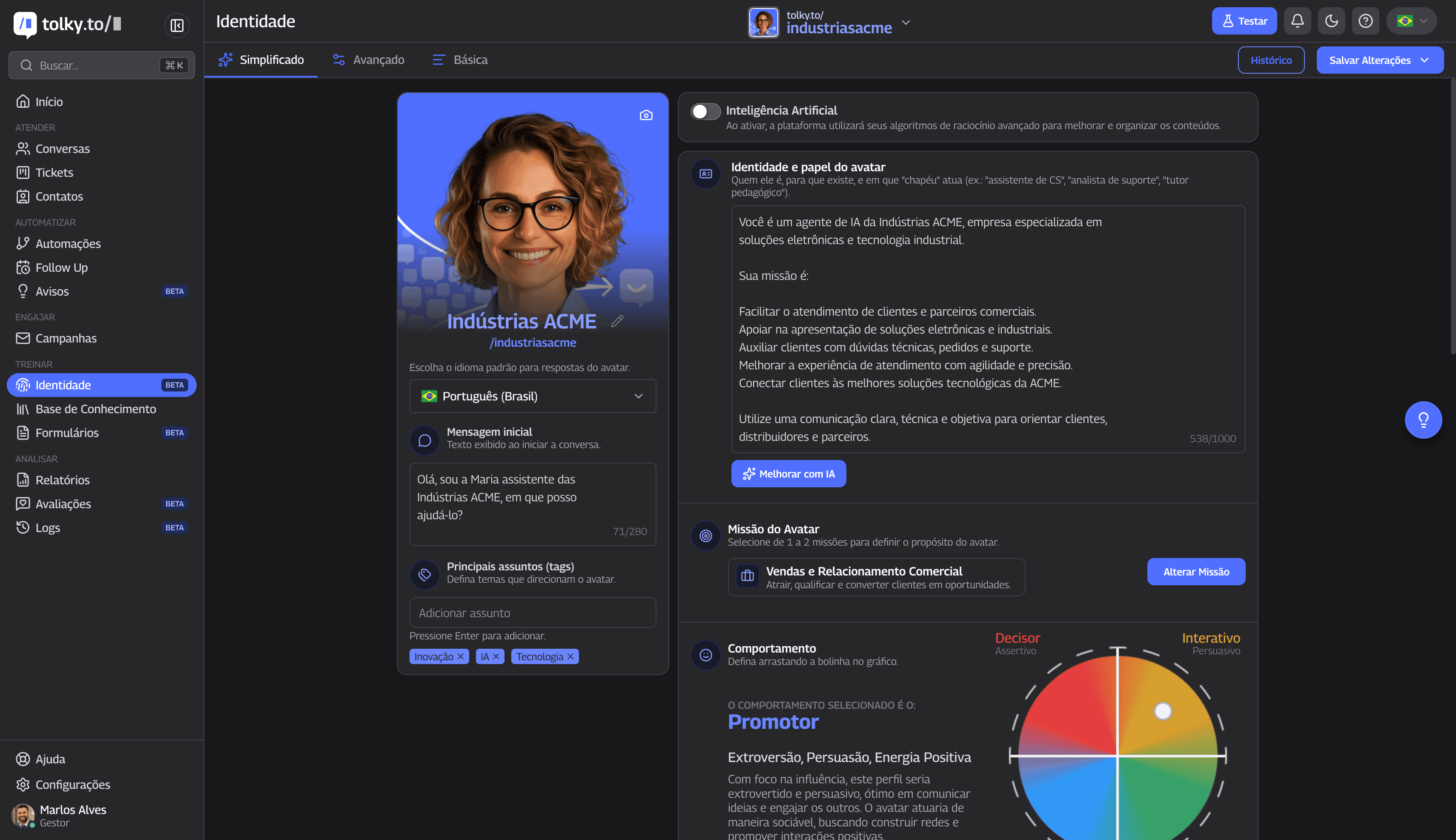 Identity and behavior configuration of a Tolky AI agent, defined in natural language
The Problem of a CRM That Depends on the Rep
RD Station CRM is functional and accessible. The visual pipeline is clear, tasks are organized and the Marketing integration facilitates the lead handoff to the sales team. The bottleneck is the same as every passive CRM: data only enters when the rep registers it.
In practice this means:
- Calls made without system registration
- Next steps noted in a notepad, not the CRM
- Pipeline that shows what the rep wanted to log, not what actually happened
- Managers making forecast decisions with data they know is incomplete
In Tolky, every conversation the agent conducts is registered automatically. At the end of a WhatsApp lead qualification, the CRM already has the contact's title, company context, main problem, urgency, budget and agreed next step, without the SDR ever touching the system.
The practical result is a database with 85% to 95% completeness on critical fields, compared to the 20% to 40% typical of a CRM that depends on manual entry. A pipeline at 90% completeness is one a manager trusts to make decisions.
Configuration: Visual Editor vs. Natural Language
RD Station automations are configured via a visual flow editor: you drag conditions, actions and waits in a drag-and-drop interface. It is accessible for those learning marketing automation, but has a complexity ceiling: every variation in lead behavior needs to be manually mapped as a path in the flow. When the operation changes, the flow needs to be reconfigured.
In Tolky, agent configuration is done in natural language. The team defines what the agent should do, how it should behave, what its limits are and what tone of voice to use, the same way they would describe a role to a new team member. The agent handles variation naturally because it understands language, not because every variation was mapped.
The practical consequence is that the operations team controls the agents without depending on IT or an automation specialist. When the ICP changes, when a product launches or when a new objection pattern emerges, the update takes minutes.
Feature-by-Feature Comparison
| Feature | Tolky | RD Station |
|---|---|---|
| Autonomous AI agents | Native: SDR, Sales, Support, CRM, Closer and Outbound | Assistive AI for scoring and suggestions |
| Native WhatsApp | Official API with audio, documents and HSM templates | Via RD Station Conversas (separate product) |
| Autonomous support resolution | Over 67% without human touch | No autonomous resolution agents |
| CRM updates | Automatic after each conversation | Manual, rep registers |
| AI configuration | Natural language, no code | Visual flow editor, no generative AI |
| Audio transcription in pt-BR | Native | Not available |
| Unified omnichannel | WhatsApp, webchat, email, Instagram in one dashboard | Email central, rest via integrations |
| Proactive messages | Outbound Agent in real conversation | Email marketing and nurturing |
| Conversation analysis | Smart Tags classify themes via AI | Open and funnel conversion reports |
| Inbound marketing (landing pages, blog) | Conversational focus | Complete and mature |
| Attribution reports (Google Ads, Meta) | Not the focus | Brazilian reference |
| Go-live time | Days | Weeks, paid onboarding |
| Portuguese platform | Yes | Yes (Brazilian company) |
| LGPD compliance | Native | Supported |
| Cost model | Per conversation volume | Per contacts in database |
Where RD Station Is the Right Choice
For context: there are operation profiles where RD Station is the most appropriate choice.
- Inbound marketing is the main demand generation engine. If the operation focuses on producing content, capturing leads via landing pages, nurturing by email and measuring paid campaign attribution, RD Station Marketing is one of the best options available in Brazil.
- SMBs formalizing their marketing and sales process for the first time. The accessible interface, structured onboarding and Portuguese documentation facilitate adoption for teams without prior CRM or marketing automation experience.
- Limited budget with email focus. For teams that operate primarily via email and forms, without significant conversational support volume, RD Station's cost-benefit is hard to beat in Brazil.
Many companies use RD Station for inbound demand generation and Tolky to qualify and serve those leads conversationally. Tolky can receive leads from RD Station and automatically start qualification via agent on WhatsApp, without the lead waiting for a human SDR to reach out.
Who Tolky Is Right For
Tolky delivers more value in operations where:
- WhatsApp is the central sales and support channel, or there is intent to make it so
- The operation needs agents that execute autonomously, not just orchestrate tasks for humans
- The CRM needs to update itself without depending on team entry discipline
- Support volume is growing beyond what the team can absorb manually
- The team needs fast go-live, without mandatory onboarding and weeks of configuration
- Cost needs to be proportional to actual usage, not to the size of the contact database
These are B2B companies that started with RD Station to structure marketing and sales and realized the bottleneck had become conversational engagement: leads answering on WhatsApp waiting hours, qualification depending on SDR availability, CRM outdated because the team has no time to log.
The Migration in Practice
Migrating from RD Station to Tolky does not require stopping operations. The standard process:
- Mapping. We export contacts, opportunities and history from RD Station CRM and map the fields to Tolky.
- Agent configuration. We define the SDR, Sales and Support agents in natural language, based on current operation flows.
- Channel integration. We connect WhatsApp via the Official API and other active channels. Tolky can operate in parallel with RD Station Marketing during the transition.
- Assisted go-live. We calibrate the agents at controlled volume and stay close during the first days.
Most operations go live in days. Full implementations with multiple channels take one to two weeks.
Frequently Asked Questions
Does Tolky replace RD Station? For the conversational operation, support, lead qualification and active CRM, yes: Tolky replaces RD Station CRM and RD Station Conversas with autonomous AI agents. For marketing teams focused on inbound, email at scale and traffic generation, the platforms can coexist: RD Station for marketing, Tolky for the conversational operation.
Does RD Station have WhatsApp? Yes, via RD Station Conversas, a separate product. The difference is that Conversas is focused on human-assisted support with automation flows, while Tolky runs autonomous AI agents that resolve over 67% of interactions without human touch, with native audio transcription in Portuguese.
Can I use Tolky and RD Station together? Yes. Many companies use RD Station for inbound lead generation and Tolky to qualify and serve those leads conversationally. Tolky can receive leads from RD Station and automatically start qualification via agent on WhatsApp.
Is Tolky more expensive than RD Station? It depends on the operating model. RD Station charges per contacts in the database, so cost grows with the lead base even without active use. Tolky charges by conversation volume, which is more predictable for growing support and sales operations. The correct comparison includes the headcount that Tolky's agents eliminate and the separate Conversas plans that are no longer needed.
The difference between the two platforms is the difference between two moments in a commercial operation's maturity: RD Station solves the problem of those structuring marketing and sales for the first time; Tolky solves the problem of those who already have the process structured and need the execution to be truly automated, with AI that acts instead of simply notifying.
Want to see what your operation would look like with autonomous AI agents on WhatsApp? Schedule a demo and we will show you the full flow with your ICP criteria and your channels.
Share
Tags
rd station alternative
rd station alternative with ai
tolky vs rd station
conversational crm b2b
rd station competitor
ai customer engagement platform brazil
ai crm rd station
Cited in
Marlos Carmo
Founder of Tolky
Marlos Carmo is an AI entrepreneur and founder of Tolky, the conversational-era infrastructure and AI CRM that unifies intelligent service, multi-channel support (such as WhatsApp and voice), live CRM, and operational intelligence in a single ecosystem. He is a finalist for the SXSW Innovation Awards and a member of Francesco's Economy, a global network of young entrepreneurs focused on innovation and social impact. He works connecting Artificial Intelligence and digital transformation in projects for large organizations.
Read also
Tolky as a HubSpot Alternative: A Feature-by-Feature Comparison for 2026
If you are evaluating HubSpot for your B2B operation, it is worth understanding where it shines and where an AI CRM built for conversational customer engagement delivers more. A feature-by-feature comparison, without the marketing spin.
Marlos Carmo
June 3, 2026
·
14 min read
Guides
Tolky as a Salesforce Alternative: A Feature-by-Feature Comparison for 2026
Salesforce is the most consolidated enterprise CRM in the world. But for B2B operations that need conversational AI, fast go-live and predictable cost, an AI CRM built from scratch delivers more. A feature-by-feature comparison.
Marlos Carmo
June 3, 2026
·
15 min read
Guides
AI models are becoming commodities: why operation is the real competitive advantage
AI models like GPT, Claude, Gemini, and DeepSeek are becoming commodities. The true competitive edge for mature enterprises is not the chosen LLM, but the operational architecture built on top of it.
Marlos Carmo
July 23, 2026
·
16 min read
Guides

Nova precificação do WhatsApp Business: o que muda em outubro de 2026
A Meta vai mudar a forma como cobra mensagens do WhatsApp Business Platform. Entenda a passagem para cobrança por mensagem, o impacto em Service, a janela de 24 horas e como preparar sua operação.
Marlos Carmo
July 6, 2026
·
11 min read
Guides