
Blog
Guides
Tolky as a HubSpot Alternative: A Feature-by-Feature Comparison for 2026
If you are evaluating HubSpot for your B2B operation, it is worth understanding where it shines and where an AI CRM built for conversational customer engagement delivers more. A feature-by-feature comparison, without the marketing spin.

Marlos Carmo
June 3, 2026
·
14 min read

TL;DR
HubSpot is a mature marketing suite with AI layered on top. Tolky is an AI CRM built from scratch to run autonomous agents across WhatsApp, webchat, email and Instagram. For B2B companies whose core motion is conversational selling and support, Tolky delivers real automation, a self-updating CRM, and go-live in days, at a predictable per-conversation cost instead of a growing per-contact bill.
Share
Every serious CRM evaluation eventually lands on HubSpot. The platform has a large marketplace, a reputation built over nearly two decades in inbound marketing, and a brand presence that often puts its name on the shortlist before any technical criteria are even defined.
But the market has changed. B2B companies operating today have a different center of gravity from what they had in 2018: customer relationships happen primarily on WhatsApp, response time expectations are immediate, and interaction volume makes it unviable to have humans execute every step of support and sales processes.
In this context, the question has shifted from "which is the best CRM?" to:
Which platform was built for the operating model I actually need to run today, a marketing suite with AI bolted on, or an AI CRM where agents are the core from the very first conversation?
This guide answers that question directly. First we detail what each platform really is, then we compare them feature by feature, and finally we map out which type of operation each one is right for.
The 30-Second Summary
For those who will not read the full guide, the table below condenses the differences that weigh most on the decision.
| Dimension | Tolky | HubSpot |
|---|---|---|
| Category | Conversational AI CRM | Marketing, sales and CRM suite |
| AI architecture | Autonomous agents are the core | Breeze: assistive AI over a traditional CRM |
| Native channels | WhatsApp, webchat, email, Instagram | Email and forms, others via integrations |
| CRM updates | Automatic after each conversation | Manual or via configured workflows |
| Resolution without humans | Over 67% of interactions | Chatbot based on pre-defined flows |
| AI configuration | Natural language, no code | Technical workflows or certified partner |
| Go-live time | Days | Weeks to months |
| Cost model | Per conversation volume | Per seat + contact tiers + add-ons |
| LGPD compliance | Native, data processed in Brazil | Depends on plan and configuration |
| Support and product | In Portuguese, team in Brazil | Localized, global support |
Both platforms are good, but for different problems. The rest of this guide shows exactly where each difference shows up in real operations.
What HubSpot Is
HubSpot was founded in 2006 at MIT and effectively coined the term "inbound marketing." For nearly two decades it has been the reference for attracting visitors with content, capturing leads with forms and landing pages, and nurturing those contacts by email until the sale. It is a mature, broad and well-documented platform.
Today HubSpot is organized into modules, sold separately or bundled:
- Marketing Hub: email marketing, landing pages, nurturing automation, campaign management and attribution reporting.
- Sales Hub: deal pipeline, email sequences, meeting scheduling and quotes.
- Service Hub: support tickets, knowledge base and satisfaction surveys.
- Content Hub (formerly CMS Hub): website and blog management integrated with the CRM.
- Operations Hub and Commerce Hub: data sync and billing.
HubSpot's AI layer is called Breeze, launched in 2024. It includes Breeze Copilot (an assistant that summarizes, suggests and helps draft), Breeze Agents (assisted automation for specific tasks) and Breeze Intelligence (data enrichment). The key point is the nature of this layer:
In HubSpot, AI is assistive. It suggests the next step, summarizes the conversation and drafts the email. But who ultimately executes is still the human team.
This is not a criticism, it is a description of the architecture. HubSpot was built as a system of record and orchestration for people to operate, and AI was added as an accelerator for those people.
Where HubSpot Is Strong
It is worth being specific about the platform's real strengths, because they are genuine:
- Inbound marketing at scale. Email marketing, landing pages, CMS and lead nurturing form a cohesive, mature ecosystem. Few platforms in the world do this better.
- Integration marketplace. Over 1,500 native integrations with global tools. If the operation depends on ready-made connectors, HubSpot rarely falls short.
- Attribution reporting. RevOps dashboards, touchpoint analysis and multi-channel attribution with a depth few platforms reach.
- Ecosystem and community. Certifications, partners, materials and a huge installed base that makes it easy to hire people who already know the tool.
What Tolky Is
Tolky was built in the opposite direction. Instead of a marketing suite that gained AI, it is an AI CRM: a platform where AI agents are the operational core, not an add-on.
The agents conduct real conversations, qualify leads, update the CRM, query systems, execute actions and escalate to humans only when context requires it. The human team steps in where situational judgment and relationship-building are irreplaceable, not in the middle of repetitive flows.
In practice, Tolky does not have a generic agent. It has specialized agents for each stage of the relationship:
- SDR Agent: qualifies inbound and outbound leads against ICP criteria and hands the team only what is ready to advance.
- CRM Agent: monitors all interactions and updates records automatically, without anyone opening the system.
- Sales Agent: answers questions based on the catalog, presents arguments and routes at the right moment.
- Closer Agent: generates personalized proposals, follows up at the right timing and works objections.
- Outbound Agent: runs active prospecting in real two-way conversations, not mass email blasts.
- Support Agent: resolves tickets autonomously, checks orders and escalates complex cases with full context.
Each agent has its own identity, name, mission, tone of voice, scope and behavioral profile, all defined in natural language, no code.
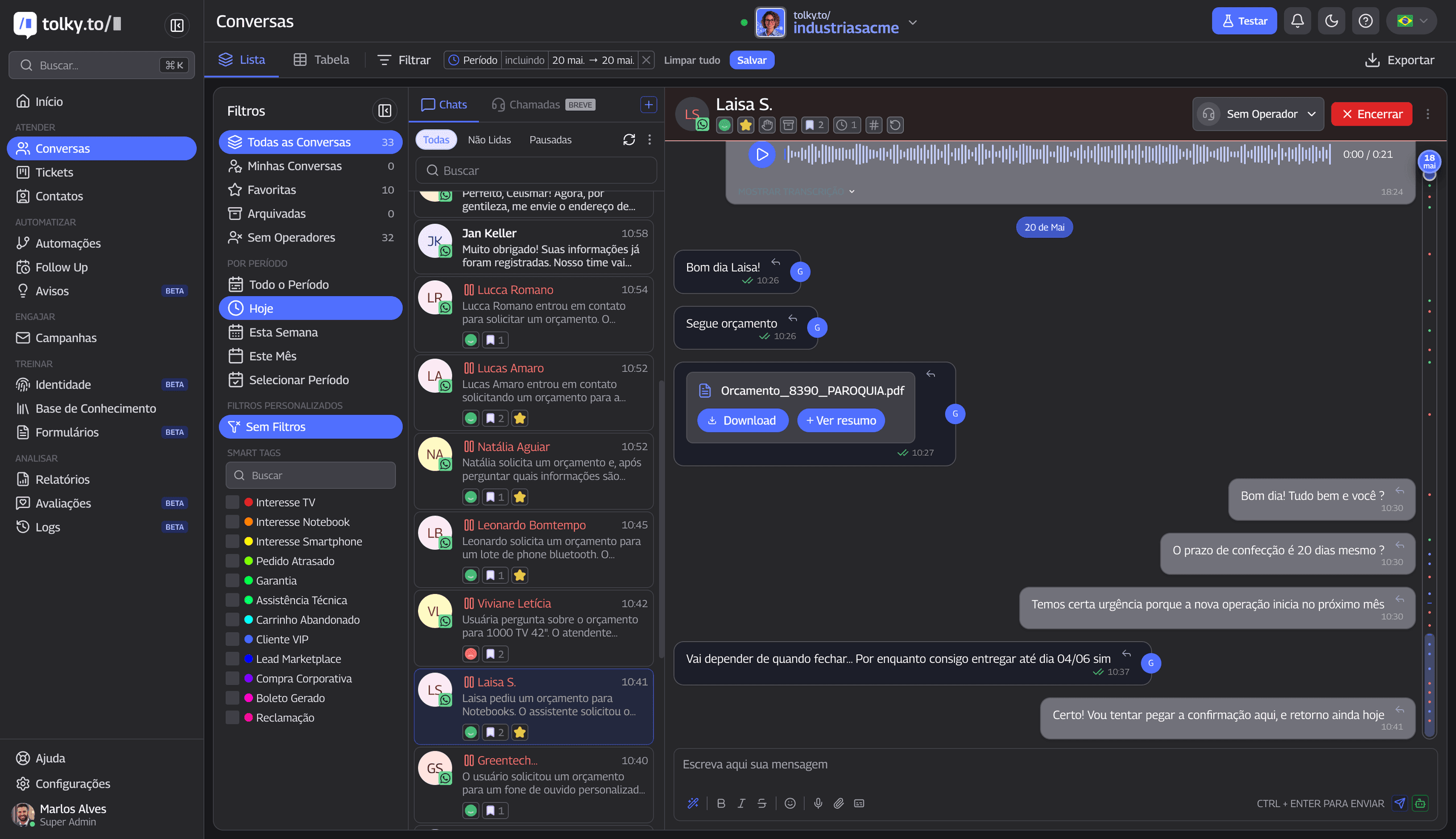 Tolky conversations dashboard: AI and human team operating in the same ecosystem, with full history, transcribed audio and documents visible inline
It is not a CRM with AI on top. It is a CRM where AI operates.
The Core Difference: Architecture, Not Features
The most accurate comparison between the two platforms starts with architecture, not feature lists. The two even converge on many line items of a feature spreadsheet. What changes is who does the work.
| Question | HubSpot | Tolky |
|---|---|---|
| Who runs the conversation with the lead? | The human team (AI suggests) | The AI agent (human supervises) |
| Who logs what was said? | The rep, manually | The agent, automatically |
| Who decides the next step? | The human, with AI suggestion | The agent, escalating when needed |
| Who resolves tier-1 support? | Flow-based chatbot + human | The agent, end to end |
The consequence is that migrating from HubSpot to Tolky is not just switching CRMs. It is changing the execution model: from processes where humans are coordinated by software, to processes where AI executes and humans supervise.
The Incomplete CRM Problem
One of the most undervalued problems in operations using traditional CRMs is data quality. Industry research shows that active CRMs have, on average, 20% to 40% completeness on fields that should be filled. The rest depends on salespeople and support agents finding time to log what happened in each interaction, and they rarely do.
In HubSpot, data enters when someone types it. Workflows automate pipeline movements, but the substance of the conversation, what the customer said, what the objection was, what next step was agreed, still needs manual entry.
In Tolky, the agent conducts the conversation and registers automatically. At the end of a WhatsApp lead qualification, the CRM already has:
- Contact title and role in the decision
- Company size and context
- Main pain point and urgency
- Estimated budget
- Agreed next step
The SDR opens the record and finds a complete brief, not a contact with just a name and email.
The practical result is a database with 85% to 95% completeness on critical fields, compared to the 20% to 40% typical of a CRM that depends on manual entry.
The difference is not cosmetic. A pipeline at 90% completeness is one a manager trusts to make decisions. One at 30% is a spreadsheet of good intentions.
Conversational Operations vs. Email Operations
HubSpot was built at a time when email was the central channel of B2B relationships. Email sequences, email nurturing, open and click reporting, CMS for lead-capturing landing pages. It is a coherent ecosystem for that operating model.
In Brazil in 2026, WhatsApp is the channel where customers are, where they expect to be served, and where read rates exceed 90%, versus the 20% to 25% typical of commercial email. A platform that supports WhatsApp via third-party integration does not deliver the same level of control, fluidity and analytical capability as one that supports it natively.
| Channel capability | HubSpot | Tolky |
|---|---|---|
| WhatsApp via Official Meta API | Via third-party integration | Native |
| Audio transcription in pt-BR | Not native | Native |
| Documents and images in chat | Limited | Native |
| Webchat, email and Instagram | Strong email, rest via integration | All native in one dashboard |
| Proactive messages (outbound) | Email sequences | Agent prospecting in real conversation |
Tolky operates on WhatsApp via the Official Meta API, with native support for audio (automatic transcription in Brazilian Portuguese), documents, images and proactive messages. The agent sends, receives, interprets and responds in all these formats without additional configuration.
This is not an incremental difference. It is the difference between a tool adapted for the channel and a tool built for it.
Configuration: Natural vs. Technical
Configuring an automation in HubSpot requires familiarity with workflow logic: triggers, conditionals, chained actions, custom properties. For complex operations, the learning curve is steep enough to justify a certified partner and weeks of onboarding.
In Tolky, agent configuration happens in natural language. The team defines the agent's name, mission, tone of voice, scope limits and behavioral profile in plain text, like writing an instruction for a new team member. No code, no flow logic to program, no partner required.
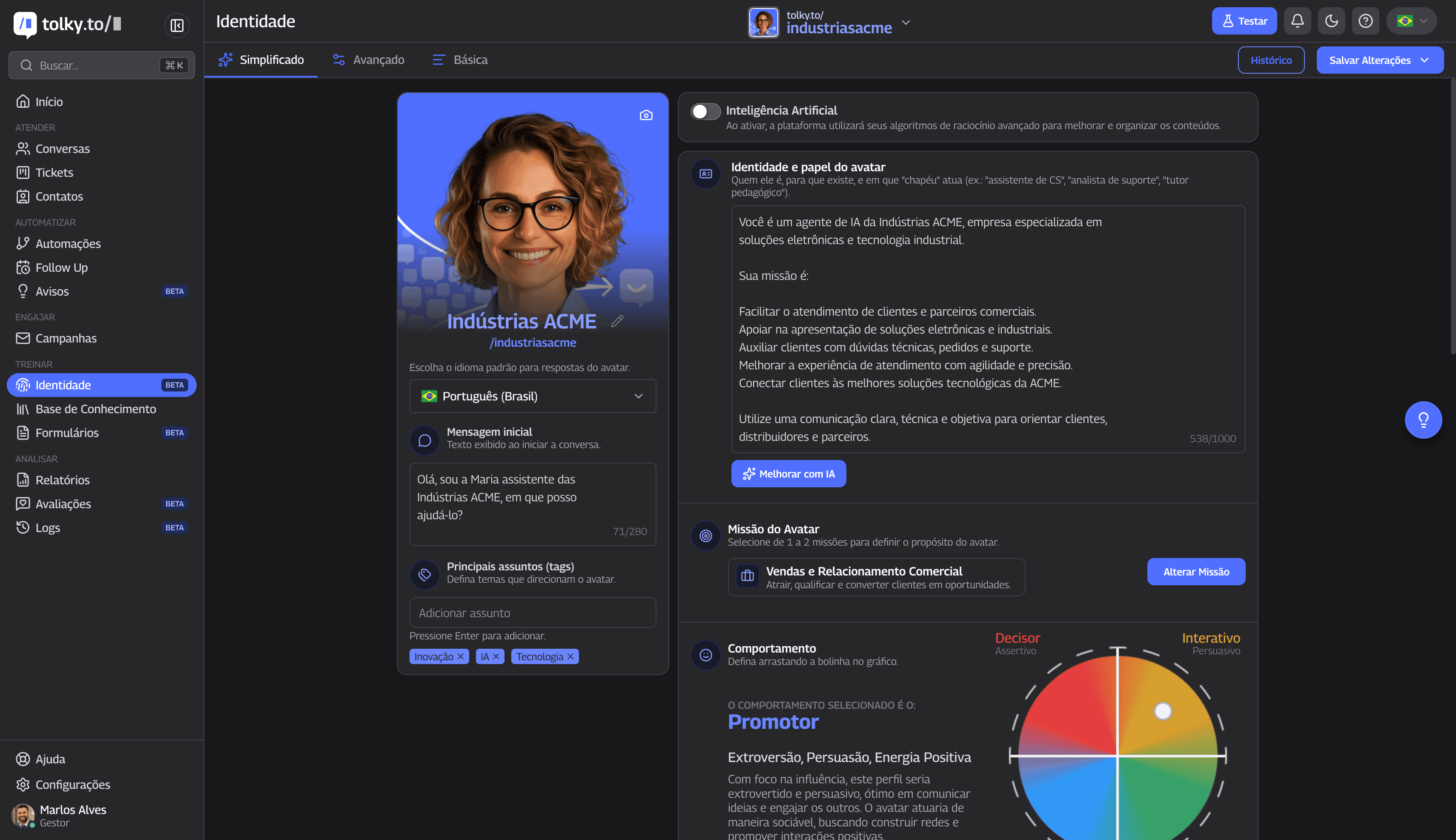 Identity and behavior configuration of a Tolky AI agent, defined in natural language
The result is that the operations team, not IT, configures and adjusts agents. When a campaign changes or a new frequent objection surfaces, the update takes minutes, not a ticket to the implementation partner.
Cost Comparison: What Grows Together
HubSpot's pricing model combines seats with marketing contact tiers and add-ons. As the contact base and team grow, the monthly cost grows with it, regardless of how many of those contacts are active. Features like advanced sequences, custom reporting and multi-team operation depend on higher-tier plans or add-ons.
Tolky charges by conversation volume, making cost directly proportional to actual activity. An operation with 10,000 contacts in the database but 500 active conversations per month pays for what it uses, not for what it accumulates.
A fair cost comparison must include the variable most often omitted:
The real cost of a CRM includes the headcount it requires to operate. Tolky's automation eliminates much of it, and that is usually the biggest line on the bill.
With over 67% autonomous resolution, operations that migrated from HubSpot to Tolky frequently absorb volume growth without hiring.
Feature-by-Feature Comparison
Bringing it all together in a single decision table:
| Feature | Tolky | HubSpot |
|---|---|---|
| Autonomous AI agents | Native: SDR, Sales, Support, CRM, Closer and Outbound | Breeze Copilot, assistive and complementary |
| Omnichannel | WhatsApp, webchat, email and Instagram native | Email-first, rest via integration |
| CRM updates | Automatic after each conversation | Manual or via workflows |
| Autonomous resolution | Over 67% without human touch | Flow-based chatbot |
| AI configuration | Natural language, no code | Technical workflows or partner |
| Audio transcription | Native, in pt-BR | Not native |
| Proactive messages | Outbound Agent in real conversation | Email sequences |
| Conversation analysis | Smart Tags classify themes via AI | Manual properties and reports |
| Implementation time | Go-live in days | Weeks to months |
| Inbound marketing (email, CMS) | Conversational focus, not inbound | Complete and mature |
| Integration marketplace | Native connectors for the main systems | Over 1,500 integrations |
| LGPD compliance | Native, processing in Brazil | Depends on plan |
| Cost model | Per conversation volume | Per seat + contacts + add-ons |
Where HubSpot Is the Right Choice
For context: there are scenarios where HubSpot is the stronger choice, and ignoring them would be dishonest to anyone making the decision.
- Inbound marketing is the heart of the operation. Email at scale, landing pages, integrated CMS and nurturing with multi-channel attribution. Here HubSpot's ecosystem is hard to beat.
- The operation depends on many ready-made connectors. If the stack uses dozens of specific global tools, the 1,500+ integration marketplace is a concrete advantage.
- RevOps measures performance with high granularity. Mature attribution dashboards and touchpoint analysis for teams that live in those reports.
If these are the core use cases of your operation, HubSpot is likely the more appropriate choice, and Tolky can even coexist with it, handling the conversational layer.
Who Tolky Is Right For
Tolky delivers more value in operations where:
- The primary sales and support channel is WhatsApp, or there is intent to make it so
- The team needs fast go-live, without weeks of paid onboarding
- The operation wants agents that resolve autonomously, not just suggest next steps
- The CRM needs to update itself without depending on team entry discipline
- There is a need for LGPD compliance and data processing in Brazil
- Cost needs to be predictable and proportional to actual usage volume
These are mid-to-large B2B companies that have served, sold and qualified via email for years and realized that the center of gravity of their customer relationships has shifted to WhatsApp, without their CRM platform keeping pace with that shift.
The Migration in Practice
Migrating from HubSpot to Tolky does not require stopping operations. The standard process follows four steps:
- Mapping. We export contacts, deals and pipelines from HubSpot and map the fields to Tolky.
- Agent configuration. We define the SDR, Sales and Support agents in natural language, based on your operation.
- Integration. We connect WhatsApp via the Official API and sync the relationship history.
- Assisted go-live. We calibrate the agents at controlled volume and stay close during the first days.
Most operations go live in days. Implementations with multiple integrations take one to three weeks. And because Tolky integrates bidirectionally, many companies keep HubSpot for inbound marketing and use Tolky for the conversational operation, reading contact context and writing back what the agents collect.
Frequently Asked Questions
Does Tolky replace HubSpot? For operations whose center of gravity is conversational support and selling on WhatsApp, yes: Tolky replaces HubSpot's CRM and support layer with autonomous AI agents. For teams focused on inbound marketing (email at scale, landing pages, CMS), Tolky can coexist with HubSpot.
Can I use Tolky and HubSpot together? Yes. The integration is bidirectional: Tolky reads contact context and writes back the information collected by the agents in conversations. Many companies keep HubSpot for marketing and use Tolky for the conversational operation.
Which is cheaper? It depends on the operating model. HubSpot charges per seat, per contact tier and per add-on, so cost grows fast as the base and team increase. Tolky charges by conversation volume, making cost more predictable for high-volume support operations. The correct comparison includes the headcount cost that Tolky's automation eliminates.
How long does migration take? Most operations go live in days. The full process, with data export, agent configuration, WhatsApp integration and calibration, usually takes one to three weeks for implementations with multiple integrations.
The question that guides the choice between the two platforms is not which one is larger or better known. It is which one was built for the operating model you need to run: a broad marketing suite with AI added on top, or an AI CRM where agents are the operational core from the very first conversation.
Want to see what your operation would look like with autonomous AI agents? Schedule a demo and we will show you the full flow with your ICP criteria and your channels.
Share
Tags
hubspot alternative
hubspot alternative with ai
ai crm vs hubspot
tolky vs hubspot
conversational crm b2b
hubspot competitor
ai customer engagement platform b2b
Cited in
Marlos Carmo
Founder of Tolky
Marlos Carmo is an AI entrepreneur and founder of Tolky, the conversational-era infrastructure and AI CRM that unifies intelligent service, multi-channel support (such as WhatsApp and voice), live CRM, and operational intelligence in a single ecosystem. He is a finalist for the SXSW Innovation Awards and a member of Francesco's Economy, a global network of young entrepreneurs focused on innovation and social impact. He works connecting Artificial Intelligence and digital transformation in projects for large organizations.
Read also

Tolky as a Salesforce Alternative: A Feature-by-Feature Comparison for 2026
Salesforce is the most consolidated enterprise CRM in the world. But for B2B operations that need conversational AI, fast go-live and predictable cost, an AI CRM built from scratch delivers more. A feature-by-feature comparison.
Marlos Carmo
June 3, 2026
·
15 min read
Guides

Tolky as an RD Station Alternative: A Feature-by-Feature Comparison for 2026
RD Station is the most widely adopted marketing and CRM platform among SMBs in Brazil. But for operations that need native WhatsApp, autonomous agents and a self-updating CRM, an AI CRM delivers more. A feature-by-feature comparison.
Marlos Carmo
June 3, 2026
·
14 min read
Guides

Tolky as a Blip Alternative: A Feature-by-Feature Comparison for 2026
Blip is one of the most established enterprise conversational platforms in Brazil. But for operations that need AI that reasons, a native CRM and go-live without a technical team, an AI CRM delivers more. A feature-by-feature comparison.
Marlos Carmo
June 3, 2026
·
13 min read
Guides

Tolky as a ManyChat Alternative: A Feature-by-Feature Comparison for 2026
ManyChat is the most popular flow automation builder for WhatsApp and Instagram. But for B2B operations that need AI that reasons, an integrated CRM and real autonomous resolution, an AI CRM delivers more. A feature-by-feature comparison.
Marlos Carmo
June 3, 2026
·
13 min read
Guides