
Blog
Guides
Tolky as a ManyChat Alternative: A Feature-by-Feature Comparison for 2026
ManyChat is the most popular flow automation builder for WhatsApp and Instagram. But for B2B operations that need AI that reasons, an integrated CRM and real autonomous resolution, an AI CRM delivers more. A feature-by-feature comparison.

Marlos Carmo
June 3, 2026
·
13 min read

TL;DR
ManyChat is a flow automation builder for WhatsApp, Instagram and Messenger: excellent for conversational marketing campaigns. Tolky is an AI CRM with agents that reason in natural language, understand variation, update the CRM and resolve support autonomously. The difference is architectural: rule-based flows vs. agents that make contextual decisions.
Share
ManyChat has become synonymous with WhatsApp automation for a large part of the market. The visual flow builder is intuitive, templates are quick to set up and results appear fast for marketing campaigns: lead capture, coupon distribution, Instagram engagement sequences.
But there is a clear limit where this model starts showing friction: when the customer says something outside the script.
Rule-based flows work well as long as the user follows the expected path. When they ask something unforeseen, request a different clarification, or use a word the bot does not recognize, the automation stalls, falls into a generic fallback, or transfers to a human without context. For marketing operations with predictable flows, this is acceptable. For B2B sales and support at scale, it is a structural bottleneck.
That is where the question emerges:
For a B2B operation that needs automation that actually resolves things, not just sends automatic messages, which platform was built for that problem?
The 30-Second Summary
| Dimension | Tolky | ManyChat |
|---|---|---|
| Category | Conversational AI CRM | Marketing flow builder |
| Architecture | AI agents that reason | Rule-based if/then flows |
| Natural language | Native, understands variation and intent | Responds to keywords and buttons |
| Integrated CRM | Native, automatic updates | No CRM, integrates via Zapier |
| Autonomous resolution | Over 67% of interactions | Only exactly mapped flow cases |
| Customer memory | Full persistent history | Limited to current session context |
| Enterprise scalability | Governance, LGPD, 99.9% SLA | Focused on SMBs and creators |
| Cost model | Per conversation volume | Per active contacts |
| Focus | Full B2B conversational operation | Conversational marketing automation |
Both tools are good for different problems. The rest of this guide details where each one stops working well and starts demanding more than it was designed to deliver.
What ManyChat Is
ManyChat was founded in 2015 and built its reputation as the reference platform for chatbot automation on Facebook Messenger. With the opening of the WhatsApp Business API and the growth of Instagram DM, it expanded to those channels and became popular among e-commerce operators, info-product creators and digital marketing teams.
The core product is a visual flow builder: you drag nodes in a drag-and-drop interface and define what the bot does at each step. Conditionals like "if the user clicked X, send Y" structure all the logic. The strengths are clear:
- Ready-made templates for lead capture, coupon distribution and engagement sequences
- Native integration with Instagram and Facebook Messenger
- Broadcasts for sending mass messages to the contact base
- Short learning curve for marketing teams without technical backgrounds
- Accessible cost for marketing operations with controlled volume
What ManyChat does not have is an AI layer that reasons. When it lists "AI" in features, it refers mostly to integrations with natural language processing to recognize specific keywords, not to agents that understand free context and make decisions based on conversation history.
ManyChat is a sophisticated rule system. It is excellent when the user follows the flow. It is limited when they do not.
Where ManyChat Is Strong
The strengths are real and relevant for certain operation profiles:
- Conversational marketing campaigns with predictable flow. Engagement sequences, lead capture via Instagram DM and coupon distribution on WhatsApp. For digital marketing teams focused on audience growth, ManyChat offers setup speed that is hard to justify replicating elsewhere.
- E-commerce and info-products. Cart recovery, post-purchase material delivery, order confirmation and post-purchase surveys with ready templates and integrations with Shopify, WooCommerce and similar platforms.
- Instagram growth. Comment automation, DM from stories, lead capture via link in bio. ManyChat has native Instagram features that few platforms replicate with the same fluidity.
- Low entry cost. For small operations with predictable flows, ManyChat is one of the most accessible tools in the market.
What Tolky Is
Tolky is an AI CRM: a platform where AI agents are the operational core. The difference from ManyChat is not of degree, it is of architecture.
A ManyChat flow executes a pre-defined sequence of steps. A Tolky agent reasons: it reads the message, interprets the intent, checks the customer history, accesses integrated systems and decides how to respond. There is no flow to follow. There is an agent with memory, context and decision-making capability.
Tolky's agents are specialized by function:
- SDR Agent: qualifies leads in natural language, asking contextual questions, interpreting unexpected answers and delivering to the team only leads with real fit.
- CRM Agent: automatically logs every conversation in the CRM without anyone opening the system.
- Sales Agent: answers product questions, presents relevant arguments for the lead profile and routes at the right moment.
- Closer Agent: generates personalized proposals, follows up at the right timing and handles objections in natural language.
- Outbound Agent: runs active prospecting in real two-way conversations, identifying interest and warming the lead.
- Support Agent: resolves tickets autonomously, queries the ERP, processes requests and escalates to humans with full context.
Each agent has its own identity defined in natural language: name, mission, tone of voice, scope and behavioral profile. No nodes to create, no conditionals to map.
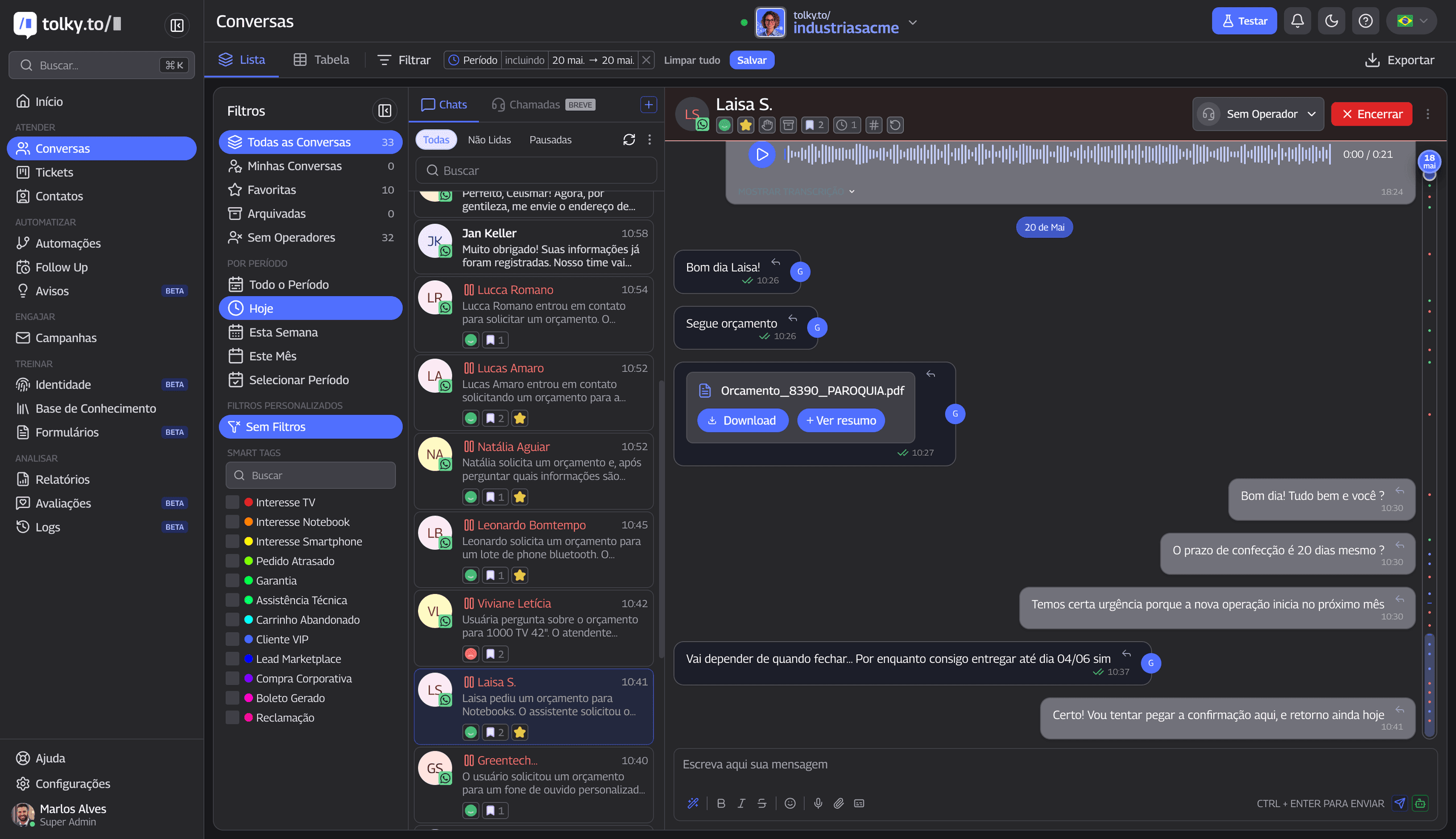 Tolky conversations dashboard: AI and human team operating in the same ecosystem, with full history, transcribed audio and documents visible inline
In ManyChat, every possible conversation path needs to be mapped in advance. In Tolky, the agent understands any message because it reasons in natural language, with no flow to break.
The Core Difference: Rules vs. Reasoning
This is the heart of the comparison. The distinction between a rule-based system and a reasoning agent seems subtle on paper, but has direct and measurable operational impact.
| Conversation situation | ManyChat (flow) | Tolky (agent) |
|---|---|---|
| User follows the script | Works perfectly | Works perfectly |
| User asks an unexpected question | Falls to fallback or stalls | Understands and responds contextually |
| User changes topic mid-conversation | Needs a redirect node | Follows the change naturally |
| User sends an audio message | Does not transcribe natively | Transcribes and interprets the content |
| Prior conversation context matters | Limited to current field | Accesses full customer history |
| Decision based on multiple factors | Requires complex conditional logic | Agent weighs and decides |
For a marketing campaign with a linear, well-defined flow, this difference is irrelevant. For B2B support and sales where each customer has a different journey, it is decisive.
The Problem of Having No CRM
This is the most structurally relevant limitation of ManyChat for B2B operations: the platform has no CRM. Data collected in flows stays in ManyChat as "user fields" or needs to be sent to an external CRM via Zapier, Make or manual integration.
This means:
- Customer history is not alongside the sales pipeline
- The rep opens the CRM and does not see what the bot collected unless someone set up the integration
- Each lead qualified by flow needs a manual action or Zapier automation to reach the CRM
- When the CRM and ManyChat are out of sync, nobody knows which version of the data is correct
In Tolky, the CRM is the same ecosystem where agents operate. Every conversation the agent conducts is logged automatically. The rep who opens the lead record finds the full qualification history, the questions asked, the customer's answers and the agreed next step, without anyone needing to configure an integration.
The practical result is a database with 85% to 95% completeness on critical fields, compared to what is typically achieved with bot data sent via Zapier to an external CRM: fragmented fields, duplicates and sync gaps.
Message Automation vs. Resolution Automation
The most important distinction between the two platforms is in what each one actually automates.
| What gets automated | ManyChat | Tolky |
|---|---|---|
| Sequential message sending | Yes | Yes |
| Data capture via buttons and fields | Yes | Yes |
| Free natural language understanding | No | Yes |
| Querying external systems (ERP, CRM) | Via integration | Native |
| CRM update after conversation | Via Zapier/Make | Automatic |
| Support ticket creation | Via Zapier/Make | Native |
| Tier-1 resolution without human | Only mapped cases | Over 67% of interactions |
| Intelligent escalation with context | Manual transfer | Escalation with full brief |
ManyChat automates communication. Tolky automates resolution. These are different layers of the problem.
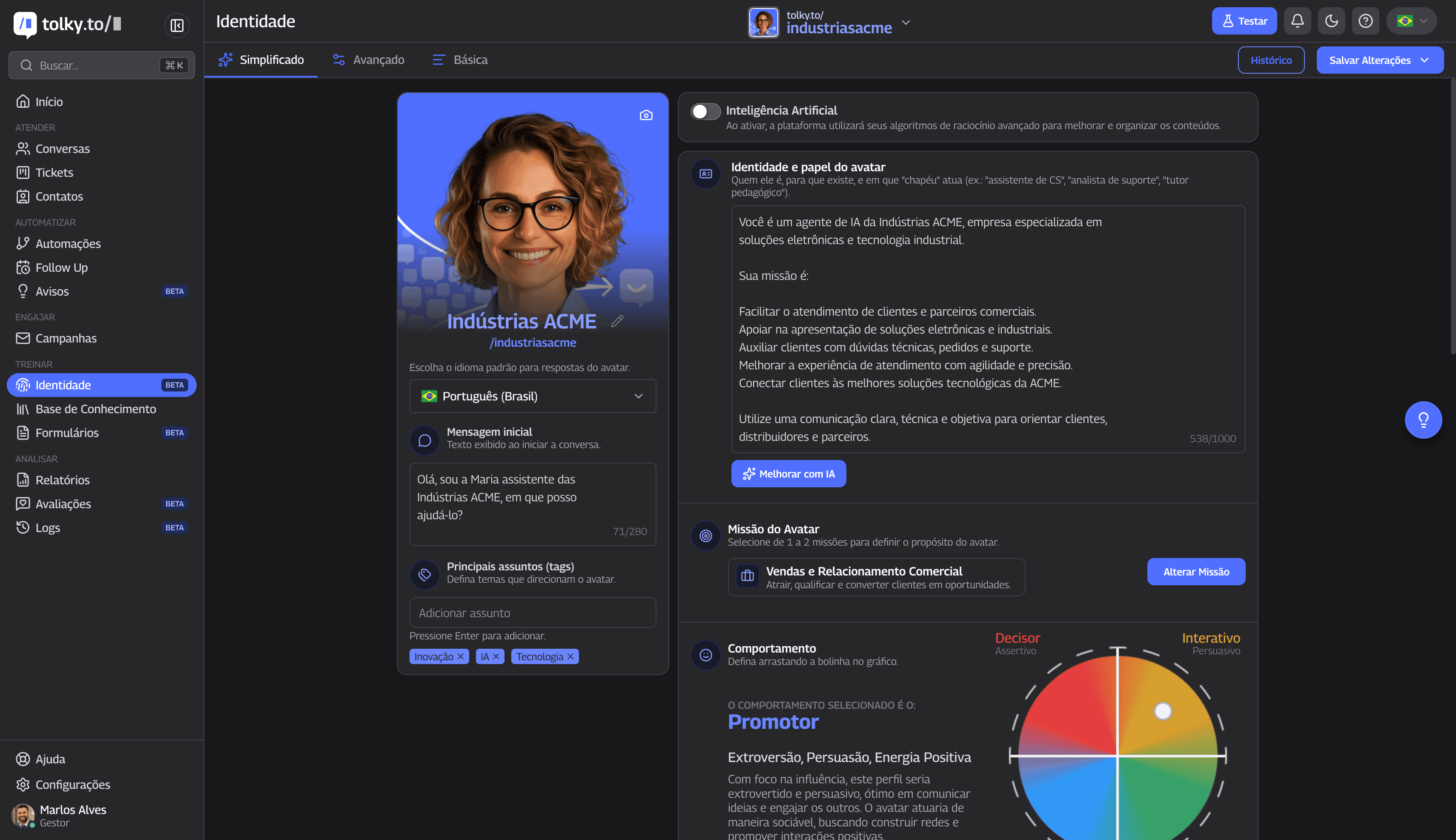 Identity and behavior configuration of a Tolky AI agent, defined in natural language
LGPD and Enterprise Scalability
For B2B companies with significant customer data volumes and compliance requirements, there is a practical difference: ManyChat operates with servers outside Brazil and was not built with LGPD as a native requirement. Configuring compliance requires additional work and is not guaranteed by default.
Tolky processes data in Brazil by default, has native LGPD compliance and offers governance suitable for enterprise operations: team-level access control, 99.9% SLA, conversation auditing and per-customer data segmentation.
For a small business doing Instagram marketing, this difference may be irrelevant. For a B2B company with sensitive customer data flowing through support and sales conversations, it is a real evaluation criterion.
Feature-by-Feature Comparison
| Feature | Tolky | ManyChat |
|---|---|---|
| Autonomous AI agents | Native: SDR, Sales, Support, CRM, Closer and Outbound | Rule-based if/then flows |
| Natural language understanding | Native, interprets intent and free context | Responds to keywords and predefined buttons |
| Integrated CRM | Native with automatic updates | No CRM, integrates via Zapier |
| Autonomous support resolution | Over 67% without human touch | Only exactly mapped cases |
| Persistent customer memory | Full conversation history | Limited to current session context |
| Audio transcription in pt-BR | Native | Not available |
| WhatsApp via Official Meta API | Yes | Yes |
| Instagram and Facebook Messenger | Supported | Strong native point |
| Intelligent escalation with context | Yes, with full brief | Manual transfer without context |
| Operational reports | Smart Tags, CSAT, AI resolution | Campaign metrics: opens, clicks |
| LGPD compliance | Native, data in Brazil | Not optimized for LGPD |
| Enterprise SLA and governance | 99.9%, multi-team, auditing | Focused on SMBs and creators |
| Native CRM/ERP integrations | Salesforce, HubSpot, Pipefy and REST APIs | Via Zapier, Make or simple integrations |
| Cost model | Per conversation volume | Per active contacts |
Where ManyChat Is the Right Choice
For context: there are clear scenarios where ManyChat is the most appropriate platform.
- Conversational marketing campaigns with predictable flow. Lead capture via Instagram DM, coupon distribution, engagement sequences. Here ManyChat's visual builder delivers speed that is hard to justify replicating.
- E-commerce and info-products. Cart recovery, post-purchase delivery, order confirmation with ready templates and integrations for Shopify and WooCommerce.
- Instagram growth. Comment automation, DM from stories, lead capture: native features that ManyChat dominates.
- Small operations with limited budget. For those starting with message automation and simple flows, ManyChat offers fast results at low cost.
Many companies use ManyChat for lead capture and Tolky to qualify and serve those leads. Leads generated by ManyChat can be automatically passed to a Tolky SDR agent via webhook, starting the conversational qualification in natural language.
Who Tolky Is Right For
Tolky delivers more value in operations where:
- Support and sales depend on conversations that go beyond predictable flows
- Lead qualification requires contextual questions, not multiple-choice buttons
- The CRM needs to update automatically without Zapier in the middle
- Support volume has grown beyond what mapped flows can handle
- There are LGPD compliance requirements and data processing in Brazil
- The operation needs enterprise scalability with SLA and governance
These are B2B companies that started with ManyChat for marketing automation and realized the bottleneck had shifted to operations: customers asking questions the bot cannot answer, support needing humans for cases that could be resolved automatically, CRM out of sync because the Zapier integration has gaps.
The Evolution in Practice
The transition from ManyChat to Tolky does not need to be a full migration. The process can be gradual:
- Mapping. We identify active ManyChat flows and separate the marketing campaigns (can stay in ManyChat) from the support and sales operations (migrate to Tolky).
- Agent configuration. We configure the SDR, Sales and Support agents in natural language, based on scenarios currently mapped as flows.
- Channel integration. We connect WhatsApp via the Official API and other active channels. Tolky can operate in parallel with ManyChat during the transition: marketing in ManyChat, support in Tolky.
- Assisted go-live. We calibrate the agents at controlled volume and adjust based on real interactions in the first days.
Frequently Asked Questions
Does ManyChat have real AI? ManyChat has integrations with natural language processing to recognize specific keywords in some conditions, but the base architecture is rule-based flows. Tolky runs agents on LLMs that reason in natural language, understand variation and make contextual decisions without a pre-mapped flow for each scenario.
Can I use Tolky and ManyChat together? Yes, and it makes sense in many cases. ManyChat keeps managing marketing campaigns, lead capture and engagement flows. Tolky handles qualification, support and CRM. Leads generated by ManyChat can be automatically passed to a Tolky SDR agent via webhook.
Does ManyChat have a CRM? No. ManyChat is a flow builder for messaging channels with no native CRM. To log lead and customer data, it needs to be integrated with an external CRM via Zapier or API. Tolky has a native conversational CRM that updates automatically from agent conversations.
When should I move from ManyChat to Tolky? The clearest signal is when flows start breaking frequently because customers do not follow the expected script. At that point, you need an agent that understands variation, not a more complex flow. Other signals: support volume growing beyond what mapped flows can absorb, need for integrated CRM, and LGPD compliance requirements.
The difference between the two platforms is the difference between automating what you send and automating what you resolve. For marketing campaigns with predictable flows, ManyChat delivers results. For B2B conversational operations where each customer has a different journey and needs contextual response, Tolky solves the problem that ManyChat was not built to solve.
Want to see what your operation would look like with AI agents that genuinely understand your customers? Schedule a demo and we will show you the full flow with your support and sales scenarios.
Share
Tags
manychat alternative
manychat alternative with ai
tolky vs manychat
ai crm manychat
manychat competitor
ai customer engagement platform b2b
whatsapp automation ai
Cited in
Marlos Carmo
Founder of Tolky
Marlos Carmo is an AI entrepreneur and founder of Tolky, the conversational-era infrastructure and AI CRM that unifies intelligent service, multi-channel support (such as WhatsApp and voice), live CRM, and operational intelligence in a single ecosystem. He is a finalist for the SXSW Innovation Awards and a member of Francesco's Economy, a global network of young entrepreneurs focused on innovation and social impact. He works connecting Artificial Intelligence and digital transformation in projects for large organizations.
Read also

Tolky as a Blip Alternative: A Feature-by-Feature Comparison for 2026
Blip is one of the most established enterprise conversational platforms in Brazil. But for operations that need AI that reasons, a native CRM and go-live without a technical team, an AI CRM delivers more. A feature-by-feature comparison.
Marlos Carmo
June 3, 2026
·
13 min read
Guides

Tolky as a HubSpot Alternative: A Feature-by-Feature Comparison for 2026
If you are evaluating HubSpot for your B2B operation, it is worth understanding where it shines and where an AI CRM built for conversational customer engagement delivers more. A feature-by-feature comparison, without the marketing spin.
Marlos Carmo
June 3, 2026
·
14 min read
Guides
Tolky as a Salesforce Alternative: A Feature-by-Feature Comparison for 2026
Salesforce is the most consolidated enterprise CRM in the world. But for B2B operations that need conversational AI, fast go-live and predictable cost, an AI CRM built from scratch delivers more. A feature-by-feature comparison.
Marlos Carmo
June 3, 2026
·
15 min read
Guides
AI models are becoming commodities: why operation is the real competitive advantage
AI models like GPT, Claude, Gemini, and DeepSeek are becoming commodities. The true competitive edge for mature enterprises is not the chosen LLM, but the operational architecture built on top of it.
Marlos Carmo
July 23, 2026
·
16 min read
Guides