
Blog
Guides
Tolky as a Salesforce Alternative: A Feature-by-Feature Comparison for 2026
Salesforce is the most consolidated enterprise CRM in the world. But for B2B operations that need conversational AI, fast go-live and predictable cost, an AI CRM built from scratch delivers more. A feature-by-feature comparison.

Marlos Carmo
June 3, 2026
·
15 min read
TL;DR
Salesforce is the most mature enterprise CRM in the world, with AI added via Einstein. Tolky is an AI CRM built from scratch to run autonomous agents across WhatsApp, webchat, email and Instagram. For B2B operations that need go-live in days, agents that execute autonomously and predictable per-conversation cost, Tolky is the more direct alternative — no IT projects, no dedicated admin, and no growing Salesforce TCO.
Share
When someone mentions enterprise CRM, Salesforce comes up first. The platform has dominated the global CRM market for over two decades, with an installed base of more than 150,000 companies and a partner and certification ecosystem that few software products have ever built.
But market dominance and fit for your specific problem are different things. And for a growing number of B2B companies that operate with WhatsApp as their central channel, need go-live in weeks (not months), and want AI agents that execute instead of just suggest, Salesforce has stopped being the obvious answer.
In this comparison, the question is direct:
For a B2B company that wants conversational AI operating at the core of its operation, when is Salesforce the right choice and when does an alternative built for that model deliver more results with less friction?
The 30-Second Summary
| Dimension | Tolky | Salesforce |
|---|---|---|
| Category | Conversational AI CRM | Enterprise CRM with AI added |
| AI architecture | Autonomous agents are the core | Einstein AI: assistive, per module, paid separately |
| Native channels | WhatsApp, webchat, email, Instagram | Email and phone, WhatsApp via AppExchange |
| CRM updates | Automatic after each conversation | Manual or via complex flows |
| Resolution without humans | Over 67% of interactions | Simple bots via Service Cloud |
| AI configuration | Natural language, no code | Apex, Flow Builder, certified partner |
| Go-live time | Days | 3 to 12 months |
| Cost model | Per conversation volume | Per user, per module, per add-on |
| LGPD compliance | Native, data in Brazil | Requires specific configuration |
Both platforms are solid, but for very different operation profiles. The rest of this guide details where each difference shows up in practice.
What Salesforce Is
Salesforce was founded in 1999 with a radical proposition for the time: CRM delivered via browser, no software installed, by subscription. That bet on the SaaS model — before the term existed as a convention — transformed the market.
Today Salesforce is a suite of platforms organized in separate clouds:
- Sales Cloud: pipeline management, opportunities, territory management, forecast and quota for enterprise sales teams.
- Service Cloud: support center, case management, knowledge base, SLAs and ticket routing.
- Marketing Cloud and Pardot (Account Engagement): marketing automation, email at scale, customer journeys and ABM.
- Commerce Cloud, Experience Cloud, Health Cloud: industry verticals and specific use cases.
- AppExchange: marketplace with over 7,000 third-party applications, the largest in the CRM market.
Salesforce's AI layer is called Einstein. Launched in 2016, it grew to include Einstein GPT, Einstein Copilot and a range of per-product features: lead scoring, close prediction, text generation, intelligent routing, conversation analysis. The key observation is the same as for any CRM that added AI on top of an existing structure:
Einstein is an assistive layer. It suggests, analyzes and summarizes. But execution is still done by the human team, coordinated by flows and automations that an admin needs to configure and maintain.
This is not a flaw in Salesforce. It is the description of a product built as a system of record for human teams, to which AI was bolted on as an accelerator.
Where Salesforce Is Strong
Salesforce's strengths are genuine and relevant for specific operation profiles:
- High-complexity enterprise operations. Hundreds of customizations, custom objects, complex business logic and deep integrations with SAP, Oracle and legacy systems. No platform matures this better.
- Advanced sales team management. Territory management, quota management, advanced forecast, credit splitting and approval hierarchies. For large distributed sales teams, Sales Cloud has depth that is hard to replicate.
- AppExchange. Over 7,000 third-party applications. For very specific integration or vertical functionality needs, the marketplace has practically everything.
- Partner ecosystem. Tens of thousands of certified consultants and partners worldwide. For companies that need specialized support for complex customizations, the ecosystem is a real asset.
What Tolky Is
Tolky was built in the opposite direction. Instead of an enterprise CRM that gained AI, it is an AI CRM: a platform where AI agents are the operational core from the initial design.
The agents conduct real conversations, qualify leads, update the CRM, query systems, execute actions and escalate to humans only when context requires. The human team steps in where situational judgment and relationship-building are irreplaceable, not in the middle of repetitive flows that could be automated.
Tolky has specialized agents for each stage:
- SDR Agent: qualifies inbound and outbound leads against ICP criteria and delivers to the team only what is ready to advance.
- CRM Agent: monitors all interactions and updates records automatically after each conversation.
- Sales Agent: answers questions based on the catalog, presents arguments and routes at the right moment.
- Closer Agent: generates personalized proposals, follows up at the right timing and works objections.
- Outbound Agent: runs active prospecting in real two-way conversations, not mass email blasts.
- Support Agent: resolves tickets autonomously, queries the ERP and escalates complex cases with full context.
Each agent has its own identity, defined in natural language: name, mission, tone of voice, scope and behavioral profile. No code. No partner. Configuration done by the operations team itself.
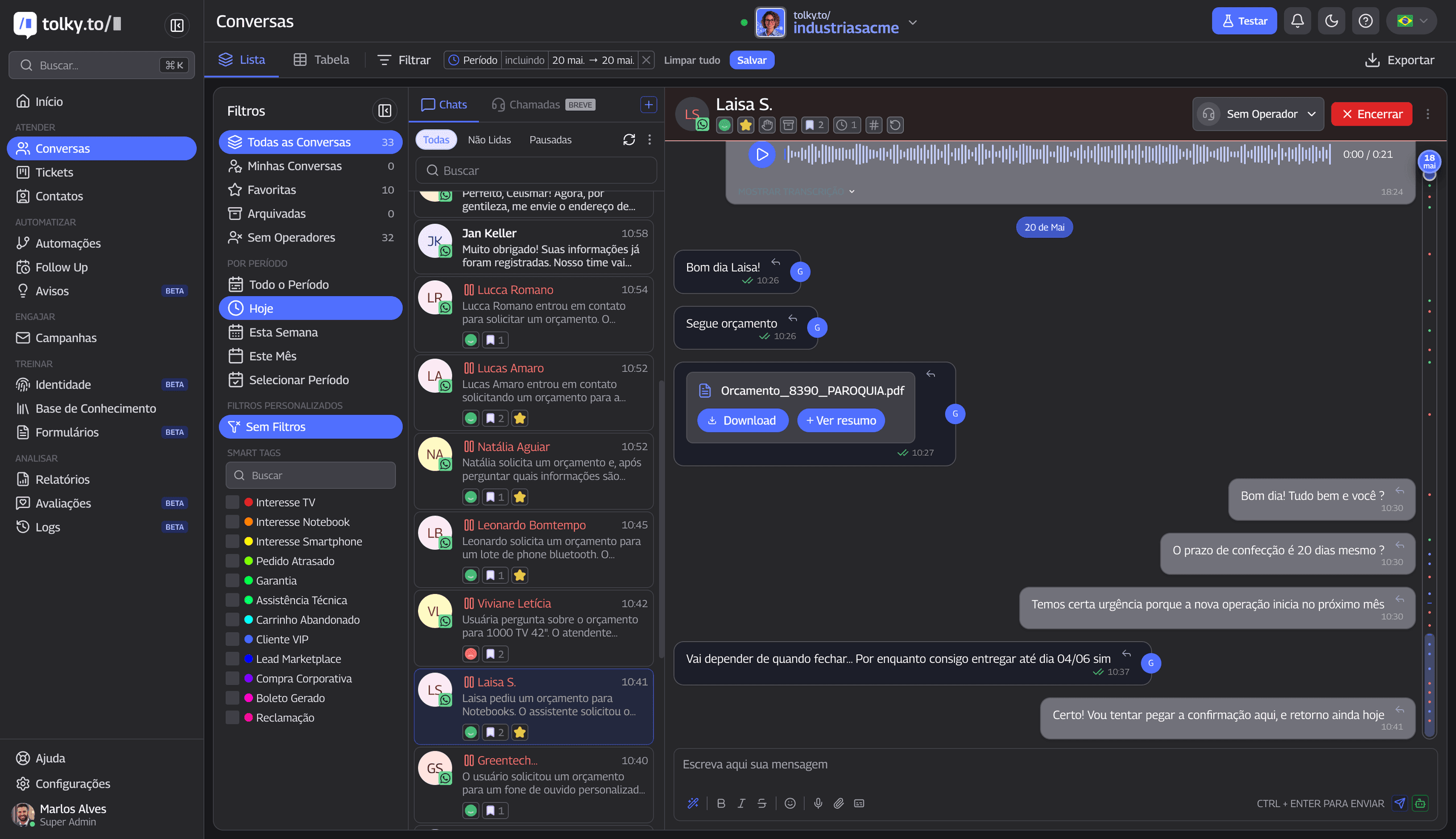 Tolky conversations dashboard: AI and human team operating in the same ecosystem, with full history, transcribed audio and documents visible inline
Replicating a complete conversational ecosystem in Salesforce requires Sales Cloud + Service Cloud + Einstein + integrations. Separate projects, separate costs, separate timelines.
The Core Difference: Speed to Value
The most clarifying comparison between the two platforms is not in the features on paper, but in speed to value: how long until the platform is generating real results in the operation.
| Stage | Salesforce | Tolky |
|---|---|---|
| Contracting and onboarding | Weeks of negotiation | Days |
| Initial configuration | 3 to 12 months with partner | Days to weeks |
| First automated conversation | Months after start | First week |
| Team operating without intensive training | Months of enablement | Natural language configuration |
| CRM updated by the system | Manual (admin maintains flows) | Automatic (agent registers) |
Salesforce is not slow because it is bad. It is slow because it was designed for high-complexity operations that justify that time investment. The problem is when that design is applied to operations that need results in weeks, not months.
A company that starts a Salesforce implementation today and plans to go live in 60 days is, statistically, underestimating the project. The average implementation time for Sales Cloud alone is 3 to 6 months with a certified partner.
Tolky goes live in days because agents are configured in natural language, with no flow logic to program and no custom objects to create.
Total Cost of Ownership: What Does Not Appear in the Proposal
The TCO of Salesforce is systematically underestimated at the time of purchase. The commercial proposal shows the per-user license cost. What does not appear is:
- Implementation cost: Sales + Service Cloud projects with a certified partner typically cost between 1x and 3x the annual license value.
- Dedicated admin: a well-configured Salesforce needs a Salesforce Admin, a role with its own certification and a relevant market salary.
- Ongoing maintenance: every change in the sales process requires flow configuration or Apex code, often a ticket to the partner.
- AI add-ons: Einstein Copilot, Einstein Analytics and Einstein GPT have separate per-user licenses.
- AppExchange: most important integrations (WhatsApp, engagement tools) are paid apps from the marketplace.
The typical TCO of a mid-size Salesforce operation exceeds R$50,000/month combining licenses, partner and maintenance. Tolky has predictable cost per conversation volume, with no per-seat cost and onboarding included.
Tolky charges by conversation volume. An operation that grows in interaction volume without growing in number of users does not pay more. And because the agent replaces a significant portion of the work previously done by SDRs and support agents, the correct comparison includes the headcount the automation eliminates.
Channels: AppExchange vs. Native
Salesforce was architected in an era when email and phone were the central channels of B2B relationships. WhatsApp, webchat and Instagram arrived via AppExchange: third-party applications that add capability to the ecosystem, with the latency and scale limitations that third-party integrations inevitably carry.
| Channel capability | Salesforce | Tolky |
|---|---|---|
| WhatsApp via Official Meta API | Via AppExchange (third parties) | Native |
| Audio transcription in pt-BR | Via Einstein Voice or third parties | Native |
| Webchat and Instagram | Via integrations | Native in the same dashboard |
| Unified history across all channels | Requires Omni-Channel configuration | Native by default |
| Proactive messages (outbound) | Via Marketing Cloud (separate product) | Native Outbound Agent |
Tolky operates on WhatsApp via the Official Meta API with native support for audio, documents, images and proactive messages. The full history of all channels is in the same dashboard without additional configuration.
For a B2B company where 70% or more of commercial and support conversations happen on WhatsApp, this difference translates to weeks of project work avoided and a smoother support experience for the customer.
Configuration: Natural Language vs. Apex + Flow Builder
Configuring an automation in Salesforce requires, depending on complexity:
- Flow Builder for declarative automations (replaces the legacy Process Builder)
- Apex for logic that flows do not support (a proprietary language similar to Java)
- Lightning Web Components for custom interfaces
- Salesforce Admin to keep everything working as the business changes
For a company that wants to change the SDR agent script because the ICP changed, this means a ticket to the admin or to the partner, with a SLA of days or weeks.
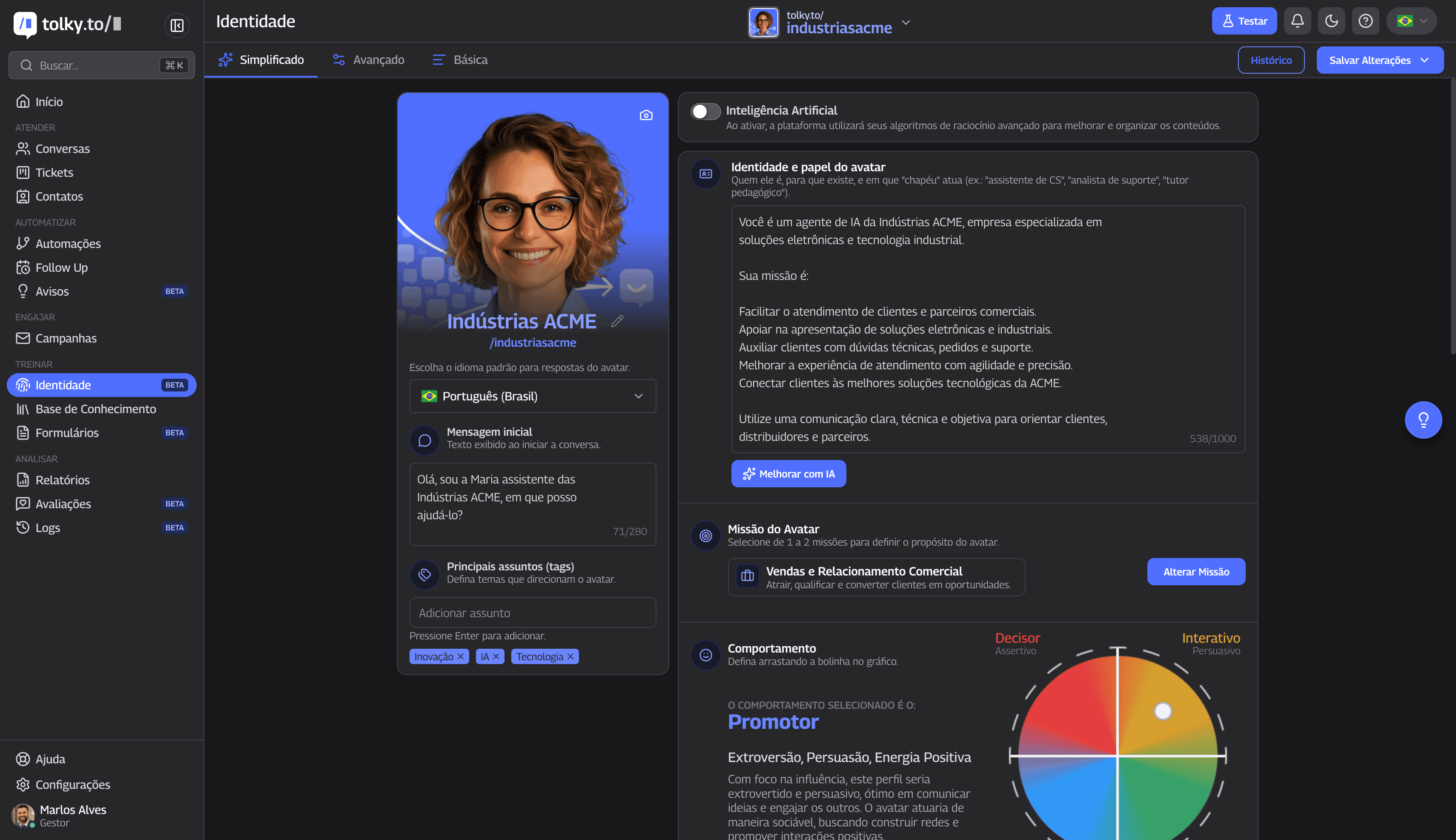 Identity and behavior configuration of a Tolky AI agent, defined in natural language
In Tolky, the same change is made in minutes by the operations team itself, in natural language, without opening a ticket for anyone. The difference is not just speed: it is who has control over the operation.
Feature-by-Feature Comparison
| Feature | Tolky | Salesforce |
|---|---|---|
| Autonomous AI agents | Native: SDR, Sales, Support, CRM, Closer and Outbound | Einstein AI — assistive, separate license per module |
| Omnichannel | WhatsApp, webchat, email and Instagram native | Email and phone native, WhatsApp via AppExchange |
| CRM updates | Automatic after each conversation | Manual or via complex flows (admin required) |
| Autonomous resolution | Over 67% without human touch | Simple bots via Service Cloud |
| AI configuration | Natural language, no code | Apex, Flow Builder, certified partner |
| Audio transcription | Native, in pt-BR | Via Einstein Voice or third parties |
| Proactive messages | Native Outbound Agent | Pardot / Marketing Cloud (separate product) |
| Conversation analysis | Smart Tags classify themes via AI | Einstein Analytics (separate license) |
| Implementation time | Go-live in days | 3 to 12 months with partner |
| Dedicated admin required | No | Yes (certified Salesforce Admin) |
| Complex enterprise operations | Focus on conversational operations | Market reference |
| AppExchange / marketplace | Native connectors for main systems | 7,000+ applications |
| LGPD compliance | Native, processing in Brazil | Requires specific configuration |
| Cost model | Per conversation volume | Per user + per module + implementation |
The Problem of a CRM That Depends on the Team
A well-maintained CRM is a huge asset. A poorly maintained CRM is a data repository no one trusts, and which the team avoids opening because they know what is in there does not reflect reality.
Salesforce is a powerful tool for organizing and visualizing the pipeline, but data only enters when someone types it. Flows and automations move records between stages, but the substance of each conversation, what the customer said, what the objection was, what was promised in the follow-up, depends on manual entry.
In Tolky, every conversation the agent conducts is registered automatically. The CRM receives:
- Full context of the contact and company
- Conversation history structured and classified by Smart Tags
- Agreed next step and deadline
- Identified objections and qualification stage
The practical result is a database with 85% to 95% completeness on critical fields, compared to the 20% to 40% typical of a CRM that depends on manual entry.
Where Salesforce Is the Right Choice
For context: there are clear scenarios where Salesforce is the most appropriate platform, and recognizing them is part of a serious evaluation.
- Enterprise operations with high customization complexity. Hundreds of custom objects, deep integrations with SAP and Oracle, proprietary business logic that took years to build. Migrating this type of operation has a cost that is rarely justified.
- Large sales teams with advanced management needs. Territory management, quota management, deal splits, complex approval hierarchies and granular forecast for teams of 50+ salespeople. Sales Cloud is still the market reference.
- Companies with Salesforce already running well. If the implementation is mature, the admin is competent and the team has adopted it, changing for the sake of change does not make sense. Tolky can integrate bidirectionally with the existing Salesforce and handle the conversational layer without requiring a full migration.
Who Tolky Is Right For
Tolky delivers more value in operations where:
- The primary sales and support channel is WhatsApp, or there is intent to make it so
- The team needs fast go-live, without months of project work with a certified partner
- The operation wants agents that execute autonomously, not just suggest next steps
- The CRM needs to update itself without depending on team entry discipline
- Cost needs to be predictable and proportional to actual usage volume
- There is no budget for a dedicated admin, implementation partner, and separate AI add-ons
These are mid-size B2B companies, or divisions of larger companies, that came to Salesforce by reputation and realized they were paying for a platform that requires more effort to operate than the value it returns to the sales and support team.
Tolky and Salesforce Together
An alternative to full migration is coexistence. Tolky integrates bidirectionally with Salesforce:
- Reads the context of contacts, opportunities and history from Salesforce
- Conducts conversations through the channels where the customer is (WhatsApp, webchat)
- Writes back the data collected by the agents into Salesforce records
Many companies keep Salesforce for enterprise deal management and use Tolky as the conversational support and qualification layer. Salesforce receives more complete data, the sales team works with better qualified leads, and the customer has a faster and more fluid support experience.
The Migration in Practice
For those who decide on full migration, the standard process follows four steps:
- Mapping. We export contacts, opportunities and history from Salesforce and map the fields to Tolky.
- Agent configuration. We define the SDR, Sales and Support agents in natural language, based on your current operation.
- Integration. We connect the active channels and sync the relationship history.
- Assisted go-live. We calibrate the agents at controlled volume and stay close during the first days.
Most operations go live in days. Implementations with multiple integrations take one to three weeks.
Frequently Asked Questions
Does Tolky replace Salesforce? For operations whose center of gravity is conversational support and selling across multiple channels, yes: Tolky replaces Salesforce's CRM and support layer with autonomous AI agents, at a fraction of the cost and implementation time. For companies with highly customized enterprise Salesforce operations, Tolky can coexist as the conversational layer without requiring a full migration.
Does Salesforce implementation really take months? Yes. A Sales + Service Cloud implementation with basic integrations typically takes 3 to 12 months with a certified partner, plus an implementation cost that frequently exceeds the annual license value. Tolky goes live in days, with natural language configuration and assisted onboarding included.
Can I use Tolky and Salesforce together? Yes. Tolky integrates bidirectionally with Salesforce: it reads contact and opportunity context and writes back what the agents collect in conversations. Many companies keep Salesforce for enterprise deal management and use Tolky for the entire conversational operation.
How much does it cost compared to Salesforce? Salesforce charges per user, per module and per add-on, with additional implementation cost. Tolky has predictable cost per conversation volume, no per-seat cost and onboarding included. The correct comparison includes the headcount the automation eliminates and the implementation cost that is not needed.
The question that guides the choice between the two platforms is the same one that guides any technology decision: was the product built for the problem you have? Salesforce was built to be the central nervous system of high-complexity enterprise sales operations. Tolky was built to be the core of a conversational operation where AI executes, updates and qualifies autonomously.
Want to see what your operation would look like with autonomous AI agents? Schedule a demo and we will show you the full flow with your ICP criteria and your channels.
Share
Tags
salesforce alternative
salesforce alternative with ai
ai crm salesforce
tolky vs salesforce
conversational crm b2b
salesforce competitor
ai customer engagement platform b2b
Cited in
Marlos Carmo
Founder of Tolky
Marlos Carmo is an AI entrepreneur and founder of Tolky, the conversational-era infrastructure and AI CRM that unifies intelligent service, multi-channel support (such as WhatsApp and voice), live CRM, and operational intelligence in a single ecosystem. He is a finalist for the SXSW Innovation Awards and a member of Francesco's Economy, a global network of young entrepreneurs focused on innovation and social impact. He works connecting Artificial Intelligence and digital transformation in projects for large organizations.
Read also

Tolky as a HubSpot Alternative: A Feature-by-Feature Comparison for 2026
If you are evaluating HubSpot for your B2B operation, it is worth understanding where it shines and where an AI CRM built for conversational customer engagement delivers more. A feature-by-feature comparison, without the marketing spin.
Marlos Carmo
June 3, 2026
·
14 min read
Guides
Tolky as an RD Station Alternative: A Feature-by-Feature Comparison for 2026
RD Station is the most widely adopted marketing and CRM platform among SMBs in Brazil. But for operations that need native WhatsApp, autonomous agents and a self-updating CRM, an AI CRM delivers more. A feature-by-feature comparison.
Marlos Carmo
June 3, 2026
·
14 min read
Guides

Tolky as a Blip Alternative: A Feature-by-Feature Comparison for 2026
Blip is one of the most established enterprise conversational platforms in Brazil. But for operations that need AI that reasons, a native CRM and go-live without a technical team, an AI CRM delivers more. A feature-by-feature comparison.
Marlos Carmo
June 3, 2026
·
13 min read
Guides

Tolky as a ManyChat Alternative: A Feature-by-Feature Comparison for 2026
ManyChat is the most popular flow automation builder for WhatsApp and Instagram. But for B2B operations that need AI that reasons, an integrated CRM and real autonomous resolution, an AI CRM delivers more. A feature-by-feature comparison.
Marlos Carmo
June 3, 2026
·
13 min read
Guides