What is NPS: how to calculate it, the scale and what a good NPS is
What NPS (Net Promoter Score) is, what the 0 to 10 scale means, how to calculate it with an example, what a good NPS is, relationship vs transactional NPS and how to act on each customer group.

TL;DR
NPS (Net Promoter Score) is the metric that measures customer loyalty with one question: on a scale of 0 to 10, how likely are you to recommend the company to a friend or colleague. Customers who answer 9 or 10 are promoters, 7 or 8 are neutrals (passives) and 0 to 6 are detractors; NPS is the percentage of promoters minus the percentage of detractors, an index from -100 to 100. A good NPS is, above all, higher than your competitors' and better than your own score in the previous period.
Share
Every customer service or after-sales manager has heard the question "what's our NPS?". The acronym shows up in board reports and bonus targets, but the person asking doesn't always know how the math works or what to do when the number drops.
This guide explains what NPS is, where it came from, how the scale works, how to calculate it with an example, what a good NPS is and how to act on each customer group. For the difference between NPS and CSAT, see NPS vs CSAT; to set up the survey on WhatsApp, see the WhatsApp customer satisfaction survey guide.
Updated November 2026.
What is NPS?
NPS (Net Promoter Score) is the metric that measures customer loyalty by how likely a customer is to recommend the company to a friend or colleague, on a scale of 0 to 10, and sums up the answers in an index from -100 to 100. The NPS entry in our glossary sums up the concept in one line.


NPS was introduced by Fred Reichheld, of Bain & Company, in the article "The One Number You Need to Grow", published in Harvard Business Review in December 2003 (checked on November 24, 2026). The history of the Net Promoter System, kept by Bain, says the team was looking for the question that best predicted customer value over time, and records the second finding: the score alone is not enough, and asking "why?" is what lets a company act.
NPS separates the customers who speak well of the company from those who speak badly of it, and shows the balance between the two groups. It does not measure the quality of a single interaction (that is CSAT) or the effort to solve a problem (that is CES).
What is the NPS question and how does the scale work?
The NPS question is "On a scale of 0 to 10, how likely are you to recommend [company] to a friend or colleague?", and the 11-point scale splits customers into detractors (0 to 6), neutrals (7 and 8) and promoters (9 and 10). That is how Bain describes the metric on the Net Promoter System website (checked on November 24, 2026).
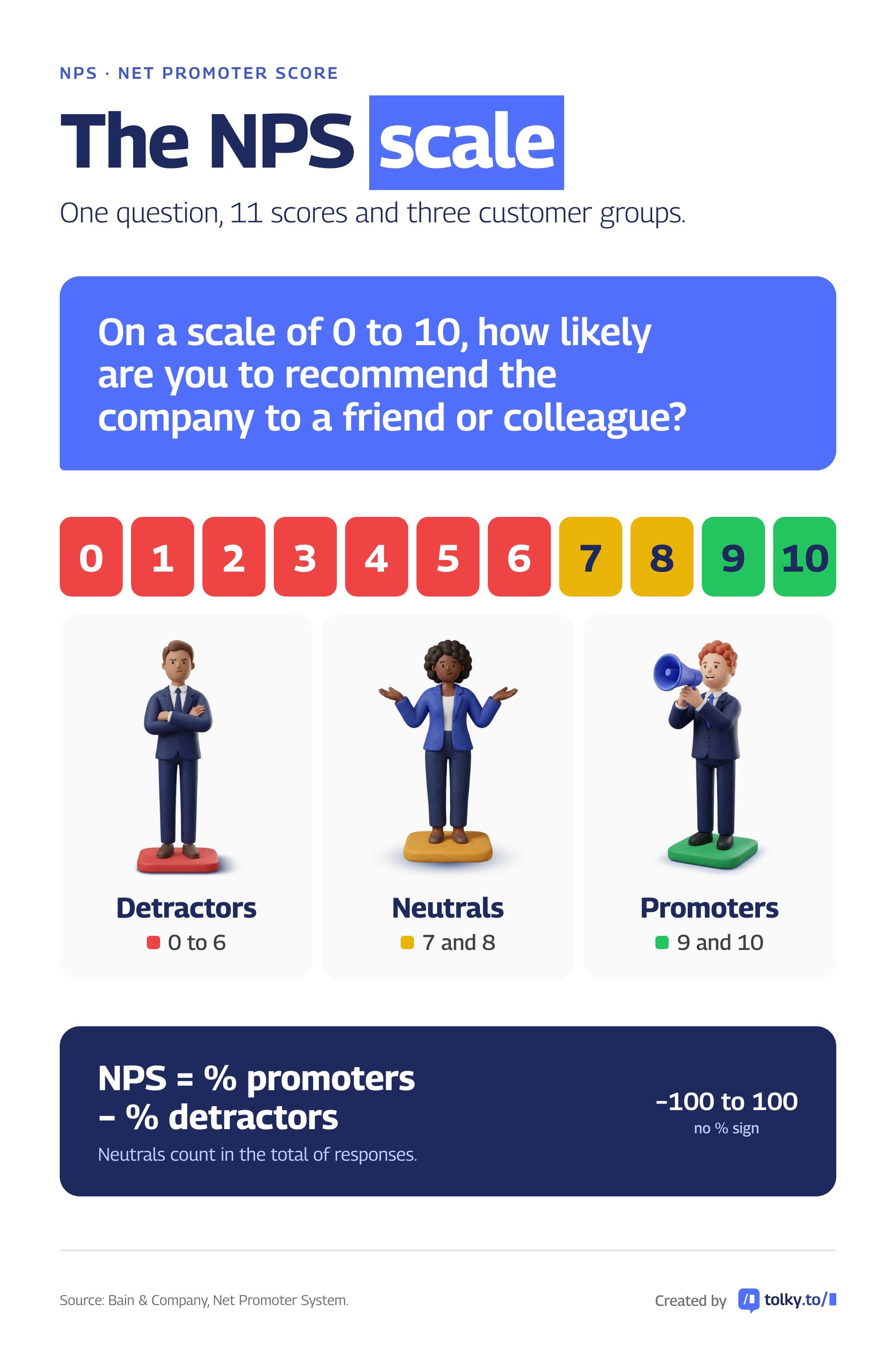 The NPS scale and the three customer groups. Source: Bain & Company.
| Score | Group | What it usually means | What to do |
|---|---|---|---|
| 9 or 10 | Promoter | Loyal customer who recommends you and tends to stay and buy more | Say thanks, ask for a referral or a testimonial |
| 7 or 8 | Neutral (Bain calls them "passives") | Satisfied for now, but open to a better offer | Ask what is missing to make it a 10 |
| 0 to 6 | Detractor | Unhappy, at risk of churning and of spreading bad word of mouth | Follow-up from a person, with the history at hand |
The scale is asymmetric on purpose: only 9 and 10 count as promoters, and a 6, which looks reasonable, is already a detractor. Don't convert it to stars or to 1 to 5, and don't change the cutoffs; if you do, the number is no longer NPS.
How do you calculate NPS?
To calculate NPS, subtract the percentage of detractors from the percentage of promoters: NPS = % promoters - % detractors. Neutrals are not subtracted, but they count in the total number of answers, which is the denominator. The result goes from -100 (all detractors) to 100 (all promoters) and is written without a percent sign.
- Gather the answers for the period (only those who answered, not the surveys sent).
- Count the 9s and 10s, the 7s and 8s, and the scores from 0 to 6.
- Divide promoters and detractors by the total number of answers and multiply by 100.
- Subtract the percentage of detractors from the percentage of promoters.
NPS calculation example
Illustrative example: a company sends the survey to 1,000 customers and gets 200 answers, a 20% response rate. Of the 200, 110 are promoters, 50 are neutrals and 40 are detractors.
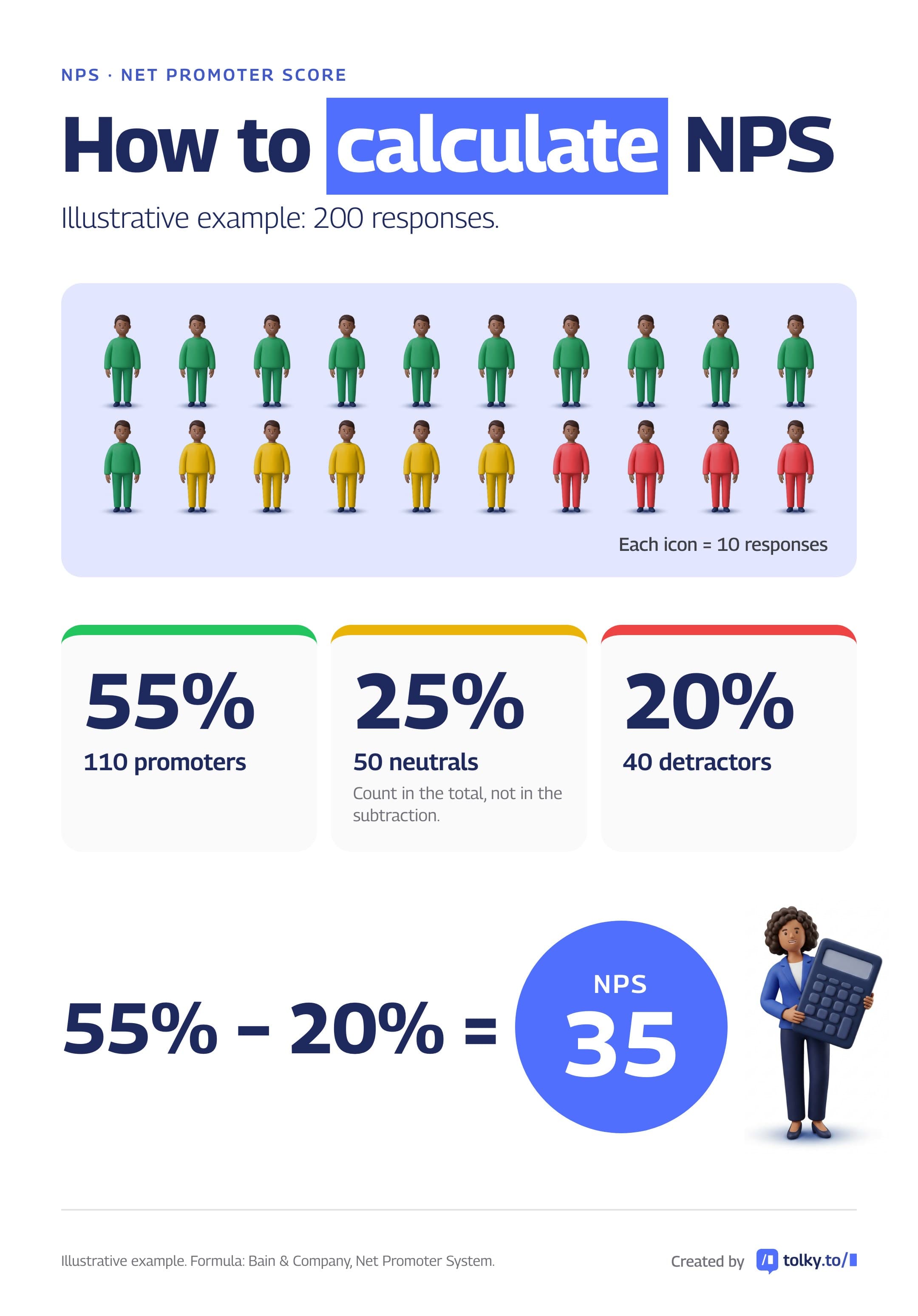 Illustrative example of an NPS calculation with 200 responses.
| Group | Answers | Math | Percentage |
|---|---|---|---|
| Promoters (9 and 10) | 110 | 110 ÷ 200 × 100 | 55% |
| Neutrals (7 and 8) | 50 | 50 ÷ 200 × 100 | 25% |
| Detractors (0 to 6) | 40 | 40 ÷ 200 × 100 | 20% |
| NPS | 200 in total | 55 - 20 | 35 |
An NPS of 35 does not mean that 35% of customers are satisfied: it is the balance between two groups. And the 800 customers who didn't answer may think differently from the 200 who did. When you report NPS, include the number of answers, the response rate and the period.
What is a good NPS?
A good NPS is, above all, higher than your competitors' and higher than your own in the previous period; any score above zero means you have more promoters than detractors. There is no universal cutoff, because averages vary a lot across industries and countries.


Two references help you read the number:
- General ranges. Qualtrics, in an article dated February 22, 2021, attributes this reading to Bain: above 0 is good, above 20 is favorable, above 50 is excellent and above 80 is world class (Qualtrics, checked on November 24, 2026). The same article shows that averages vary widely across industries.
- Comparison with the market. Rob Markey, of Bain, wrote in 2014 that an NPS higher than the competition's, even if it seems low in absolute terms, is a reliable indicator of future growth (Bain & Company, checked on November 24, 2026).
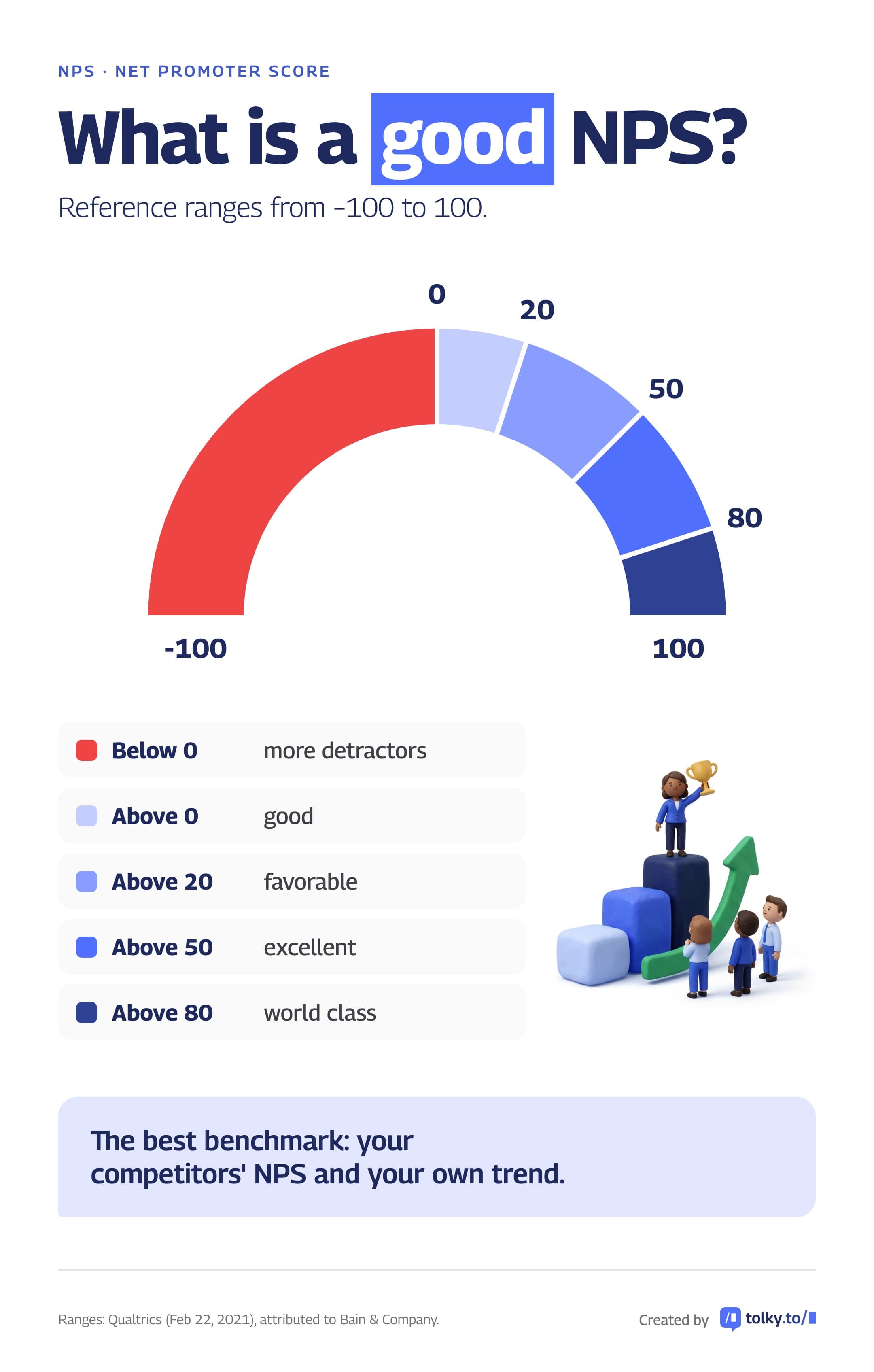 NPS reference ranges according to Qualtrics, which attributes them to Bain.
Use the ranges as a starting point and track your own trend: an NPS that goes from 20 to 35 in six months says more than an isolated 35.
When and how should you send the NPS survey?
Send the NPS survey on the channel where the customer already talks to you, right after the moment you want to measure (transactional) or on a fixed cycle (relationship), with one main question and one short open question. The channel changes the response rate more than the wording does.
- WhatsApp: the question lands in the support chat and the customer replies with just the number. Inside the 24-hour window it goes as a free-form message; outside it, as an approved template. There is ready-to-use text in the WhatsApp NPS survey template.
- Email: useful for relationship NPS across a large base, with a link to a form, but it usually gets fewer answers.
- In the product: good for software, after a completed action.
On any channel, set a minimum interval between surveys for the same customer, don't send in the middle of an open problem and never ask for the score ("please give us a 10").
Relationship vs transactional NPS: what is the difference?
Relationship NPS measures the customer's relationship with the company as a whole and is sent on a cycle; transactional NPS measures likelihood to recommend right after a specific moment, such as a support interaction or a delivery. Bain calls the first "relationship NPS" and the second "experience NPS" in the same article by Rob Markey.
- Relationship: every quarter or half-year, or at milestones such as renewal. It answers "how is our relationship with the base?" and helps prevent churn.
- Transactional: right after the interaction or the delivery. It answers "did this moment make the customer want to recommend us?" and ties the score to a conversation, a product or a team.
The two numbers don't mix. Report each one under its own name.
The open question after the score
The score says how much; the open question says why. Ask "What weighed most in your score?", keep the answer optional and group the comments into a few themes (delays, product, delivery, price).
How do you act on detractors, neutrals and promoters?
Acting on NPS means closing the loop: every detractor gets a follow-up from a person, every neutral is asked what is missing, every promoter is invited to refer, and the patterns go to whoever can change the process. A survey with no follow-up teaches customers not to answer.
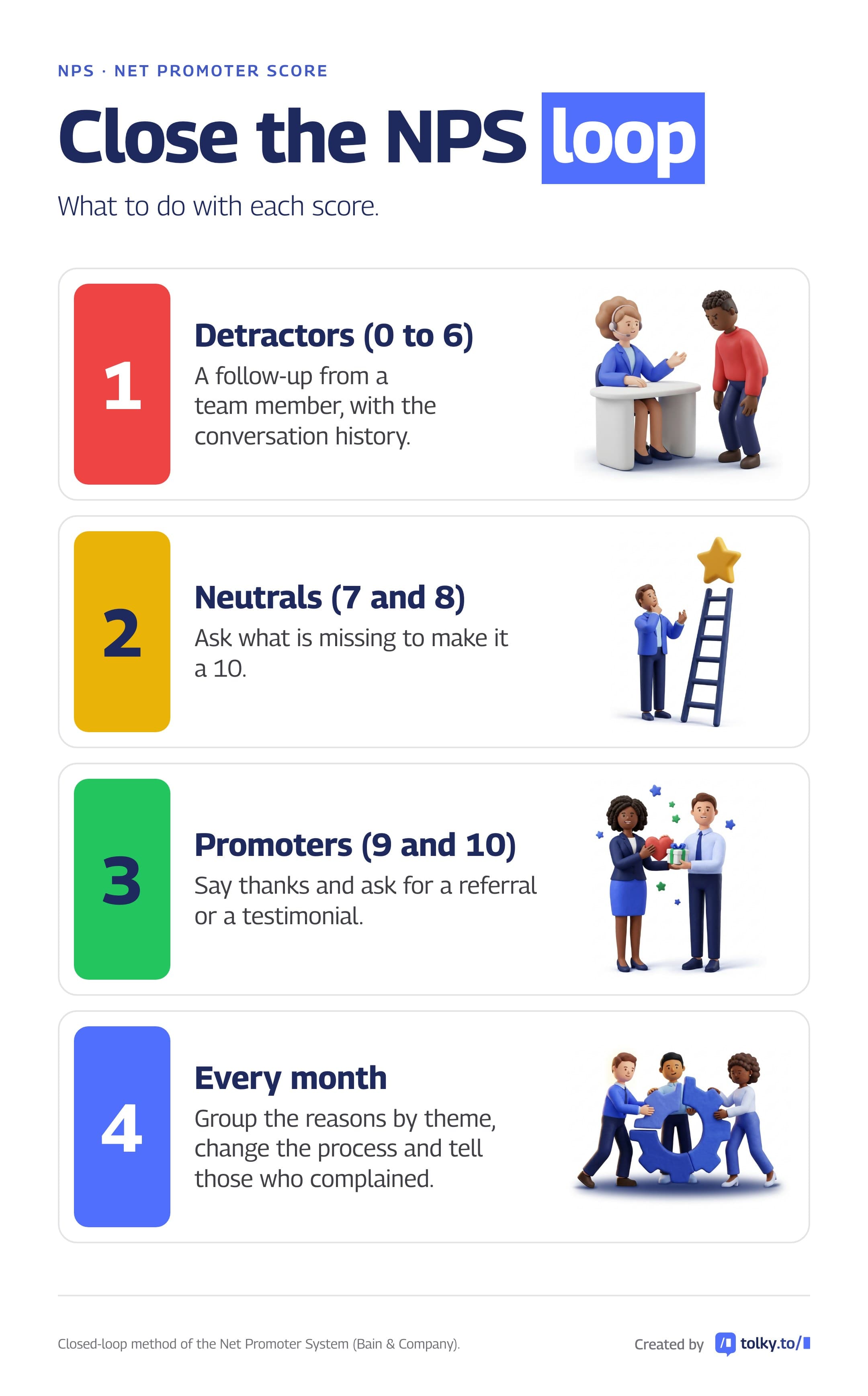 How to close the NPS loop with each customer group.
- Inner loop, with the customer. The detractor is contacted within a few days by someone who has read the conversation. When AI handles service, the handoff to a person carries the context, as the AI to human handoff guide shows.
- Outer loop, with the company. Once a month, the most cited themes go to product, logistics or service, with an owner and a deadline. When something changes, tell the customers who complained.
In after-sales service, NPS is one of the entry points for this work; the after-sales area page shows how it connects to follow-up and renewal.
Common mistakes when measuring NPS
The most common mistakes are changing the scale, reading NPS as a percentage, comparing small samples and doing nothing with the answers. Each one makes the number misleading or useless.
- A different scale. NPS from 1 to 5 or with stars is not NPS.
- Reading "35" as "35%". The index is a balance, not a share of satisfied customers.
- Small samples. With 20 answers, one more detractor moves the index by 5 points.
- Mixing relationship and transactional NPS into a single number.
- Not closing the loop. Customers notice when their opinion changes nothing.
How do you measure the NPS of AI and of human agents?
To measure the NPS of AI and of people, split the answers by conversation type (resolved by AI only or with a human agent) and compare the two indexes in the same period, knowing the cases are not the same. Without that split, a good overall NPS can hide an AI that annoys customers, or the opposite.


AI usually handles the simplest requests, and the conversations that reach a person tend to be the hardest; a lower NPS with an agent does not prove the team serves customers worse. Compare by topic, read the score alongside the AI resolution rate and read detractor comments on both sides. For the full picture of experience metrics, see the Customer Experience guide.
Where Tolky fits in
Tolky is an AI conversational CRM with a native NPS survey: it sends the question on WhatsApp at the end of a conversation and shows the results on the Feedbacks screen, split between AI-only conversations and conversations with a human agent. The WhatsApp NPS survey page covers the feature in detail.
- Automatic sending. After a customer-silence time you set (from 5 to 1,380 minutes), the AI checks whether the conversation has ended and, if so, sends the survey.
- Manual and workflow sending. The agent sends NPS from the chat's recommended actions, and the "require survey on close" option prevents closing a WhatsApp conversation without sending it. In Flows, the close-conversation action can send the survey and wait for the score.
- After the score. Instructions tell the AI how to behave once the customer answers, for example by asking the reason for a low score. The conversation can close on its own, with a closing message and a template if the 24-hour window has already closed. Rules define whether each ticket is surveyed, the minimum interval between surveys and when unanswered surveys expire.
- Dashboard. NPS index from -100 to 100, average score, promoters, neutrals and detractors, response rate, distribution of scores from 0 to 10 and a list with comments, with a filter by agent and export.
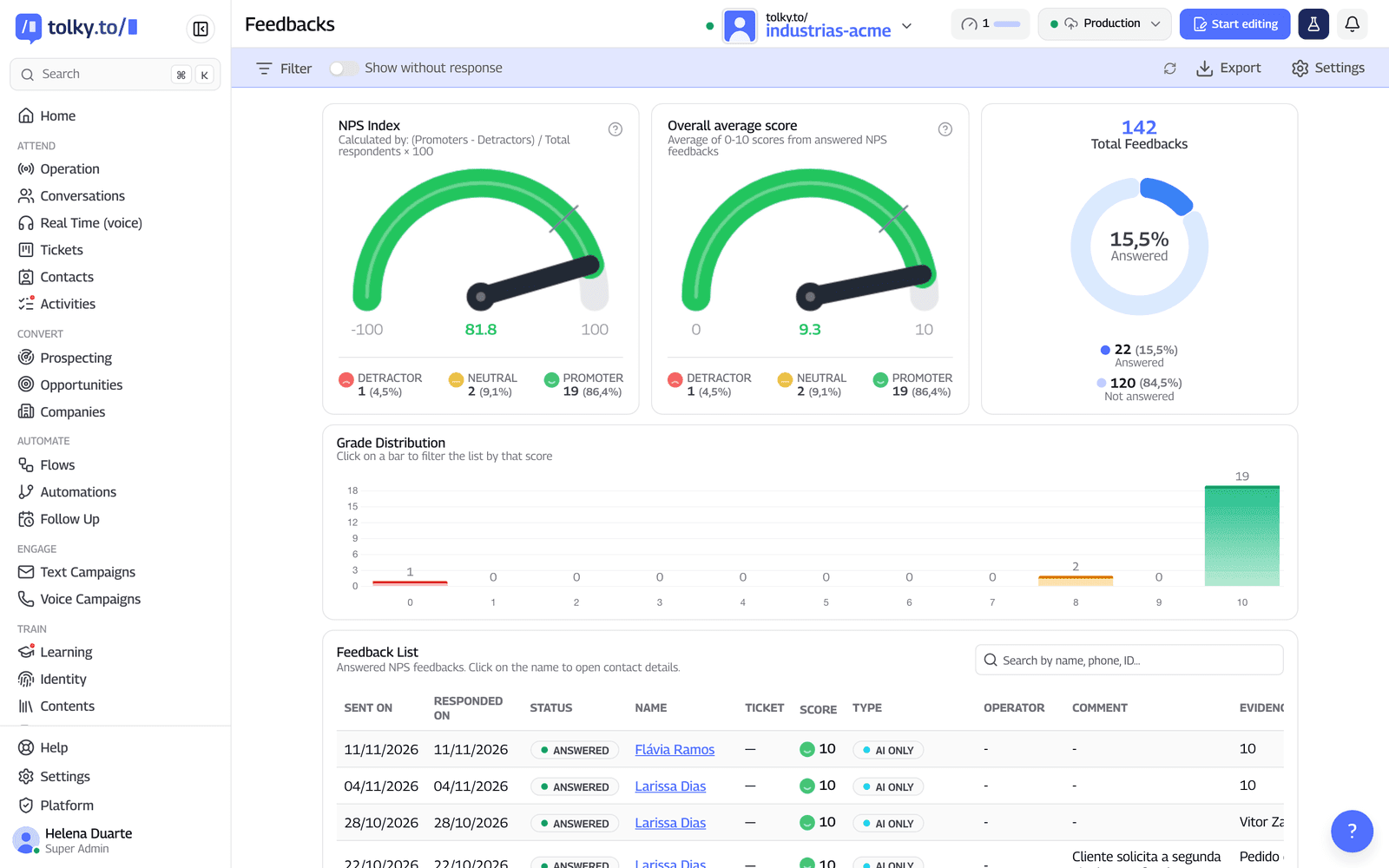
The survey is part of the Professional and Enterprise plans, as "Automatic follow-up and NPS" (see the plans). The platform processes more than 5 million AI messages per month and resolves more than 67% of conversations with AI; these are platform numbers, not a customer's results.
The follow-up with detractors comes from the feedback list, handled by the team, or from the AI itself, which asks the reason for a low score. For another survey format, such as CSAT, CES or email NPS, talk to our consultants. WhatsApp Service covers conversations, tickets, queues and NPS.
Frequently asked questions
What does NPS stand for?
NPS stands for Net Promoter Score. It is the metric introduced by Fred Reichheld, of Bain & Company, in 2003, which measures loyalty by how likely the customer is to recommend the company, on a scale of 0 to 10.
How do you calculate NPS?
Sort the answers into promoters (9 and 10), neutrals (7 and 8) and detractors (0 to 6), calculate the percentage of promoters and of detractors over the total answers and subtract one from the other. With 55% promoters and 20% detractors, NPS is 35.
What is the NPS scale?
The question uses a scale of 0 to 10, with 11 options. The final index goes from -100, when everyone is a detractor, to 100, when everyone is a promoter.
What is a good NPS score?
Any NPS above zero means more promoters than detractors. In the reading Qualtrics attributes to Bain, above 20 is favorable, above 50 is excellent and above 80 is world class, but the best benchmark is your competitors' NPS and your own trend.
Can NPS be negative?
Yes. When there are more detractors than promoters, the index falls below zero. A negative NPS calls for immediate attention to the detractors' reasons.
How does Tolky run satisfaction surveys?
With an automatic NPS survey on WhatsApp at the end of each conversation, in the Professional and Enterprise plans, and results on the Feedbacks screen, with the score split between AI-only conversations and those handled with the team. For another survey format, such as CSAT or CES, talk to our consultants.
Conclusion
NPS is a simple question with simple math: from 0 to 10, how likely the customer is to recommend the company, and the percentage of promoters minus the percentage of detractors. Its value lies in what comes next: the open question, the follow-up with every detractor and an honest comparison over time, including between AI and people.
See the WhatsApp NPS survey, learn about NPS in the glossary, see the plans or talk to the team →. Let's talk?
Share
Tags
- what is NPS
- how to calculate NPS
- NPS meaning
- NPS scale
- good NPS score
- Net Promoter Score
- NPS survey
- #conversational CRM
About the author

Co-founder of Tolky
Marlos Carmo is an AI entrepreneur and founder of Tolky, the conversational-era infrastructure and AI CRM that unifies intelligent service, multi-channel support (such as WhatsApp and voice), live CRM, and operational intelligence in a single ecosystem. He is a finalist for the SXSW Innovation Awards and a member of Francesco's Economy, a global network of young entrepreneurs focused on innovation and social impact. He works connecting Artificial Intelligence and digital transformation in projects for large organizations.
Next step
Want to bring this to your operation?
Tati, Tolky's AI assistant, understands your scenario in a few questions, suggests the best path and connects you with someone from the team, with full context.
Share