After-sales service: what it is, strategies and using AI on WhatsApp
What after-sales service is, the stages after a purchase, strategies for each one, what Brazilian consumer law requires, metrics and how to use AI and WhatsApp without wearing customers out.
TL;DR
After-sales service is everything a company does once the customer has bought: confirm and deliver, help with first use, answer questions, measure satisfaction, drive repeat purchases, ask for referrals and win back customers who stopped buying. On WhatsApp, AI answers questions right away and picks up stalled conversations, while the team handles the cases that need a human decision.
Share
The deal closes, the customer pays and the company disappears. The next message is an offer, weeks later, with nobody having asked whether the product arrived or worked. That is how a new customer becomes a lost customer.
This guide covers what after-sales service is, the stages after a purchase, what to do in each one, what the law requires in Brazil, how to measure it and how to use WhatsApp and AI without turning the relationship into spam.
Updated November 2026.
What is after-sales service?
After-sales service is the set of actions a company takes after a purchase so the customer receives what they bought, can use it, gets help when needed and comes back to buy again or recommends the brand. It starts with the order confirmation and has no end date: it lasts as long as the relationship does.
After-sales brings together support, customer success and relationship marketing. The short definition is in the after-sales glossary entry; in B2B companies, the same idea shows up in the bow-tie funnel, as the half of the funnel after the deal closes. This guide is operational: what to do, step by step, after the sale.
Why does after-sales service matter?
After-sales service matters because it decides whether the first purchase becomes a relationship: a customer who is looked after comes back, buys more and refers others; a forgotten one cancels, complains or simply leaves. The first sale pays for acquisition; profit tends to come from the ones that follow.
- Retention. Every customer who stays lowers churn, the share of customers lost in a period.
- Repeat purchase and expansion. Customers who trust the brand buy again and accept upsell offers more easily.
- Referral. A satisfied customer recommends you, with a trust no ad can buy.
- Value over time. All of this raises LTV, the value a customer generates over the relationship.
The financial effect has been known for decades. Bain & Company writes that increasing retention by as little as 5% can boost profits by as much as 95%, in an article from January 20, 2006, checked on November 24, 2026. The figure varies a lot by industry; treat it as a sign of direction, not as a target for your business.
What are the stages of after-sales service?
After-sales service has seven stages: confirmation and delivery, first use, support and questions, satisfaction measurement, relationship and repeat purchase, referral and win-back. Skipping one usually shows up later as a complaint or a cancellation.
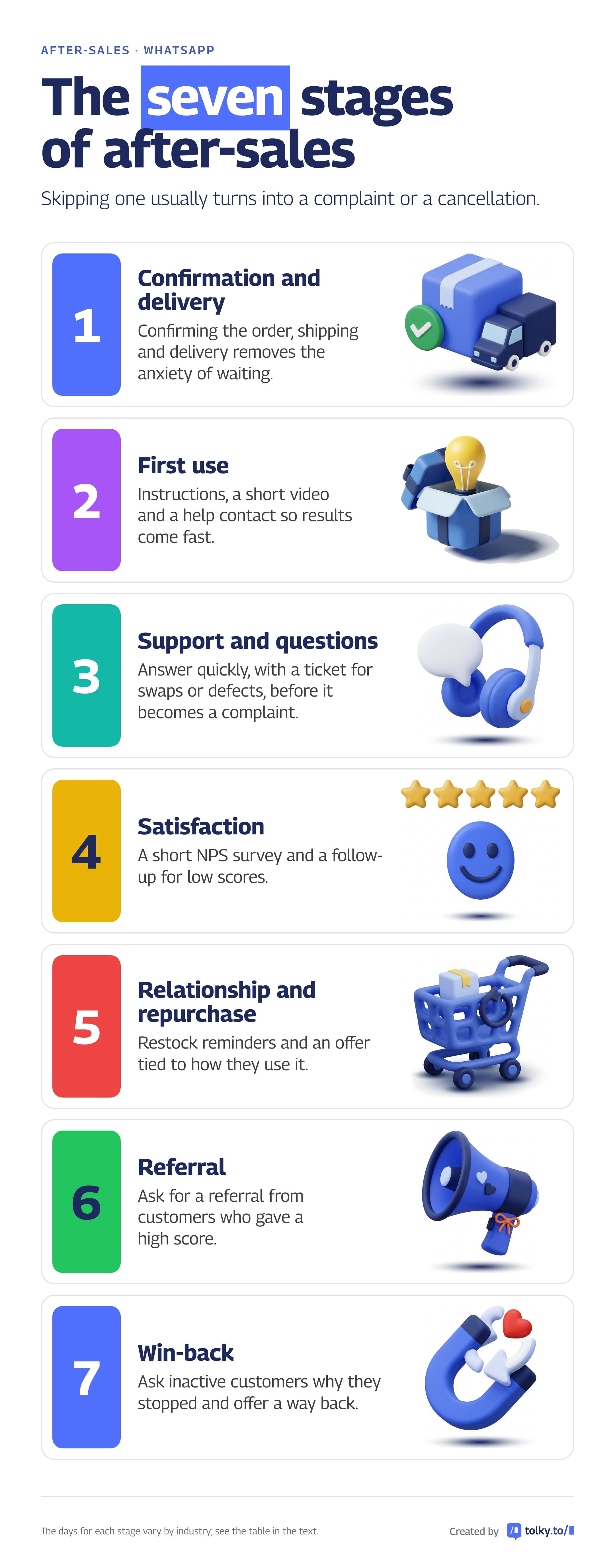 The seven after-sales stages, from order confirmation to winning back inactive customers.
The days are illustrative: a cosmetics store thinks about repeat purchases in weeks; a software company, in months. The table shows the same path, with the goal of each stage and the type of WhatsApp message it uses.
| Stage | Goal | What to do | WhatsApp message |
|---|---|---|---|
| Confirmation and delivery | Remove the anxiety of waiting | Confirm order, shipping and delivery | Utility template |
| First use | Quick results | Instructions, short video, help contact | Utility, if about the order and with no offer |
| Support and questions | Solve it before it becomes a complaint | Reply fast, ticket for exchanges or defects | Service, inside the 24-hour window |
| Satisfaction | Know how the customer feels | Short NPS and follow-up on low scores | Service in the window; utility if tied to an order |
| Relationship and repeat purchase | Drive the next purchase | Refill reminder, offer tied to usage | Marketing template |
| Referral | Bring in new customers | Ask high scorers for a referral | Marketing template |
| Win-back | Bring back those who stopped | Ask why, offer a way back | Marketing template |
After-sales strategies for each stage
The after-sales strategy that works is simple: at each stage, one useful message, at the right time, with a person available when the customer needs one.


Confirmation, delivery and first use
Confirm the order right away, with the number, the delivery estimate and a channel for questions, and announce shipping and delivery before anyone asks: every "where is my order?" is a notice that was missing. After delivery, a short walkthrough or a direct question ("Were you able to set it up?") prevents returns caused by confusion. In software, this stage is onboarding, covered in the guide to customer onboarding automation with AI.
Support, questions and exchanges
Reply fast and in the channel where the purchase happened. AI handles simple questions (delivery time, usage, invoice copy); exchanges, defects and complaints become tickets with an owner and a deadline and go to a person with the history, so the customer repeats nothing.
Satisfaction, repeat purchase and referral
Measure satisfaction with a short question, like the NPS question, after first use. A high score is a referral candidate; a low score calls for a follow-up before any offer. Repeat purchases work when the offer relates to what was bought: refills, a higher plan, an accessory.
Winning back inactive customers
Define what inactive means for you (for example, 120 days without buying, an illustrative number) and ask why before offering a discount: price, product, service and simple forgetfulness call for different actions.
What does the law require in after-sales service?
In Brazil, the Consumer Protection Code gives customers 30 days to complain about an apparent defect in a non-durable product and 90 days for a durable one, counted from delivery, plus 7 days to withdraw from purchases made outside a physical store. Companies selling to Brazilian consumers need an after-sales process ready for these requests.
- Time to complain (art. 26). The right to complain about apparent or easily detected defects expires in 30 days for non-durable services and products and in 90 days for durable services and products, counted from actual delivery or from the end of the service.
- Time to fix (art. 18, § 1). If the defect is not fixed within 30 days, the consumer can choose between replacing the product, getting the money back or a price reduction.
- Right of withdrawal (art. 49). For purchases made outside the business premises, such as by phone or at home, the consumer can withdraw within 7 days of signing or receipt, and any amounts paid are refunded immediately.
- E-commerce (Decree 7,962/2013, art. 5). Online stores must clearly state how to exercise withdrawal, accept it through the same tool used to buy and confirm receipt of the request.
Sources: Consumer Protection Code, Law 8,078/1990, and Decree 7,962/2013, on the Brazilian Presidency website (Planalto), checked on November 24, 2026. This summary is not legal advice.
In practice, the after-sales WhatsApp line needs to accept exchange and withdrawal requests, record the date and reply within the deadline.
How do you use WhatsApp and AI in after-sales service?
WhatsApp works for after-sales because the customer is already there, and AI works because it replies instantly, at any hour, and picks up stalled conversations, as long as the team takes the cases that need a decision. The care goes into Meta's rules for business-initiated messages.


- 24-hour window. When the customer writes, a 24-hour window opens in which the business can reply with free-form messages. Outside it, only with an approved template. The guide to the 24-hour window and templates in campaigns explains the rules.
- Template category. Meta's template categorization guidelines, checked on November 24, 2026, accept order confirmations, order updates and delivery notices as utility. A message with an upsell, a cross-sell or a promotion is marketing, even when it comes with an order update.
- AI as first level. An AI agent answers delivery, usage and common questions from the knowledge base and passes exchanges, defects and dissatisfaction to a person, with the history.
- Follow-up. When a customer stops replying in the middle of an exchange, a nudge keeps the case alive. The same technique for sales is in the guide to lead follow-up on WhatsApp.
- Relationship campaigns. Refill reminders go out through WhatsApp bulk messaging, with a segmented list and an opt-out.
Ready-to-use texts for each stage, with the category marked, are in the after-sales message templates.
How do you measure after-sales service?
Measure after-sales with six numbers: NPS, churn, repeat purchase rate, LTV, first response time and resolution. Look at them together: a good NPS with rising churn means you are only hearing from those who stayed.
| Metric | What it measures | How to calculate |
|---|---|---|
| NPS | Likelihood to recommend | % of promoters (9 and 10) minus % of detractors (0 to 6) |
| Churn | Customers lost | Customers who left in the period ÷ customers at the start of the period |
| Repeat purchase rate | Customers who came back | Customers with more than one purchase in the period ÷ total customers |
| LTV | Customer value over the relationship | Average order value × purchases per year × years of relationship |
| First response time | Speed of service | Average time between the customer's message and the first reply |
| Resolution rate | Problems solved | Resolved conversations ÷ total conversations |
The NPS rule comes from Bain & Company: promoters score 9 or 10, passives 7 or 8 and detractors 0 to 6, according to the Net Promoter System website, checked on November 24, 2026. The guide what is NPS walks through the calculation with an example, and the one on WhatsApp customer satisfaction surveys shows question templates.


How to act on each NPS score
A score only matters when it turns into action. The flow sums up each range.
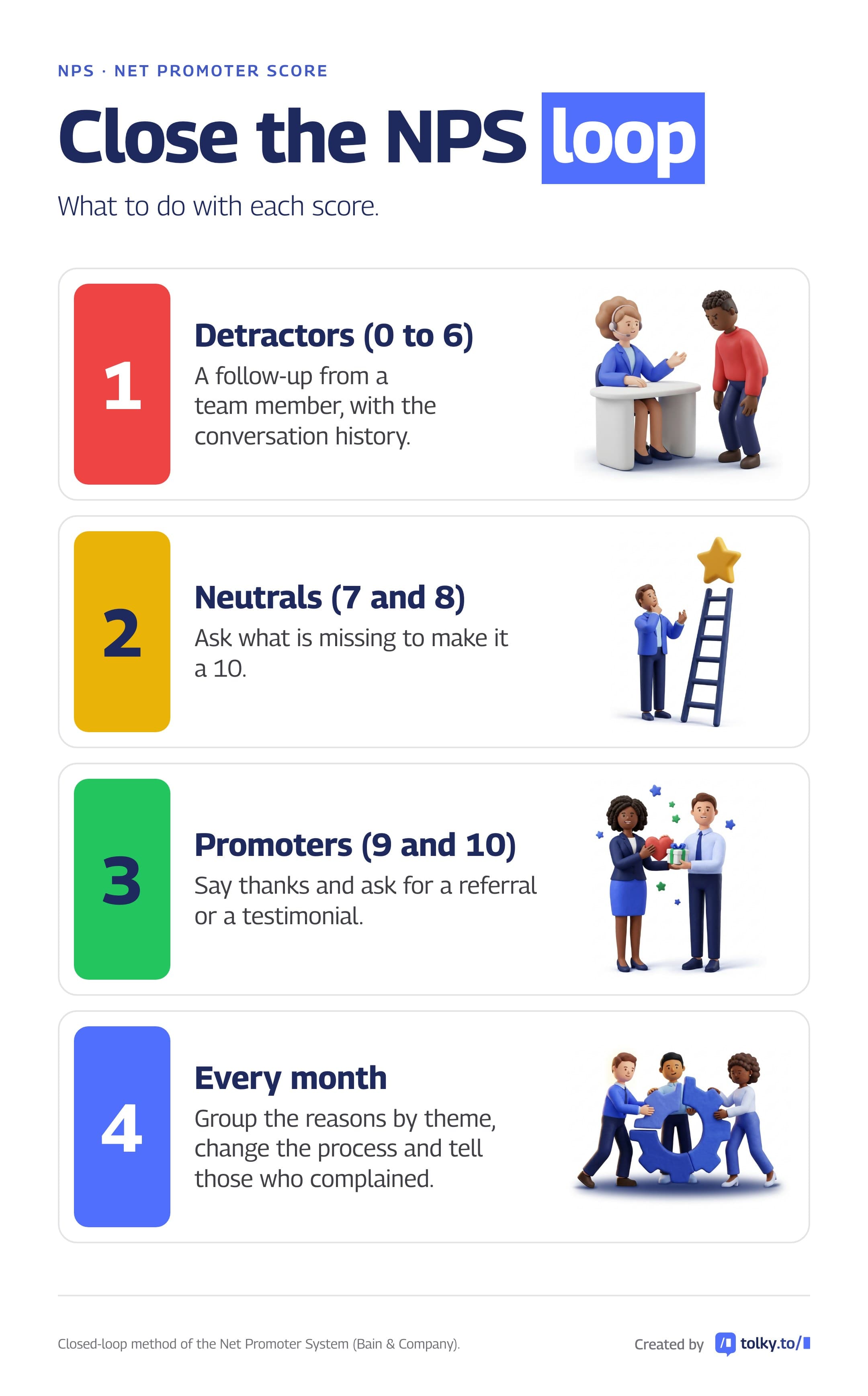 What to do with each NPS range. Source: Net Promoter System (Bain & Company).
- 0 to 6 (detractor): ask why and have a team member follow up, with the history at hand, before any offer.
- 7 or 8 (passive): ask what was missing for a 10 and group the answers by theme.
- 9 or 10 (promoter): say thanks and, a few days later, ask for a referral or a public review.
Common after-sales mistakes
The most common after-sales mistake is treating someone who just bought as a lead: sending an offer before knowing whether the product arrived and worked.


- Disappearing after payment. Without a delivery notice, the customer contacts support just to ask about the order.
- Selling to someone who complained. A campaign sent to a detractor with an open issue makes the relationship worse.
- Switching channels midway. They bought on WhatsApp, but the exchange requires email and a form.
- Surveys with no follow-up. Customers who give a low score and hear nothing stop answering.
- Too many messages. Weekly marketing to the whole base turns into blocks and lowers the number's quality rating.
- Measuring only NPS. Without churn and repeat purchases next to it, the score hides those who already left.
Where Tolky fits in after-sales service
Tolky is a conversational AI CRM: AI agents serve customers on the official WhatsApp API after the purchase, pick up stalled conversations with Follow Up, send the NPS survey at the end of the conversation and log everything in the CRM, with the team handling the cases that need a person. The after-sales and retention page shows the full flow.
- AI and team. Agents configured by mission (support, sales and relationship, engagement) serve customers on WhatsApp, website chat, email, voice and Microsoft Teams. Exchanges and defects become tickets with stages and priority, and whoever takes over gets the history.
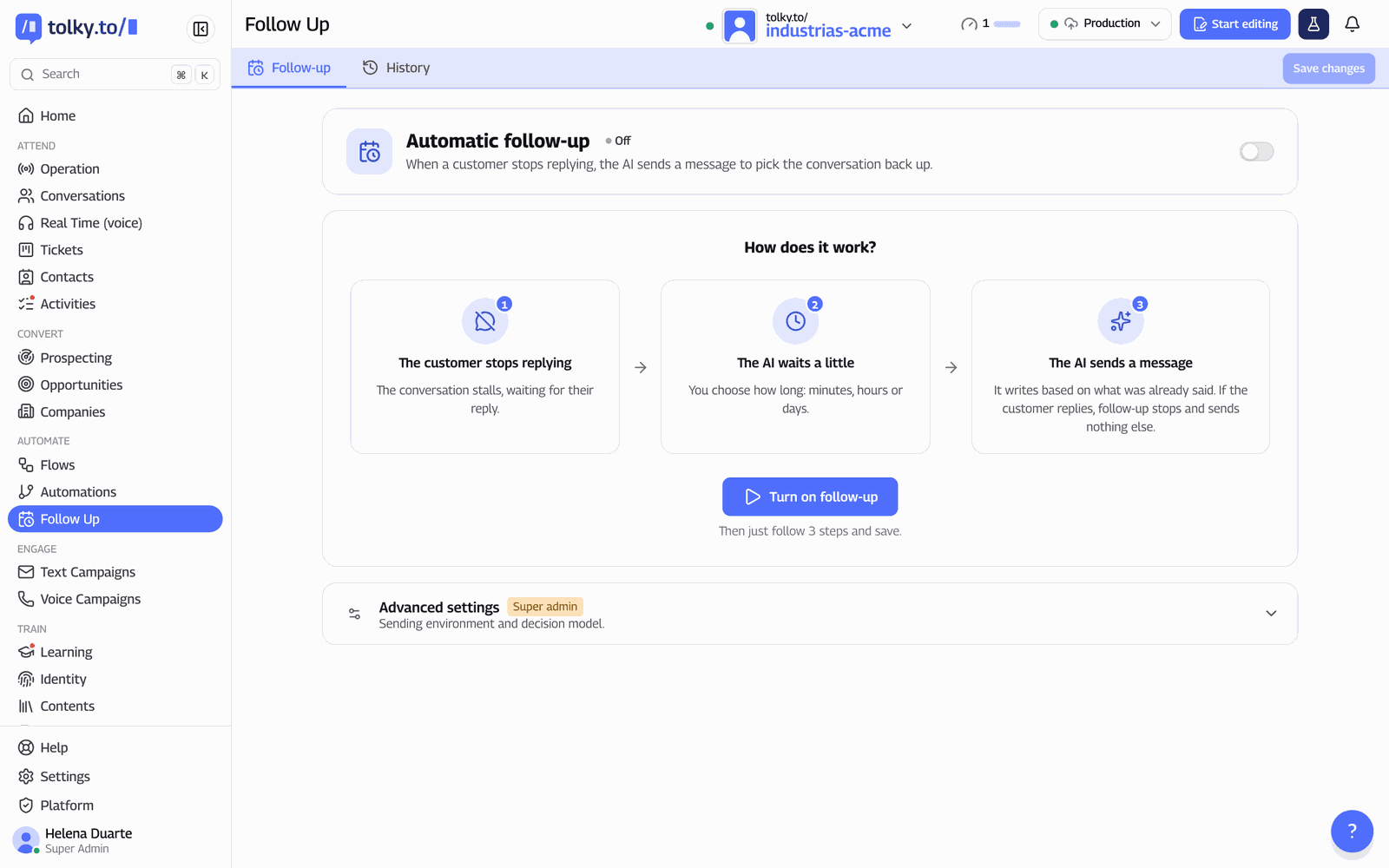
- Automatic Follow Up. When the customer stops replying, the AI waits as long as you choose (minutes, hours or days) and sends a message written from what was already said. If the customer replies, the follow-up stops.
- NPS at the end of the conversation. The survey goes out on WhatsApp when the AI detects the end of the conversation, after a configurable silence period, or when an operator sends it. You instruct the AI on what to do after the score (such as asking the reason for a low one), and the dashboard shows the index, the average, the 0 to 10 distribution, comments, a filter by operator and the split between AI-only and operator-assisted conversations. See the WhatsApp NPS survey page.
- Campaigns and CRM. Text campaigns go out on WhatsApp, Teams and email, and the WhatsApp CRM keeps the history. Order data comes in through native integrations with HubSpot, Salesforce and Pipedrive (RD Station CRM and Pipefy through the API), more than 1,000 apps in the Integration node of Workflows, the REST API or webhooks.
As a platform metric, not a customer result, Tolky handles more than 5 million AI messages per month, with more than 67% resolved by AI. Automatic Follow Up and NPS are in the Professional and Enterprise plans; see pricing.
Follow-up with detractors comes from the NPS dashboard and the instruction given to the AI. Tolky handles the conversation and the CRM; your ERP and carrier stay in your systems, connected through integrations. For another survey format or for SMS, talk to our consultants.
Frequently asked questions
What is after-sales service?
After-sales service is the set of actions a company takes after a purchase, from the order confirmation to winning back inactive customers. The goal is to keep the customer and get them to buy again and refer others.
What are the stages of after-sales service?
The seven most common stages are confirmation and delivery, first use, support and questions, satisfaction measurement, relationship and repeat purchase, referral and win-back. The order and the gap between them depend on the product.
What are the best after-sales strategies?
Notify customers before they ask, help with first use, reply fast in the channel of the purchase, measure satisfaction with a short question and only sell again after solving open issues.
How do you do after-sales on WhatsApp?
Use the official API, send confirmations and delivery notices as utility templates, answer questions inside the 24-hour window and keep marketing templates for repeat purchase, referral and win-back. AI answers the simple questions and passes the hard ones to the team.
How long do customers in Brazil have to complain about a product?
Under article 26 of Brazil's Consumer Protection Code, 30 days for non-durable products and services and 90 days for durable ones, counted from delivery, for apparent defects. For purchases made outside a physical store, article 49 gives 7 days to withdraw.
Does Tolky run satisfaction surveys in after-sales?
Yes, NPS: the survey goes out on WhatsApp at the end of the conversation, automatically or by an operator, and automatic NPS is in the Professional and Enterprise plans. For another survey format, such as CSAT or CES, talk to our consultants.
Conclusion
After-sales service is what turns a purchase into a relationship. Notify before customers ask, help with first use, solve issues in the same channel, measure with NPS, follow up on low scores and only then offer the next purchase. WhatsApp and AI scale that care, with the team close by for the cases that need a person.
See after-sales and retention, understand NPS, see pricing or talk to the team →. Let's talk?
Share
Tags
- after-sales service
- what is after-sales service
- after-sales strategies
- after-sales on whatsapp
- customer retention
- nps
- repeat purchase
- #conversational CRM
About the author

Co-founder of Tolky
Marlos Carmo is an AI entrepreneur and founder of Tolky, the conversational-era infrastructure and AI CRM that unifies intelligent service, multi-channel support (such as WhatsApp and voice), live CRM, and operational intelligence in a single ecosystem. He is a finalist for the SXSW Innovation Awards and a member of Francesco's Economy, a global network of young entrepreneurs focused on innovation and social impact. He works connecting Artificial Intelligence and digital transformation in projects for large organizations.
Next step
Want to bring this to your operation?
Tati, Tolky's AI assistant, understands your scenario in a few questions, suggests the best path and connects you with someone from the team, with full context.
Share