WhatsApp customer satisfaction survey: CSAT, NPS, CES and templates
How to run a customer satisfaction survey on WhatsApp: CSAT, NPS or CES, question templates, when to send, which template category to use, reply formats and how to act on the results.
TL;DR
A WhatsApp customer satisfaction survey is a short question sent in the chat, right after a support interaction or a purchase, to measure CSAT (satisfaction with the interaction), NPS (likelihood to recommend) or CES (effort to get the issue solved). Inside the 24-hour window it goes as a service message; outside it, only as a template, which Meta accepts as utility when the survey is about a specific order or interaction and treats as marketing when it is generic or includes an offer.
Share
Every business that serves customers on WhatsApp wants to know whether they left happy. Email surveys arrive late and hardly anyone answers; on WhatsApp, the question lands in the same chat where the conversation happened, and replying takes one tap.
But there are rules. Meta sorts messages into categories and prices each one differently, and a generic survey sent as utility can be recategorized as marketing. This guide covers which metric to use, question templates, when to send, how to set up the template and what to do with the answers.
Updated November 2026.
What is a WhatsApp customer satisfaction survey?
A WhatsApp customer satisfaction survey is a short question, answered with a button, a list, a number or text, sent in the chat to measure how the customer rated a support interaction, a purchase or the relationship with the company. The result becomes a metric such as CSAT, NPS or CES, and each answer stays linked to the contact.
The difference from an email survey is context: the question shows up right below the last message and the answer goes back into the same history, so you can match the score with who handled the case, how long it took and whether there was a handoff. A good survey has one main question, one optional open question and nothing else.
CSAT, NPS or CES: which metric should you use?
Use CSAT to rate a specific interaction, NPS to track the relationship with the brand over time and CES to find out how much effort the customer spent solving a problem. The three can coexist as long as each one has its own moment.


| Metric | Typical question | Scale | When to send | What it shows |
|---|---|---|---|---|
| CSAT | "How would you rate today's service?" | 1 to 5 | Right after the conversation closes | The quality of that interaction |
| NPS | "On a scale of 0 to 10, how likely are you to recommend us to a friend or colleague?" | 0 to 10 | Periodically or after relationship milestones | Loyalty and likelihood to recommend |
| CES | "Was it easy to get your request handled?" | 1 to 5 or 1 to 7 | After a resolved request | Friction in the process |
NPS has a fixed formula: promoters score 9 or 10, passives 7 or 8 and detractors 0 to 6, and the score is the percentage of promoters minus the percentage of detractors, according to the Net Promoter System website from Bain & Company, checked on November 23, 2026. CSAT and CES have no single owner and each company sets its own scale; what matters is keeping the same scale over time so you can compare.
For the difference between the two most used metrics, with a numeric example, read NPS vs CSAT: differences and which to choose.
Satisfaction survey question templates for WhatsApp
A good WhatsApp satisfaction survey template names the company, mentions the interaction or order, asks a single question and explains the scale. The examples below are illustrative; adjust the tone to your brand.
CSAT template after a support conversation
"Hi Ana, this is Example Store. Your request about exchanging order 4821 has been closed. How would you rate today's service? Reply from 1 (very poor) to 5 (excellent)."
After the score, a short open question: "Would you like to tell us what drove your score? Feel free to skip this."
NPS template
"Hi Carlos, you have been an Example Clinic patient for six months. On a scale of 0 to 10, how likely are you to recommend the clinic to a friend or colleague? Just reply with the number."
For scores from 0 to 6: "Thank you for being honest. What could we have done better?"
CES template
"Hi Julia, your duplicate invoice request is complete. Was it easy to get this done with us? Reply: 1 (very hard) to 5 (very easy)."
Three rules apply to all of them: one question per message, the scale explained in the message itself and no offer attached. The library of WhatsApp message templates has more ready-to-use texts, with the Meta category for each.
When should you send the satisfaction survey?
Send CSAT and CES right after the interaction ends, while the experience is fresh, and NPS in regular cycles or after relationship milestones, never in the middle of an open problem. Timing changes the score as much as the wording.
- CSAT: at closing. Minutes after the conversation or ticket is closed. If the customer is still waiting for a fix, the score measures the wait, not the service.
- CES: at resolution. After the exchange or the duplicate invoice is complete.
- NPS: in cycles. Every quarter or half year, or after milestones such as 90 days into a contract or a renewal. Sending NPS after every conversation tires customers and mixes the relationship with the interaction.
- Frequency and timing. Set a minimum interval per contact and respect business hours. A survey at 11:00 p.m. gets a block, not an answer.
Sending early also avoids templates: inside the 24-hour window, the survey goes as a free-form message.
Which message category does a WhatsApp survey use?
Inside the 24-hour window, the survey goes as a service message; outside it, you need an approved template, which Meta accepts as utility when the survey is about a specific order, transaction or interaction and treats as marketing when it is generic. This rule decides both approval and price.
Meta's template categorization guidelines, checked on November 23, 2026, include feedback surveys in the utility category when they collect feedback on "previous orders, transactions, or engagements" with customers. The same page says a generic survey will not be approved as utility and a survey with promotional content is treated as marketing.


| Situation | How to send | Likely category | Cost at Meta |
|---|---|---|---|
| Customer messaged you in the last 24 hours | Free-form or interactive message | Service | 1,000 free per number per month, then charged |
| Survey about an order or interaction, outside the window | Template | Utility | Utility rate for the recipient's country |
| General brand NPS, outside the window | Template | Marketing | Marketing rate, the highest |
| Survey with a coupon, offer or purchase invitation | Template | Marketing | Marketing rate |
Source: WhatsApp Business Platform pricing, checked on November 23, 2026. Since October 1, 2026, each business phone number gets 1,000 free service messages per month, and the rest are charged. Rates by country are in the guide to WhatsApp Business pricing.
When Meta decides a utility template should be marketing, it changes the category after advance notice, and repeated misuse can restrict utility sending, according to the same page. See also the 24-hour window and templates in campaigns.
Buttons, list, typed number or WhatsApp Flows: how does the customer answer?
The reply format depends on the scale: buttons work for up to three options, a list for up to ten, a typed number for any scale and a WhatsApp Flow when the survey has several questions. The NPS 0 to 10 scale has 11 options and does not fit in a list.
- Reply buttons. Meta allows up to 3 buttons per message, with up to 20 characters each, according to the reply buttons documentation. Good for a three-point CSAT ("Good", "Okay", "Poor") or for "Yes" and "No".
- List. Up to 10 rows in total, according to the list messages documentation. A 1 to 5 CSAT or CES fits.
- Typed number. The customer replies "8". It is the simple path for NPS.
- WhatsApp Flows. A one or multi-screen form inside the chat, with score, reason and comment. It requires the official API and, to send to customers, a verified business. The WhatsApp Flows guide covers requirements and limits.
Choose the format with the fewest taps: every extra screen is another reason to drop off.
How do you increase the response rate of a WhatsApp survey?
Response rates go up when the survey is short, arrives right after the experience, comes from the same number as the conversation and shows the customer that their opinion changes something. There is no reliable benchmark across industries; measure your own and compare it with itself.
- Same number. Customers reply to someone they already know. A survey from a different number looks like a scam, and the post on WhatsApp scams shows why that matters.
- Context in the message. Mention the order, the date or the topic. Without context, the survey gets fewer answers and is harder to approve as utility.
- Answer in the chat. Avoid external links: replying right there is faster than opening a website.
- Close the loop. Customers who gave a low score and heard back tend to answer again; those who never hear back stop answering.
Track the response rate by team and by type of interaction. A sudden drop may signal a template category change or the wrong sending time.
How do you act on the survey results?
Results only matter when they turn into action: detractors hear back from a person, low scores are grouped by reason and the pattern goes to whoever can change the process. A survey without follow-up teaches customers not to answer.


- Quick follow-up with detractors. An NPS of 0 to 6 or a CSAT of 1 or 2 opens a task for someone to contact the customer with the history at hand, as the guide to AI to human handoff explains.
- Reasons, not just scores. Group comments into a few themes: delay, wrong answer, product, delivery, price. The most cited theme is the priority for the month.
- Cross-check with operations. Compare the score with first response time, handoffs and first contact resolution. Sometimes a low score comes from the queue, not from the person who answered.
- Don't push for the score. Asking "please give us a 10" distorts the metric.
Where Tolky fits in satisfaction surveys
Tolky is an AI conversational CRM that automatically sends an NPS survey at the end of each WhatsApp conversation and shows the result on the dashboard, alongside how much the AI solved on its own and how much needed human support. Tolky does not currently offer CSAT or CES surveys: its native satisfaction metric is NPS.
- NPS at the end of the conversation. The survey goes out from the same official number as the chat, without the agent having to remember. Agents also see sending the NPS among the recommended actions.
- Context next to the score. Each conversation gets a summary, topic and sentiment, and reports show conversations, AI resolution and human support on the same dashboard.
- Plan. Automatic NPS and Follow Up are included in the Professional and Enterprise plans; WhatsApp starts on Starter. See the plans.
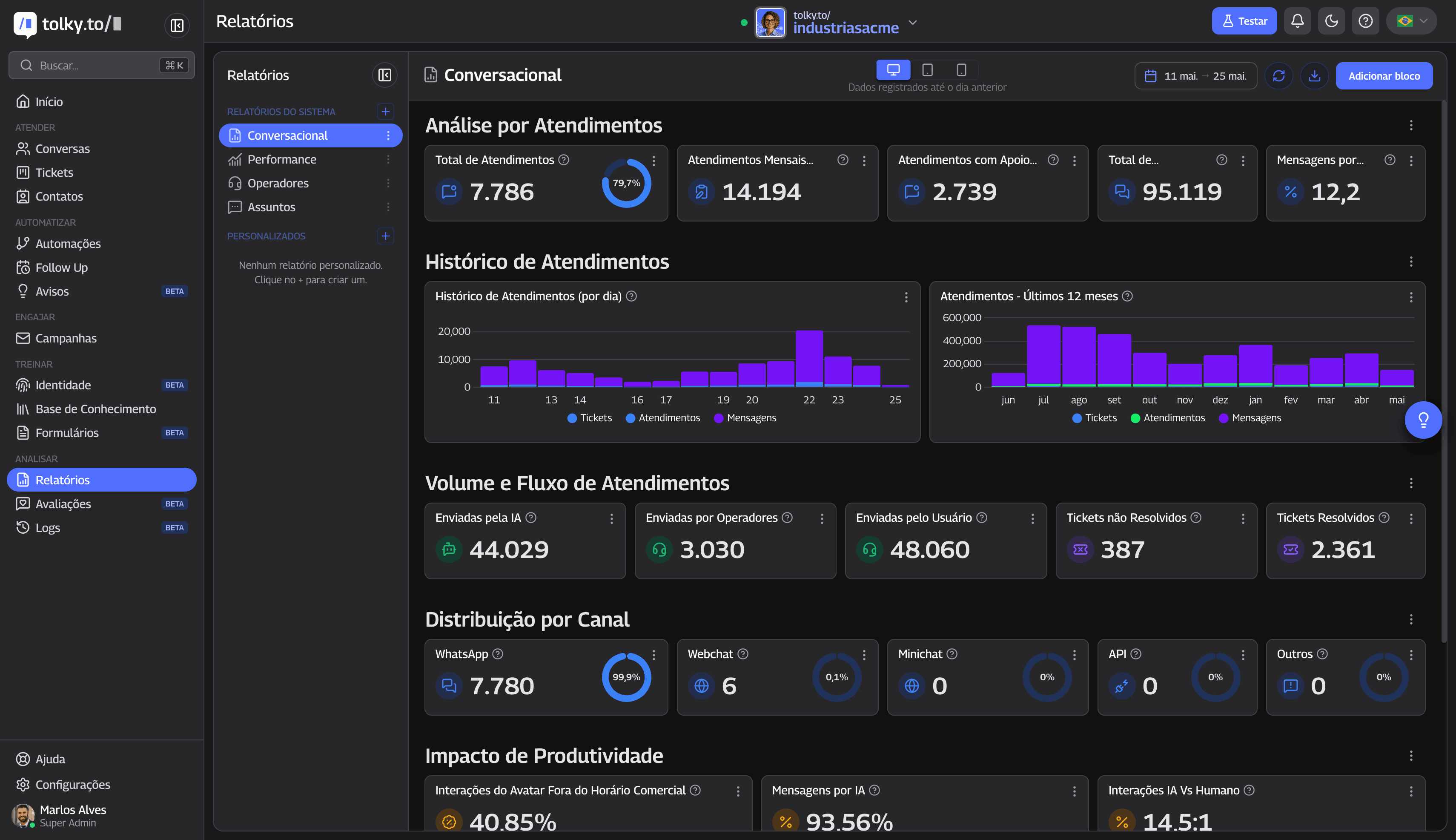
What Tolky does not do: it does not send CSAT or CES and does not build WhatsApp Flows. If your operation needs CSAT for every interaction, use a dedicated survey tool or a provider that publishes Flows; they serve that case better. Tolky's WhatsApp Service covers the conversation, tickets, queues and NPS.
Frequently asked questions
How do you run a satisfaction survey on WhatsApp?
Pick the metric, write a short question with the scale explained and send it right after the interaction: inside the 24-hour window as a free-form message, outside it as an approved template. Follow up with anyone who gives a low score.
Is a WhatsApp satisfaction survey a utility or marketing template?
It depends on the content. According to Meta, a survey about a specific order or interaction can be utility; a generic survey is not approved as utility, and a survey with an offer is marketing.
What is the best metric to measure WhatsApp customer service?
CSAT, because it measures the interaction that just happened. NPS measures the relationship with the brand and works better in cycles.
How do you run an NPS survey on WhatsApp if a list only holds 10 options?
The NPS scale runs from 0 to 10, which is 11 options, and Meta's interactive list allows up to 10 rows. The options are asking the customer to type the number, using a WhatsApp Flow or letting a platform send the survey and interpret the reply.
How much does it cost to send a satisfaction survey on WhatsApp?
Inside the 24-hour window, the survey is a service message: each number gets 1,000 free per month, and the rest are charged. Outside the window, you pay the utility or marketing template rate for the recipient's country.
Does Tolky offer CSAT surveys?
No. Tolky sends the NPS survey automatically at the end of each conversation, on the Professional and Enterprise plans, and shows the result on the dashboard. For CSAT or CES, use a dedicated tool.
Conclusion
A WhatsApp satisfaction survey works when it is short, arrives at the right moment and turns into action. Use CSAT for the interaction, NPS for the relationship and CES for effort, send inside the window whenever you can and follow up with every detractor with the history at hand.
See WhatsApp Service, learn about NPS, see the plans or talk to the team →. Let's talk?
Share
Tags
- whatsapp customer satisfaction survey
- whatsapp nps survey
- csat whatsapp
- satisfaction survey template
- customer effort score
- customer service rating
- whatsapp template
- #conversational CRM
Cited in
- Chatbot for clothing stores: sizing, exchanges and WhatsApp sales
- What is SAC? Brazil's customer service rules, SAC 3.0 and AI
- WhatsApp automation for business: what to automate and how to start
- Free WhatsApp CRM: what is really free and what you pay for
- WhatsApp Business auto reply: greeting, away messages and templates
- WhatsApp Business: what it is, benefits, tools and when to migrate
- WhatsApp Flows: what it is, what it is for and use case examples
- What is customer experience (CX): journey, metrics, AI and examples
- What is CSAT: how to calculate it and how it differs from NPS
- WhatsApp customer service platform for businesses: how to choose
About the author

Co-founder of Tolky
Marlos Carmo is an AI entrepreneur and founder of Tolky, the conversational-era infrastructure and AI CRM that unifies intelligent service, multi-channel support (such as WhatsApp and voice), live CRM, and operational intelligence in a single ecosystem. He is a finalist for the SXSW Innovation Awards and a member of Francesco's Economy, a global network of young entrepreneurs focused on innovation and social impact. He works connecting Artificial Intelligence and digital transformation in projects for large organizations.
Next step
Want to bring this to your operation?
Tati, Tolky's AI assistant, understands your scenario in a few questions, suggests the best path and connects you with someone from the team, with full context.
Share