AI virtual receptionist: phone answering for clinics and law firms
What an AI virtual receptionist does on the phone and on WhatsApp for clinics, law firms and real estate agencies: scheduling, questions, triage, messages and transfers, with data privacy care.
TL;DR
An AI virtual receptionist is an agent that answers the calls and WhatsApp messages of clinics, practices, law firms and real estate agencies: it books, reschedules and confirms appointments, answers questions, triages, takes messages and transfers to the right person, including after hours. It gives no clinical or legal advice, says it is an AI and treats health data as sensitive data, as Brazil's LGPD requires.
Share
In clinics, practices and law offices, the front desk does three things at once: it serves whoever is at the counter, answers WhatsApp and picks up the phone. When the phone rings while someone is being helped, one of the three loses. In a business that runs on appointments, an unanswered call is often an appointment that never got booked.
An AI virtual receptionist, also called an AI receptionist or AI virtual assistant, picks up that call right away. This guide covers what it does, how it compares with an in-house receptionist and a remote answering service, how it works in each type of business and what care to take with health data.
Updated in November 2026.
What is an AI virtual receptionist?
An AI virtual receptionist is a voice and text agent that answers the calls and messages of an appointment-based business, understands the request in natural language, handles the administrative part and passes to the team whatever needs a person. It is not a recording with a keypad menu, nor a person working from home.
Under the hood, it is a voice agent: it transcribes what the caller says, decides the reply with a language model and answers with a synthetic voice. On WhatsApp, the same agent replies in text and understands voice notes. The full technical explanation is in AI voice agent for customer service.
The name changes by industry: "virtual receptionist" is common in clinics, "virtual assistant" or "AI secretary" in practices and law offices, "virtual agent" in larger companies. The job is the same.
What does an AI virtual receptionist do on a call?
An AI virtual receptionist does the administrative work that repeats on every call: booking, rescheduling and confirming appointments, answering questions, triaging, taking messages and transferring to the right person. After hours, it keeps handling whatever has a clear rule.


- Scheduling. Takes the request, offers options based on the calendar rules, reschedules and confirms. When the calendar is not integrated, it collects the preference and the team confirms.
- Questions. Address, parking, accepted insurance plans, documents to bring, self-pay fees, preparation instructions written by the team.
- Triage. Asks the type of visit (first appointment, follow-up, test, meeting, viewing) and routes it.
- Messages. Notes who called, the subject and the best time to call back, and logs it for the team.
- Transfers. Passes the call to the right person or department, with the reason, and offers an alternative if nobody picks up.
- After hours. Handles the administrative part, logs requests and says when the team will get back.
The setup steps (channel, greeting, voice, knowledge base, transfers and testing) are in AI to answer business calls. Here the focus is what changes in an appointment-based business.
In-house receptionist, remote service or AI: which to choose?
An in-house receptionist is best at judgment and warmth, a remote answering service covers hours and peaks with people, and AI answers several calls at once, at any hour, with everything logged. In practice, the most common mix is AI on the front line and people on the cases that need judgment.
| Criterion | In-house receptionist | Remote answering service | AI virtual receptionist |
|---|---|---|---|
| Hours | The team's working hours | Per contract | Any time |
| Simultaneous calls | One per person | Depends on the contracted team | Several in parallel |
| Knowledge of the business | Deep, built with experience | Limited to the script provided | What is in the knowledge base |
| Warmth and judgment | Best of the three | Good, with people | Limited; transfers delicate cases |
| Record of each call | Depends on who takes notes | Message by text or email | Transcript in the contact's history |
| WhatsApp alongside the phone | Splits attention | Not always included | Same agent on both channels |
| Cost model | Salary and payroll costs | Monthly fee or call bundle | Platform plus usage |
The table leaves out amounts because they vary widely by city, contract and volume. To estimate the return in your case, use the customer service ROI calculator.
How does it work in each type of business?
The basic design is the same in any appointment-based business, but what the AI can answer, what it collects and who it transfers to changes by industry. Three examples:
Clinics and medical practices
The AI books, reschedules and confirms appointments, explains insurance and preparation and sends the confirmation afterward on WhatsApp. It does not interpret symptoms, tests or medication: any mention of those goes to the team, and signs of urgency get the safety reply defined by the clinical lead. The industry setup is in AI customer service for healthcare, and the WhatsApp side in chatbot for clinics on WhatsApp.
Law firms
The AI answers callers, identifies the practice area (employment, family, corporate), books the intake meeting and gives a generic case update when there is a rule for it. It does not give legal opinions or estimate the odds of winning. See AI customer service for law firms and the guide on WhatsApp for law firms.
Real estate and service providers with a calendar
The AI answers questions about the property or service, qualifies the interest, books the viewing or estimate and hands off to the agent or technician in charge. See AI customer service for real estate and the guide on real estate CRM with WhatsApp.
An AI receptionist on the phone and on WhatsApp
An AI receptionist works best when the same agent answers both the phone and WhatsApp, because patients and clients use both and expect the same answer on either channel. Whoever calls today texts tomorrow, and the history has to be in one place.
Three common scenarios:
- Called and wants the confirmation in writing. The AI reschedules by voice and the confirmation follows on WhatsApp.
- Sent a voice note on WhatsApp. The agent understands the audio and replies in text or in audio, depending on the setup.
- Called through WhatsApp. The call button in the chat reaches the same AI. The rules for these WhatsApp calls are in WhatsApp Business calls.
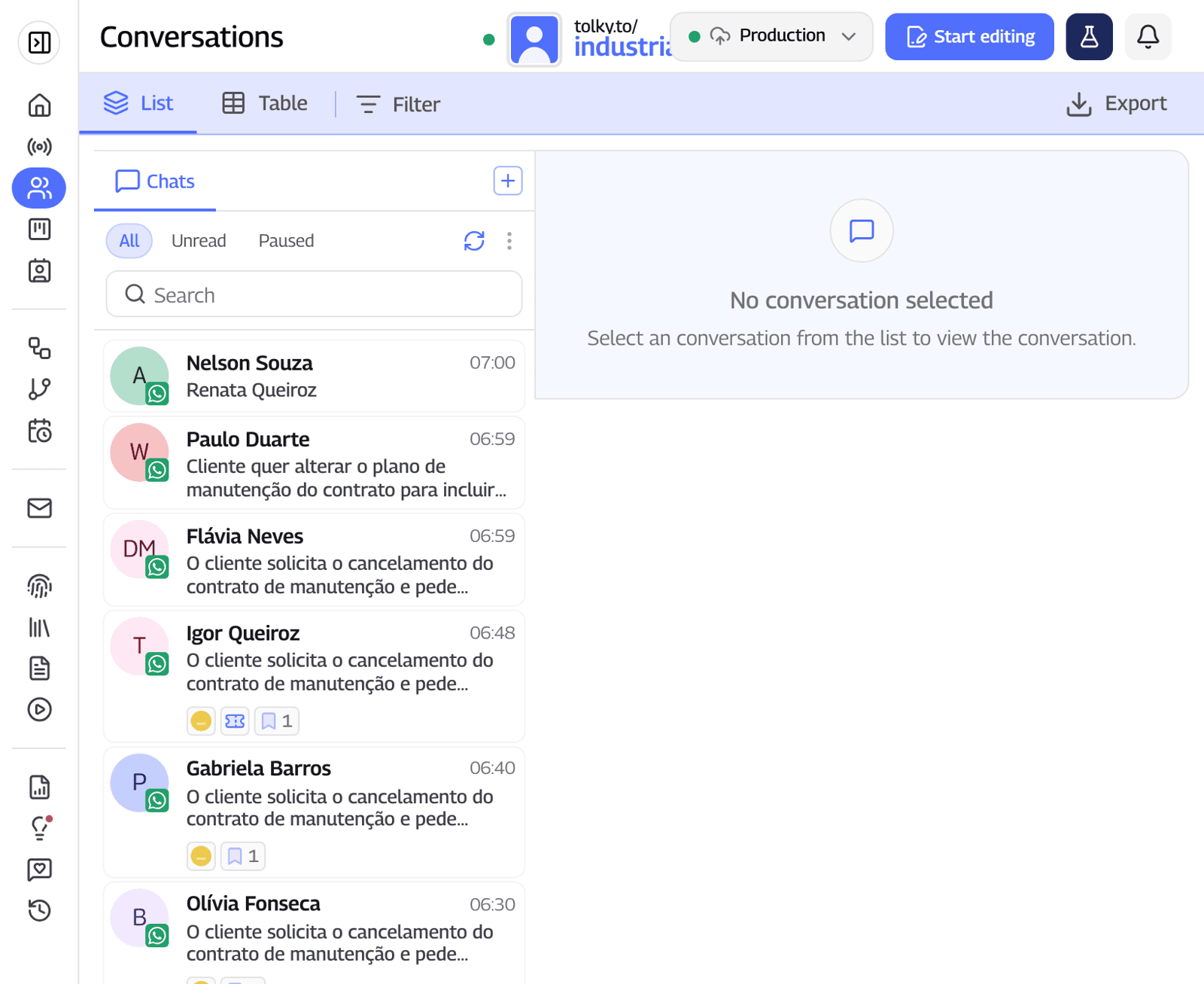
With voice and text in the same history, the human front desk sees what the AI already did before taking over, and nobody asks everything again.
What care to take with health data, AI disclosure and limits?
An AI virtual receptionist needs four safeguards: treat health data as sensitive data, disclose that the caller is talking to an AI, give no clinical or legal advice and guarantee transfer to a person. These protect the patient, the client and the business.


What Brazil's LGPD says about health data
Under Brazil's Law No. 13,709/2018 (LGPD), checked on November 20, 2026, health data is sensitive personal data (art. 5, II). Article 11 says such data may only be processed in the cases it lists, such as the data subject's consent "in a specific and highlighted manner, for specific purposes" (item I, our translation) or health protection, exclusively in procedures carried out by health professionals, health services or health authorities (item II, "f"). Which basis applies to each flow is a decision for the clinic with its legal counsel and data protection officer. Rules vary by country, so outside Brazil check your own health privacy law. See the LGPD glossary entry.
In practice, the safest design is for the AI not to ask about symptoms "to speed things up". It asks the type of visit, not the clinical picture, and collects only what is needed to book.
The other three safeguards:
- AI disclosure. The greeting says the caller is speaking with a virtual assistant and can ask for the team.
- No clinical or legal advice. The knowledge base holds only administrative content. Questions about health or the case go to a professional.
- Guaranteed transfer. A request to speak with a person is honored at any point. The rules are in AI to human handoff.
How to roll out an AI virtual receptionist
The rollout takes five stages, from the list of call reasons to monitoring the first weeks, and someone who knows the front desk needs to take part in all of them. The table sums up what to do and who does it.
| Stage | What to do | Who takes part |
|---|---|---|
| 1. Reasons | List why people call and message | Front desk |
| 2. Knowledge base | Write administrative answers and what must never be answered | Front desk and clinical lead or partner |
| 3. Calendar | Set the rules for booking, rescheduling and confirming, and decide on integration | Front desk and whoever runs the systems |
| 4. Transfers | Decide where each type of request goes and what happens after hours | Operations manager |
| 5. Testing and monitoring | Call as a patient or client, read transcripts and adjust | Front desk |
Start with confirmations and rescheduling, which are repetitive and easy to measure. Then expand to questions and triage.
Where Tolky fits in
Tolky is a conversational AI CRM in which the same agent handles voice and text, and Voice Service turns it into a virtual receptionist that answers calls on the phone line, on WhatsApp and through voice on the website. The phone line is available by activation, with the number and agent you choose.
- Natural speech. Voice with a regional accent, opening greeting, short replies and interruptions allowed.
- Clinics and services with a calendar. Rescheduling by voice, confirmation sent afterward on WhatsApp and after-hours answering.
- People on the line. The team follows calls live and can listen in; when an operator joins the audio, the AI goes silent. If the owner does not pick up a transfer, the call rings other operators.
- One history. The transcript stays in the contact's history, next to the text conversations.
- Calendar and systems. The platform connects to other systems through Flows (the Integration node catalog includes Google Calendar and Outlook Calendar), the API and webhooks. Check in the demo how your calendar fits into the call.
To confirm appointments and viewings in volume, Voice Campaigns have the AI call the day's list, with time windows, retries and a transcription notice at the start of every call.
What Tolky does not do: it gives no clinical or legal advice, voice is not on by default and it is not a voiceover or voice cloning tool.
Frequently asked questions
What is an AI virtual receptionist?
It is an AI agent that answers the calls and messages of a practice, law office or clinic, books and confirms appointments, answers administrative questions, takes messages and transfers to the team. It works at any hour and logs every interaction.
Does an AI virtual receptionist work on WhatsApp?
Yes, when the platform covers both channels. The same agent replies to messages, understands voice notes and answers WhatsApp calls, with voice and text in the same history.
Can an AI receptionist give medical advice?
No. It handles only the administrative side. Any question about symptoms, tests or medication goes to a professional, and signs of urgency get the safety reply defined by the clinical lead.
Does an AI virtual receptionist replace the human receptionist?
No. It absorbs repetitive calls, peaks and after-hours answering. The front desk keeps in-person care and the cases that need judgment.
How does Brazil's LGPD apply to a clinic's AI receptionist?
Health data is sensitive personal data under the LGPD (art. 5, II) and may only be processed in the cases of art. 11. The safest design is not collecting clinical information on the call, restricting access and defining the legal basis with counsel.
Conclusion
An AI virtual receptionist answers the call that rings unanswered today, books and confirms appointments, triages and passes to the team what belongs to people. Start with the calendar, disclose that it is an AI, keep health data out of the conversation and follow the first weeks through the transcripts.
Explore Voice Service, see Voice Campaigns, see the plans or talk to the team →. Let's talk?
Share
Tags
- ai virtual receptionist
- ai receptionist
- virtual receptionist for clinics
- ai receptionist for law firms
- ai virtual assistant whatsapp
- #ai voice agent
- health data privacy
- #conversational CRM
About the author

Co-founder of Tolky
Marlos Carmo is an AI entrepreneur and founder of Tolky, the conversational-era infrastructure and AI CRM that unifies intelligent service, multi-channel support (such as WhatsApp and voice), live CRM, and operational intelligence in a single ecosystem. He is a finalist for the SXSW Innovation Awards and a member of Francesco's Economy, a global network of young entrepreneurs focused on innovation and social impact. He works connecting Artificial Intelligence and digital transformation in projects for large organizations.
Next step
Want to bring this to your operation?
Tati, Tolky's AI assistant, understands your scenario in a few questions, suggests the best path and connects you with someone from the team, with full context.
Share