Real estate CRM with WhatsApp: how agencies stop losing leads
What a real estate CRM needs so portal and ad leads are not lost: selection criteria, the flow from listing to showing, the role of AI on WhatsApp, metrics and common mistakes.
TL;DR
A real estate CRM is the system that records every property inquiry, where it came from, what the person is looking for and which stage they are in, and makes sure someone replies and follows up until the showing. With WhatsApp at the center, it needs to take in contacts from portals, ads and the website, distribute them among agents, follow up and keep the history. AI helps reply right away and qualify; the showing, the offer and the negotiation stay with the agent.
Share
A prospect sees an apartment on a listing portal at 10:40 p.m., taps the WhatsApp button and asks whether it is still available. Nobody answers until the next morning. By the time the agent writes back, the prospect has already booked a showing for another property, with another agency.
This is the most common leak in real estate, and more advertising does not fix it. A real estate CRM does: one that takes in every contact, replies fast, routes to the right agent and does not let anyone fall through the cracks. This guide covers what that CRM needs, how a lead should move from listing to showing and where AI helps without taking the agent out of the negotiation.
Updated in November 2026.
What is a real estate CRM?
A real estate CRM is the system that records everyone interested in buying, renting or listing a property, with the source of the contact, the search profile, the deal stage and the full conversation history. It tells the agency who is waiting for a reply, who is ready for a showing and who needs a follow-up.
What sets a real estate CRM apart from a generic CRM are the fields and stages: neighborhood, price range, number of bedrooms, purpose (to live in or invest), timeline, property of interest, showing requested and offer. When service happens on WhatsApp, the CRM needs to be tied to the conversation, not to a spreadsheet filled in later.
Why do agencies lose leads from portals and ads?
Agencies lose leads because contacts arrive at any hour, through several paths, and land in a WhatsApp inbox with no owner, no filter and no follow-up reminder. The problem is rarely a lack of prospects; it is the gap between the message and the reply.


The most common causes:
- Timing. Portals, ads and the website send contacts at night and on weekends, when the on-duty shift does not cover them.
- Several sources. Portal forms, the WhatsApp button on an ad, website chat and referrals arrive through different channels, and each agent keeps their own.
- Agents with no filter. Questions about price, square footage and location take up the day, and the agent does not know who is ready for a showing.
- No follow-up. People who stopped replying after the first conversation rarely get a second message.
- History on the agent's phone. When the agent leaves the agency, the list of prospects leaves too.
We break down this leak, with signs to diagnose it in your operation, in lead loss on WhatsApp.
What does a real estate CRM need?
A real estate CRM needs to bring contacts from every source together, distribute them among agents with a clear rule, remind the team to follow up, record showing requests and keep the history with the company. The table sums up the criteria and the question worth asking any vendor.
| Criterion | Why it matters | Question for the vendor |
|---|---|---|
| Intake from portals, ads and website | A lead cannot depend on someone copying the contact | How does each source reach the CRM: WhatsApp, website, email, API or integration? |
| Distribution among agents | Avoids disputes and leads with no owner | Does distribution consider who is online and show why each contact went to each person? |
| Follow-up | Someone who did not reply to the first message may still be interested | Does the system re-engage people who stopped replying on its own, respecting quiet hours? |
| Showing request | It is the moment of highest intent | How is a showing requested, recorded and confirmed, and who confirms it? |
| Central history | The client list belongs to the agency, not to a phone | Does the whole conversation stay in the CRM even if the agent changes? |
| Access profiles | Agents should not see everyone's contacts | Can each agent be limited to their own conversations? |
| Reports by source | Shows which portal or ad brings showings, not just clicks | Can I see response time and conversion by source? |
A practical rule: ask the vendor to walk a real lead from the ad to the agent, live. If the answer is "a developer will set that up later," note it as cost and time.
How does a lead move from listing to showing?
The ideal flow has six steps: the prospect writes, gets an immediate reply and is qualified, goes to the right agent, asks for a showing, the agent confirms and, if the conversation stalls, the agency re-engages. Each step needs to leave a record in the CRM.


| Step | Who does it | What gets recorded |
|---|---|---|
| 1. The prospect writes | From the portal, the ad or the website, at any hour | Source, property of interest, date and time |
| 2. Reply and qualification | The AI, with the properties registered in the knowledge base | Neighborhood, price range, purpose, timeline |
| 3. Distribution | Queue rule among online agents | Assigned agent and reason for the choice |
| 4. Showing request | The AI collects the preferred day and time | Preference saved in the history |
| 5. Confirmation | The agent confirms the showing and availability | Showing confirmed at the pipeline stage |
| 6. Re-engagement | Automatic follow-up or campaign | Attempts and the contact's reply |
The critical point is the handoff between steps 2 and 3. If the agent receives only a name and a phone number, they start the conversation from scratch and the prospect repeats everything. With the summary, the agent starts out knowing what the client wants and which time they asked for. For re-engagement, see lead follow-up on WhatsApp.
What is the role of AI in real estate customer service?
AI replies to the prospect right away, at any hour, with the details of the registered properties, understands what they are looking for and hands the agent the people who are ready to talk. It does not replace the agent: it handles the first reply and screening so the agent spends the day with people who will actually visit.
What AI does well in real estate:
- Replies around the clock to questions about availability, square footage, parking, location and HOA fees, using what is in the knowledge base.
- Qualifies with short questions: to live in or invest, neighborhood, price range, timeline. The logic is the same as AI lead qualification, adapted to property.
- Collects the showing request, with the preferred day and time, and passes it to the agent to confirm.
- Re-engages people who stopped replying, with a message written from the conversation.
What should stay with the agent: offers, discounts, payment terms, contract questions, paperwork and mortgage financing. A clear handoff rule keeps the AI from promising what it cannot. A menu-based WhatsApp chatbot also helps with screening, but it does not understand open questions like "anything near the subway under 500k?".
Which metrics should a real estate CRM track?
The metrics that say the most about lead loss are first response time, the lead-to-showing rate and the number of leads with no follow-up. They show where the funnel leaks, not just how many contacts came in.
- First response time, split between business hours and after hours.
- After-hours leads that got a reply out of all leads that arrived after hours.
- Lead-to-showing and showing-to-offer rates, by source.
- Leads with no follow-up: how many stopped replying and never got another message.
- Time until the agent takes over after qualification.
- Cost per showing for each portal or ad, not just cost per lead.
Compare before and after you change the process, over the same period and for the same type of property. Benchmarks vary a lot by city and price point, so set yours from your own agency's history.
Common mistakes when rolling out a real estate CRM
The most common mistake is rolling out the CRM while service stays on each agent's phone, which leaves the system empty and the leads where they were before. Other frequent mistakes:
- Registering incomplete listings in the knowledge base, which makes the AI answer "let me check" to everything.
- Distributing with no rule, first come first served in a group chat, which creates disputes and forgotten leads.
- Not recording the reason a deal was lost, so you never know whether it was price, location or delay.
- Letting the AI negotiate, instead of passing offers and discounts to the agent.
- Measuring only leads per portal, without looking at showings and offers by source.
Where Tolky fits
Tolky is an AI conversational CRM in which AI agents reply to prospects on WhatsApp and on the website, understand what each one is looking for, record everything in the CRM and hand the agent the people ready to talk. The page for real estate agencies and developers shows the full flow.
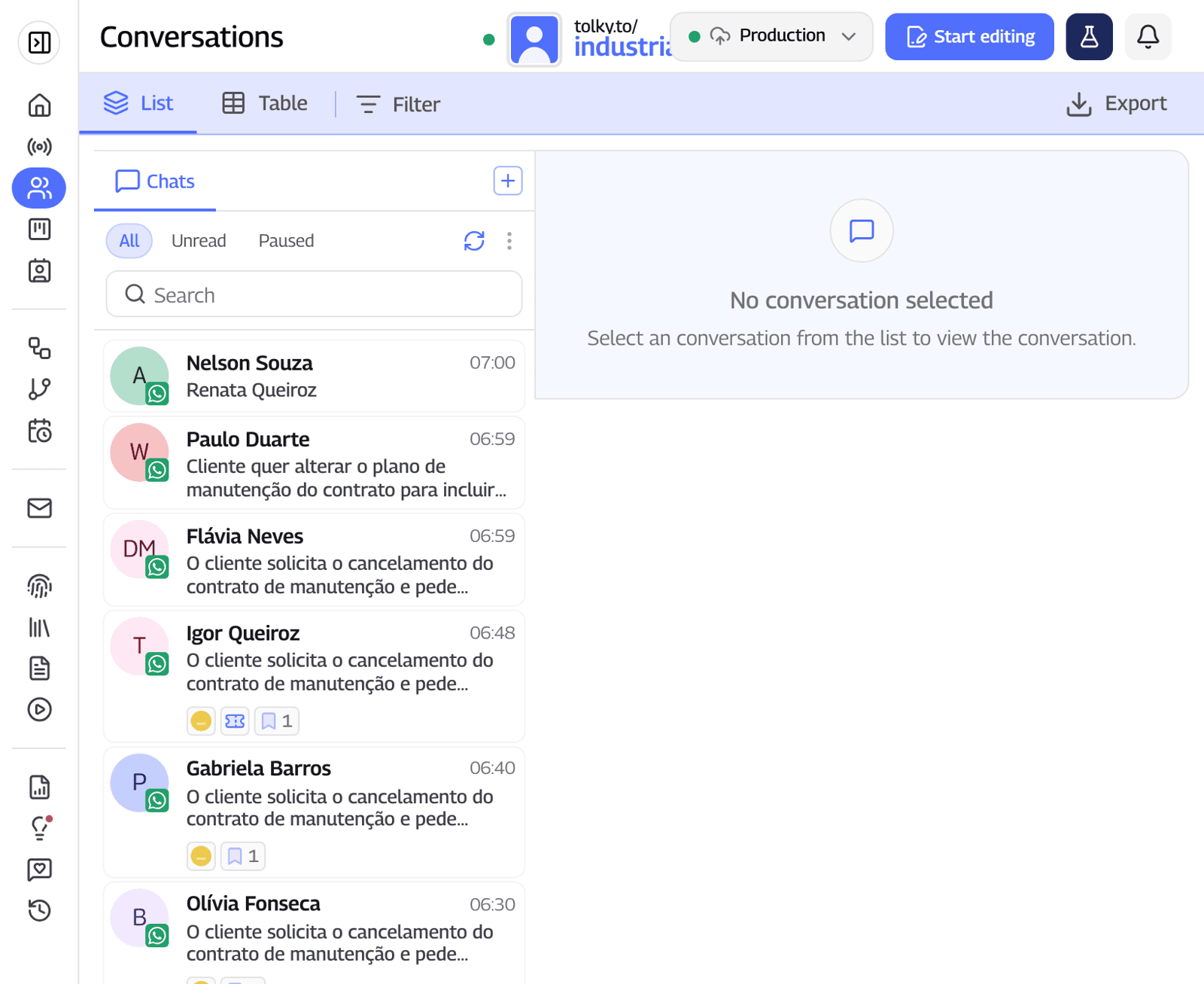
What Tolky does in this flow:
- Immediate reply with the properties and developments registered in the knowledge base, on WhatsApp and on the website.
- Qualification in the pipeline of the WhatsApp CRM, with neighborhood, price range and timeline, and handoff to the agent with a summary of the conversation.
- Distribution among agents through queues, among online operators, with an explanation of why each contact went to each person, and profiles that limit each agent to their own conversations.
- Automatic follow-up for people who stopped replying and WhatsApp campaigns for launches and re-engaging the contact base.
- Native HubSpot integration, more than 1,000 apps in Flows and a REST API.
What Tolky does not do: it has no native integration with real estate portals. When the portal or ad sends the contact to the agency's WhatsApp or website, the AI replies right away; other sources can be connected through the REST API, webhooks or Flows. It also does not book showings on a calendar by itself: the AI collects the preferred day and time, and the agent confirms. Offers, discounts, contracts and financing stay with the team.
Plans are on Tolky's pricing page: on November 19, 2026, Starter costs US$90 a month with 500 attendances and 2 users, and Professional costs US$450 a month with 1,000 attendances and up to 10 users. WhatsApp starts on Starter.
Frequently asked questions
What is a real estate CRM?
It is the system that records every property inquiry, with the source, the search profile, the deal stage and the conversation history. It shows who is waiting for a reply, who is ready for a showing and who needs a follow-up.
What is the best CRM for a real estate agency?
It depends on where service happens. If most prospects talk to you on WhatsApp, prioritize a CRM tied to the conversation, with distribution among agents, follow-up and a central history. Ask for a demo with a real lead, from the ad to the agent.
Is a CRM worth it for an independent real estate agent?
It is when the agent gets leads from more than one source and has already lost prospects for lack of a reply. For agents who handle few contacts a month, a simple CRM with follow-up reminders is usually enough.
Can AI book property showings?
It depends on the tool. In Tolky, the AI collects the preferred day and time and passes it to the agent, who confirms the showing and availability, with everything recorded in the history.
Do portal leads reach the CRM automatically?
It depends on how the portal delivers the contact and what the CRM accepts. In Tolky, when the portal or ad sends the contact to WhatsApp or the website, the AI replies right away; other sources can be connected through the REST API, webhooks or Flows.
How much does a real estate CRM with AI cost?
It varies with the pricing model: per user, per contact or per conversation. At Tolky, Starter costs US$90 a month with 500 attendances and 2 users as of November 19, 2026, and Meta's WhatsApp fees are outside the plan.
Conclusion
An agency that loses leads almost never lacks prospects: it has slow first replies, distribution with no rule and forgotten follow-ups. A real estate CRM tied to WhatsApp fixes this when it takes in every source, replies right away, hands the agent the contact with context and re-engages people who went quiet. AI handles the first reply and screening; the showing and the negotiation stay with the agent.
See the plans, explore Tolky for real estate, see the WhatsApp CRM or talk to the team →. Let's talk?
Share
Tags
- real estate crm
- crm for real estate agencies
- crm for real estate agents
- real estate crm whatsapp
- real estate leads
- ai for real estate customer service
- #conversational CRM
About the author

Co-founder of Tolky
Marlos Carmo is an AI entrepreneur and founder of Tolky, the conversational-era infrastructure and AI CRM that unifies intelligent service, multi-channel support (such as WhatsApp and voice), live CRM, and operational intelligence in a single ecosystem. He is a finalist for the SXSW Innovation Awards and a member of Francesco's Economy, a global network of young entrepreneurs focused on innovation and social impact. He works connecting Artificial Intelligence and digital transformation in projects for large organizations.
Next step
Want to bring this to your operation?
Tati, Tolky's AI assistant, understands your scenario in a few questions, suggests the best path and connects you with someone from the team, with full context.
Share