Brazil's new SAC law 2026: what Decree No. 13,135 changes
Brazil's new SAC law is Decree No. 13,135/2026, in force since Nov 2, 2026: human service 8 a.m. to 8 p.m., waits up to 20 seconds, at most five menu levels and AI with a human exit.
TL;DR
Brazil's new SAC law is Decree No. 13,135 of October 9, 2026, which revoked Decree No. 11,034/2022 and has been in force since November 2, 2026. SAC is Brazil's consumer service channel. The decree requires a 24-hour electronic channel, human service from 8 a.m. to 8 p.m. every day, phone waits of up to 20 seconds for 80% of calls, no more than five menu levels and a reply within 7 days, and it allows AI as long as the consumer can reach a person.
Share
In October 2026, Brazil's federal government replaced the rules for consumer service channels for the second time in four years. Companies that had just adapted to the 2022 decree now need to review staffing, menus, deadlines and, above all, the role of AI in service.
SAC (Serviço de Atendimento ao Consumidor) is the consumer service channel that Brazilian companies must provide to existing customers. This guide explains what the new SAC law is, who must comply, what changed from the previous rule and how to use AI and people together to meet the requirements. It is a summary for service managers, not legal advice: confirm how it applies to you with your legal team.
Updated in November 2026.
What is Brazil's new SAC law?
Brazil's new SAC law is Decree No. 13,135 of October 9, 2026, which regulates the Consumer Protection Code to set rules for the Serviço de Atendimento ao Consumidor (SAC). It was published in the Official Gazette on October 13, 2026, took effect 20 days later, on November 2, 2026, and revoked Decree No. 11,034/2022 (arts. 24 and 25). Text checked on Planalto, the federal government's legislation site, on November 23, 2026.
Technically it is not a law but a decree that regulates Law No. 8,078/1990, Brazil's Consumer Protection Code. "SAC law" has been the popular name since the first decree, in 2008. To understand the SAC concept and how it differs from customer service and the ombudsman, see the guide what is SAC.
Timeline of the SAC rules
- Decree No. 6,523 of July 31, 2008. The first "SAC law", focused on call centers.
- Decree No. 11,034 of April 5, 2022. Revoked the 2008 decree and took effect 180 days after publication, in October 2022 (text on Planalto, checked on November 23, 2026).
- Decree No. 13,135 of October 9, 2026. Revoked the 2022 decree and has applied since November 2, 2026.
Who must comply with the new SAC decree?
Decree No. 13,135/2026 applies to providers of products and services regulated by Brazil's federal executive branch that meet the regulator's criteria, and to anyone offering financial services through digital means subject to regulation or supervision by the Central Bank of Brazil (art. 1). In practice, that includes federally regulated sectors such as telecom, energy, health plans, aviation and transportation, as well as digital banks, fintechs and payment providers, according to each regulator's criteria.


A third group has a different obligation. Digital intermediation platforms, ride-hailing and delivery companies must send the National Consumer Secretariat (Senacon) their service model, with complaint volume, resolution rate and satisfaction (art. 2).
An online store, a private clinic or a school outside these groups is not bound by the decree's metrics, but it answers to the Consumer Protection Code and is compared by customers with those who comply. As of November 23, 2026, we found no Senacon ordinance supplementing the new text; sector regulators may have their own wait-time and urgency rules, which prevail on the points the decree specifies.
What changed from Decree No. 11,034/2022?
The main change is human service: before, eight hours a day on the phone was enough; now a person must be available from 8 a.m. to 8 p.m., every day, on the phone and on the electronic channel. The decree also sets wait times, limits menu levels and mentions artificial intelligence for the first time.
| Topic | Decree No. 11,034/2022 | Decree No. 13,135/2026 |
|---|---|---|
| Human service | On the phone, at least 8 hours a day | 8 a.m. to 8 p.m., every day, on phone and electronic channel |
| Wait time | Set by each regulator | Up to 20 s for 80% of calls and up to 300 s for the rest, unless the regulator has a rule |
| Menu | First menu with minimum options, such as complaint and cancellation | No more than five levels; cancellation and a person at any level |
| Artificial intelligence | Not mentioned | Allowed for triage, routing and resolution, with a human option |
| Dropped call | Company calls back | Callback within 300 seconds |
| Advertising | Banned during the wait without consent | Banned at any stage of service |
| History sent to consumer | Within 5 calendar days | Within 5 business days, kept for at least 6 months after resolution |
| Improper charge | Immediate suspension | Immediate suspension, completed within 48 hours |
| Older adults | No specific rule | Priority treatment |
The general reply deadline stays the same: up to 7 calendar days from when the request is registered. Recordings must still be kept for 90 days, now including text and voice messages.
What are the rules of the new SAC?
The rules fall into four blocks: electronic channels, phone, request tracking and cancellation. All of them start from the principles in article 4: timeliness, security, privacy, efficiency, courtesy, resolution and human service when requested.
Electronic channels
At least one electronic channel must work 24 hours a day, seven days a week, and guarantee real-time service by a person from 8 a.m. to 8 p.m. (art. 12). The decree defines an electronic channel as contact by voice, text or video with real-time interaction, including website or app chat and instant messaging apps such as WhatsApp (art. 3, § 2). There can be no more than five levels to complete a request, with cancellation and access to a person at any level, and the consumer must be told the estimated wait time (art. 13).
Phone
A phone line is mandatory (art. 14). A person answers from 8 a.m. to 8 p.m., every day, and urgent cases are handled at any time. The wait for an agent is up to 20 seconds for at least 80% of requests and up to 300 seconds for the rest, unless the sector regulator has a specific rule (art. 15). The first menu level states the option to speak with a person, and a dropped call must be returned within 300 seconds.
Protocol, history and deadlines
The consumer tracks the request with a protocol number, receives the history within 5 business days upon request (art. 18) and gets a reply within 7 calendar days (art. 21). Recordings and messages are kept for at least 90 days (art. 19). The company cannot ask the customer to repeat the request after it was first registered, nor make service depend on prior data (arts. 6 and 8).
Cancellation
Cancellation can be requested through SAC and through the same channel used to sign up, with no extra menus or agents, takes effect immediately even with pending payments, unless technical processing is expressly justified, and generates an electronic receipt (art. 20).
Can AI handle SAC under the new rules?
Yes: article 3, § 3, allows automated procedures, including artificial intelligence systems, for triage, routing and resolution, as long as the consumer keeps the option of real-time human service. It is the first time a SAC decree mentions AI.


That changes the question. It is no longer "can I use AI in SAC?" but "does my AI let the customer reach a person at any moment?". Three practical consequences:
- The human exit cannot be hidden. If the customer asks for a person at the first level, the AI transfers. From 8 a.m. to 8 p.m., insisting on keeping the customer with the bot goes against articles 13 and 16.
- AI also takes up levels. Each automated step is likely to count toward the five-level limit, so keep flows short.
- The handoff carries context. Since the customer cannot be asked to repeat the request, the person receives the summary and the history of what the AI already did.
The handoff triggers are detailed in the guide to AI-to-human handoff, and how to balance automation and care in the guide to human-centered customer service.
How do you comply with the new SAC law using AI and people?
AI helps with the rules that depend on availability, record-keeping and speed; people remain responsible for the rules that depend on judgment and human hours. The table below is a starting point, not a compliance report.
| Rule (article) | What it requires | How to comply with AI and people |
|---|---|---|
| 24-hour channel (art. 12) | One always-on electronic channel | AI agent on WhatsApp or chat answers at any hour and records the request |
| Person from 8 a.m. to 8 p.m. (arts. 12 and 14) | Real-time human service every day | Staff schedule; AI reduces the volume reaching the queue |
| Human exit at any level (arts. 13 and 16) | Option to reach a person from the first level | "I want to talk to a person" trigger always active in the agent |
| Estimated wait (arts. 13 and 15) | Tell the expected wait | Handoff message with the estimate and live queue monitor |
| 20-second wait (art. 15) | 80% of calls with a person within 20 s | Voice agent resolves part of the calls; size the team for the rest |
| No repeating the request (art. 6) | Cannot ask for the story again | Handoff with summary and a single contact history |
| Protocol and history (art. 18) | Tracking and delivery within 5 business days | Ticket with a code, history in the CRM and export |
| Reply in 7 days (art. 21) | Clear and conclusive answer | Tickets with stages, deadlines and follow-up |
| Immediate cancellation (art. 20) | No extra menus | AI recognizes the intent to cancel and completes or transfers right away |
| No advertising (art. 6) | No offers during service | Keep SAC flows separate from campaigns |
Two rules cannot be solved with software: staffing for the extended hours and the quality of the final answer. Measure compliance with AHT, ASA and first response time and track the SLA per queue.
Where Tolky helps with SAC
Tolky is a conversational AI CRM that serves customers on WhatsApp through the official API, website chat, voice, email and Microsoft Teams, with AI agents that hand off to the team with context, tickets with stages and each contact's history in the CRM. It supports several of the decree's rules, but it does not make you compliant automatically.
- 24 hours with a human exit. The agent answers at any hour; the team pauses and resumes the AI, and the handoff carries the whole conversation. See WhatsApp Service.
- Phone. Voice Service with a semantic IVR, on activation, that transfers to the team.
- Queues and waits. Queues by department, distribution among online agents and a live queue monitor.
- Protocol and deadlines. Tickets with a code, stages and priority, and automatic NPS at the end of each conversation.
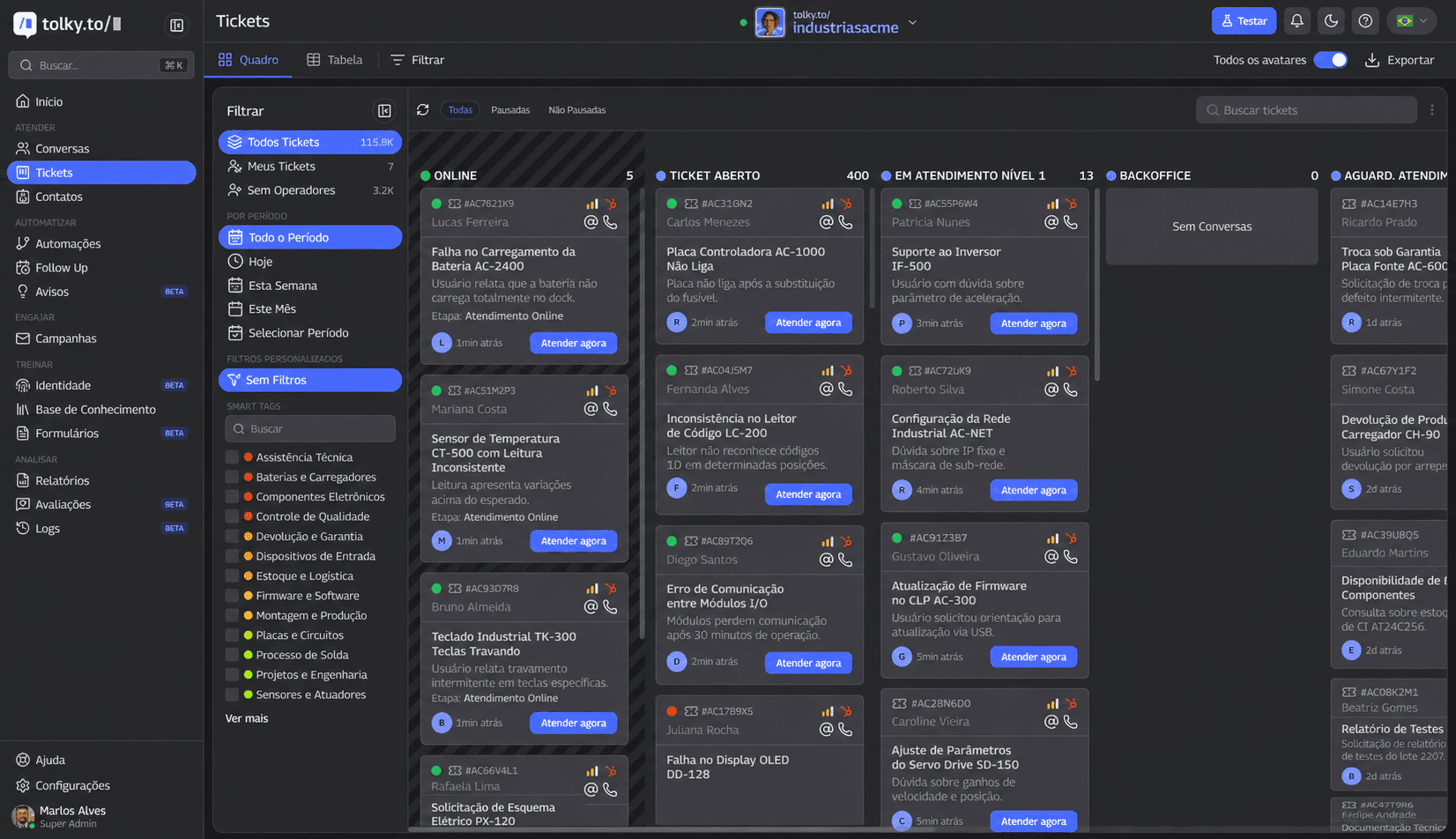
What Tolky does not do: it does not build your staff schedule, it has no configurable data retention (confirm that storage meets the deadlines in articles 18 and 19) and it does not replace a legal review of your flows. For high-volume contact centers, see also AI CRM for customer relationship centers and the plans.
Frequently asked questions
What is Brazil's new SAC law?
It is Decree No. 13,135 of October 9, 2026, published in the Official Gazette on October 13 and in force since November 2, 2026. It revoked Decree No. 11,034/2022 and regulates Brazil's Consumer Protection Code for consumer service channels.
Is Decree No. 11,034/2022 still valid?
No. Article 24 of Decree No. 13,135/2026 revoked Decree No. 11,034/2022. The 2022 rules are now only a historical reference.
What human service hours does SAC require?
From 8 a.m. to 8 p.m., every day of the week, on the phone and on the electronic channel. Outside those hours, the electronic channel keeps working 24 hours, and urgent cases are handled at any time.
What is the maximum wait time in SAC?
On the phone, up to 20 seconds for at least 80% of requests and up to 300 seconds for the rest, unless the sector regulator has a specific rule. On electronic channels, the consumer must be told the estimated wait time.
Are chatbots and AI allowed in SAC?
Yes. The decree allows artificial intelligence systems for triage, routing and resolution, as long as the consumer has the option to reach a person in real time at any level of service, during the required hours.
Does my company need to follow the new SAC decree?
If it provides products or services regulated by Brazil's federal government, within the regulator's criteria, or offers digital financial services supervised by the Central Bank, yes. Other companies follow the Consumer Protection Code. Confirm with your legal team.
How long does SAC have to reply to the consumer?
Up to 7 calendar days from when the request is registered. For an improper charge or an unrequested service, the company must suspend it immediately and complete the process within 48 hours.
Conclusion
Brazil's new SAC law confirms what customers already expected: an answer at any hour, a person within reach during the day, fewer menus and no request to repeat the story. AI fits this design as a first line that resolves and records, as long as the human exit is always open. Review menus, staffing and deadlines with your legal team and measure compliance per queue.
Read the guide what is SAC, see WhatsApp Service, see the plans or talk to the team →. Let's talk?
Share
Tags
- brazil new sac law
- decree 13135/2026
- sac law brazil
- sac decree
- decree 11034/2022
- sac rules brazil
- sac with ai
- #conversational CRM
Cited in
- Chatbot for banks: customer service, security and regulation
- What is SAC? Brazil's customer service rules, SAC 3.0 and AI
- Inbound vs outbound call center: differences, IVR and when to use each
- Customer service SLA: what it is, how to calculate it and AHT targets
- Humanized customer service with AI: automate without losing care
- How to implement AI in customer service: handoff and hybrid model
About the author

Co-founder of Tolky
Marlos Carmo is an AI entrepreneur and founder of Tolky, the conversational-era infrastructure and AI CRM that unifies intelligent service, multi-channel support (such as WhatsApp and voice), live CRM, and operational intelligence in a single ecosystem. He is a finalist for the SXSW Innovation Awards and a member of Francesco's Economy, a global network of young entrepreneurs focused on innovation and social impact. He works connecting Artificial Intelligence and digital transformation in projects for large organizations.
Next step
Want to bring this to your operation?
Tati, Tolky's AI assistant, understands your scenario in a few questions, suggests the best path and connects you with someone from the team, with full context.
Share