Chatbot for banks: customer service, security and regulation
A chatbot for banks and lenders: what to automate, how to authenticate customers, what never to ask for in a chat, how it helps against scams and what Brazil's Central Bank rules require.
TL;DR
A chatbot for banks handles product questions, duplicate bills, request status and scam guidance on WhatsApp, in the app and by voice, and passes anything that needs analysis to people. It must authenticate customers according to the risk of each request, never ask for a password in the chat and follow the regulator's rules, such as Brazil's CMN Resolution No. 4,949/2021, which requires service without unreasonable barriers.
Share
Bank customers want to solve things fast and safely, and those two goals seem to pull in opposite directions. A service channel that answers in seconds needs to know who it is talking to; a channel full of checks becomes a barrier and pushes the customer to the branch or to a complaint.
A well-designed chatbot for banks resolves that tension in layers: it answers public questions without authentication, asks for verification proportional to the risk of personal requests and passes anything that needs analysis to people. This guide covers what to automate, how to authenticate, what the chatbot must never ask for and what industry rules require, using Brazil as the reference market.
Updated November 2026.
What is a chatbot for banks?
A chatbot for banks is an automated assistant that serves customers of banks, lenders, credit unions and fintechs on WhatsApp, in the app, on the website or by voice, answers questions, runs simple authenticated services and routes anything that requires analysis or a decision to people. With AI, it understands questions in natural language and answers using the policies the institution provides.
In financial services, a chatbot carries two duties other industries do not feel as strongly: proving who the customer is before showing any data, and leaving a record of every answer. For the basics, see what a chatbot is and how it differs from an AI agent.
What can a banking chatbot handle?
A banking chatbot handles repetitive, low-risk requests well, such as questions about products and fees, duplicate bills and request status, and routes the ones that need analysis, such as disputes, credit and suspected fraud. The institution draws the line between the two groups, in writing.


| Request | The chatbot can | Stays with a person |
|---|---|---|
| Question about a fee, deadline or product | Answer with the policies provided | Request for an exception or waiver |
| Duplicate bill or statement | Send it after authentication | Disputed amount |
| Status of a request or ticket | Check the system and report | Complaint about the delay |
| Blocking a lost card | Guide the customer and start the block in the authorized channel | Suspected misuse that already happened |
| Due date reminder | Remind with the amount and payment method | Negotiation outside the rules |
| Credit, investments, portability | Explain what the institution has published | Recommendation and decision |
| Scam in progress | Tell the customer to stop the contact and hand off immediately | Case analysis and dispute |
The right-hand column is not a failure of the chatbot. It is where the institution answers for a decision, and the conversation must reach a person with the history and the reason, so the customer does not repeat the story.
What do Brazil's Central Bank rules require from customer service?
The rules of Brazil's National Monetary Council (CMN) and Central Bank require customer service to be ethical, transparent and free of unreasonable barriers, every request to be recorded and handled, and data and cloud services to be contracted under security requirements. Three resolutions directly affect a chatbot project. All were checked on the Central Bank website on November 23, 2026.
- Customer relationships. CMN Resolution No. 4,949/2021 requires fair and equitable treatment that considers customers' "relationship profiles and associated vulnerabilities" (art. 3, II), and service without "unreasonable barriers, criteria or procedures", including for canceling contracts (art. 4, VII). It also bans refusing or hindering in-person service at the institution's premises, even when other channels exist (art. 5), and calls for routines to record and handle requests (art. 7, VIII).
- Ombudsman. CMN Resolution No. 4,860/2020 defines the ombudsman as the last resort for issues not solved in primary service, with a protocol number and a reply within ten business days (art. 6). The chatbot is primary service: it must tell customers how to reach the ombudsman.
- Cybersecurity and cloud. CMN Resolution No. 4,893/2021 requires a cybersecurity policy and, before contracting relevant data processing, storage or cloud services, an assessment of the provider's capabilities (art. 12). The contract must be reported to the Central Bank within ten days (art. 15).
Under the wording in force since March 1, 2024, the three resolutions do not apply to consortium administrators, payment institutions, securities brokers and dealers or foreign exchange brokers, which follow the Central Bank's own rules. Check which rule applies to your license. Outside Brazil, look for the equivalent conduct, complaint-handling and outsourcing rules of your regulator. For customer service rules in general, see the post on Brazil's new SAC law.
This summary does not replace review by your legal and compliance teams.
How should a bank chatbot authenticate customers?
Authenticate customers in the chatbot according to the risk of the request: public information needs no verification, personal information needs one extra factor, and anything that moves money or changes account details needs the strongest channel the institution has. Asking for everything every time creates barriers; asking for the minimum every time invites fraud.


| Risk level | Example request | Suggested authentication |
|---|---|---|
| Public | Opening hours, published fee, how a product works | None |
| Personal | Duplicate bill, request status, statement balance | Registered number plus something only the customer knows, or a one-time code |
| Sensitive | New phone, address change, unblocking | One-time code and confirmation in the institution's app |
| High risk | Credit limit increase, new payment key, large transaction | Flow in the app or verification with ID document, selfie and liveness check |
A one-time code on WhatsApp falls under Meta's authentication message category, reserved for temporary passcodes that verify identity. For high-risk requests, a liveness check confirms that the person on the other side is the person on the document, not a photo, a screen or a recorded video. We cover the privacy considerations in the post on liveness checks with selfie and ID.
One simple rule prevents most problems: the chatbot never runs a high-risk operation just because the conversation came from the registered number. A WhatsApp number can be cloned or sitting on another device.
What should a bank chatbot never ask for?
A bank chatbot must never ask for a password, card security code, full card number, token or a code sent by text message that the customer did not request. Those details do not belong in the free text of a conversation, even when the customer offers them.


When the institution needs to collect sensitive data, such as a document number, the path is a form marked as sensitive, encrypted and visible only to people with permission, not a message that stays in the history. Biometric data is sensitive personal data under Brazil's data protection law, the LGPD (art. 5, II, of Law No. 13,709/2018), and art. 46 requires technical and administrative security measures to protect personal data. See the glossary entry on sensitive personal data.
The chatbot should also say plainly, and more than once, what the institution never asks for. That sentence is one of the best defenses against fake call center scams.
Chatbots and fraud prevention: where do they help and where don't they?
A chatbot helps against fraud by being a recognizable official channel, guiding the customer during a scam and handing off immediately to the security team, but it does not replace transaction fraud prevention. Analyzing instant payments, cards and account behavior is the job of the institution's own systems.
Three uses work well:
- A verifiable official channel. A number on the official API, with an official business account and an approved display name, gives customers a reference point. A scammer posing as the bank does not write from that number.
- Guidance at the right moment. When a customer writes "the bank called and asked me to transfer money", the agent recognizes the pattern, tells them to hang up and brings in someone from security with a summary. The most common scams are covered in WhatsApp scams targeting businesses.
- Verification before sensitive operations. Changing phones or registering a device can require a link for ID document, selfie and liveness check, with the result approved, rejected or under review.
There is also fraud that arrives through the legal department: mass lawsuits with forged documents filed against banks. That is a different problem with a different tool, analyzing evidence in the case files, which we explain in abusive litigation.
How do you measure a chatbot for banks?
Measure a banking chatbot by barrier-free resolution and security together: resolving a lot with weak authentication is a risk, and authenticating a lot without resolving is a barrier. Track:
- Resolution by topic, with no handoff and no repeat contact within seven days.
- Drop-off at authentication. If many people give up at the code step, it is too heavy for the risk of the request.
- Time to reach a person when the customer asks, and how many requests were honored.
- Requests that became ombudsman cases or external complaints, by reason.
- Audited answers. A weekly sample of conversations reviewed by compliance, with the source of each answer.
The guide to the AI resolution rate shows how to calculate the first metric without inflating it.
Where Tolky fits in financial services
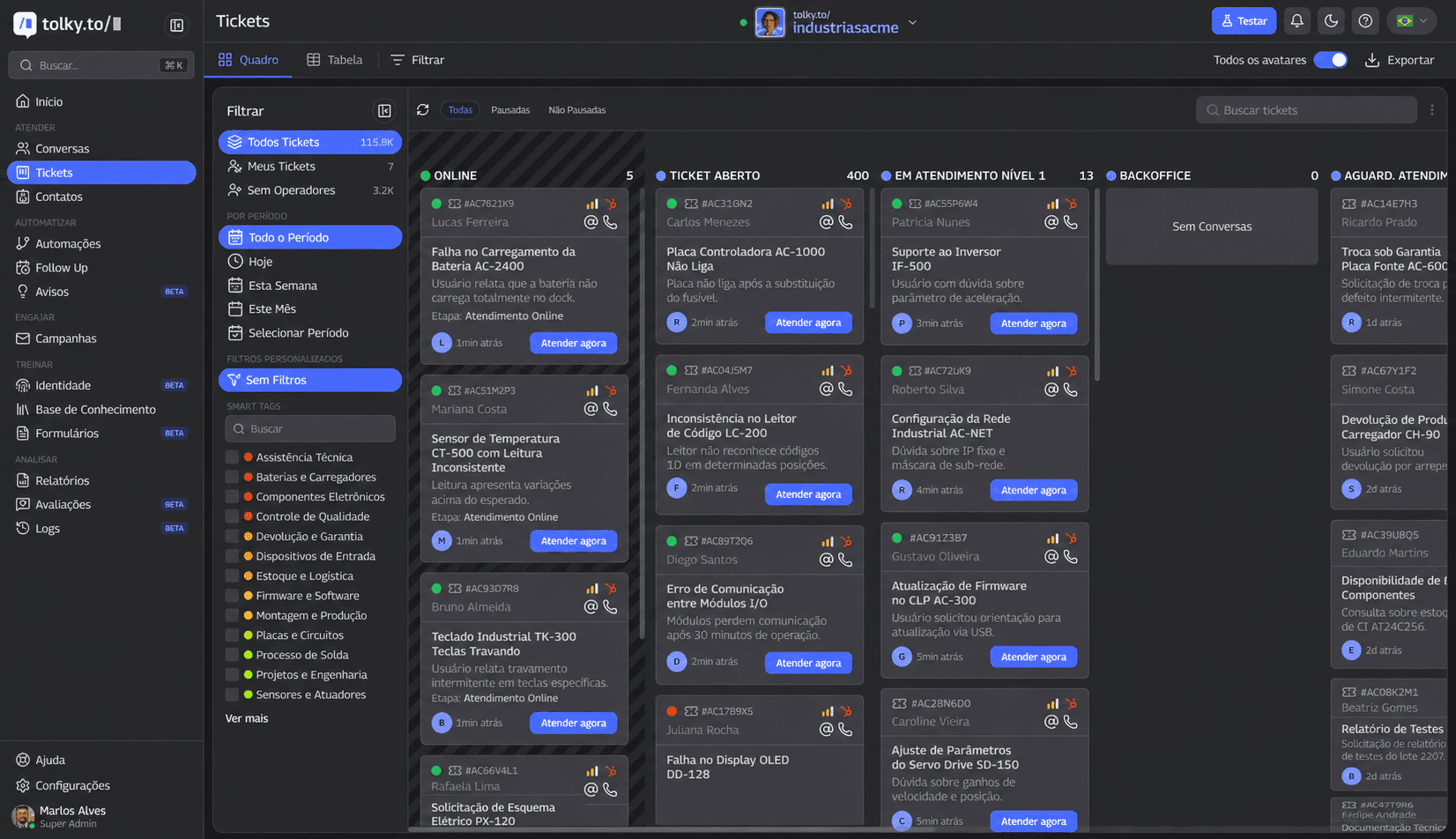
Tolky is a conversational AI CRM in which AI agents serve customers on official WhatsApp, on the website and by voice using the policies the institution provides, and every AI answer can be investigated. The setup for the industry is on the financial services page.


- A record behind every answer. The Investigate feature shows the instructions, knowledge base excerpts and external calls behind each AI message. See trustworthy AI.
- Access controls. Profiles by module and action, such as viewing, exporting and deleting conversations, and an audit log you can export to CSV or Excel. The verified controls are listed on the security page.
- Sensitive forms. Anything that must be collected goes into a form encrypted with AES-256, outside the conversation text.
- Liveness Check. ID document, selfie and liveness check in one link, with no app, and a reason code for every result. It is in early access and does not yet query official databases.
- Anti-fraud for legal teams. Forensic tests read the case files and deliver a dossier of signs of document fraud and abusive litigation, with the file, page and excerpt.
- People when it matters. Department queues, tickets with stages and handoffs with a summary. Payment reminders follow the guide to the debt collection chatbot.
What Tolky does not do: it is not a core banking system, it does not run transaction fraud prevention (instant payments, cards or account behavior), it does not give financial advice and it does not decide credit or agreements outside the rules. The only native integration is HubSpot; the institution's systems connect through the REST API, webhooks and HTTP requests.
Frequently asked questions
Is a chatbot for banks secure?
It is secure when it authenticates customers according to the risk of each request, never asks for passwords or security codes in the chat, stores sensitive data in encrypted forms and keeps a record of every answer. Security comes from the design, not the channel.
What can a bank chatbot do on WhatsApp?
Answer questions about products and fees, send duplicate bills after authentication, report the status of requests, send due date reminders and guide customers during a scam. High-risk operations should go through the app or strong verification.
Can a bank serve customers only through a chatbot?
Not in Brazil. CMN Resolution No. 4,949/2021 bans refusing or hindering in-person service at the institution's premises, even when other channels exist, and requires service without unreasonable barriers. The chatbot adds a channel; it does not close the others.
How does the chatbot confirm the customer's identity?
In layers: the registered number plus something only the customer knows for personal requests, a one-time code for sensitive requests, and verification with ID document, selfie and liveness check for high risk. Public requests need no authentication.
Can a bank chatbot ask for a password?
Never. Passwords, card security codes, full card numbers and tokens stay out of the conversation. The chatbot should tell customers the institution never asks for this information, which also helps them spot scams.
Does the chatbot help fight fraud?
It helps as a recognizable official channel, by guiding customers during a scam and by bringing in the security team immediately. Analysis of suspicious transactions stays with the institution's fraud prevention systems.
Conclusion
A chatbot for banks works when it resolves repetitive requests without creating barriers and protects what is sensitive without blocking the customer. Start with public questions and duplicate bills, set authentication by risk level, write down what the chatbot must never ask for and guarantee the path to a person and to the ombudsman.
See Tolky for financial services, explore the Liveness Check, see the plans or talk to the team →. Let's talk?
Share
Tags
- chatbot for banks
- banking chatbot
- ai banking customer service
- chatbot for lenders
- banking customer service security
- whatsapp authentication
- #conversational CRM
Cited in
- Debt collection chatbot on WhatsApp: reminders, bills and deals
- Chatbot examples: 12 use cases by function and industry, in dialogue
- AI for debt collection: voice agent calls and WhatsApp reminders
- WhatsApp AI agent: how to build one with n8n, a platform or Meta
- What is a chatbot? Types, NLP, examples, cost and how to choose
About the author

Co-founder of Tolky
Marlos Carmo is an AI entrepreneur and founder of Tolky, the conversational-era infrastructure and AI CRM that unifies intelligent service, multi-channel support (such as WhatsApp and voice), live CRM, and operational intelligence in a single ecosystem. He is a finalist for the SXSW Innovation Awards and a member of Francesco's Economy, a global network of young entrepreneurs focused on innovation and social impact. He works connecting Artificial Intelligence and digital transformation in projects for large organizations.
Next step
Want to bring this to your operation?
Tati, Tolky's AI assistant, understands your scenario in a few questions, suggests the best path and connects you with someone from the team, with full context.
Share