What is SAC? Brazil's customer service rules, SAC 3.0 and AI
What SAC is in Brazil, how it differs from customer service and the ombudsman, what SAC 2.0, 3.0 and 4.0 mean, what the 2026 rules require and how to run SAC on WhatsApp with AI.
TL;DR
SAC (Serviço de Atendimento ao Consumidor) is Brazil's term for the official consumer service channel, where a company handles questions, complaints, disputes and cancellation requests from existing customers. It is regulated by Decree No. 13,135/2026, which requires a 24-hour channel, human service from 8 a.m. to 8 p.m. every day and a reply within 7 days. SAC 2.0, 3.0 and 4.0 are market labels for how the channels evolved, not legal categories.
Share
Every customer, at some point, needs to talk to the company after the sale: the bill is wrong, the order is late, the service stopped working, they want to cancel. In Brazil, the place they go is called the SAC, and how that place works decides whether the problem becomes a solution or a public complaint.
SAC stands for Serviço de Atendimento ao Consumidor, Brazil's consumer service channel. This guide explains what it is, how it differs from customer service in general and from the ombudsman, what the labels SAC 2.0, 3.0 and 4.0 mean, what the law requires after the October 2026 decree, which metrics to track and how to run SAC on WhatsApp with AI without taking people out of the loop.
Updated in November 2026.
In short:
- SAC is Brazil's consumer service channel for information, questions, complaints, disputes, suspension and cancellation from people who already bought. Sales are not SAC.
- Since November 2, 2026, Decree No. 13,135/2026 regulates the SAC of companies in federally regulated sectors and of digital financial services supervised by the Central Bank of Brazil.
- It requires a 24-hour electronic channel, human service from 8 a.m. to 8 p.m. every day, a mandatory phone line, no more than five menu levels and a reply within 7 calendar days.
- SAC 2.0, 3.0 and 4.0 are market labels: social media, omnichannel integration and the use of AI and data, in that order. The law only says SAC.
- AI can triage, answer and resolve, as long as the consumer can reach a person in real time when they ask.
What is SAC?
SAC, short for Serviço de Atendimento ao Consumidor, is the channel a company uses in Brazil to receive and handle requests from existing customers: information requests, questions, complaints, disputes and requests to suspend or cancel contracts and services. The definition is in article 3 of Decree No. 13,135 of October 9, 2026, checked on November 23, 2026.
SAC can run by phone or over electronic channels such as chat, apps and instant messaging. And service aimed at offering and selling products is not SAC (art. 3, § 4): a sales conversation on WhatsApp becomes SAC the moment the customer asks to cancel.
See also the SAC entry in the glossary for a short definition.


What is the difference between SAC, customer service and the ombudsman?
Customer service covers every contact between a company and its customers; SAC is the part of that service that handles post-sale requests under legal rules; the ombudsman (ouvidoria) is the second tier, used when SAC did not solve the problem. The three complement each other, and confusing them puts the queue in the wrong place.
| Aspect | Customer service | SAC | Ombudsman (ouvidoria) |
|---|---|---|---|
| What it is | Every contact between company and customer, before and after the sale | Channel for post-sale requests: questions, complaints, disputes, cancellation | Appeal tier for people whose request was not solved by SAC |
| Who uses it | Leads, customers, former customers | People who already bought | People who already went through SAC |
| Legal rule | Brazil's Consumer Protection Code | Consumer Protection Code and Decree No. 13,135/2026 in the sectors it covers | Rules from each regulator (banking, telecom, private health plans) |
| Goal | Sell, guide, retain, resolve | Resolve the request on first contact and on time | Review the case and fix process failures |
| Typical channels | WhatsApp, website, phone, email, store | Mandatory phone line and at least one 24-hour electronic channel | Dedicated phone, form and email |
A small company can have one team covering customer service and SAC on the same WhatsApp number. What matters is knowing when the conversation changes nature: a prospect's question is sales, an existing customer's wrong charge is a SAC request, with a deadline.
The ombudsman is not mandatory for every company: it is required by regulators such as those for banking, telecom and health plans.
What are SAC 2.0, SAC 3.0 and SAC 4.0?
SAC 2.0, SAC 3.0 and SAC 4.0 are market labels that describe how service channels and tools evolved; none of them exists in the law, which only says SAC. There is no official definition, and each vendor uses the terms its own way, so it helps to understand the idea behind each one.
- SAC 1.0 (the classic): toll-free phone line, call center, keypad IVR and email. Reactive contact, one channel at a time.
- SAC 2.0: the company also answers on social media and complaint websites. The conversation becomes public, and response speed becomes a reputation issue.
- SAC 3.0: channels stop being islands. Phone, chat, WhatsApp, email and social media share the same history, the customer starts on one channel and finishes on another without repeating the story, and self-service handles the simple cases. The market calls this omnichannel; the SAC 3.0 glossary entry has the short definition.
- SAC 4.0: the newest label, used for SAC where AI agents talk in natural language, look up systems, resolve part of the requests and pass the rest to people with context, using data to anticipate problems.
The label matters less than the result: a "4.0" SAC that traps the customer in a bot with no way out is worse than a well-run SAC 1.0, and it breaks the rule that guarantees access to a person. The guide to omnichannel customer service shows how to integrate the channels in practice.
Which channels does a SAC need?
Under Decree No. 13,135/2026, SAC needs a phone line and at least one electronic channel that works 24 hours a day, 7 days a week, with real-time human service from 8 a.m. to 8 p.m. every day. Outside the sectors the decree covers there is no mandatory list, and the choice follows where customers already are.


- Phone. Mandatory for companies under the decree (art. 14). It can use an electronic menu or IVR, but with the option to reach a person at every level.
- WhatsApp. In Brazil, it is where many customers already talk to companies. It counts as an electronic channel because it is instant messaging with real-time interaction.
- Website and app chat. Good for logged-in customers who want to solve things without leaving the page.
- Email. Useful for requests with documents and long answers, but on its own it does not meet the real-time requirement.
- Social media and complaint websites. They do not replace SAC, but they need answers, because the conversation is public.
The most common mistake is opening channels without integrating them, each with its own queue and history. An integrated SAC records everything on the same contact, as the guide to the AI-powered contact center explains.
What does Brazilian law require from SAC in 2026?
Since November 2, 2026, the SAC of companies in federally regulated sectors and of digital financial services follows Decree No. 13,135/2026, which replaced Decree No. 11,034/2022. The text was published in Brazil's Official Gazette on October 13, 2026 and took effect 20 days later (art. 25).
The core rules, checked in the text on Planalto, the federal government's legislation site, on November 23, 2026:
- A 24-hour electronic channel and real-time human service from 8 a.m. to 8 p.m., seven days a week (art. 12).
- A mandatory phone line, with a wait of up to 20 seconds for at least 80% of calls and up to 300 seconds for the rest, unless the sector regulator has a specific rule (arts. 14 and 15).
- No more than five menu levels, with cancellation and access to a person at any level, including the first (arts. 13 and 16).
- A reply within 7 calendar days and a protocol number to track the request (arts. 18 and 21).
- AI allowed for triage, routing and resolution, as long as the consumer keeps the option of real-time human service (art. 3, § 3).
The decree does not cover every company. An online store or a private clinic outside those sectors is still bound by the Consumer Protection Code, but not by the decree's metrics. Even so, the rules have become the benchmark for what consumers expect. The details, the timeline and a table on how to comply with AI are in the guide to Brazil's new SAC law. This summary is not legal advice.
Which metrics measure the quality of a SAC?
A SAC is measured by five main numbers: AHT, ASA, FCR, CSAT and NPS, plus compliance with the reply deadline. Together they show whether customers wait little, get it solved the first time and leave satisfied.
| Metric | What it measures | How to calculate | Watch out |
|---|---|---|---|
| AHT | Average handling time | Total handling time ÷ number of interactions | A drop on its own can mean rushed service |
| ASA | Average wait until reaching someone | Total wait time ÷ number of interactions | In the decree, the reference is the maximum wait per call, not the average |
| FCR | First contact resolution | Requests solved on first contact ÷ total requests | Define up front what counts as "solved" |
| CSAT | Satisfaction with a specific interaction | Scores of 4 and 5 ÷ total responses (1 to 5 scale) | Measures the moment, not the relationship |
| NPS | Likelihood to recommend the company | % promoters minus % detractors (0 to 10 scale) | Measures the relationship, moves slowly |
| Reply deadline | Requests answered on time | Answered within 7 days ÷ registered | A legal requirement in the covered sectors |
Track the contact reason too: a reason that keeps repeating points to a process failure, not a SAC failure. The time calculations are detailed in the guide to AHT, SLA and first response time, and the choice between surveys in the comparison NPS or CSAT.


How does SAC on WhatsApp with AI work?
SAC on WhatsApp with AI uses an agent that talks in natural language on the company's official number, resolves simple requests on the spot, opens a ticket and protocol for the rest and passes the conversation to a person with the full history when the customer asks or the case requires it. The customer writes the way they would to a person, with no numbered menu.
The flow of a typical request:
- Identification. The agent greets the customer, introduces itself as an AI assistant and understands the request without demanding an ID number first, because the decree forbids making the start of service depend on prior data (art. 8).
- Resolution. Duplicate bills, order status, scheduling and knowledge base questions are solved in the conversation, by looking up the company's systems.
- Record. Requests that need review become a ticket with a code and a stage, and the customer knows how to follow up.
- Handoff. A dispute, a request outside the rules, an upset customer or "I want to talk to a person" triggers a handoff, with the conversation summary for the agent.
- Feedback. At the end, a short survey measures the experience. See how to build a customer satisfaction survey on WhatsApp.
AI works 24 hours, which helps with the always-on channel. Human service from 8 a.m. to 8 p.m. still depends on the company's staffing: AI reduces the volume that reaches people, it does not remove the need for them. The guide to AI-to-human handoff rules has ready-made triggers.
What about SAC by phone?
The phone is still mandatory in the decree's sectors, and a smart IVR understands what the customer says instead of asking them to "press 1". A voice agent can resolve part of the calls and transfer the rest with context, which helps keep the wait within the limit.
What does SAC look like in each sector?
SAC priorities change by sector: in finance, disputes weigh most; in healthcare, urgency and confidentiality; in retail, returns and tracking. The law is the same wherever the decree applies, but the most frequent requests are different.
Financial services and insurance
The decree explicitly includes digital financial services supervised by the Central Bank of Brazil. Charge disputes, card blocks and cancellations lead the volume, and the 48-hour deadline to finish suspending an improper charge (art. 21, § 3) requires a well-designed process. See financial services and insurance.
Healthcare
Scheduling, authorizations and test results, with sensitive data in the middle. Urgent cases need an immediate path to a person. See healthcare.
Retail and e-commerce
Tracking, exchanges and returns make up most of the volume, and nearly all of it can be solved by AI looking up the order system. See retail and e-commerce.
What are the most common SAC mistakes?
The mistakes that generate the most SAC complaints are the ones that waste the customer's time: menus with no way out, repeating the story at every transfer, promising callbacks that never happen and making cancellation hard. Several of them now also break the decree in the covered sectors.
- A bot with no exit. A chatbot or IVR that never offers a person. The decree requires the human option at every level during service hours.
- Making the customer repeat. Asking again for name, ID and the story at every transfer. Article 6 forbids asking the consumer to repeat the request after it was first registered.
- Hiding cancellation. Requiring extra menus or a retention agent before cancelling. Cancellation must be available at any level and take effect immediately.
- Advertising while on hold. Forbidden at any stage of service, including the wait (art. 6).
- Disconnected channels. Each channel with its own history and no single protocol.
- Measuring volume only. Counting interactions without looking at resolution, deadlines and satisfaction.
For the balance between automation and care, see the guide to human-centered customer service.
How do you choose a SAC tool?
Choose a SAC tool by what it guarantees the customer and the operation: channels integrated into a single history, AI that hands off to people, protocols and tickets, reports on wait and deadlines and compliance with Brazil's data protection law (LGPD). Price per seat and feature count come after.


Questions that separate the tools:
- Are the channels I need integrated? WhatsApp through the official API, website chat, phone and email, on the same contact.
- Does the AI hold a conversation or just follow a menu? And does it pass to a person with a summary, without the customer repeating?
- Are there tickets with protocol, stages and deadlines? The decree requires tracking by protocol and a reply within 7 days.
- Do the reports show wait time, first response time and satisfaction?
- Is the history stored and exportable for as long as your rules require?
- How does the tool handle personal data, and who is the controller of each piece of information?
The guide to customer service software and platforms has more detailed criteria, and the alternatives page compares Tolky with other platforms on the market, including when they are the better choice.
How much does it cost to set up a SAC?
The cost of a SAC has three parts: people, platform and channels; AI mainly changes the first, because it takes the repetitive volume and leaves people for the cases that need them. The exact amount depends on volume and on the hours your rules require you to cover.
- People. Most of the cost: covering 8 a.m. to 8 p.m. every day requires weekend shifts.
- Platform. Billed per seat, per conversation or by credits, depending on the vendor.
- Channels. On WhatsApp through the official API, Meta charges per delivered template message, by category (see per-message pricing). Phone lines have line and per-minute costs.
At Tolky, there is a free Individual plan to get started and paid plans by volume, all on pricing. For teams already running a high-volume contact center, the page on AI CRM for customer relationship centers sums up what changes in the operation.
Where Tolky fits in SAC
Tolky is a conversational AI CRM that handles SAC on WhatsApp through the official API, website chat, voice, email and Microsoft Teams, with AI agents that resolve and hand off to the team with context, tickets with stages and each contact's history in the CRM. It is what the market calls SAC 3.0 or 4.0, with a person always within reach.
What the platform offers a SAC:
- AI service on WhatsApp. The agent answers from the company's knowledge base, looks up systems and opens tickets, at any hour. See WhatsApp Service.
- People when it matters. Pause and resume the AI, handoff message, queues by department, distribution among online agents and transfer with approval.
- Voice. Voice Service with a semantic IVR, on activation, for the phone channel.
- Tickets and history. A board with stages and priority, and the whole conversation on the contact in the CRM.
- Measurement. Live queue monitor, time to first response and automatic NPS at the end of each conversation.
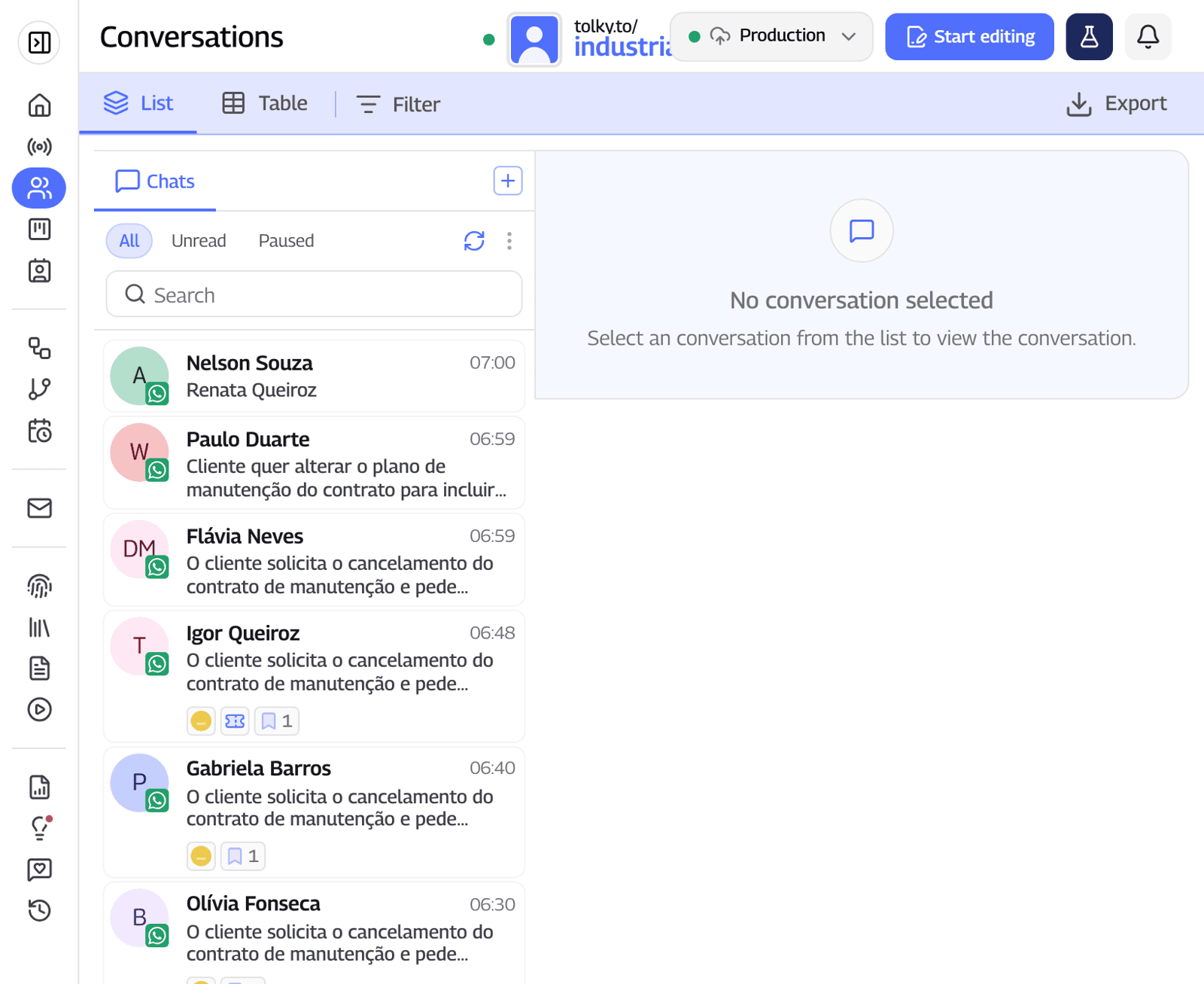
What Tolky does not do: it has no native CSAT survey (the automatic survey is NPS), no configurable data retention, and it does not make you compliant with the decree on its own. Staffing, deadlines and the wording of answers remain your company's decisions.
Frequently asked questions
What does SAC stand for?
SAC stands for Serviço de Atendimento ao Consumidor, Brazil's consumer service channel. It is where a company receives questions, complaints, disputes and cancellation requests from existing customers, by phone or over electronic channels such as WhatsApp and chat.
What is the difference between SAC and customer service?
Customer service is every contact between a company and its customers, including sales and pre-sales. SAC is the part of that service that handles requests from people who already bought, with its own legal rules in the sectors covered by Decree No. 13,135/2026.
What is SAC 3.0?
SAC 3.0 is a market label for service in which the channels (phone, chat, WhatsApp, email and social media) share the same history and the customer does not need to repeat the story. It does not exist in the law, which only says SAC.
Is every company in Brazil required to have a SAC?
Every company answers to the Consumer Protection Code, but the detailed rules of Decree No. 13,135/2026 apply to providers of products and services regulated by the federal government and to digital financial services supervised by the Central Bank. Check with your legal team whether your company is in that group.
Can SAC be run by a bot only?
Not in the sectors the decree covers. AI can triage, route and resolve, but the consumer must have the option to talk to a person in real time from 8 a.m. to 8 p.m., every day, at any level of service.
Can WhatsApp be a SAC channel?
Yes. The decree accepts instant messaging as an electronic channel, as long as there is real-time interaction with a person during the required hours. In the covered sectors, the phone line is still mandatory alongside WhatsApp.
How long does SAC have to reply?
Under article 21 of Decree No. 13,135/2026, non-urgent requests must be answered within 7 calendar days of registration. An improper charge or an unrequested service requires immediate action, completed within 48 hours.
What is the difference between SAC and the ombudsman?
SAC is the first tier, which receives and handles the request. The ombudsman (ouvidoria) is the second, used when the customer was not satisfied with SAC's answer, and it is required by regulators such as those for banking, telecom and health plans.
Conclusion
SAC is where the promise of the sale is tested. A good SAC serves customers on integrated channels, solves the simple cases the first time, records what needs review, replies on time and always keeps a person within reach. Labels like 3.0 and 4.0 help describe the evolution, but in Brazil the yardstick is now Decree No. 13,135/2026 and the customer experience.
See WhatsApp Service, read the guide to Brazil's new SAC law, see the plans or talk to the team →. Let's talk?
Share
Tags
- what is sac
- sac brazil
- sac 3.0
- #customer service
- consumer service brazil
- sac 2.0
- sac on whatsapp
- #conversational CRM
Cited in
- Brazil's new SAC law 2026: what Decree No. 13,135 changes
- Customer service SLA: what it is, how to calculate it and AHT targets
- Humanized customer service with AI: automate without losing care
- What is customer experience (CX): journey, metrics, AI and examples
- Omnichannel strategy: what omnichannel service is and how to build it
- Self-service with AI: what it is, ticket deflection and how to measure
About the author

Co-founder of Tolky
Marlos Carmo is an AI entrepreneur and founder of Tolky, the conversational-era infrastructure and AI CRM that unifies intelligent service, multi-channel support (such as WhatsApp and voice), live CRM, and operational intelligence in a single ecosystem. He is a finalist for the SXSW Innovation Awards and a member of Francesco's Economy, a global network of young entrepreneurs focused on innovation and social impact. He works connecting Artificial Intelligence and digital transformation in projects for large organizations.
Next step
Want to bring this to your operation?
Tati, Tolky's AI assistant, understands your scenario in a few questions, suggests the best path and connects you with someone from the team, with full context.
Share