CRM for marketing agencies: what to use and what to give clients
A CRM for marketing agencies answers two questions: which CRM the agency uses to sell its own services, and which one it puts in the client so ad leads turn into sales.
TL;DR
A CRM for marketing agencies has two jobs: running the agency's own sales (prospecting, proposals and renewals) and giving the client a pipeline where ad leads become sales. The first needs a simple sales CRM; the second needs a CRM built from the WhatsApp conversation, with history, follow-up and reports the agency can read. Choose each one with different criteria.
Share
If you run a marketing agency and search for "CRM for agencies," you usually have two questions mixed together. The first is internal: where does the agency track prospecting, proposals and renewals of its own contracts? The second belongs to the client: in which system will the lead your media generated be answered, followed up and converted?
The second question has more weight on the account. When a lead arrives and nobody records what happened, the agency's report shows clicks and cost per lead, but no sales. And without sales in the report, the retainer becomes the first line the client cuts. This guide answers both questions, with selection criteria for each.
Updated in November 2026.
What is a CRM for marketing agencies?
A CRM for marketing agencies is the system that stores contacts, opportunities and conversation history, used in two ways: for the agency to sell its own services and for the agency's client to turn media leads into sales. The general concept is in what is a CRM; here the focus is the routine of whoever manages a client portfolio.
The two uses have different owners. The internal CRM belongs to the agency, with few users and a pipeline of contracts. The client's CRM belongs to the advertiser, with their sales team, lots of contacts and a sales pipeline that starts in a conversation. Treating both as the same purchase is the most common mistake.


What does the agency use a CRM for in its own sales?
In the agency's own sales, the CRM covers three moments: prospecting new accounts, proposals under negotiation and renewal of active contracts. Without it, the agency depends on a partner's memory and a spreadsheet nobody updates.
An agency sells few high-value contracts, with long cycles and many meetings. So the internal pipeline is short, and each stage needs a date and an owner. The guide on how to choose a sales CRM shows how to build that pipeline; for an agency, it usually looks like this:
| Agency pipeline stage | What to record | Metric to track |
|---|---|---|
| Prospecting | Lead source, industry, who referred | Meetings booked per month |
| Discovery | Client pain, media budget, systems they use | Discovery calls that become proposals |
| Proposal | Scope, retainer, send and reply dates | Time between sending and reply |
| Closing | Contract, start date, account owner | Close rate by source |
| Renewal and expansion | Renewal date, results delivered, new services | Accounts renewed and services added |
The last stage pays the most and gets forgotten the most. A contract with a renewal date in the CRM becomes a task 60 days ahead, leaving time to bring the client the period's results and an expansion proposal, instead of a conversation about discounts.
For this internal use, well-known sales CRMs work fine. Before signing, check prices and limits in the guides on HubSpot CRM pricing and Pipedrive pricing.
The client's CRM: a pipeline that starts in the conversation
For the agency's client, the right CRM records the lead the moment it arrives on WhatsApp, keeps the whole conversation and shows which stage each opportunity is in. That is where the media the agency bought becomes a sale or gets lost.
In many markets, a large share of ads sends people to a WhatsApp conversation. If the client's salesperson answers from a personal phone, the conversation stays on that device, the lead never enters a pipeline and follow-up depends on memory. The result is familiar: the client says "the leads are bad," and the agency has no data to prove otherwise. The guide on losing leads on WhatsApp shows where those leads slip away.
A conversational CRM fixes the root of the problem: the contact and the opportunity are born in the conversation, and the history stays in the system, not on someone's phone. The full definition is in the glossary entry for conversational CRM. In practice, the agency's client gets:
- Automatic capture of every lead that messages on WhatsApp, with name, phone and conversation.
- A visible pipeline, with stages the agency helps define and that go into the report.
- Scheduled follow-up, so a lead who stopped replying doesn't vanish. See how in WhatsApp lead follow-up.
- AI-powered service after hours, so a lead who writes at night doesn't wait until the next day.
One limit should be clear from the sale: the CRM shows what happened to each lead, but linking each sale to the ad that generated it depends on the client's process or a custom integration. Don't promise campaign attribution before confirming how it will work.
How to choose the best CRM for marketing agencies
The best CRM for marketing agencies is chosen with different criteria for each use: for internal sales, simplicity matters; for the client, the WhatsApp channel, conversation history and the agency's view across accounts matter. The table sums up the criteria.


| Criterion | Agency's own sales CRM | CRM the agency delivers to the client |
|---|---|---|
| Main channel | Email, meetings and phone | WhatsApp via the official API, webchat and other channels |
| Contact volume | Low, dozens per month | High, hundreds or thousands per month |
| Users | Partners and agency sales | The client's salespeople and agents |
| Automation | Proposal and renewal reminders | Follow-up, lead routing and AI agent |
| Reporting | Contract pipeline and recurring revenue | Leads answered, response time, opportunities and sales |
| Agency access | Full, it's the agency's system | Access to each client account without switching tools |
| Integrations | Calendar and email | Website, forms, client systems via API or integration |
Two criteria usually decide the choice for the client. The first is WhatsApp through the official API: integrations based on WhatsApp Web put the client's number at risk, and the guide on why WhatsApp is not a CRM explains the difference. The second is history: if the conversation doesn't live in the CRM, the pipeline becomes a field filled in by hand, and nobody fills it in.
Does a free CRM work for a marketing agency?
A free CRM works well for the internal sales of a small agency and works poorly for a client that gets leads on WhatsApp, because free plans usually limit users, contacts and channels. The math changes with the use.
In our comparison of the best free CRMs, checked on November 19, 2026, free plans ranged from 1 to 15 users, and none of the nine included WhatsApp through the official API in the free plan. For an agency's contract pipeline with two or three partners, that's enough. For a client with five salespeople and hundreds of leads a month, it isn't.
There's also a cost that never shows up on the invoice: the time someone spends copying WhatsApp conversations into the CRM. The guide on free WhatsApp CRMs lists options with WhatsApp and where each one stops. At Tolky, the Individual plan is free, with 1 user, webchat and AI; WhatsApp starts on the Starter plan, as the pricing page shows.
One CRM for every client in a single login: what to check
For the agency, the client's CRM works best when the agency can enter each account with the same login and read service, opportunities and metrics without asking anyone for screenshots. That changes the results meeting: instead of debating lead quality, the agency shows what happened to each lead.
Check four points before standardizing a CRM across your portfolio:
- One account per client, with separate data, so contacts from different advertisers never mix.
- Access profiles, so the agency sees what it needs and each client salesperson sees only their own queue.
- Activity logs, to know who changed a stage or a rule.
- Reports the agency can export, without depending on someone at the client.
Some agencies want to go further and deliver the CRM under their own brand. At Tolky, that starts from the Enterprise plan's "Own brand and domain" feature: the platform opens on the agency's domain, with its logo, colors and system emails, and the partner enters each client account with the same login. The guide on white label CRM with WhatsApp covers that model.
What does this change for your agency?
When the agency chooses and implements the client's CRM, it stops delivering only leads and starts delivering the whole pipeline, which changes the service it sells, the results conversation and the odds of renewal. In practice, there are four changes:
- A new service to sell: CRM implementation, pipeline design and follow-up setup, billed as a project. The guide on running a marketing agency with AI shows how to reposition the offer.
- A recurring line in the retainer: monthly pipeline operation, with stage reviews, reactivation campaigns and AI agent adjustments.
- Reports with sales, not just clicks: the meeting now shows leads answered, response time and opportunities by stage.
- Retention: when the client's service and pipeline run on a system the agency implemented and monitors, switching agencies becomes harder than switching media vendors.
If the agency wants to go further and build its own AI practice, the guide on AI automation agencies covers the models.
Where Tolky fits
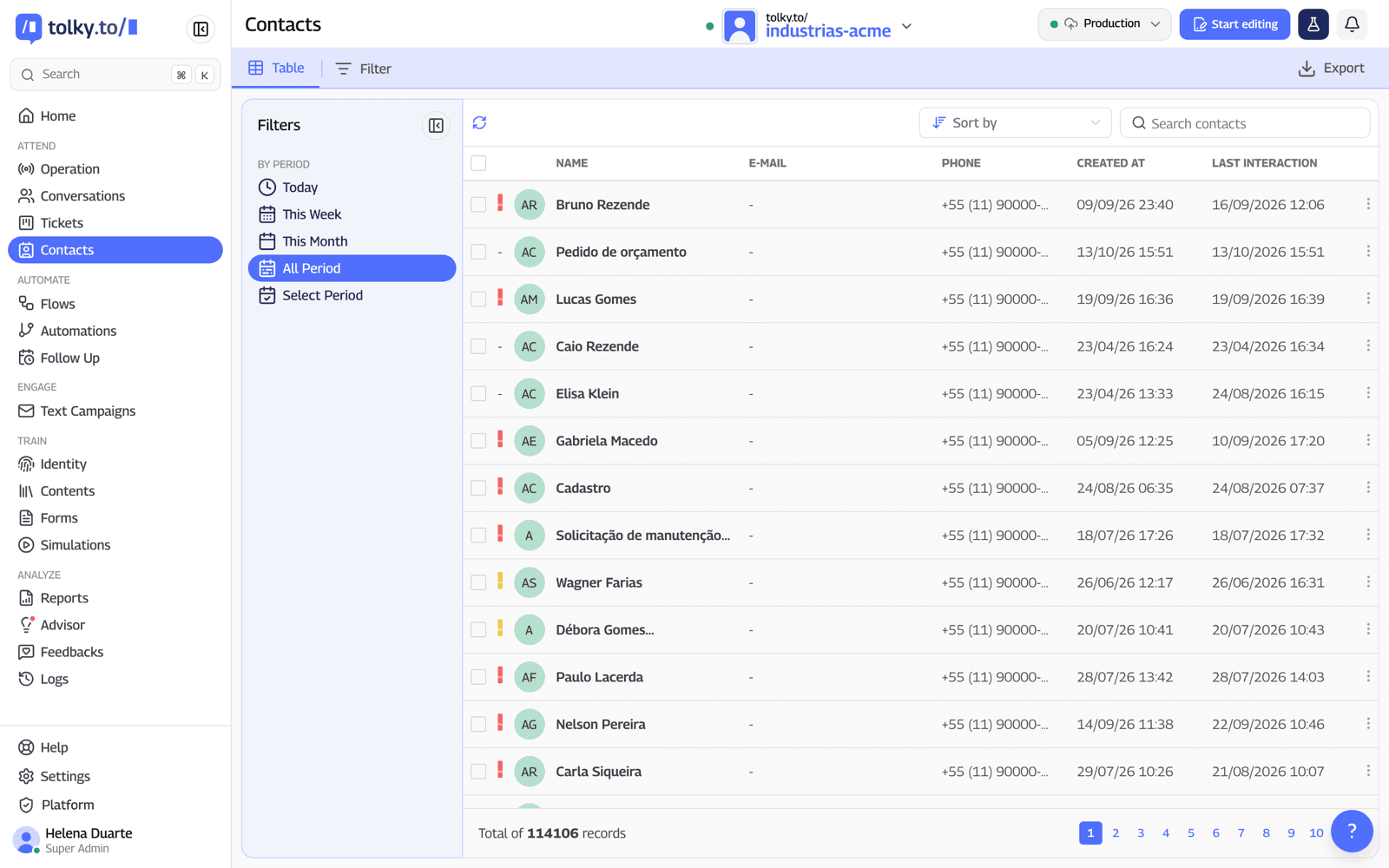
Tolky is a conversational AI CRM: the CRM is born from the conversation on WhatsApp, webchat and other channels, with AI agents that answer, qualify and hand off to the team with context. For the agency, it works as the CRM that goes into the client.
What Tolky delivers today: its own CRM with contacts, opportunities, pipeline and history; automatic Follow Up; AI agents configured by mission (support, sales, engagement); WhatsApp campaigns; access profiles and activity logs with export. The native integration is HubSpot, and other systems connect through the REST API, webhooks and 1,000+ apps in the Flows Integration node. See it all in Tolky's CRM.
What Tolky doesn't do: it doesn't manage ads, doesn't automatically store the source ad of each lead and has no native Salesforce or Pipefy integration. Linking sales to campaigns depends on the client's process or a custom integration; confirm the setup in a demo.
Frequently asked questions
What is the best CRM for marketing agencies?
It depends on the use. For internal sales, a simple sales CRM with a proposal pipeline and renewal reminders does the job. For a client that gets leads on WhatsApp, the best fit is a conversational CRM that keeps the conversation and the pipeline in one place.
Is a CRM for advertising agencies different from one for paid media agencies?
The tool can be the same, but the weight shifts. Advertising agencies lean more on the internal CRM for proposals and renewals; paid media agencies depend more on the client's CRM, because their results are measured by what happens to the lead after the click.
Is there a free CRM for marketing agencies?
Yes, and it works for a small agency's own sales. Free plans usually limit users and contacts, and in our November 2026 comparison none included WhatsApp through the official API. For a client with a sales team on WhatsApp, a free plan usually falls short.
Should the agency use the same CRM for every client?
Standardizing helps: the team learns one tool, implementation becomes a process and reports become comparable. Keep a separate account per client, with access profiles, so data never mixes.
Does the CRM show which ad each sale came from?
Not on its own. The CRM shows what happened to each lead after it arrived. Linking a sale to an ad requires a process at the client or a custom integration, and that should be agreed before you promise it in a report.
Conclusion
A CRM for marketing agencies is really two choices: a simple sales CRM for the agency's own pipeline and a conversational CRM for the client, where media leads turn into sales. The second choice is the one that protects the account, because it puts what happens after the click into the report and turns pipeline implementation and operation into a recurring agency service.
Your agency can deliver this with Tolky
The Tolky Partner Program is for agencies that want to bring AI agents, CRM and WhatsApp campaigns to their own portfolio, with recurring revenue. On the Solution track, the agency sells, implements and supports the client's CRM under the Tolky brand and bills its own implementation and operation services; the other tracks are referring Tolky or running the platform under your own brand and domain. Training and certification are free for program companies, and the Tolky team supports every initial project in 1:1 sessions.
Explore the Partner Program → Let's talk?
Share
Tags
- crm for marketing agencies
- best crm for marketing agencies
- free crm for marketing agencies
- crm for advertising agencies
- crm for paid media agencies
- #whatsapp crm
- #partner program
- #conversational CRM
About the author

Co-founder of Tolky
Marlos Carmo is an AI entrepreneur and founder of Tolky, the conversational-era infrastructure and AI CRM that unifies intelligent service, multi-channel support (such as WhatsApp and voice), live CRM, and operational intelligence in a single ecosystem. He is a finalist for the SXSW Innovation Awards and a member of Francesco's Economy, a global network of young entrepreneurs focused on innovation and social impact. He works connecting Artificial Intelligence and digital transformation in projects for large organizations.
Next step
Want to bring this to your operation?
Tati, Tolky's AI assistant, understands your scenario in a few questions, suggests the best path and connects you with someone from the team, with full context.
Share